Axios Future of Health Care

December 06, 2024

1 big thing: RFK Jr. may be on to something
Like Robert F. Kennedy Jr. or not, he and the MAHA movement's focus on chronic disease gets at an ugly truth: America is not as healthy as other countries. And predictions say that will get worse.
- That doesn't mean America used to be healthier overall. It's that it used to be healthier compared with the rest of the world and is falling further behind, although the U.S. has ranked behind other developed nations on health outcomes for decades.
- For all of Kennedy's falsehoods, a political spotlight on chronic disease could open doors to examining U.S. health care failings that don't always get a lot of attention.
Why it matters: The U.S. outspends other countries on health care by a landslide, but it's not buying us the longer, healthier lives that people in other countries enjoy — and that will only become more true over time.
- The big question is whether Kennedy's proposed solutions — some of which have run counter to or well outside of mainstream science, to say the least — will help or make the U.S. even worse off.
- And if those solutions include diverting resources away from infectious disease, better chronic health outcomes could come at the expense of declining vaccination rates, more measles outbreaks or other public health problems.
By the numbers: U.S. life expectancy is projected to increase from 78.3 years in 2022 to 80.4 years in 2050, a "modest" increase compared with other countries around the world, according to a new study by researchers at the Institute for Health Metrics and Evaluation published in The Lancet.
- Its ranking globally will drop from 49th to 66th.
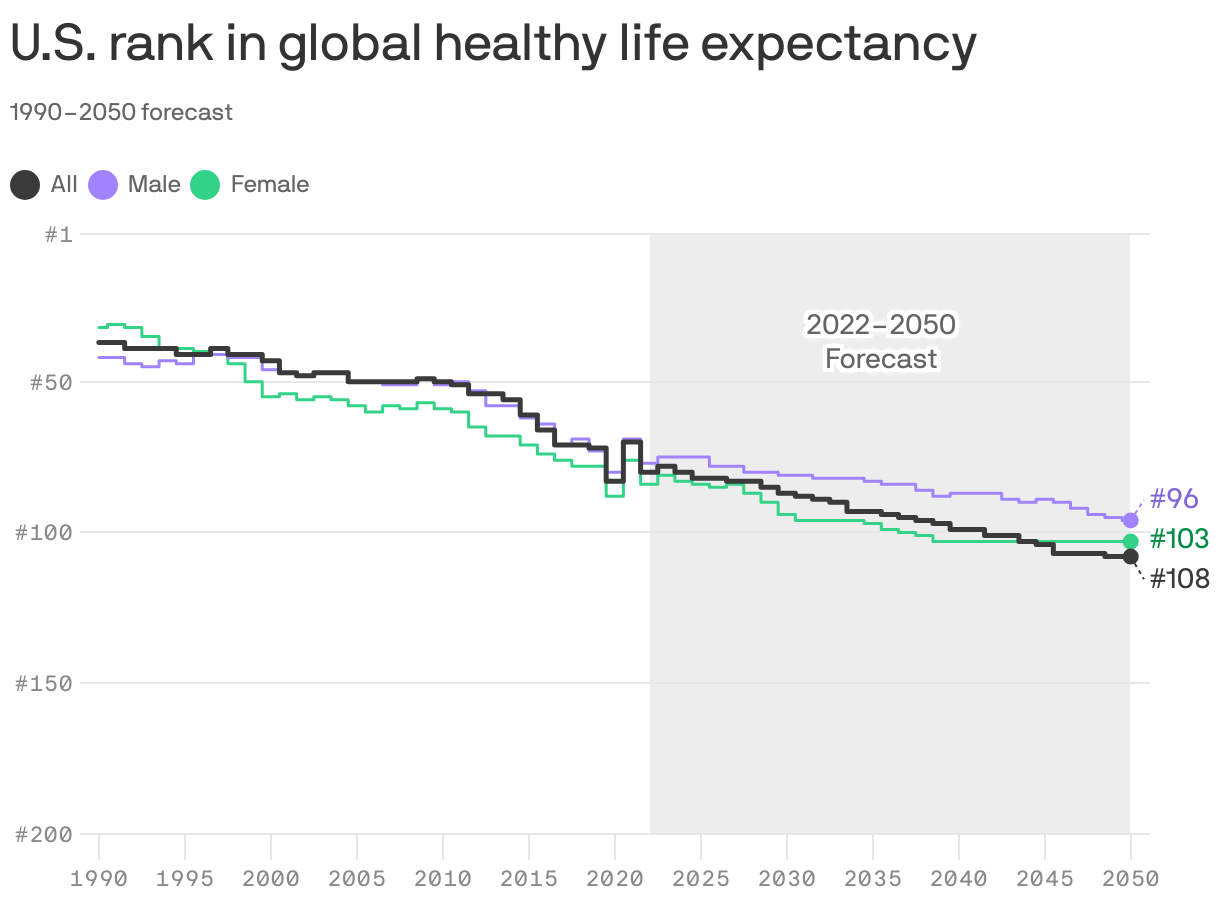
- It fares even worse in terms of how many years Americans can expect to live in good health. That number is projected to increase from 65.4 years in 2022 to 67 years in 2050, but the U.S. ranking will drop from 80th to 108th. In 1990, it was 37th.
Details: Mortality rates from chronic kidney disease, Alzheimer's and drug use disorders are expected to increase. The U.S. drug-use mortality rate will be the highest in the world — more than twice as high as the runner-up, which is Canada.
- Even though there will be a small increase in life expectancy by 2050, "our models forecast health improvements slowing down due to rising rates of obesity, which is a serious risk factor to many chronic diseases and forecasted to leap to levels never before seen," co-senior author Christopher Murray, director of IHME, said in a statement.
- "The rise in obesity and overweight rates in the U.S., with IHME forecasting over 260 million people affected by 2050, signals a public health crisis of unimaginable scale."
Yes, but: There's some good news. The death rates from ischemic heart disease, stroke and diabetes are expected to decline significantly, contributing to the higher overall U.S. life expectancy in 2050.
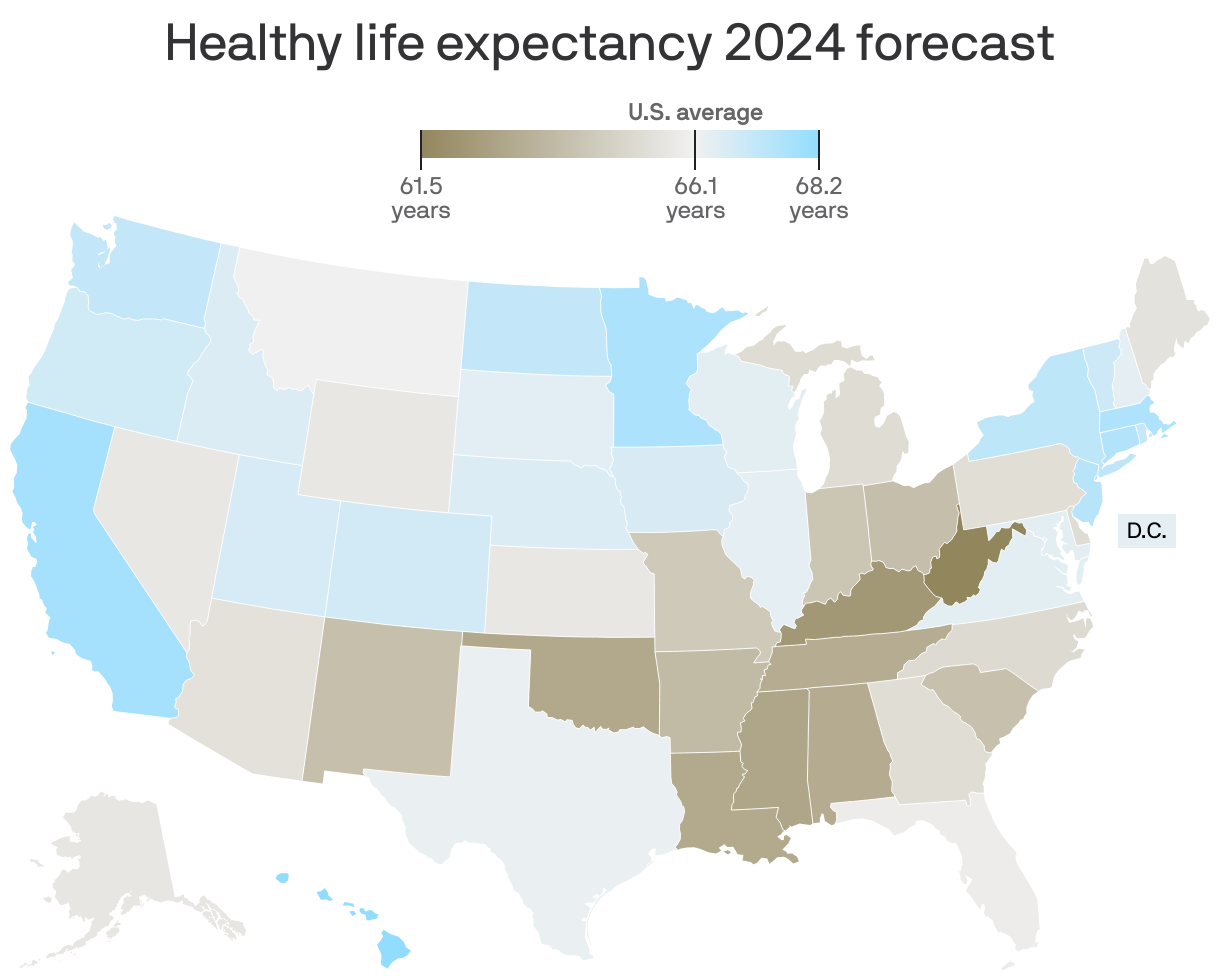
Zoom in: Women's health is falling behind globally even further than men's. And in 20 states — including Ohio, Tennessee and Indiana — the number of years women can expect to live in good health is actually expected to decline by 2050.
Go deeper ...
2. An opening for a Big Food fight
Poor U.S. health outcomes are no secret within the health policy community. But if there were easy solutions, they could have been implemented years ago.
Between the lines: There's no one thing that America's health status can be blamed on, although top culprits include a health system that allows people to easily fall through the cracks, widespread socioeconomic disparities and a lack of emphasis on preventative care.
- But there are some risk factors that loom larger than others, including drug use and high obesity rates.
Where it stands: Obesity is becoming an increasingly political topic with the emergence of GLP-1s, their high prices and the dilemma of how to give people access to them.
- But whether medication is the right solution to focus on is set to become an extra political question once president-elect Trump takes office in January. Kennedy has made clear that he's skeptical of GLP-1s' merits, and his allies have insisted the focus needs to be on the root causes of obesity.
What we're watching: If there's anything that can draw a pretty large consensus, it's that the American diet plays a large role in the country's obesity problem.
- "Many of the USA's biggest health concerns are associated with diet," the IHME researchers conclude. Even with the development of GLP-1s, "it is difficult to imagine a future in which the prevalence of overweight and obesity in the USA declines considerably without population-level changes to diet quality."
The intrigue: Just yesterday, the Senate health committee held a hearing questioning FDA leaders about what they're doing "to reduce the diabetes and obesity epidemics in America and take on the greed of the food and beverage industry."
- "For decades, Congress and the FDA have allowed large corporations to make huge profits by enticing children and adults to consume ultra-processed food and beverages loaded up with sugar, salt and saturated fat," Chairman Bernie Sanders said in prepared remarks.
- "Much of the food that we as Americans are now consuming are making us unhealthy and are contributing to the fact that our life expectancy is significantly lower than many other wealthy countries," he added.
My thought bubble: For all of their differences, Sanders sounds a lot like Kennedy there.
- That to me suggests that taking on the food industry in the name of public health could be an idea with decent bipartisan support next year, should Kennedy get confirmed as HHS secretary.
3. 🔎 A potential political clue
Axios Future of Health Care