Axios Future of Health Care

September 21, 2026


Welcome back, gang. We have an early look at how the Trump administration intends to oversee the way health plans provide mental health and substance abuse services.
🚨 Situational awareness: President Trump has asked for an executive order that would put a board with political appointees in charge of deciding which biomedical research grants NIH funds, per Politico.
Today's newsletter is 1,005 words, a 4-minute read.
1 big thing: New push for mental health parity

The Trump administration is wading into the difficult issue of mental health parity, laying out requirements aimed at making health plans cover behavioral health at the same level as physical health.
Why it matters: It's a sign that the administration could steer in a different direction from the Biden administration, which put a focus on compliance reporting that the Trump team is rejecting.
- Patient advocates say insurers haven't adequately covered mental health and substance abuse services, despite a 2008 law intended to ensure parity.
- Inconsistent standards about what "parity" means and piecemeal policymaking are prompting calls for more clarity from employers, patients and others.
Driving the news: The Department of Labor issued guidance this month on how it intends to enforce parity requirements — the start of a process that's expected to lead to a proposed regulation by the end of this year.
- The department "seeks to achieve the right balance to ensure that its enforcement is fair and even-handed," per the Sept. 8 directive from Assistant Secretary Daniel Aronowitz.
- Areas of focus include limitations on care like the use of pretreatment claims reviews, as well as the adequacy of insurer networks.
The move comes after the administration refused to enforce a Biden-era parity rule that required plans to regularly evaluate their provider networks, payment rates and other factors.
- It was challenged in court by an employer group that said it overstepped statutory authority.
Between the lines: There are a lot of disparities in who has access to behavioral health services, compared with medical or surgical coverage, according to advocacy groups and policy experts.
- That can result in longer wait times and a reliance on out-of-network specialists that drives up out-of-pocket costs.
- Mental health care and substance use disorder treatment was paid 16% to 59% less than physical health in four major insurance networks analyzed by the Kennedy Forum, an advocacy group co-founded by former Rep. Patrick Kennedy (D-R.I.).
- Some managed care organizations have undercut parity requirements by using internal guidelines to determine what gets covered, even when they were contrary to professional standards of care, a 2023 Health Affairs analysis found.
The other side: Employers generally support the idea of parity, but say the standards for compliance have been too subjective and overly technical.
- "There remain significant gaps in the guidance and uncertainty as to practical, reasonable steps to demonstrate compliance," according to the Business Group on Health.
- The government's parity investigations can take a year or longer and involve bringing in outside experts or litigation, according to a 2023 report to Congress. Employers complain they can be held liable for disparities and provider issues that are out of their control.
- The Association for Behavioral Health and Wellness, which represents payers that manage behavioral health coverage, views the new guidance as "helpful providing plans with a clearer roadmap of where [the Labor Department] wants to focus its reviews," CEO Debbie Witchey told Axios.
The big picture: The new effort comes as the United States is experiencing a mental health and substance use crisis, with 154 million Americans living in areas lacking enough mental health professionals to meet the need.
- Many counselors and therapists don't accept insurance, meaning even Americans with health insurance can find treatment cost-prohibitive.
- More than half of adults with a mental illness say they haven't received treatment for it, and nearly a quarter say they weren't able to obtain treatment.
The Labor Department said it will focus on instances in which insurers make blanket exclusions for mental health and substance abuse treatments, adding it may also address more narrow limitations, especially in response to complaints.
- While nothing prohibits group health plans from setting coverage limits, the department said it will focus on insurers' use of prior authorization, real-time checks of whether a service is medically necessary and post-service reviews.
- Health plans that don't comply with parity rules have been required to modify coverage limits, reprocess claims and pay for benefits that should have been covered.
What's next: The department is expected to issue a proposed new parity regulation by December.
2. Anthropic begins physical bio experiments
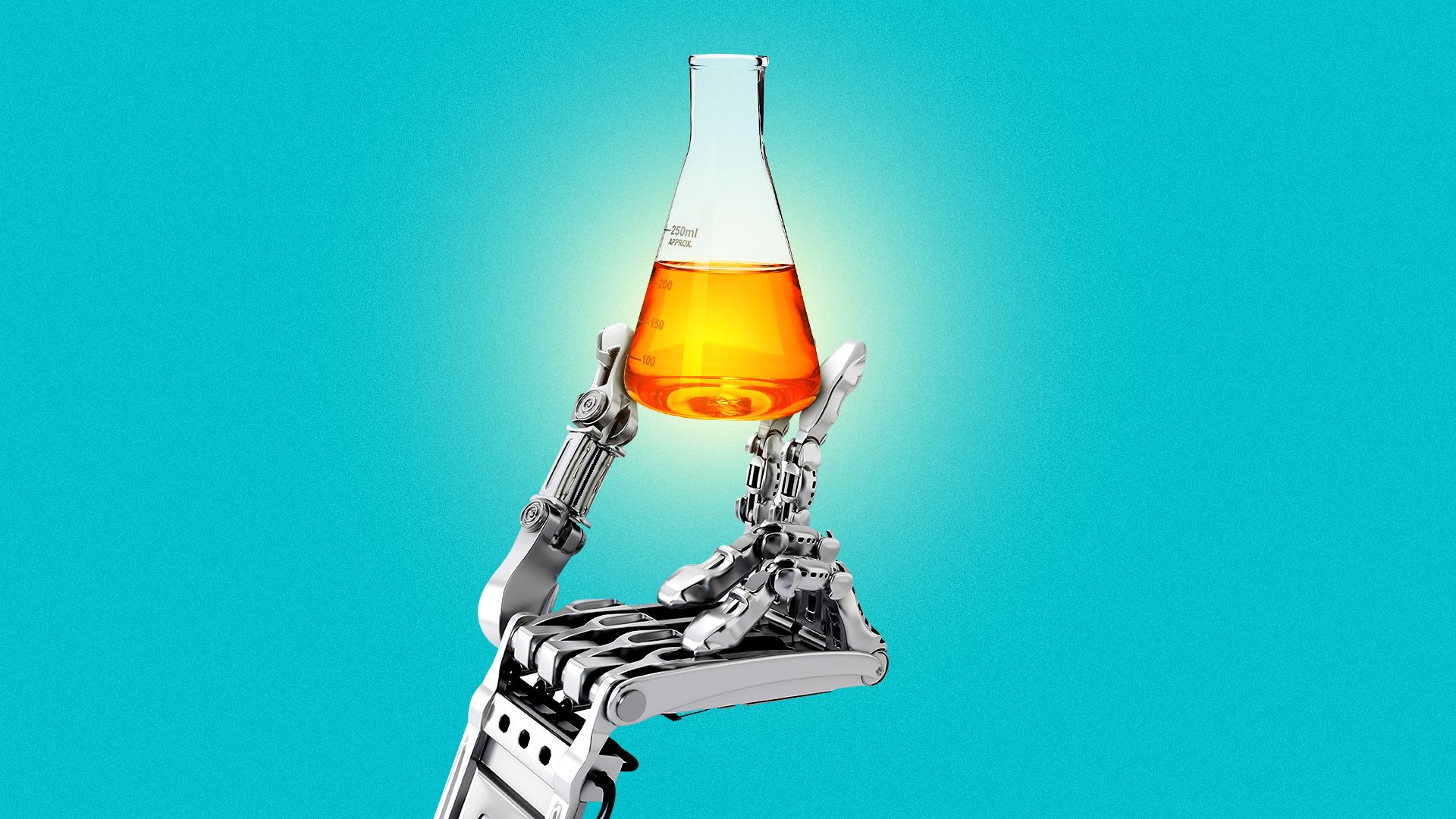
Anthropic is testing whether Claude can run life sciences experiments with minimal human participation.
Why it matters: The work in a research lab in the San Francisco Bay Area is the latest example of how AI giants are leaning into health care and could speed the development of rare disease drugs.
- It's also a sign of how computer automation and traditional "wet lab" research are rapidly converging.
Driving the news: Anthropic is exploring how to make Claude control robots to carry out scientific experiments, Reuters first reported.
- The work could expand the possibilities for new therapies that big drug companies won't touch, though a spokesperson told Reuters the effort isn't specifically built around drug discovery.
- Anthropic in June launched Claude Science, a research workbench combining dozens of databases and tools it says can be used to predict the structure of proteins, analyze sequences of RNA and more. It also acquired a biotech startup that was working on AI models for biological research.
Threat level: Fears about unchecked AI are refocusing attention on how models are already being used in high-risk experiments.
- Anthropic recently disclosed that it disrupted five potential instances of actors using its models in ways that could support the development of biological weapons.
- Anthropic isn't saying much beyond confirming the San Francisco lab's existence, but its head of life sciences told Reuters that human oversight is essential for safety and that the company hasn't run any clinical trials.
Thanks for reading Axios Future of Health Care, and to editor David Nather and copy editor Matt Piper. Please ask your friends and colleagues to sign up.
Sign up for Axios Future of Health Care