Axios Future of Health Care

September 27, 2024

Good morning! Let's just get right to it today.
Today's word count is 1,639, or a 6-minute read.
1 big thing: Medical debt relief's limits
Relieving patients of medical debt is en vogue around the country, but preventing it from accumulating in the first place is much harder because it requires addressing some of the U.S. health system's fundamental problems.
Why it matters: Medical debt is ultimately the result of high U.S. health care prices and the choices made to manage them, including by insurers' use of deductibles and other out-of-pocket cost sharing.
- But even chipping away at those prices faces the assured threat of intensive political blowback, even as prices continue to rise.
State of play: Vice President Kamala Harris' campaign website says "she'll work with states to cancel medical debt for even more Americans," and North Carolina's debt relief plan has received national attention of late as a potential model.
- Democratic Gov. Roy Cooper secured a deal with the state's hospitals in which they will receive $3.9 billion in additional funding as part of the state's Medicaid expansion. In exchange, the hospitals will erase $4 billion in medical debt and have new requirements around financial assistance for people with low incomes, Stat reported.
- Just this week, California Gov. Gavin Newsom signed a legislative package that includes new consumer protections for people with medical debt.
Other states have undertaken some form of debt relief over the last couple of years.
- "I think the whole movement on medical debt is to provide immediate relief, which provides those tangible benefits, but also to pair it with upstream efforts," said Heather Howard, a Princeton professor and the author of a Health Affairs piece on states' efforts.
Between the lines: There's a spectrum of policy responses here.
- On one end is one-time debt relief, which has obvious benefits to those whose debt is erased but doesn't do anything to prevent medical debt accumulation going forward.
- Somewhere in the middle are measures that protect patients from the impact of medical debt, such as by preventing medical debt from appearing on credit reports, restricting the sale of medical debt or capping interest rates on medical debt. The Biden administration has also been active within this bucket.
- Then there are approaches that strengthen hospitals' financial assistance requirements, which could help some people — usually lower-income patients — avoid new debt.
And then at the other end of the spectrum would be anything that limits what providers charge, limits insured patients' out-of-pocket liability or further decreases the uninsured rate — all enormous lifts.
- Tackling prices is "not always politically feasible, and people get stuck in the middle of that, and so I think it makes sense in this time and age with the deductibles being where they are and the prices being where they are that we at least protect the patients first," said Maanasa Kona, an assistant professor at Georgetown University.
- "The thing that would help prices the most ... is to regulate prices of health care, but this is clearly a very politically difficult thing to do," she added.
The intrigue: The medical debt conversation dovetails with scrutiny on nonprofit hospitals' tax-exempt status and whether they're offering commensurate amounts of community benefit, which includes charity care.
- Federal financial assistance requirements are vague, experts say, although some states have taken steps to better define them.
- There's bipartisan congressional interest in scrutinizing whether hospitals are fulfilling their obligation, and lawmakers have expressed their alarm over reports of nonprofit hospitals suing patients or failing to offer discounted care to eligible patients.
This newsletter isn't going to get into the fight over whether nonprofits are earning their tax break (at least not today). But here's a sampling of how messy it gets:
- Just this week, the American Hospital Association released an analysis that found 2,500 nonprofit hospitals were exempt from $13.2 billion in taxes in 2020 but provided $129 billion in community benefits.
- But a study published in JAMA — also this week— concluded that nearly 3,000 nonprofit hospitals received a $37.4 billion total tax benefit in 2021, and a report by the Lown Institute earlier this year found that 80% of nonprofit hospitals spent less on financial assistance and community investment than the estimated value of their tax breaks.
- The Lown Institute directly ties that gap — which it calls the "fair share deficit" — to medical debt, saying it was large enough in 2021 to erase 29% of the country's medical debt.
The bottom line: "Yes, the underlying problem continues," Howard said. "That's the history of health reform in the U.S. We're doing incremental expansions, we're providing immediate relief, but it's hard."
2. Why tackling the root causes is so hard
A fundamental truth about the U.S. health care system is that the more something costs, the more income someone has. Thus the reverse is true: Slashing costs slashes someone's income.
- This is usually the lens through which to view industry backlash to cost control attempts.
- And when they warn of consequences, they have a point: We've decided to set up a system that depends on market incentives, and businesses should be expected to adjust their behavior when those incentives change.
Zoom in: Read these two excerpts from different North Carolina dispatches.
- From Stat: "North Carolina's experience shows how big nonprofit hospitals could use their political influence to ensure that they make money off of a broader national initiative. If they succeed, taxpayers could end up paying hospitals for medical bills that should have been covered by charity programs for poor patients, or that could have been canceled far more cheaply."
- And from KFF Health News: "Multibillion-dollar health systems and the industry's powerful trade group vigorously fought the medical debt plan, records show. They sowed fears of collapsing rural health care. They warned of legal fights and a showdown with the legislature. And they maneuvered to get the federal government to kill the plan."
- My thought bubble: This was, in the grand scheme of things, a pretty good deal for hospitals. And getting it across the finish line was still a huge effort.
The big picture: Hospitals have already begun laying the groundwork for a big federal fight over medical debt, if there ever is one, by pointing the finger at insurers.
- "Hospital financial assistance will never be a substitute for a health insurance plan that covers all necessary care at an affordable price," AHA vice president Molly Smith told Axios in a statement.
- "The true drivers of medical debt are inadequate enrollment in comprehensive health care coverage, commercial insurer consolidation and poorly designed health plans masquerading as real coverage that intentionally push more costs onto patients who can't afford them."
But Georgetown's Kona pointed out that while states and the federal government have some regulatory sway over insurance plans, there's no equivalent for hospital costs.
- "It's hard for an insurance regulator to be like, you know what, eat those costs," she said. "So at the end of the day, there's someone who watches insurers and what they're doing with premiums, but there's no such counterpart with hospital prices."
3. The various routes to cheaper Ozempic
This was a big week in the showdown over the prices of new anti-obesity drugs. But while a lot of people want them to be cheaper, there are a few options as to how that could come to be.
State of play: Semaglutide — the active ingredient for both drugs — is expected to be part of the next group of drugs chosen for Medicare price negotiations, and Novo Nordisk CEO Lars Fruergaard Jørgensen confirmed this week that he expects Ozempic to be selected within the year.
- It's not clear whether CMS would bundle Ozempic — a diabetes drug — together with Wegovy, which is the weight-loss version of the drug.
- Regardless, critics are looking beyond negotiated prices; many are instead focusing on what generic prices should or would be, with some even calling for the government to take extraordinary action to bring them to market faster.
The big picture: Medicare negotiations would likely lower the net prices of the selected drugs, although it's arguable how meaningful those reductions would be. But those prices aren't nearly the same as what generic competition typically yields.
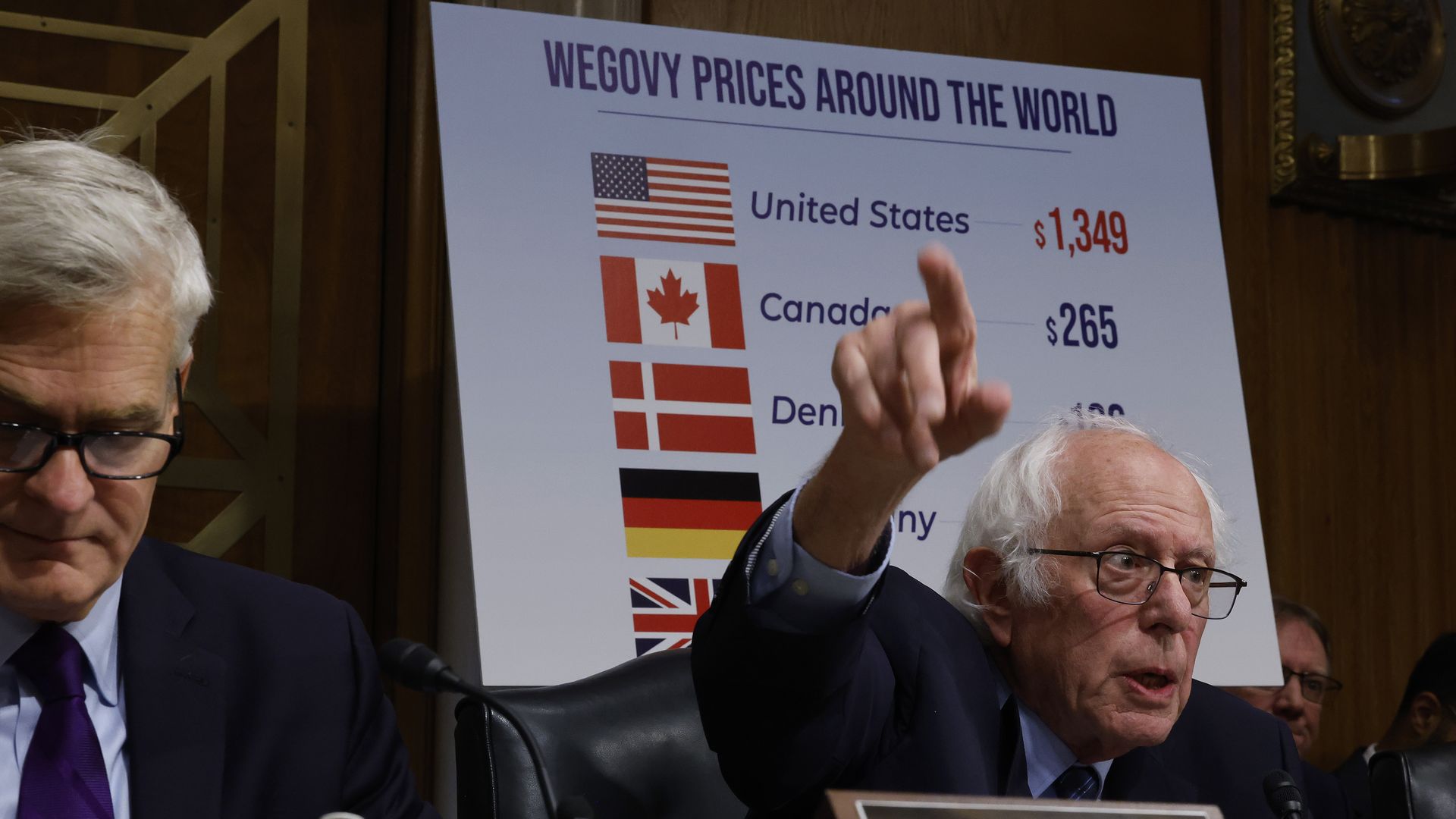
By the numbers: Senate health committee Chair Bernie Sanders recently announced that generic manufacturers have told him they could sell a generic version of Ozempic in the U.S. for less than $100 a month.
- Ozempic's estimated net price is nearly $600 and Wegovy's is over $800 a month, per Sanders.
A group of organizations including Public Citizen this week called for HHS to use its legal authority to authorize generic competition against semaglutide. A group of Democratic lawmakers made a similar request.
- "You get much steeper price reductions through price competition than negotiation. This in our view isn't a drug that is a little too expensive; it's an order of magnitude too expensive," said Public Citizen's Peter Maybarduk.
- "It's a good thing to flex public muscle sometimes and not only rely on the established track under" the drug negotiation law, he added.
Reality check: This level of government intervention seems unlikely to happen under the Biden administration, which has met calls for exercising "march-in rights," a similar idea, with a framework for doing so.
- But there's a third way to get the drugs' prices lowered: the bully pulpit, and that's exactly what Sanders is employing.
- "The bully pulpit is — it's our leaders leading, and they define values for all of us, including corporations and ultimately, if drugmakers find themselves far out of line from what's acceptable to the public, that's a risk for them," Maybarduk said.
4. What I'm reading
💊 As anticipated, the FDA approved the first new schizophrenia drug in decades yesterday, the NYT reports.
💉 If you've been wondering why GLP-1s seem to work against so many health conditions, Nature has done a deep dive on the science.
🧠 Severe depression manifests differently in the brains of youth and adults, a finding with implications for the treatment of youth depression via brain stimulation therapies, The Guardian reports.
Thanks to Nicholas Johnston for editing and Matt Piper for copy editing.
Sign up for Axios Future of Health Care