Axios Future of Health Care

November 25, 2026

Happy Almost Thanksgiving. Many Americans say the government is responsible for not stopping the spread of measles. They also seem eager to put the outbreaks behind them.
🦃 Programming note: Future of Health will not publish on Thursday and Friday but will return on Monday. Enjoy the long weekend!
Today's newsletter is 820 words, a 3-minute read.
1 big thing: Most blame government for measles return
Nearly 6 in 10 Americans hold government leaders responsible for the loss of the United States' measles elimination status, according to a new Ipsos poll. But there are few signs that the public wants to dwell on it.
Why it matters: Partisan divisions over vaccines and outbreaks are so entrenched that Democrats won't have a broad mandate beyond their base to investigate the government's response when they take control of Congress.
- There's also a generational divide. People age 65 and over — who remember the introduction of the measles vaccine — are more likely to say the current situation bothers them a lot.
What they found: Roughly 3 in 5 Americans (58%) think the loss of the measles elimination status could have been prevented if government leaders had done a better job encouraging people to get vaccinated and responding to outbreaks.
- 38% said there wasn't much government leaders could have done, because people make their own health decisions.
- There's a huge partisan split behind those numbers: 84% of Democrats say the return of measles could have been avoided if the government had done a better job, compared with 38% of Republicans.
Just over a quarter of Americans (26%) say they're extremely or very concerned about an outbreak occurring in their community.
- There's a nearly 30-percentage-point partisan gap on concern, with 42% of Democrats extremely or very concerned, compared with 13% of Republicans. Independents are in the middle (25%).
The findings come as Americans are sharply divided over the prospect of the next Congress investigating the Trump administration. And if COVID-19 is any guide, the public tends to be eager to put public health calamities in the rearview.
- A Reuters-Ipsos post-election poll found that just 10% of Republicans said they want the new Congress to focus a great deal or quite a bit on investigating the Trump administration, compared with 71% of Democrats.
- "As frustrating as the loss of measles elimination status is for many Americans, there's little in the [new] survey to suggest it will lead people who were not already supportive of investigating the administration to prioritize congressional oversight on this issue," said Alec Tyson, senior vice president of Ipsos U.S. Public Affairs.
That isn't discouraging some Democrats on Capitol Hill. Incoming Senate health committee Chair Bernie Sanders (I-Vt.) said last week that Health Secretary Robert F. Kennedy Jr.'s stewardship of the federal health apparatus during the measles outbreaks is "certainly one area that needs investigation."
- House Energy and Commerce Democrats want to know whether the CDC suppressed the number of measles deaths reported to the public.
- They've also criticized agency director Erica Schwartz for not providing meaningful answers about decision-making around the reporting and response.
The CDC has said it's committed to stopping outbreaks and regaining the measles elimination status.
- It has pointed to actions like providing about $100 million in extra funding to strengthen prevention and response to measles and other vaccine-preventable diseases.
What we're watching: Support for childhood vaccinations appears stronger than in the immediate aftermath of the pandemic.
2. COVID on the rise heading into Thanksgiving
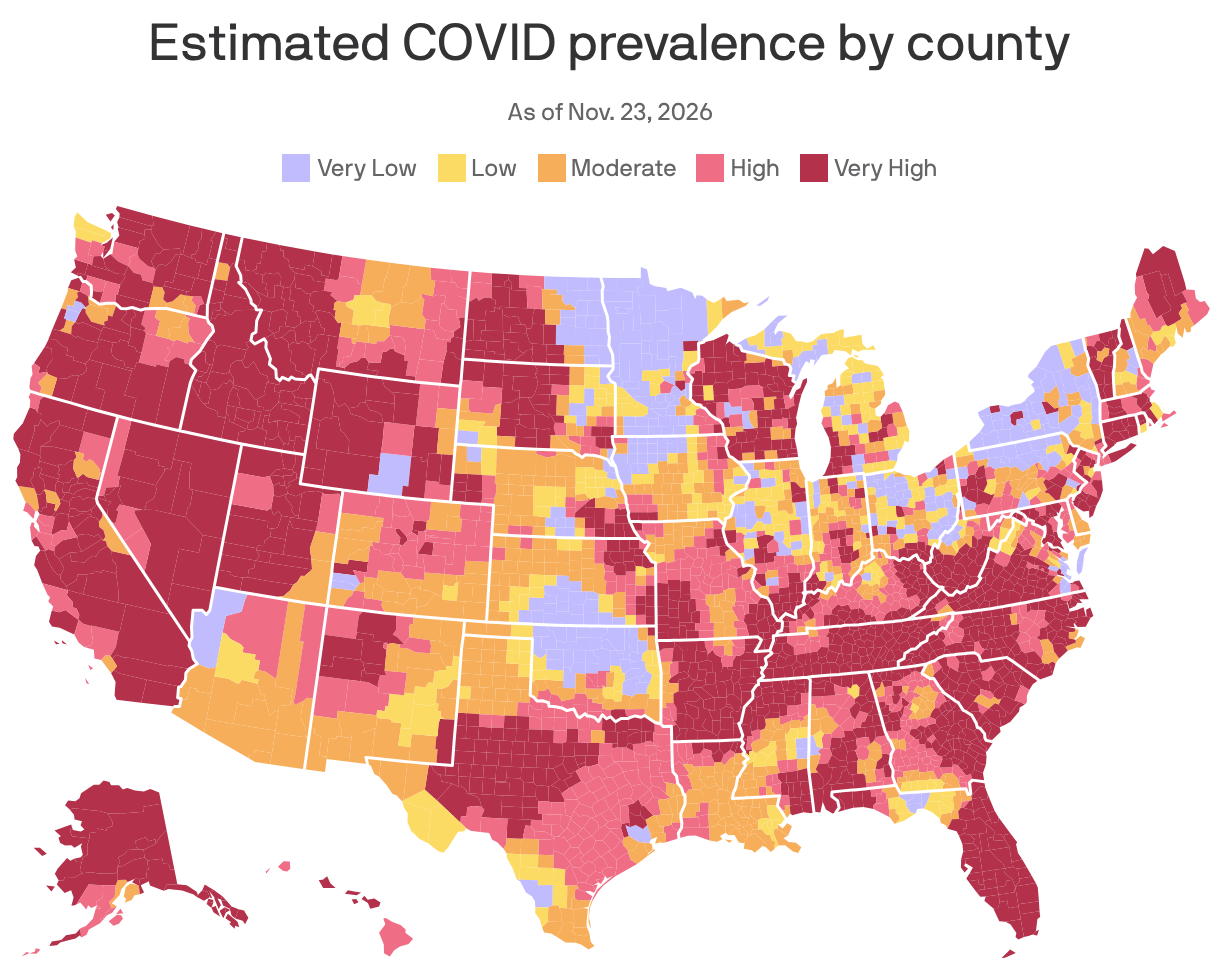
There's a lot of COVID going around, and acute respiratory illness is on the rise heading into Thanksgiving.
Why it matters: If you're gathering with a bunch of people in the next few days, take some basic precautions against getting sick.
By the numbers: COVID infections are growing or likely growing in 34 states as of last week, according to the CDC. Flu infections are also on the rise in 34 states, and RSV cases are increasing in 39.
- Emergency department visits for the three viral infections are currently low nationally, but rising.
- Only 0.6% of emergency department visits during the week ending Nov. 14 were associated with COVID, compared with 2.4% associated with flu and 0.2% with RSV.
- The CDC says there's "moderate" COVID viral activity in wastewater nationally, but it's high to very high in some states.
Between the lines: The Pandemic Mitigation Collaborative, a Tulane University project, estimates there are currently 1.4 million new daily infections, which is the highest level of spread in more than 14 months and an "all-time high" for this time of year.
My thought bubble: This explains why I got COVID a few weeks ago for the first time in years!
The bottom line: The crisis phase of the pandemic is long behind us, but COVID itself isn't.
- The virus is now much more manageable, but it's still not exactly fun to get infected with it.
Thanks for reading Axios Future of Health Care, and to editor David Nather and copy editor Matt Piper. Please ask your friends and colleagues to sign up.
Sign up for Axios Future of Health Care