Axios Future of Health Care

March 07, 2025

Good morning. Another week down. Let's get right to it.
Today's word count is 1,370, or a 5-minute read.
1 big thing: The real concern with FDA drug approvals

Forget all of the conspiratorial — and unfounded — concerns about the FDA allowing unsafe vaccines to come onto the market; many critics' real concern over the last few years has been about whether the agency is approving drugs without enough evidence that they work.
Why it matters: The FDA is tasked with proving new drugs are both safe and effective, but deciding what counts as enough evidence that a drug works — especially for diseases lacking alternate treatments — is essentially a judgment call.
- A series of agency decisions in recent years have been met with backlash, at least within certain circles. At the same time, these controversial approvals have been for therapies targeting populations desperate for options, and were applauded by some patient groups.
- It will now be the Trump administration's turn to thread this needle at a time when public trust in public health agencies is slipping — a shift partially fueled by members of the new administration, especially HHS Secretary Robert F. Kennedy Jr.
- Kennedy's past complaints about the FDA go much further than experts' — and are condemned by many of them — but there could be some areas of potential alliance.
Driving the news: The controversy over the FDA's use of the accelerated approval pathway — a huge topic during the Biden years — didn't really come up during FDA commissioner nominee Marty Makary's confirmation hearing yesterday, although the pathway itself briefly did in an exchange with Sen. Lisa Murkowski about ALS drugs.
- "We have to customize the regulatory process to the condition that we're trying to be able to offer hope for," Makary said.
- It's unclear where the Trump administration will land in the (admittedly pretty wonky) fight over what the threshold for drug approvals should be. The FDA did not respond to a request for comment.
- But Trump's choice for HHS deputy secretary, Jim O'Neill, has drawn opposition from some health care groups in part over his prior support for FDA approval of drugs based on safety but not efficacy data.
- And in Trump's first term, he signed a bill into law that would increase terminally ill patients' access to unapproved medicines, which he touted during last summer's GOP convention.
State of play: A series of high-profile, controversial drug approvals thrust the FDA into an uncomfortable — if not embarassing — position during the Biden administration's tenure, ultimately bringing into question the agency's credibility.
- The largest such controversy was over the 2021 accelerated approval of Biogen's Aduhelm, the first drug to receive an approval for treating Alzheimer's disease by targeting amyloid plaques in the brain.
- The decision caused an uproar among the scientific and medical community, especially because the company announced it would charge $56,000 a year for the drug and it was known to cause significant side effects.
- A congressional investigation later found that the FDA didn't follow its own guidance and inappropriately collaborated with Biogen before the drug's approval. The company pulled the drug from the market last year.
Other approvals followed similar patterns. An ALS drug that received FDA approval based on a single clinical trial was also pulled from the market last year after a follow-up study found it didn't work.
- Just last week, consumer advocacy group Public Citizen released a report critical of a pair of decisions the FDA made regarding the approval of a gene therapy for Duchenne muscular dystrophy. The drug costs north of $3 million.
- "The pendulum has shifted too far in the direction of approving drugs and biologics when there's not good evidence of effectiveness and there hasn't been adequate time to prove the therapies are actually safe," said Robert Steinbrook, the director of Public Citizen's Health Research Group and an author of the report.
- "The FDA should, whether it's through accelerated approval or traditional approval, should have a higher bar for what it gives the green light to," he added.
Although much of the consternation in recent years has been focused on the accelerated approval program, some experts' concerns go beyond that.
- "More and more drugs are approved with uncertainties about their actual clinical benefit," said Aaron Kesselheim, a professor at Harvard Medical School and a former member of an FDA advisory committee. He resigned in the aftermath of the Aduhelm decision.
- "I don't think its fair to say that the FDA's just approving a lot of drugs that don't work. That's not what's going on," he added.
The other side: Numerous patient groups have applauded the approvals and the use of the accelerated approval program more broadly, arguing that they give hope to patients with limited or no options.
Continued below ...
2. A potential alliance
Public mistrust of federal health agencies, including the FDA, has become so prominent that Kennedy, one of its primary instigators, is now in charge of all of them.
- "It's much easier for the FDA to lose public confidence than to develop it," said Rachel Sachs, a professor at WashU Law and an author of a piece published in JAMA yesterday on the dangers of lowering effectiveness standards.
- Sachs also said effectiveness can't be divorced from safety, as "the concept of safety is relative to the question of efficacy and the conditions of use."
Flashback: Before his nomination as HHS secretary, Kennedy railed not only against vaccines but also against the agency itself, accusing it of being beholden to industry interests.
- In a now-notorious post on X, he wrote that "FDA's war on public health is about to end. ... If you work for the FDA and are part of this corrupt system, I have two messages for you: 1. Preserve your records, and 2. Pack your bags."
- Although he has noticeably shifted his tone since being nominated, especially during his confirmation hearings, he's already alarmed the public health world after the FDA canceled an advisory committee meeting on flu vaccines under his new tenure.
Between the lines: The concerns Kennedy has raised, especially prior to his nomination, have usually been very different than the debates taking place among academics and policy wonks.
- Those critics are clear that their concerns are more nuanced and specific than Kennedy's.
- "The FDA is a huge agency, and not every drug is controversial. In many instances, many of which are not publicized, we agree that the FDA does the right thing," said Public Citizen's Steinbrook.
- "I don't want to ever give the impression that the FDA is a failure of an agency. The FDA is the most important public health agency in the country, and arguably the world," Kesselheim said.
Yes, but: There's some overlap, especially between Kennedy and left-leaning critics who allege that the FDA is way too beholden to special interests. One specific area of concern Kennedy has brought up is the agency's reliance on "user fees" paid by pharmaceutical companies for its funding.
- "Philosophically, we would welcome anything that made the FDA more independent of industry. But the important thing is the details," Steinbrook said.
- "The vast majority of what the FDA does is well-grounded in science," he added. "So I think the question is whether the new administration is going to take measures which will enhance trust in the FDA or undermine that trust."
Other groups have raised concerns about the "revolving door" between the agency and industry.
- "The cozy relationship between industry and government helps Big Pharma promote their interests in Washington in pursuit of larger profits — leaving Americans on the receiving end of a very bad deal," the Pharmaceutical Reform Alliance wrote in a statement this week.
The bottom line: Serious debates about the FDA's drug approval standards exist within a relatively narrow lane. But efforts Kennedy or other health officials may take to put more distance between the agency and the drug industry could find some interesting allies.
3. Why Medicaid cuts are so hard
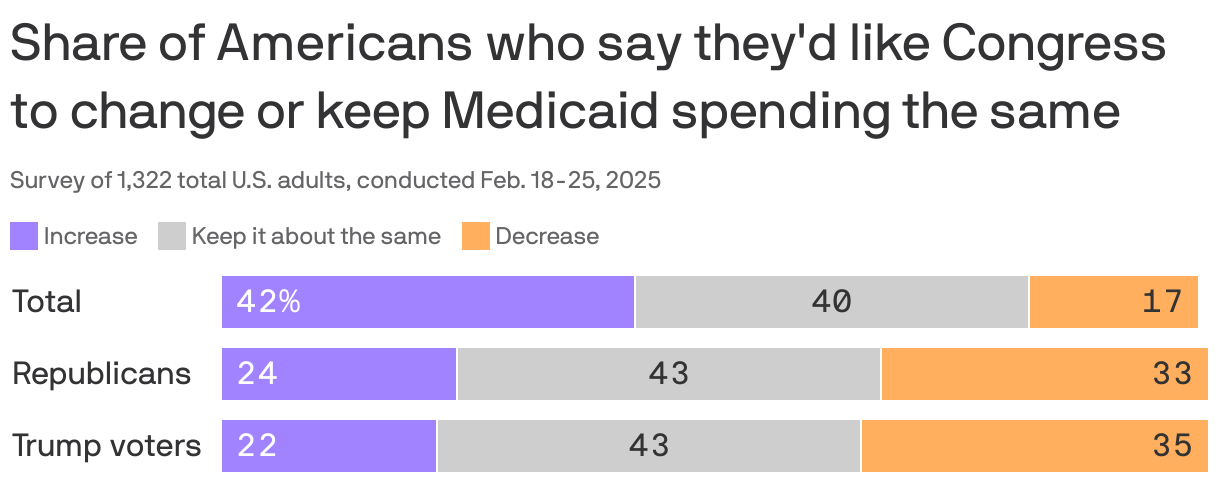
New KFF polling drives home exactly why it's going to be politically tough for Republicans to cut federal Medicaid spending: Even most of their own voters don't want them to.
Yes, but: KFF found higher levels of support for more targeted policies like work requirements and reductions in federal spending on the expansion population, both of which are leading ideas among House Republicans.
- But those views are fluid and change based on arguments made for or against them.
Thanks to Nicholas Johnston and Adriel Bettelheim for editing and Matt Piper for copy editing.
Sign up for Axios Future of Health Care