Axios Future of Health Care

May 10, 2024

Good morning. Remember our chat last week about GLP-1s? KFF has some interesting new polling out this morning:
- 1 in 8 adults — 12%! — report having taken a GLP-1 drug, including Ozempic, Mounjaro or Wegovy, and 6% say they're currently taking one.
- A little over half who have taken the drugs say it was difficult to afford them.
Today's word count is 1,408, or a 5.5-minute read.
1 big thing: The U.S. health care casino

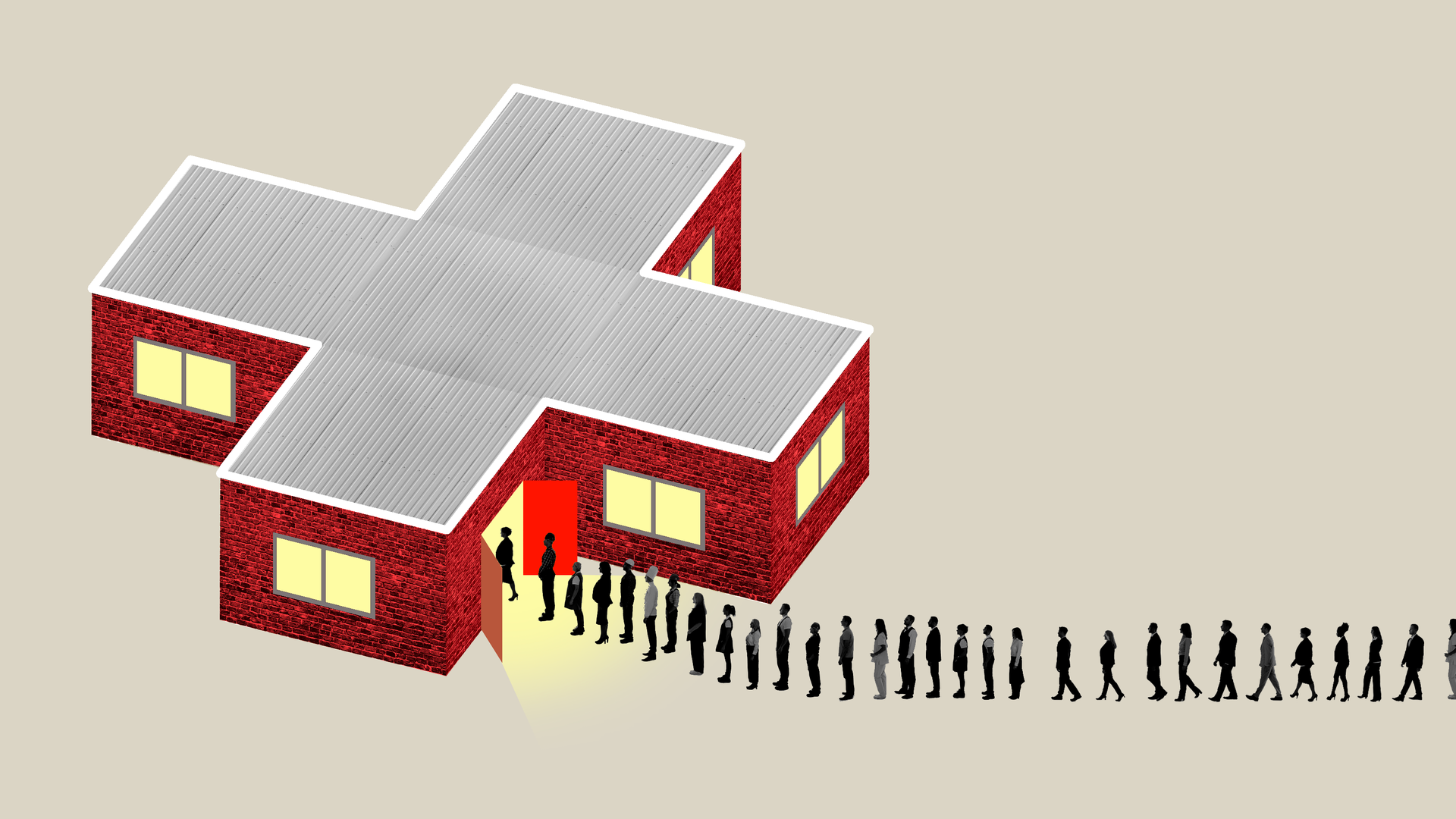
For the decade-ish that I've been reporting on health care, insurance coverage has dominated conversations about who has access to care. But in the post-pandemic era, it's become clear that having insurance is only the first step toward receiving quality care.
Why it matters: Where Americans live, their health status and a range of socioeconomic factors increasingly determine their experience with the health care system, and in many cases that experience appears to be getting worse.
- Affordability, while critical, isn't synonymous with access. Long wait times for doctor appointments, crowded emergency departments, complicated insurance requirements and a dearth of local providers are all making things tougher on patients.
- For many people, whether they can get the care they need when they need it seems to come down to the luck of the draw.
State of play: Provider shortages and a post-pandemic surge in demand for care have played a large role in today's squeeze.
- That's being felt all along the care continuum, whether you're trying to schedule an annual physical or waiting in the ER.
- "All the noise that we're hearing is a signal. This is real," said Joe Betancourt, president of the Commonwealth Fund. "There's no doubt that in my career ... I've seen access challenges evolving."
Zoom in: Primary care especially is in short supply, which is particularly alarming given its role in keeping people healthy and from needing more specialized care down the road.
- The number of primary care doctors isn't keeping up with population increases, partly because it's hard to convince medical students graduating with mountains of debt to resist the draw of more lucrative specialties.
- Factors like administrative burden and burnout have meanwhile "led to what's a pretty daunting exodus in primary care and a significant decrease in people going into primary care," said Betancourt, who is a primary care doctor himself.
- Specialists are also being stretched thin, he added.
- Staffing shortages — particularly among primary care physicians — are projected to only get worse, according to the Association of American Medical Colleges.
Between the lines: Who has bad luck when it comes to getting care can be predictable — or at times it isn't really luck at all.
- "The Silicon Valley where I live is a lesson in how money talks," said KFF president and CEO Drew Altman.
- "Primary care docs and specialists have been lured by generous tech company benefits into concierge practices that have long waiting lists ... leaving little left over for working and low-income people — most people — even if they can afford it."
What we're watching: Experts chalk up the recent surge in demand to people catching up on care they put off during the pandemic.
- If and when that subsides, it would likely alleviate at least some of the challenges with getting appointments.
- New technology could help with some more systemic issues, like administrative burden. And expanding the scope of practice for non-physician providers, like physician assistants and nurse practitioners, could also increase the system's capacity.
2. Insurance handcuffs


Having insurance makes health care more accessible than not having insurance, but all plans are not created equal.
- Most insured adults — despite rating their insurance positively — report problems actually using their coverage.
Why it matters: Patients who get their insurance from different places tend to have different barriers to obtaining care, and experts and policymakers are raising the alarm about the effect of practices like prior authorization.
Zoom in: People in fair or poor health are more likely than those in good health to struggle with using their insurance, according to KFF polling published last year.
- More than a quarter of insured adults said there was a time in the past year when their health insurance paid less than they expected for a medical bill, a quarter said there was a time when an in-network doctor they needed to see didn't have available appointments, and 14% said there was a time when a particular doctor or hospital they needed wasn't covered by their insurance.
- 16% said their plan denied or delayed prior approval for needed care in the past 12 months, with higher rates among Medicaid enrollees. 23% said their plan either didn't cover or charged a very high copay for a prescription drug prescribed by a doctor.
- People with private insurance — either employer insurance or ACA plans — were much more likely to rate their insurance negatively when it comes to premiums and out-of-pocket costs than those with Medicare or Medicaid.
"While most consumers continue to rate their health insurer favorably, we share consumers' concerns about the continued affordability, access and experience challenges in the system and are committed to doing our part and working collaboratively to address them," said Mike Tuffin, CEO of AHIP.
The bottom line: Payers are "creating a lot of hoops now, more than ever, for patients to jump through to get things they need," Betancourt said.
3. Wait time mystery
We originally hoped to include a chart here from a dataset of average emergency department wait times at around 4,700 U.S. hospitals. But no single variable that we tested could explain why wait times are longer in some places versus others.
- The closest relationship we could find was between wait times and a state's nurse-to-population ratio, which isn't the county-level analysis we were hoping for but is an interesting trend.
- It also makes sense, as nursing shortages are known to affect care in the ER.
- Factors that didn't show any kind of meaningful correlation: a county's income, its share of the population enrolled in Medicare or Medicaid or even whether it was urban or rural.
Why it matters: People around the U.S. are waiting hours for emergency care, and those wait times — at least at a county level — don't vary based on some of the usual factors.
- Not only is waiting a long time for emergency care inconvenient, it can also be dangerous.
- Hospitals and providers have been sounding the alarm about patient "boarding," when an admitted patient has to wait in the emergency department for an inpatient bed to open up.
Go deeper: ER visits are getting longer amid hospital staffing shortages
4. Axios interview: Rethinking primary care

I chatted on the phone this week with Jeff Wells, CEO of Marathon Health. Before we got into our standard questions, I asked him to tell me about the company and what sets it apart. Some snippets:
- Marathon provides in-person and virtual primary care to workers at around 650 employers and union organizations, serving 2.5 million patients. It uses a value-based payment model, rather than being paid for each individual service provided.
- How it's different from other primary care providers: "We really try to design the physical space — where it's located, how it feels when you go in — with a consumer retail mindset." And, he added, "We spend more than three times longer for an average visit with a patient."
- How it's addressing primary care workforce issues: "One of the key advantages that we have is allowing the primary care providers to work in a different model, in a value-based model, so they get back to what fulfills them."
Now let's get to our standard set of questions ...
Q: One trend transforming health care that we're not paying enough attention to?
A: The importance of influencing human behavior change. Most of the challenges with an individual's health and ultimately cost are the chronic conditions that are largely lifestyle influenced. ... We as people have power to do something about it, but change is hard.
Q: Biggest challenge health care faces?
A: Rising cost.
Q: Biggest opportunity?
A: Redesigning incentives that allow us to redesign the care model. Today, 97% of health care reimbursement is still flowing through a transactional, fee-for-service kind of "sick care" model.
Q: Biggest wild card?
A: The role that technology can play, and specifically advanced AI-related technologies.
Q: What's your go-to piece of advice?
A: Seek first to understand.
Q: When/where do you do your best thinking?
A: Outside the office, probably brainstorming with one or two people.
Q: Favorite piece of technology that you own?
A: A Power Plate.
1 fun prediction: Tell us something about what health care is going to be like in 5-10 years that's different from today.
A: More self-directed care, so the idea that whether it's through technology or just services at the home, we will enable patients to manage more and more of their own health versus having to go through the professional gatekeeper model.
Thanks to Nicholas Johnston and Jason Millman for editing and Matt Piper for copy editing.
Sign up for Axios Future of Health Care