Axios Future of Health Care

May 03, 2024

Good morning.
👀 Remember when we talked a few weeks ago about how big insurance-plus companies have gotten? Here's Senate Finance Committee Chairman Ron Wyden at an oversight hearing this week:
- "The Change hack is a dire warning about the consequences of 'too big to fail' mega-corporations gobbling up larger and larger shares of the health care system."
- Where's all of this headed? Hit reply to send me your predictions (or scoops, should you know something juicy)!
Today's newsletter is 1,389 words ... 5 minutes.
1 big thing: Medicine's society-altering moment
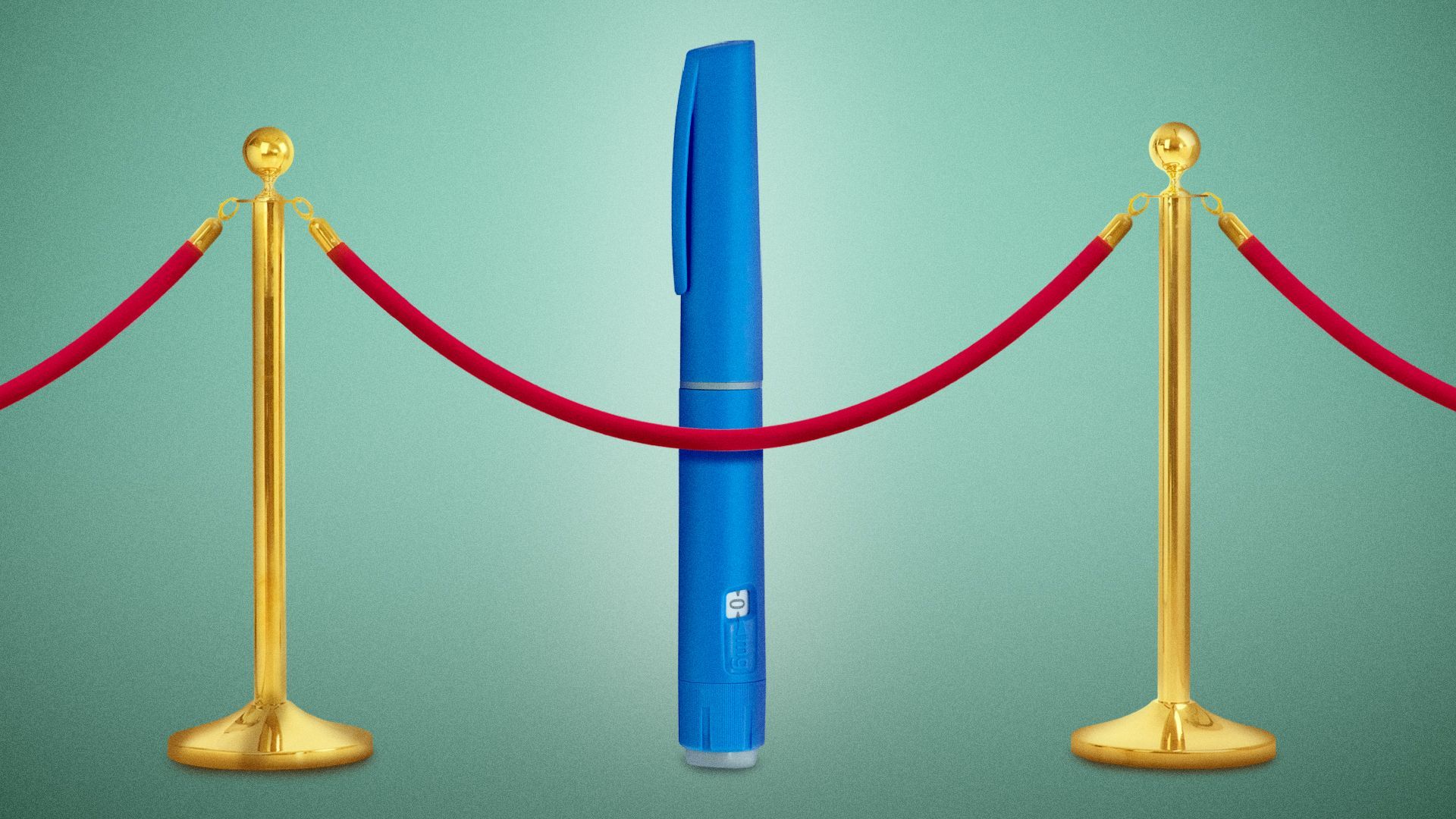
Illustration: Shoshana Gordon/Axios
I've written some version of this many times now, but it's such an important trend that it bears repeating: Extremely promising drugs are making their way onto the market, with more on the horizon, but we have no good way to pay for them all.
Why it matters: We could be at an inflection point for how society manages people's health, presenting life-altering possibilities with crippling costs.
- It's becoming easier and easier to imagine a world in which major diseases and their drivers are more curable, preventable or at least less debilitating.
- But much less imagination has been applied so far to how society can afford that kind of medical revolution without breaking the bank — and that may ultimately prevent this new era of health care from ever really taking off.
It's impossible to start this conversation anywhere but with GLP-1s — which are often referred to as the new class of anti-obesity drugs, but which actually may turn out to be "nearly everything" drugs.
- Drugs like Ozempic and Mounjaro — originally on the market for diabetes treatment — have gained popularity for their extraordinary effectiveness at helping people lose weight, a breakthrough that on its own has wide ramifications for a country in which more than 40% of people have obesity.
- Weight-loss drug Wegovy, which has the same active ingredient as Ozempic, recently received Food and Drug Administration approval for use in reducing the risk of serious heart problems in overweight or obese patients.
- Clinical trials have also shown GLP-1s to be promising against kidney disease, Parkinson's disease, substance use disorders and even Alzheimer's disease.
- "A compulsive nation has stumbled into what looks like a treatment for compulsion and one that happens to protect against some of the country's biggest killers and curb some of its most pervasive pathologies and inner demons," David Wallace-Wells wrote last week in the New York Times.
Even pharma's critics extol GLP-1s' potential.
- "Drug companies get away with murder," said health economist Paul Hughes-Cromwick. "But it seems like we're in this moment in America where we're afraid to celebrate good news."
- "If the only thing this stuff did was obesity, that alone we should be screaming from the rooftops while still being eyes-open about the abuses," he added.
But all of this comes at a price:
- The drugs are priced at more than $11,000 a year in the U.S., before accounting for rebates and discounts that may cut their costs by more than half.
- At their current prices, "making this class of drugs available to all obese Americans could eventually cost over $1 trillion per year," exceeding the budgetary savings that would come from healthier patients, a trio of economists wrote in the NYT earlier this year.
Drugmakers say all the handwringing over prices of groundbreaking treatments is just a smokescreen for payers to restrict coverage by citing cost concerns.
- "Yet as we saw with treatments for hepatitis C, high cholesterol and other medicines, these claims turned out to be false — because we have a competitive market that results in significant rebates and discounts, and eventually low-cost generics and biosimilars," said PhRMA spokesperson Alex Schriver.
Let's get back to the bigger picture....
2. Good news and bad news
GLP-1s aren't the only potentially revolutionary new drugs hitting the market.
- Gene therapies with price tags in the millions are steadily becoming available, and patients with conditions like sickle cell disease now have a better shot at a cure.
- New Alzheimer's drugs are also coming to market, although experts continue to debate whether their relatively mild benefits are worth the risks they pose and the hassle required to provide them.
- Advances in technology, artificial intelligence, biology and genomics are opening doors to potential treatments in ways that once sounded like science fiction.
Again, why this matters: The health care system isn't set up to pay for all of this.
- The economic promise of drugs like the GLP-1s and gene therapies is downstream savings and a major step toward the realization of what many experts dream of — a less expensive health system that spends most of its resources keeping people well instead of caring for them when they are sick.
- "The expense for the drugs is upfront, and a lot of these health benefits take decades to accrue — and that's a big part of the problem here," said the Mayo Clinic's Eric Tichy.
- "Yes, these things will have health benefits, but it's going to take maybe a decade or more for these health benefits to manifest themselves in terms of an impact on health care spending."
The bigger the potential group of recipients, the bigger the budget problem.
- If researchers find a more effective Alzheimer's drug, "obviously that's a showstopper," Hughes-Cromwick said. Personalized medicine enabled by gene therapies represents a huge wild card, too.
- Although gene therapies are for relatively small patient populations, they especially present a budgetary challenge for state Medicaid programs and small employers' health plans.
By the numbers: A recent study found that U.S. drug spending grew 13.6% last year compared with 2022, with semaglutide — the generic name for Ozempic and Wegovy — the leading expenditure.
- It projects drug spending will grow another 10%-12% this year.
- "The fact that it grew at double digits is almost mind-boggling," said Tichy, who co-authored the study. "And that's why I think it gets a lot of concern. So the question is, how is this sustainable? Is this going to continue to grow at these rates?"
The bottom line: "Yes, super expensive. Yes, potential fiscal nightmare. But let's at least celebrate the miracle that these things appear to be," Hughes-Cromwick said.
3. Potential solutions to the GLP-1 math problem
Illustration: Natalie Peeples/Axios
Experts brought up a few big things that could make absorbing the costs of these new drugs easier, one way or another.
- Medicare negotiations. Given how much Medicare is already spending on semaglutide, it could be selected by Medicare for price negotiations as soon as 2025, per KFF.
- Competition. More than 100 obesity drugs are currently under development. If even a fraction of them comes to market, it could drive prices down as manufacturers compete for market share.
- Lackluster demand. This one's hard to see happening for the anti-obesity drugs, and the major problem right now is ramping up the supply.
- But it's already playing out among the new class of Alzheimer's drugs and some gene therapies, which are also burdensome to receive.
- One eye-opening number here: IQVIA said its marker for success this year will be seeing more than 2% of the U.S. sickle cell patient population — roughly 2,000 people — receive treatment with the new gene therapies.
4. One to keep an eye on

Illustration: Sarah Grillo/Axios
After years of struggles developing treatments, there's a promising new schizophrenia drug that could get approved by the FDA later this year — and it could become a blockbuster.
Why it matters: Aside from the obviously big financial implications, there's a severe need for better psychiatric drugs that give patients more options to try.
- If KarXT — which was acquired by Bristol Myers Squibb last year in a $14 billion deal — gets approved, it will be the first in a new class of schizophrenia drugs.
- Some 2.8 million Americans have schizophrenia, according to the drugmaker. Around 30% don't respond to currently available treatments, which also have limited efficacy and significant side effects.
Driving the news: Late-stage clinical trial results published this week in JAMA Psychiatry indicated the drug was effective and generally well-tolerated.
- Market research firm Evaluate Pharma listed KarXT at the top of its biggest potential drug launches for the year, estimating it will reach $2.8 billion in annual sales by 2028.
- For context, that would put it above Evaluate's projected sales for an Alzheimer's drug candidate from Eli Lilly that could get approved this year.
- Remember what we said earlier: Drugs with large potential patient populations can get expensive quickly.
- The Institute for Clinical and Economic Review said in February that KarXT would be cost-effective at an annual price of $16,000-$20,000 if long-term data confirms its benefits and lack of weight gain, which is a major side effect with current treatments.
The bottom line: This likely doesn't create the kind of budgetary problem that GLP-1s or future Alzheimer's drugs might (unless Bristol Myers sets an unexpectedly high price).
- But it does illustrate the trade-offs that come with major therapeutic breakthroughs, and the fact that none of the extremely costly stuff is happening in isolation.
Thanks to Nicholas Johnston and Jason Millman for editing and Amy Stern for copy editing.
Sign up for Axios Future of Health Care

Keep up with health care politics, policy and business