Axios Future of Energy

February 11, 2026

๐ฎ It's a wild moment on the policy front. Today we're exploring...
- The climate, political, and data center stakes of EPA's "endangerment" rollback
- New moves on Venezuela, EV charging, and Puerto Rico
- State action on data centers and more, all in 1,543 words, 6 minutes
๐จ Situational awareness: President Trump will today "unveil plans to use government funding and Pentagon contracts to sustain US coal-fired power plants," Bloomberg reports.
๐๏ธ Join us tomorrow at 8am ET in Richmond for an event on Virginia's shifting energy landscape. RSVP here.
๐ง Exactly 30 years ago, the immortal Mary J. Blige ruled Billboard's R&B chart with today's intro tune...
1 big thing: The stakes of Trump's biggest move against climate rules

EPA's sledgehammer blow against future climate regs is obviously a BFD, but it's probably easy to over-interpret how much it locks in more emissions than would otherwise occur.
๐Catch up quick: Tomorrow, EPA is slated to repeal the endangerment finding โ the 2009 scientific conclusion that greenhouse gas emissions threaten humans.
Why it matters: It's the legal underpinning for GHG regs. EPA's repeal addresses vehicle emissions but could also thwart future controls on power plants and more.
- This goes way beyond Trump officials' ongoing work to kill Biden-era rules on cars and energy.
- "Trump is not simply withdrawing prior rules but attempting to block such rules in the future, absent an act of Congress," Capital Alpha Partners' James Lucier said in a note.
Reality check: It doesn't take a "lol nothing matters" schtick to realize the effect is pretty speculative.
- For one thing, under President Biden, the biggest focus of U.S. climate policy was money, not regulation. The 2022 climate law funneled unprecedented subsidies into EV purchases, wind and solar power and lots more.
- The 2025 GOP budget law and other Trump policies have already eroded a big chunk of the Biden-era support. And Trump's EPA is already pulling back Biden's biggest climate regulations, even with the finding in place.
The big picture: That leaves the effect of Trump's new move to be settled by...
- What courts do with the endangerment finding repeal.
- Whether the next administration wants to seek tough emissions controls.
- How much other countries feel less pressure to act on climate as the U.S. backs off even further.
๐ Flashback: Gauging how much the endangerment finding has already helped cut U.S. emissions is tricky.
- President Obama's power plant rules never took effect, and neither did Biden's replacement. But there's a case that power companies have boosted renewables โ which have soared in recent years โ based on where the puck seemed to be heading.
- Rules on vehicle emissions have been the stuff of wildly complicated legal and regulatory battles.
- Still, one EPA vet notes that car companies had started planning for the future based on rules set under Obama and later Biden, whose mandates covered model years 2027-2032.
"We were pushing forward to a trajectory where you were going to have substantially decarbonized transportation and energy," said Bryan Hubbell, a senior fellow at the nonpartisan think tank Resources For the Future.
- "I don't know that we're on that same trajectory now," said Hubbell, a former longtime EPA official.
๐ญ What's next: The Supreme Court, eventually.
- "We anticipate that the D.C. Circuit Court of Appeals will rule against him, so Trump must race against the clock to get a final Supreme Court ruling, in his favor, by July 2028, before his term as president ends," Lucier writes.
2. ๐ณ๏ธ Trump's climate anvil enters the 2028 race
I asked Rahm Emanuel, a potential Democratic 2028 White House hopeful, about the endangerment finding repeal โ and his answer went right to prices, not climate change.
Why it matters: It's a sign of the times.
- Many Democrats are pointing to climbing electricity prices โ not climbing temperatures โ as they frame their energy messages ahead of the midterm elections and 2028.
State of play: Emanuel said Republicans "crushed" new supply in the 2025 budget law that slashed renewables support โ and said that's helping push prices up as demand climbs.
- "These guys decided to put all the chips on natural gas and oil and coal, and I see this in that continuum," he said of the repeal plan.
- Instead, Emanuel argues, the country should have "continued with an all-of-the-above energy strategy, whether it was renewables, whether it was geothermal, whether it was small nuclear, or whether it was natural gas," he said.
- Emanuel, who was President Obama's chief of staff, called it "obviously a significant step backwards" that puts the U.S. at a disadvantage in the technological race against China.
Flashback: Other potential candidates responded more directly on climate grounds when Trump officials floated killing the endangerment finding last year.
- That includes California Gov. Gavin Newsom and, via wider coalition statements, Illinois Gov. JB Pritzker, Sen. Cory Booker of New Jersey and Ruben Gallego of Arizona.
What we're watching: What other 2028 Democratic hopefuls have to say about the latest move.
3. ๐ข The data center angle on EPA's "endangerment" move

Scuttling the endangerment finding is bullish for powering data centers with natural gas, Capital Alpha Partners' Lucier writes in a note.
The big picture: "[W]ithdrawal ... is about making it as difficult as possible for some future administration to reimpose carbon dioxide emission limits on gas-fired power plants, thus possibly crimping the Trump administration's drive to fuel the data center boom with natural gas, and also to re-impose an electric vehicle mandate in the future," he writes.
The intrigue: Speaking of power, one thing to watch when the EPA rule finally lands is how the agency tries to restrict it to vehicle emissions.
- That's a big deal. Utilities are spooked about a new Wild West in the absence of any federal CO2 authority over power plants, fearing new legal jeopardy.
Friction point: Let's flash back to what the Edison Electric Institute, a major utility lobbying group, said last fall in comments on EPA's draft plan.
- "[T]he possibility increases that the power sector could be further exposed to competing and conflicting regulations through a patchwork of state regulations, as does the potential for increased litigation alleging common-law claims, regardless of the merits of those suits."
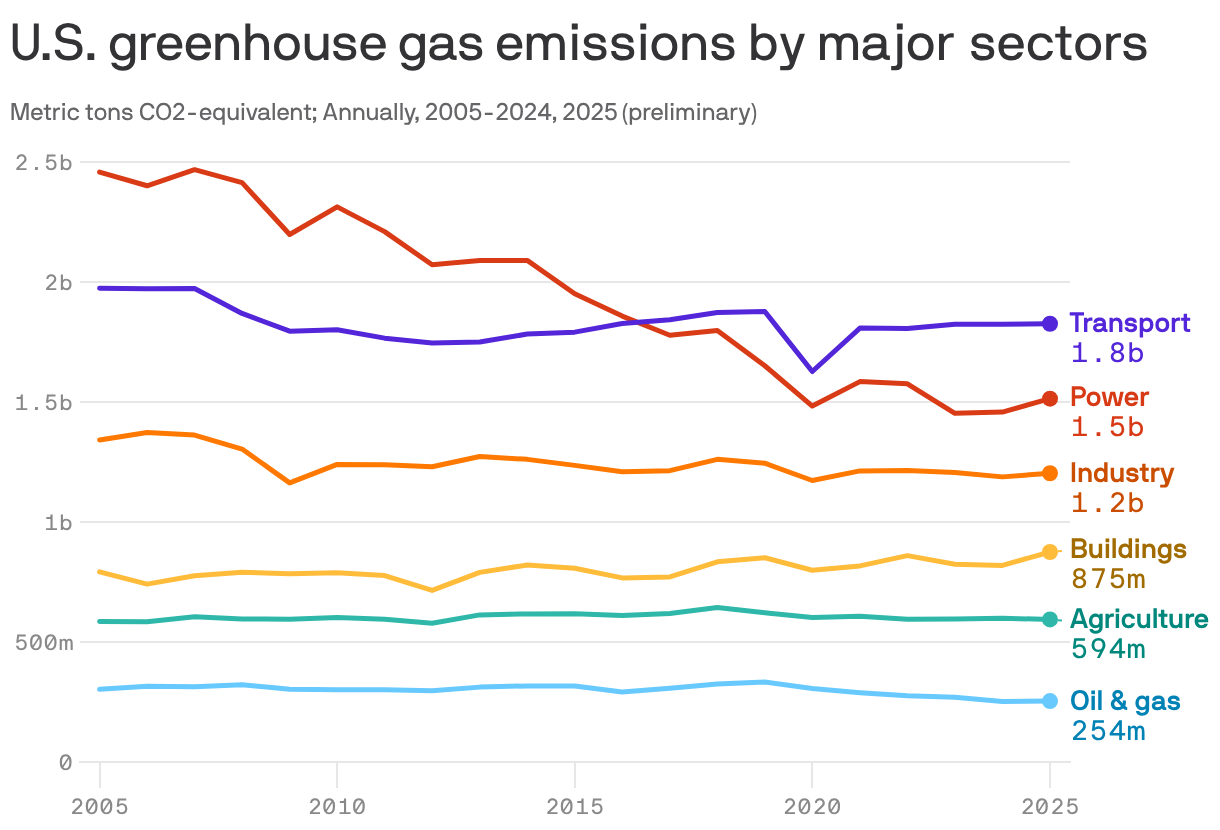
4. ๐ง Bonus: Charting U.S. emissions

U.S. emissions have been on a downward trend for nearly two decades, but the declines are nowhere near enough to meet Biden-era pledges under the Paris Agreement.
- The biggest reason is natural gas and, more recently, renewables shoving aside coal in power markets.
5. ๐ Exclusive: Startup emerges to use spent nuke fuel in military gear

Project Omega exited stealth today with a $12 million seed round under its belt and plans to convert spent nuclear fuel into power sources that the military can use for wearables, sensors, drones and more.
The big picture: The ambitions could help solve, in the long run, three major American concerns:
- What to do with all the spent fuel lying around.
- How to keep troops healthy, informed and out of harm's way.
- How to satiate an energy appetite that's growing, thanks to artificial intelligence and other factors.
"We need to make sure that we're self-sufficient, we're energy independent. And that means we need the nuclear fuel cycle here in the United States," CEO Staff Sheehan told me.
- "We're the picks and shovels of the nuclear gold rush."
State of play: Omega is already working with the Department of Energy.
- It's doing separation and refining at Idaho National Lab and is turning the material into products at the Pacific Northwest National Lab.
6. ๐ Catch up quick on policy: Venezuela, EV charging, DOE layoffs

๐ข๏ธ Trump officials took another step toward clearing the way for U.S. companies to operate in Venezuela's oil sector.
- The latest: The Treasury Department license allows oilfield services work and the provision of goods, software and other tech.
- What we're watching: How much it might enable production increases from existing wells in the country's broken-down oilfields. Treasury, per the WSJ, is soon slated to issue a broader license to allow U.S. oil companies to invest and drill there.
๐ The Transportation Department plans to require that federally funded EV charging infrastructure must have 100% U.S.-made components.
- The big picture: It will "unleash American manufacturing" and "prevent taxpayer dollars from subsidizing our foreign adversaries," DOT said.
- Friction point: EV advocates called it a bankshot way to block the flow of charging dollars in the 2021 infrastructure law.
- Threat level: The Electrification Coalition called the 100% requirement untenable. "[T]his change would effectively end the goal of the National Electric Vehicle Infrastructure (NEVI) program and years of investment from communities across the country," the group said.
โ๏ธ The National Laboratory of the Rockies, formerly the National Renewable Energy Laboratory, laid off another 134 people, per The Colorado Sun and other outlets.
๐ต๐ท DOE renewed emergency orders that it says will enable the Puerto Rico Electric Power Authority to boost reliability ahead of the next hurricane season.
- The intrigue: It comes on the heels of Bad Bunny calling attention to the island's power woes during his Super Bowl halftime show.
7. ๐งฎ Number of the day: Six
That's the number of states with some kind of proposed legislation to impose a moratorium on new data centers, per a Jefferies note.
- They are: New York, Oklahoma, Georgia, Virginia, Maryland and Vermont.
Why it matters: It's one data point that captures the simmering political backlash as power prices rise.
What we're watching: Even more common are proposals โ and in some cases enacted policies โ that look to shield consumers and force tech companies to shoulder more costs.
๐ Thanks to Chuck McCutcheon and Chris Speckhard for edits to today's newsletter, along with the brilliant Axios Visuals team.
๐ฌ Did a friend send you this newsletter? Welcome, please sign up.
Sign up for Axios Future of Energy