Axios Future of Energy

October 16, 2025

🐣 Good morning! We're opening with a look at a new climate project and then diving into all kinds of policy and tech news, all in just 1,480 words, 5.5 minutes.
🙏 Thanks to Chuck McCutcheon and Chris Speckhard for edits to today's edition, along with the brilliant Axios Visuals team.
🎸 This week marks 40 years since INXS dropped "Listen Like Thieves," which provides today's impeccable intro tune...
1 big thing: TED leader launches new climate initiative

The man who made TED a household name is moving from ideas to (climate) action.
Why it matters: After nearly 25 years at TED, Chris Anderson is stepping back to launch a new initiative seeking to mobilize businesses on climate change — as political focus wanes and investor energy shifts to AI.
- Anderson announced yesterday that Sal Khan, educator and founder of Khan Academy, would take over the nonprofit TED conference, which produces expert thinkers' "TED Talks."
"Ideas can change the world," Anderson said after a recent private gathering about the new initiative in Half Moon Bay, Calif. "But only if someone can figure out how to turn them into action. That's what I see cleantech entrepreneurs doing every day."
Driving the news: Anderson's new venture is a combined new fund, coalition and convening called All Aboard.
- It compels an atypical level of coordination and collaboration for investors, even among those funding climate technologies who are often more collaborative than most.
- The goal is to boost startups from lab proof of concept to massive scale, which is particularly hard and expensive for capital-intensive technologies such as climate.
Zoom in: Anderson himself isn't a household name — about once a month he gets called "Ted." But he has one of the broadest and most unique global networks because he has led TED for so long and engaged with its speakers.
- "It turns out a lot of those minds are concerned about climate," he said.
Flashback: Anderson, who accumulated significant wealth through his early media ventures, traced the beginning of his journey toward this new chapter back to 2019. That was when he helped launch the climate-specific initiative TED Countdown.
- Two TED speakers he said had particular influence on him: Mexican climate activist Xiye Bastida and John Doerr, the philanthropist and investor whom Anderson said helped convince him to launch Countdown.
"I became more and more persuaded that the biggest impact would come from changing what businesses did, and the biggest impact on that would be the disruption caused by exciting startups in this space," Anderson said.
The intrigue: Anderson, an affable 68-year-old who was raised in Pakistan by British parents, carries himself as an extrovert but says he's an introvert.
- Across one evening during Climate Week NYC and three days in Half Moon Bay shortly thereafter, Anderson hosted what in many ways felt like a tailor-made TED conference for a small group of invited climate investors and entrepreneurs.
The big picture: Anderson is going all-in on climate during what is otherwise a trough of climate momentum, particularly given President Trump's rollback of U.S. climate policies.
- "At the stage we're at right now, the government role is less influential than we know," Anderson said. "Things have moved and are unstoppable."
2. ‼️ Exclusive: Google DeepMind partners with fusion startup

Google DeepMind is partnering with a Boston-area energy startup to use AI to speed the development of fusion as a clean energy source.
Why it matters: "Everyone talks about how much energy AI is going to use, but AI can actually help the energy equation on the supply side too," Commonwealth Fusion Systems (CFS) CEO Bob Mumgaard told Axios.
Driving the news: CFS will use Google's open-source software to simulate the physics of plasma — the particles that reach 100 million° C to form fusion's fuel — as researchers attempt to figure out the most efficient systems.
- CFS plans to use the software, known as TORAX, to help optimize its SPARC fusion reactor before it's fully turned on in late 2026 or early 2027.
- The companies will also test how Google DeepMind's software could help with the operation of SPARC and future fusion energy systems.
Catch up quick: It formalizes joint work that began four years ago and is the latest of several deals between the two companies.
- Google said earlier this year it will buy 200 megawatts of energy from CFS, and parent company Alphabet is already an investor.
3. 👀 DOE closes $1.6B transmission loan guarantee for utility giant

The Energy Department just finalized a $1.6 billion loan guarantee for American Electric Power to optimize and rebuild around 5,000 miles of transmission lines across five states.
Why it matters: Getting new interstate lines approved is really hard even as power demand rises, and grid analysts see lots of potential in boosting capacity along existing infrastructure and corridors.
State of play: The project will upgrade lines in Indiana, Michigan, Ohio, Oklahoma, and West Virginia, per AEP and DOE.
- The financing will support the replacement of lines in existing rights-of-way with new lines that can transmit more power, the company said.
- AEP claimed that financing at a "preferred interest rate" will save its customers roughly $275 million over the life of the loan.
What's next: "Approximately 100 miles of transmission lines across Ohio and Oklahoma are the first projects to be supported by the loan guarantee," AEP said.
4. ⚛️ Here's Amazon's small reactor vision

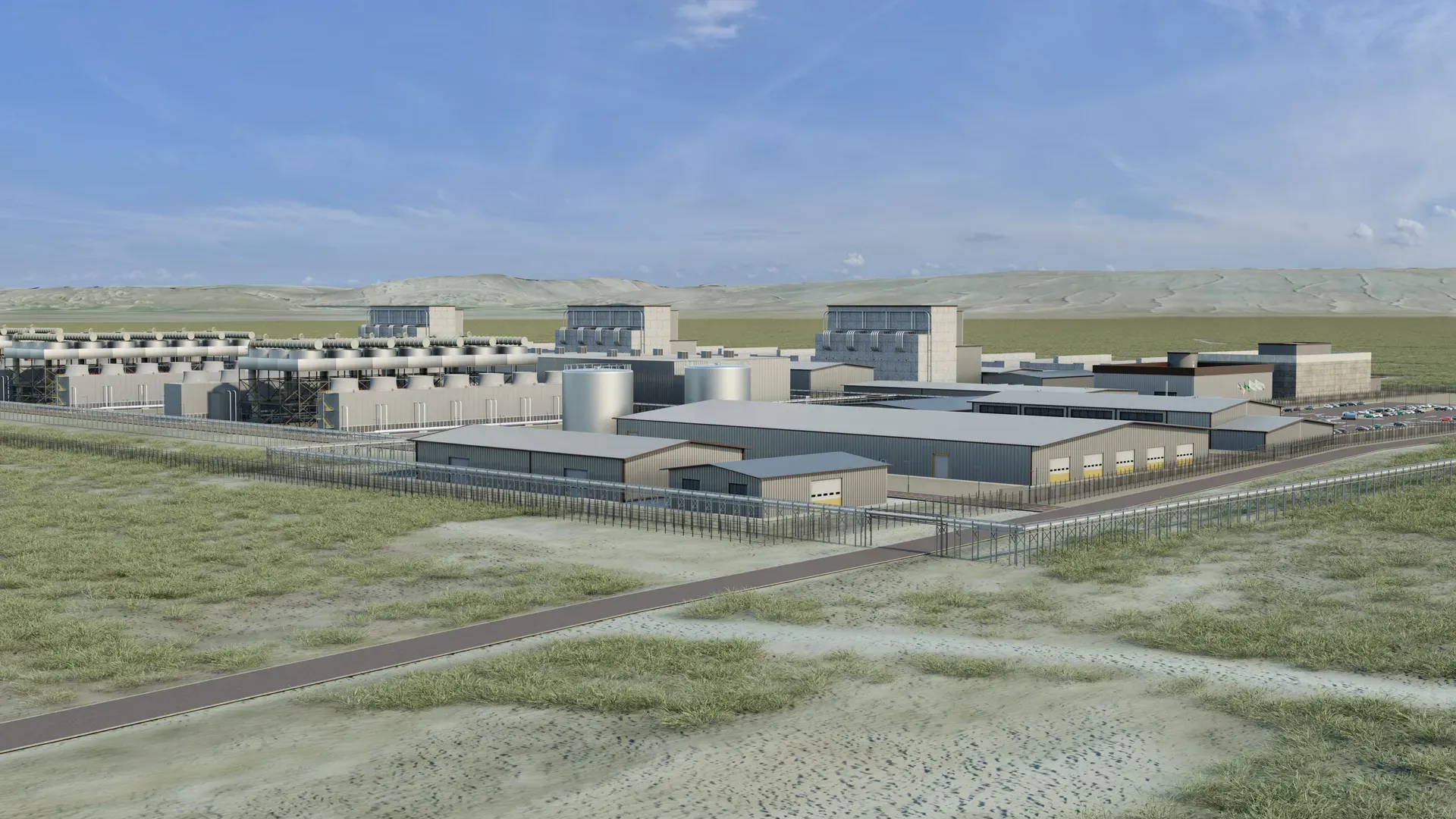
Amazon has unveiled plans and renderings of its forthcoming small modular reactor facility in Washington state to power AI and cloud services.
Why it matters: The Cascade Advanced Energy Facility is one of the country's first SMR projects, with Energy Northwest and X-energy planning to build up to 12 SMRs.
Driving the news: Cascade will be built outside Richland, Wash., near Energy Northwest's Columbia Generating Station.
- Construction is slated to begin by the end of this decade, with operations targeted to commence in the 2030s.
- Amazon said the project will create over 1,000 construction jobs and more than 100 permanent positions.
"This project isn't just about new technology; it's about creating a reliable source of carbon-free energy that will support our growing digital world," said Kara Hurst, Amazon's chief sustainability officer, in a statement.
- Amazon last year led a $500 million investment round in X-energy, which X-energy officials hailed as a boon for the burgeoning SMR industry.
What we're watching: Greg Cullen, Energy Northwest's VP for energy services and development, told Axios that officials are making progress in discussions with state regulators and the Nuclear Regulatory Commission that must approve the project.
- X-energy is seeking to incorporate features of another SMR project it has in Texas to try to standardize the process as much as possible, said Ben Reinke, the company's senior VP for global business development.
5. 💵 A global clean tech rebound

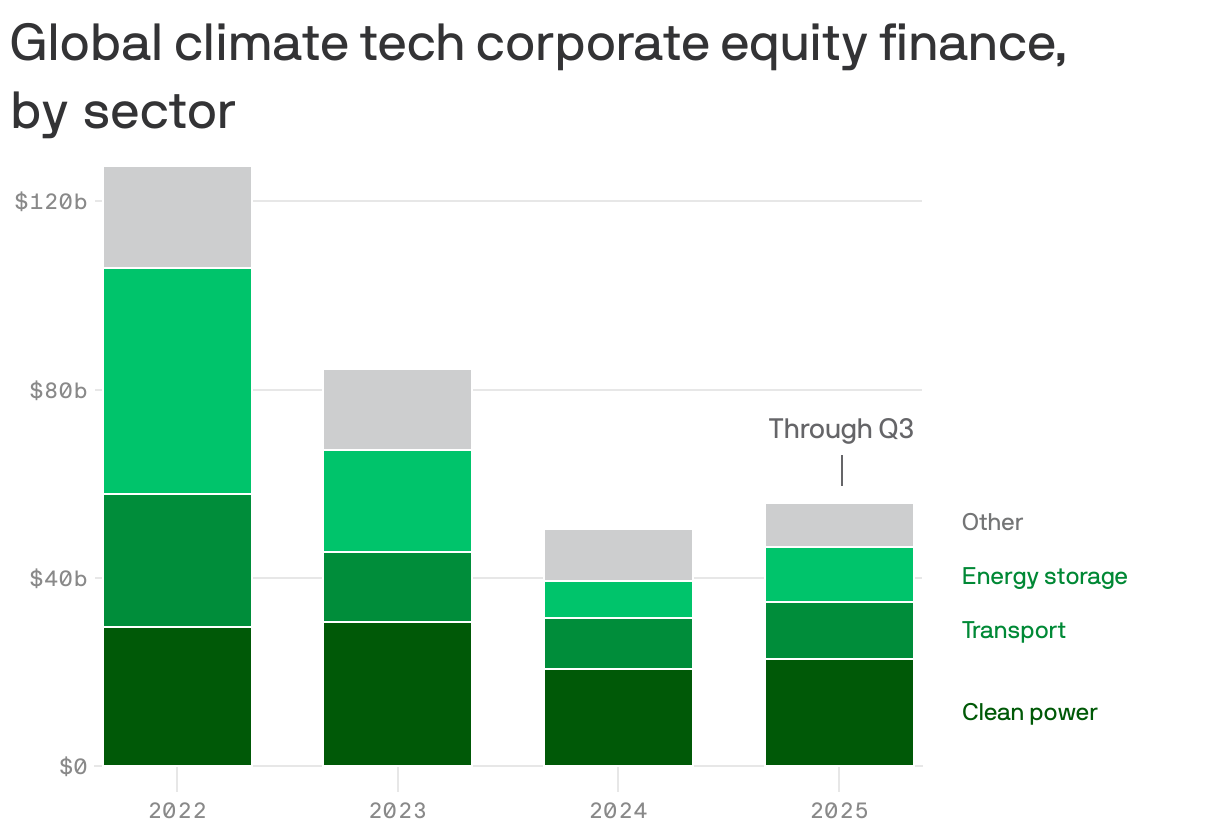
Yes, call it a comeback: Corporate finance for climate tech is slated for a big year-over-year rise, the research firm BloombergNEF projects.
State of play: Thirst for electrons — near-term and far — to power data centers is part of the story, alongside rising electricity demand in general.
- Clean power was the best-funded sector in Q3 of this year, with moves including Iberdrola's $5.9B share sale and Commonwealth Fusion Systems' $863M venture raise.
- There were also major renewables and storage deals in China and India.
What's next: BloombergNEF sees total corporate equity finance rising to nearly $75B this year, up from $50B last year, but far below 2021-2023 levels.
- The report covers VC, private equity, M&A and public markets.
The intrigue: There's a split screen. VC and private equity funding fell again in Q3, but public markets rose (though that Iberdrola raise was a big chunk of that).
The bottom line: It's part of a wider and mixed picture, especially in the U.S., where manufacturing investment in low-carbon tech is falling and federal support is pulling back.
6. 🏃 Catch up quick on tech finance: planes and reactors
▶️ Electric aviation startup Beta Technologies hopes to raise up to $825 million in an IPO, it said in an SEC filing that values the company at up to $7.2 billion.
- Why it matters: The company argues there's a massive potential market in electric flight via commercial and military applications.
- The big picture: It sees a market for electric/hybrid aircraft of roughly "60,000 units with an assumed value of $250 billion...through 2035." And then there's even larger revenue opportunity in the life of the vehicles, the filing argues.
- Reality check: There's a lot of uncertainty about the future of this market, let alone any one company's path. Take the risk disclosures section of the filing for a spin to see what we mean.
⚛️ Shares of SMR startup NuScale Power jumped almost 17% on news that the U.S. Army is launching a "next-generation nuclear power program that will deliver resilient, secure, and assured energy to support national defense installations and critical missions." Go deeper
7. ⛏️ Number of the day: +24 percent
That's the projected rise in global copper demand by 2035 thanks to "traditional economic development alongside new structural demand from electrification and digitalisation," a Wood Mackenzie analysis finds.
What we're watching: "[D]ata centres represent the most unpredictable variable in copper demand forecasting," it finds.
📬 Did a friend send you this newsletter? Welcome, please sign up.
Sign up for Axios Future of Energy