Axios Future of Energy

November 04, 2025


🎙️ We've got news on the great climate memo freakout of 2025, plus a lot more, all in 1,312 words, 5 minutes.
🙏 Thanks to Chuck McCutcheon and Chris Speckhard for edits to today's edition, along with the brilliant Axios Visuals team.
🎸Happy birthday to Chris Difford of Squeeze, who have today's perfectly written intro tune...
1 big thing: Gates defends climate memo

Bill Gates last night defended criticism from all sides about his controversial memo calling for a shift to prioritizing human welfare in climate debates.
Why it matters: Gates' response to the polarizing reactions to his own shifting positions shows the high stakes of this debate — and his influence as a major funder of both climate and public health initiatives.
Driving the news: Gates, in an interview with Axios in front of roughly 1,000 Caltech students, talked at length about the memo, his broader views on energy and climate change and more.
"I'm glad people are listening," he said, before adding that it was hard to convey "nuanced positions nowadays."
State of play: Since the Microsoft co-founder published the memo on Oct. 28, reaction has been wide-reaching and fierce.
- Numerous conservative leaders — including President Trump — are cheering what they described as a wholesale retreat for the billionaire philanthropist.
"It's a gigantic misreading of the memo," Gates said of Trump's post and others like it. He said his funding toward addressing climate change and public health measures are both going up.
- "I didn't think the memo was going to convert the non-believers into believers, and sure enough, it didn't convert them," Gates said.
Context: Gates has ramped up his funding of the Gates Foundation while announcing its closure in 2045.
- He cut some parts of his clean energy group, Breakthrough Energy, earlier this year, but he is continuing his venture capital investments and has talked about increasing them.
Friction point: Gates also pushed back against climate scientists who said he was setting up a false dichotomy pitting climate efforts against foreign aid.
- "What world do they live in?" Gates said. He went on to say that foreign aid budgets going to poorer countries do often choose between climate and health. "This is a numeric game in a world with very finite resources, more finite than they should be," Gates said.
The intrigue: Gates briefly waded into the controversial topic of geoengineering.
- He said society should consider using geoengineering — a set of controversial technologies that could temporarily reduce global temperatures — if the planet reaches so-called "tipping points" where non-linear climatic changes occur.
- A funder of research into geoengineering, Gates also expressed concerns, namely that such technology could take away arguments to reduce emissions. He also said local impacts from geoengineering must be understood.
What we're watching: A group of climate scientists is talking about Gates' memo in a virtual briefing today hosted by Covering Climate Now.
Disclosure: Amy Harder is a former employee of Breakthrough Energy in her role leading Cipher News, an independent news outlet supported by Breakthrough Energy.
2. 🚧 COP30 confronts limits of the Paris system

New estimates of global warming's march underscore the stakes of COP30.
Why it matters: This month's UN climate summit in Belém, Brazil, will test whether the Paris Agreement remains fit for purpose.
- I know, I know, I know — that's always the case! But it's especially true this year.
- Energy costs, limited national spending appetites, AI, trade friction, and White House stances confront the summit.
- Ten years after Paris, global emissions are still climbing.
Threat level: Fresh UN analysis finds that nations' updated emissions pledges to date will barely lower previously projected warming.
- And that's if they're implemented — a gigantic "if."
The big picture: Countries' "nationally determined contributions" (NDCs) would bring warming of 2.3°C to 2.5°C above preindustrial levels, the annual "emissions gap" report finds.
- Meanwhile, current policies yield 2.8°C of warming. That's under last year's projection, but still a really harmful amount.
- And some improvement stems from "methodological updates," while the U.S. policy pivot will also erode some of the progress, it finds.
Friction point: "Alignment with [the Paris Agreement's] 1.5°C and 2°C goals would require rapid and unprecedented cuts to greenhouse gas emissions far above what has been pledged," a summary states.
- The 1.5°C goal appears dead (though there's some hope of eventually cooling things back down after "overshoot").
Yes, but: If the floor is unfortunately higher, the temperature ceiling is now lower.
- Back when Paris was adopted, nations' current policies were on track to bring catastrophic warming of roughly 4°C, the UN claims.
The intrigue: A new Rhodium Group study sees a likely warming range of 2.3°C to 3.4°C by 2100, and a mean of 2.8°C — well below pre-Paris estimates, but still a "dire climate future."
- Nobody claims Paris alone changed the equation — there are variables upon variables here.
- But it shows that peer pressure on finance and policy works.
What we're watching: Bloomberg reports that "this year's COP30 summit in Brazil will be conspicuously free of top-level Wall Street bankers discussing how to cut their financed emissions," citing climate focus giving way to meeting demand and security.
- ING analysts, in a note about COP30, see "little cause for optimism at this stage."
- However, "corporate climate action remains resilient, but more discreet."
- Keep an eye on how much Trump might try to influence actions in Brazil despite the White House's decision not to send any senior officials.
The bottom line: "Victory on the big issues in Belém might merely mean establishing a process that could facilitate braver, science-based political decisions in the future — a sad consolation prize," Nigel Purvis, a former U.S. climate diplomat, writes in Foreign Policy.
3. 🌡️ Charted: the vanishing Paris goals
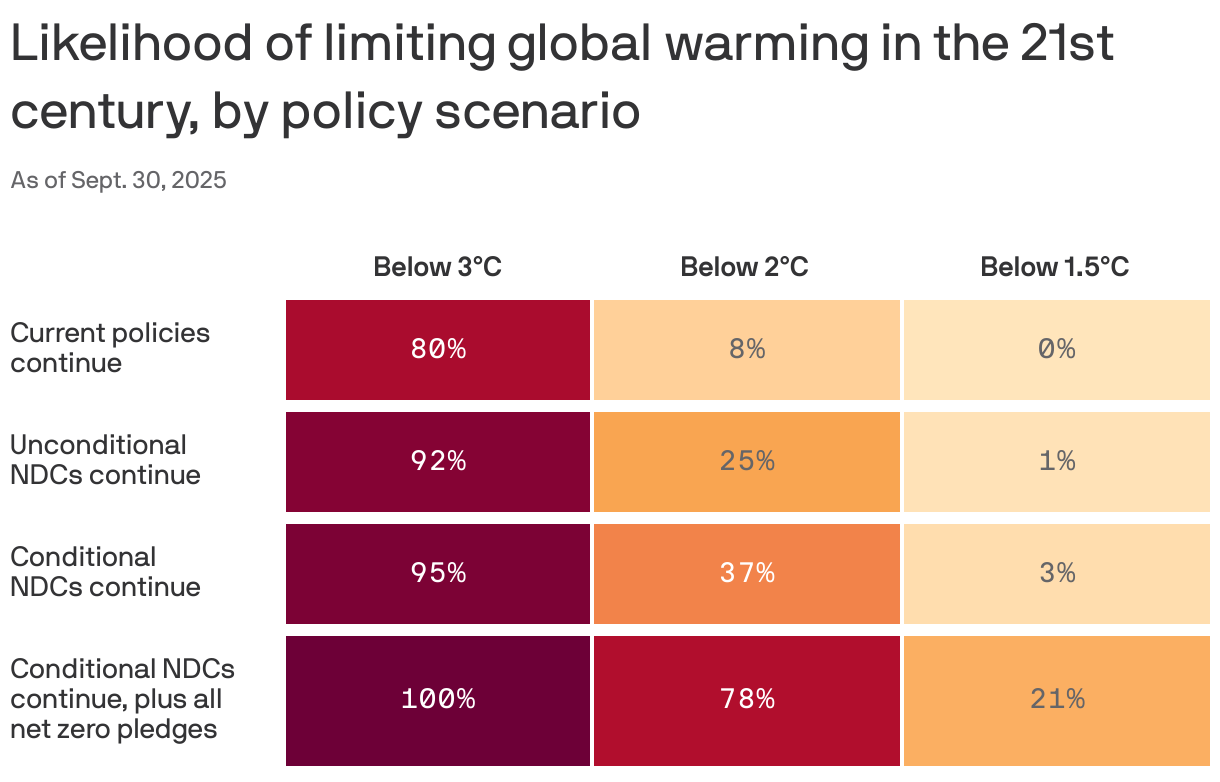
This graphic from the new UN report shows two things at once.
- One is that today's policies and NDCs won't achieve Paris Agreement goals of limiting temperature rise well under 2°C with a stretch goal of 1.5°C.
- The other is that some of the most catastrophic outcomes now seem out of the picture.
4. 💵 Finance notes: Data centers and rare earths



🆒 Liquid cooling deals are hot, thanks to the soaring power needs of AI data centers.
- Why it matters: Data centers are finally embracing liquid cooling, after the tech has spent years at the margins, and are beginning to look at what's next.
- Driving the news: Power giant Eaton announced yesterday it plans to buy Boyd Thermal, a Goldman Sachs Asset Management portfolio company, for $9.5 billion.
- Catch up quick: Also yesterday, power company Vertiv announced it would acquire HVAC services firm PurgeRite Intermediate for about $1 billion to bolster its liquid cooling tech.
- Go deeper: Unlock the whole story, and a steady diet of scoops and smart analysis, by talking to our sales team about Axios Pro Deals.
🏭 Vulcan Elements, a startup trying to re-shore U.S. rare-earth magnet production, said it's secured over $1 billion in financing from the federal government and private investors to kick-start its first large-scale factory in the U.S.
- Why it matters: Rare-earth magnets have become a notable bone of contention in U.S.-China trade talks, as China currently dominates the supply of rare-earth materials. Full story
5. 🏃 Catch up quick: Forests, Big Oil, targets
🌳 Deforestation is declining in the Brazilian Amazon, but lots of trees are still vanishing, per data analyst Hannah Ritchie's "Sustainability by numbers."
🛢️BP's Q3 net profit of $2.21 billion beat expectations as the company pivots back toward its core oil and gas biz.
- The intrigue: "For the first time in 8 years, BP's quarterly stock announcement doesn't include the word 'transition' (this is a document that runs over 30-40 pages)," Bloomberg analyst Javier Blas posted on his personal X account.
🇪🇺 Via Reuters, "EU climate ministers will make a last-ditch attempt to pass a new climate change target on Tuesday, in an effort to avoid going to the U.N. COP30 summit in Brazil empty-handed."
6. 🛢️ Number of the day: 13.8 million barrels per day
That's estimated U.S. crude oil production in August, the last month with robust data available, per the Energy Department's independent stats arm.
Why it matters: Output levels have been outpacing expectations despite modest prices.
📬 Did a friend send you this newsletter? Welcome, please sign up.
Sign up for Axios Future of Energy