Axios Future of Energy

April 07, 2026

😬 We're all awaiting the outcome of President Trump's threat to obliterate Iranian civilian infrastructure if the Strait of Hormuz isn't open by 8pm. Meantime, we're exploring...
- How the war could reshape energy policies worldwide
- Data center politics, nuclear regulations and more, all in 1,308 words, 5 minutes.
🙏 Thanks to Chuck McCutcheon and Chris Speckhard for edits to today's newsletter, along with the brilliant Axios Visuals team.
🎶 Happy birthday to John Oates of Hall & Oates, who co-wrote and has rare lead vocals on today's lovely intro tune...
1 big thing: How a new energy order could emerge from the war
The throttling of oil and gas flows could push multiple countries to try to cut exposure to seaborne energy commodities — and create different risks in the process.
Why it matters: The Iran crisis is chaotic and costly enough to spur long-term policy changes.
- New or faster efforts to swap hydrocarbon imports for homegrown electrons are something that analysts are increasingly watching as shortages bite.
Threat level: "The inherent risk to economies relying on oil and LNG shipped from the Gulf has been laid bare," Wood Mackenzie researchers write.
- It follows the Kremlin's 2022 move against Ukraine that highlighted risks of heavy reliance on single regions — in that case, European thirst for Russian gas.
What we're watching: Fast-growing, import-dependent economies in Asia, where the war is already prompting emergency rationing measures.
- The second gas price spike in recent years — Russia's invasion also increased costs — will boost competition from coal, renewables, and storage, Ben Cahill writes for the Atlantic Council.
Driving the news: Woodmac has begun modeling what happens if the crisis becomes a catalyst for hydrocarbon importers to seek self-sufficiency.
- For many nations, that means accelerating electrification.
- Its analysts see more EVs, deferred coal-plant retirements, and more renewables.
Zoom out: It also looks very long term.
- "After 2040, nuclear power and supporting supply chains rapidly scale. Road transport power demand surges 57% as EVs achieve a dominant market share and oil demand in transport drops 30%, relative to our current base case," a summary states.
- Its modeling shows global oil demand declining to 75 million barrels per day in 2050, 20% lower than its base case. Global gas demand falls by 10% by 2050.
- The cost of building out domestic electrification is a brake on faster efforts.
My thought bubble: Big policy changes are something to watch — not to assume.
- One reason is money. Another is short memories. And another is inertia.
- BloombergNEF researcher Martin Tengler warns against seeing the war boosting green hydrogen (the stuff made with renewable inputs).
- Investors are unlikely to see gas prices staying high long enough to make it competitive, he writes.
The intrigue: A new essay in Foreign Affairs says countries seeking isolation and "energy autarky," or independence, face big risks and costs.
- "There are better solutions than retreating from markets," Jason Bordoff and Meghan O'Sullivan write.
- Yes, nations should seek greater domestic capabilities where appropriate, and strategic reserves — but also a wider pool of global suppliers, steps to reduce the influence of chokepoints, and other moves to boost the resilience of global markets.
The bottom line: "China looks to be an out-and-out winner," the Woodmac analysts write.
- "It has plentiful coal, as well as a material domestic oil and gas resource, and can leverage its dominant existing clean-tech platform."
2. 👟 Catch up quick on Iran: Tenterhooks edition

📊 Oil prices are trading in a relatively narrow range — by current standards, anyway — as all eyes are on Trump's threat to obliterate Iran's infrastructure beginning at 8pm ET.
- What we're watching: "If the president sees a deal is coming together, he'll probably hold off. But only he and he alone makes that decision," a senior administration official told Axios. Go deeper via Axios' Barak Ravid and Marc Caputo.
- The latest: The global benchmark Brent crude is $110 this morning — up over 50% since the war began.
⛽ U.S. gasoline prices are up to an average of $4.14 per gallon, per AAA, with diesel up another few cents overnight to $5.65. Diesel is approaching the record of $5.82 set in 2022.
👀 Via Bloomberg, "As President Donald Trump muses about seizing control of Iran's oil sector, one potential upside is looming in his thinking: expanding US global energy dominance to gain trade leverage against China."
- Yes, but: The story, which cites "people familiar with the matter," is stuffed with caveats.
3. 🗳️ Data centers are on the midterm ballot

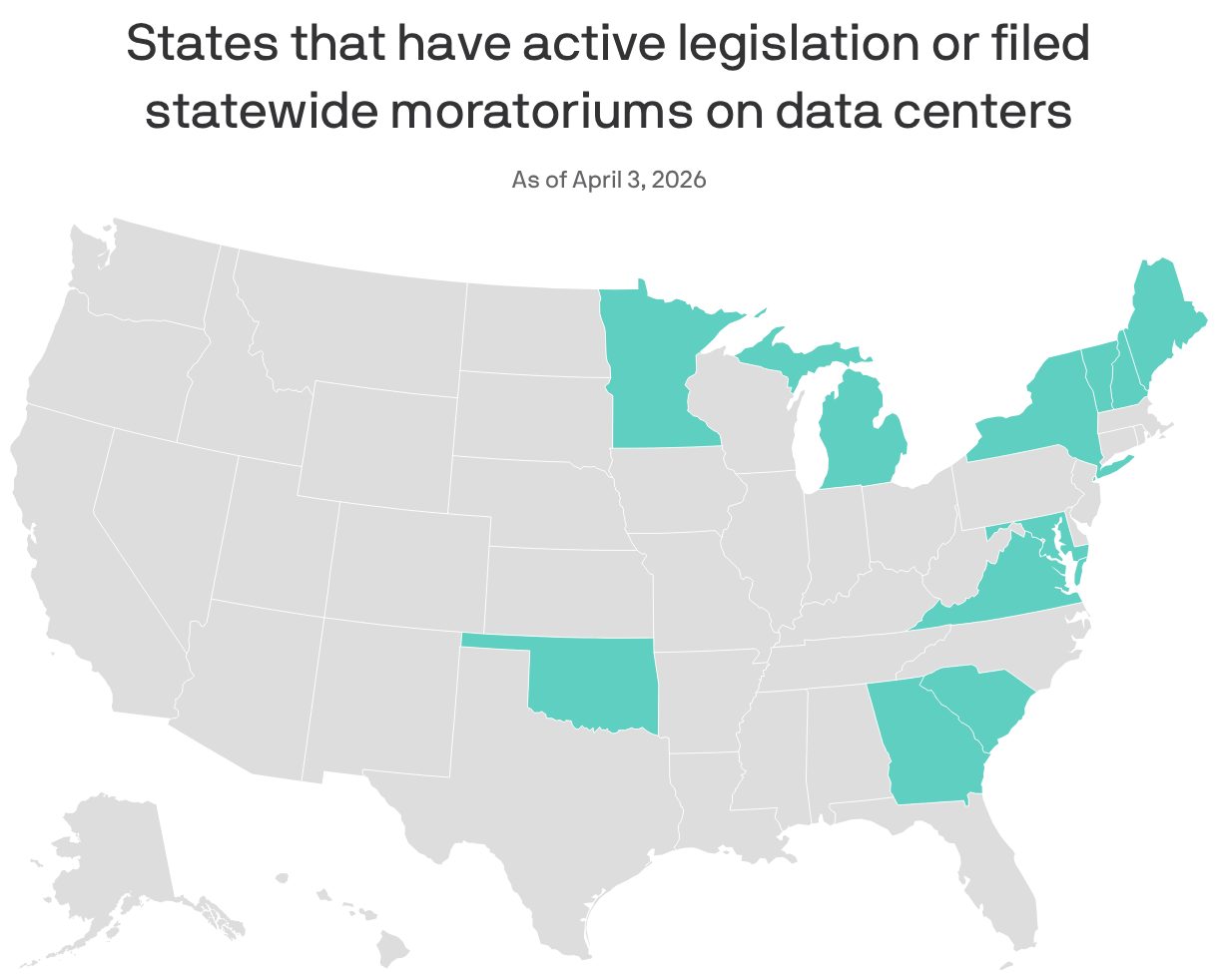
Data centers have become a boxy, hulking flashpoint heading into the midterms — and the backlash is spreading fast across red and blue states.
Why it matters: States are fielding constituent anger over power grids, water supplies and strained local infrastructure.
- But investment keeps accelerating; Wall Street isn't slowing down, and neither is Washington's appetite for AI dominance.
- At least 11 states have proposed some legislation to restrict or ban data center development since late 2025.
Driving the news: Maine is on track to be the first to ban construction outright. A bill pausing development until November 2027 is expected to clear the state Senate and be signed by Gov. Janet Mills (D).
- Another dozen states have seen local pushback or enacted restrictions tackling environmental concerns, consumer data or energy bills.
The big picture: Politicians are positioning themselves carefully on data centers ahead of the midterms, and their stances are often a direct response to local voter angst.
What they're saying: "Maine is the canary in the coal mine," Anirban Basu, chief economist for trade group Associated Builders and Contractors, told the Wall Street Journal.
4. ⚛️ NRC seeks to clarify DOE, Pentagon input on reactors

The Nuclear Regulatory Commission is giving a clearer path to approval for companies with reactor designs that have already been vetted by the Pentagon or the Energy Department.
Why it matters: It's a bid to streamline licensing — and reflects the military's and DOE's newly muscular Trump-era role in getting new reactors off the ground.
- Still, a longtime NRC critic said the proposal eases his earlier fears that it would be a "rubber stamp" that bypassed NRC.
Driving the news: The agency said in a Federal Register notice that it aims to spell out how companies can justify DOE- or Pentagon-authorized demonstration reactor designs in meeting NRC safety requirements.
- Once DOE or the Pentagon "thoroughly tests a reactor design and shows it operates safely, we're going to build on that work, not repeat it," Jeremy Bowen, director of NRC's Office of Advanced Reactors, said in a statement.
Zoom out: Both the DOE and Pentagon have taken on expanded roles as the Trump administration seeks to swiftly deploy more nuclear power to meet massive AI data center demand.
What they're saying: Edwin Lyman, the Union of Concerned Scientists' director of nuclear power safety, said he initially had been concerned that the proposed rule would bypass NRC's procedures and ways for the public to comment.
- But he noted it still would require companies to show how the Pentagon or DOE authorizations meet NRC regulations.
- "So although I am relieved that the proposal is not as bad as I had feared, my sense is this falls far short of the rubber stamp the reactor vendors were hoping for," Lyman said in an email.
What we're watching: The rulemaking now goes through a public comment process.
5. 🏃 Catch up quick on policy: EPA and FERC
🛢️ Via The Hill, "The Trump administration undertook an early step Monday in what is expected to be a significant rollback of a Biden-era rule restricting methane emissions from oil and gas production."
⚡ E&E News reports: "Xcel Energy and other Midwest utilities are pressing federal regulators and the Trump administration to suspend competitive bidding for certain power line projects — arguing the nation's appetite for electricity to fuel artificial intelligence depends on it."
6. 🧮 Number of the day: 71%
That's the share of GOP and GOP-leaning U.S. adults who say expanding fossil fuels should take priority over growing wind and solar, per Pew Research Center polling.
Why it matters: That share has doubled over the last six years, the research group's new survey conducted in mid-March shows. Full results
📫 Did a friend send you this newsletter? Welcome, please sign up.
Sign up for Axios Future of Energy