Axios Future of Energy
July 30, 2026

π¨π³ Here's a reason you're not paying even more for gasoline: China. Axios' Matt Phillips explores why, and then we move on to...
- An AI power plan that sums up 2026
- Fusion finance, EV sales trends and Shell's big quarter, all in 1,341 words, 5 minutes
π Breaking: Thermal battery startup Antora Energy closed a $550 million Series C round to support building a second factory and more as it eyes data centers and other industries. Announcement ... Bloomberg coverage
π Happy 90th birthday to blues legend Buddy Guy, who has today's intro tune...
1 big thing: Iran war shows China role in setting the price of oil


The Iran war has revealed China's enormous power over global oil prices, thanks to its position as the world's largest buyer.
Why it matters: China's reaction to the oil shock β by substantially withdrawing from buying on world markets β helped prevent the worst of the price spikes that experts thought would follow from the effective closure of the Strait of Hormuz.
Catch up quick: After the U.S. and Israel launched the war on Feb. 28, Chinese crude oil imports dove as prices spiked.
- At first, the decline in imports didn't surprise analysts. (China has long been known as a price-sensitive buyer.)
Yes, but: Few expected that China could maintain this low level of oil buying without deeply damaging its domestic economy.
- But as the war approaches its sixth month, China has done just that.
By the numbers: Through June, Chinese oil imports remain down over 40% from the previous year.
- "I guess the surprise has been just how low Chinese demand can go," said Michal Meidan, head of China energy research at the Oxford Institute for Energy Studies. "But it's been low without impairing the well-functioning of the economy."
How it works: Chinese policymakers have pulled several levers to mitigate the impact of the decline in oil imports, Goldman Sachs analysts say.
- Chinese officials tapped into domestic reserves of coal, oil and natural gas for supplies, and boosted renewables usage.
- And China took advantage of its giant fleet of electric vehicles, reflected by the fact that "despite much lower gasoline consumption, traffic congestion remained relatively stable," Goldman analysts say.
The big picture: Broadly speaking, analysts say that China has taken such steps almost exclusively for the benefit of its domestic economy. But the benefits of those decisions β basically lower global oil prices β have been broadly shared.
Caveat: China isn't the only reason that the world economy was able to deal with the energy supply disruptions of the war.
- Rich nations released large amounts of oil from their own strategic reserves.
- And U.S. energy companies drastically boosted exports to meet global demand.
Still, China's energy policy β and its ability to keep global prices in check β could be a valuable asset, as it positions itself as a source of stability, often in contrast to current U.S. leadership.
- "China is doing this for China, fundamentally," said Ruby Osman, a senior policy advisor on China at the Tony Blair Institute for Global Change. "But obviously it's not unhelpful for China that it has become a global public good."
What we're watching: Any hints that Chinese buyers are flocking back to global markets. Early indications suggest a bit of a bounce in July purchases.
2. π° The AI era, in a $100 billion project
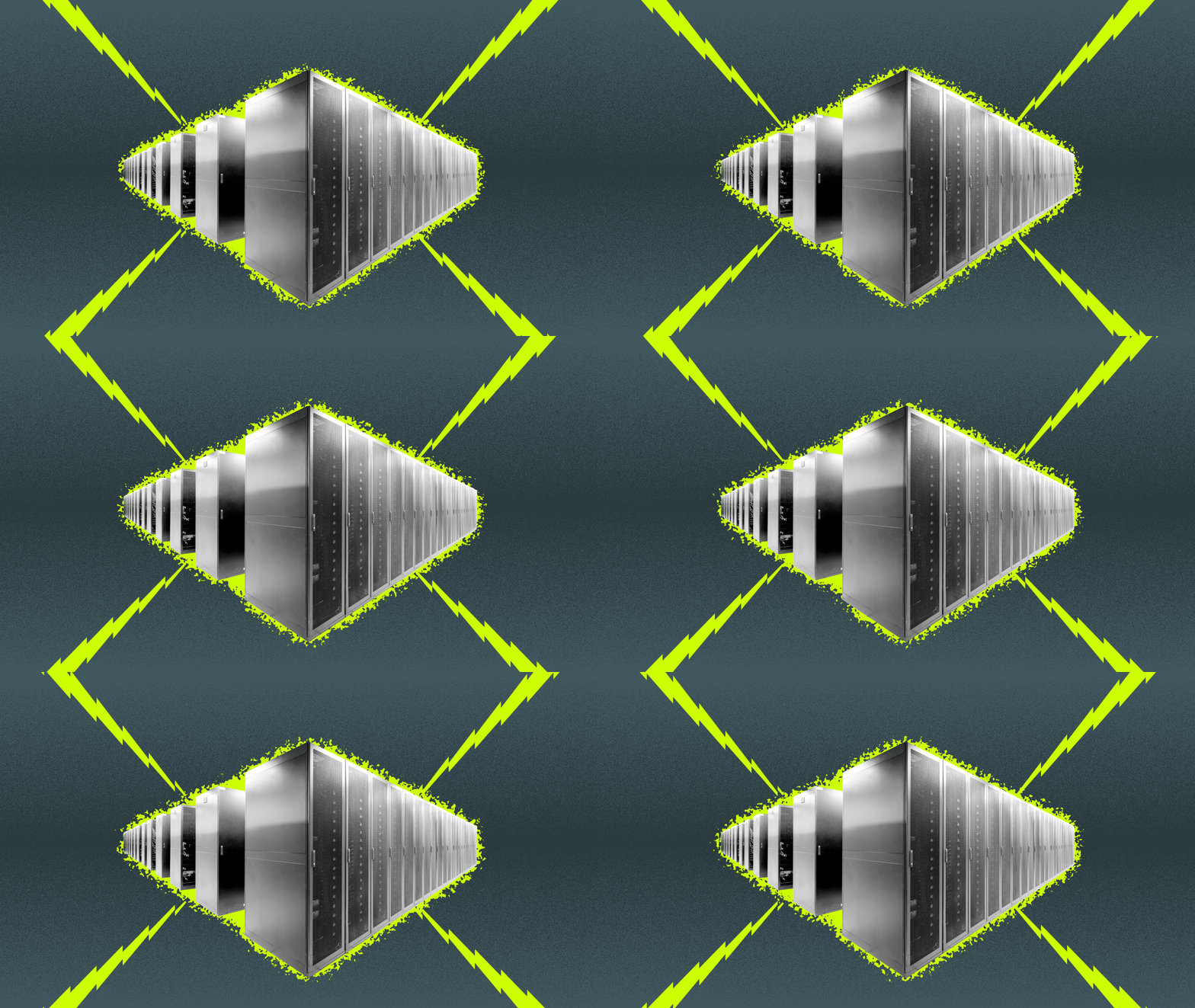
New plans for a huge power and data center campus in Kentucky read like a playlist for the AI era β eye-popping numbers tossed around, pledges to shield consumers from costs, and heavy federal involvement.
State of play: NextEra Energy and investment giant Brookfield are teaming up with DOE on plans for development at DOE's Paducah Site, a large Cold War-era uranium enrichment complex that has ceased operations.
- The plan announced yesterday with local utilities calls it a $100 billion privately funded project.
- It includes up to 2 gigawatts of gas-fired power, up to 2.6 GW of battery storage capacity, and lots of new computing power for the campus slated to be fully built in 2032.
Between the lines: Several aspects are very of-the-moment at a time of public backlash to data centers.
- NextEra president and CEO John Ketchum pledged "not a dollar of added cost on an existing customer's electric bill."
- Trump officials are pulling several levers to support AI while aiming to show that the ratepayers won't pay the price.
- The New York Times points out that it's the third time DOE has unveiled plans to repurpose Cold War-era nuclear facilities.
And, like a lot of big AI-energy visions, it's aspirational at this point.
- "The project is subject to negotiation and execution of definitive documentation," the announcement states.
- The rollout doesn't identify any tenants for the planned data centers, though the FT reports that "Brookfield has already begun talks with hyperscalers to become an anchor for the campus."
Zoom out: The Paducah site's existing transmission, water infrastructure, fiber connectivity, and available land make it "uniquely positioned" to support AI and attract investment, DOE said.
The bottom line: It's a BFD β if it gels.
- The joint announcement claims it would bring 8,000 construction jobs and 600 full-time jobs operating the site.
- "DOE's former enrichment site proved to be the ideal location for the largest economic investment in Kentucky's history," it states.
3. βοΈ Fusion's big money day
Commonwealth Fusion Systems has raised another $1 billion in a round executives believe may not be the last before the fusion developer goes public.
Why it matters: The startup continues to raise private rounds despite being among the most anticipated public listings in low-carbon energy.
State of play: The round, announced early this morning, drew investment from pension funds, sovereign wealth funds, infrastructure firms, and industrial corporates, Commonwealth says.
- Executives declined to name specific investors, a departure from previous rounds. "This was largely new investors," CFO Lorence Kim told reporters.
Follow the money: The raise brings Commonwealth's total funding to about $4 billion, or nearly one-third of all the capital invested in fusion energy, the company says.
- The long list of prior investors includes Nvidia's NVentures, Morgan Stanley's Counterpoint Global, Gigascale Capital, Breakthrough Energy Ventures, Gates Frontier, Google, Khosla Ventures, and Lowercarbon Capital.
- The fresh $1 billion will fund Commonwealth's demonstration reactor, SPARC, but it won't cover its first commercial project, the 400 MW ARC reactor in Virginia.
What we're watching: Commonwealth executives indicated they may pursue further private funding before going public.
- "I would not characterize this as pre-IPO funding in the way that that's traditionally used," Kim said.
Unlock the whole story, and for a steady diet of scoops and smart analysis, talk to our sales team about Axios Pro Deals.
4. π Global EV sales rise despite U.S., China slowdown


Electric vehicle sales will reach a fresh record in 2026 even as they have softened in China β the world's largest auto market β and the U.S., the International Energy Agency finds.
Why it matters: The growth in many other countries signals a widening market, with sales in the second quarter reaching all-time highs in 50 countries.
- That Q2 data are at least partially related to the Middle East war driving up petroleum prices.
- And governments in oil import-reliant regions like Southeast Asia have introduced new policies to encourage EVs during the crisis, IEA notes.
Case in point: One sign of the consumer reaction is that Australia's roughly 34% jump in gasoline prices earlier this year coincided with April EV sales almost tripling compared to April 2025.
Zoom out: Overall, IEA sees EVs reaching 29% of global car sales in 2026.
What we're watching: The longer-term effect of the Iran crisis.
- "While a lag in consumer responses and policy implementation means the full effects will take time to materialise, the crisis has clearly reinforced the case for EVs as a way to address energy security and fuel cost concerns," the report states.
5. π Number of the day: $9.84 billion
That's Shell's second-quarter profit announced this morning.
Why it matters: It's Shell's biggest quarter since 2022, reflecting higher commodity prices, strong trading results, and refining margins during the Iran crisis. CNBC has more.
What's next: Exxon and Chevron report Q2 numbers before markets open tomorrow.
π Thanks to Mackenzie Weinger, David Nather and Chris Speckhard for editing and to our brilliant Axios visuals team.
π« Did a friend send you this newsletter? Welcome, please sign up.
Sign up for Axios Future of Energy