Axios Future of Energy

November 20, 2026


🍸 Made it. We're closing the week with a look at how one large city is navigating the AI boom, then moving on to...
- The permitting bill's future, Big Tech emissions, a wild oil stat and good weekend reads, all in 1,337 words, 5 minutes.
🙏 Thanks to David Nather and Chris Speckhard for editing, and to our brilliant Axios visuals team.
🎹 This month marks 55 years since Sly and the Family Stone released the album "There's a Riot Goin' On," which provides today's intro tune...
1 big thing: Phoenix mayor walks fine line on AI boom

Phoenix Mayor Kate Gallego wants more tech investment in her city — but on her terms, as data centers strain resources and frustrate residents.
Why it matters: Phoenix has become a bellwether for the AI industry's growing demands on electricity and water in an increasingly hot, resource-constrained world.
- As the mayor, Gallego is navigating an outsized dilemma facing communities nationwide: How to embrace the AI boom while protecting residents and resources.
"I do want us to lead in technology, and I want us to be a tech-forward community," Gallego said at a recent event co-hosted by the University of Chicago's Institute of Politics and Energy Policy Institute, and moderated by Axios.
- But she added: "I want companies who care about our community and will give back to it, and not just a race to see who can get the deepest incentives and the cheapest" power.
- "We're open for business, but we're not for sale," she said.
State of play: Gallego, the longest-serving current mayor of America's 10 largest cities, has spent recent years trying to balance that.
- She helped push to eliminate Arizona's generous data center sales tax exemptions. The state enacted a three-year pause on new applications this summer.
- She opposes a blanket construction moratorium, favoring more local control over where facilities are built, particularly near homes.
- Phoenix adopted tougher zoning rules last year requiring special permits for new data centers.
Gallego says communities should have more bargaining power over data centers, including where they're built and what residents get in return.
- That could mean more permanent jobs, transparency about electricity and water use, and benefits for neighbors affected by development.
Friction point: Phoenix's efforts to rein in data centers have sparked legal challenges, with developers originally seeking roughly $750 million in compensation over zoning restrictions adopted last year.
- The city has granted several exemptions while fighting other claims in court.
- "We have been open and good partners to the industry, and it's deeply disappointing that they don't want to work with us," Gallego told Axios.
The other side: Developers argue the restrictions infringe on their property rights and diminish land values, entitling them to compensation under Arizona law, though industry allies have also acknowledged tensions.
Gallego is also navigating the tradeoffs between electricity, water and heat in the desert.
- "We're seeing many of these data centers get power from natural gas plants in an area of our state that is very constrained around water," Gallego said.
What we're watching: Gallego worries Arizona might be betting too heavily on an industry whose long-term trajectory remains uncertain.
- She compared the risk of abandoned data centers to Phoenix's vacant Kmart stores, many of which have been difficult to redevelop.
"What will I do in a community if we have these giant windowless boxes" that are no longer operating, she asked. "How will we redevelop or make them not become blight?"
2. 🗳️ What's next for the permitting bill

Last night's 62-33 Senate passage of a huge, bipartisan permitting and transmission bill casts it into an uncertain future.
👟 Catch up quick: 47 Republicans, 14 Democrats and Maine's Angus King (I), who caucuses with Dems, supported the plan.
- 30 Democrats, Bernie Sanders (I) and two Republicans voted no on the White House-backed measure.
➡️ What's next: House Speaker Mike Johnson has signaled he'll try to move it through the chamber.
- His office didn't comment last night. Nor did aides to Dem leader Hakeem Jeffries, who has previously called for more negotiation with his members.
What they're saying: The House outlook is "decidedly mixed," TD Cowen analysts said this morning in a note, citing timing and uncertain Democratic backing in the closely divided chamber.
🏀 State of play: "We'll get the votes in the House, and the president will sign it," Senate Majority Whip John Barrasso (R-Wyo.) told reporters at the Capitol.
- Bill co-author Sen. Shelley Moore Capito (R-W.Va.) claimed "great momentum," and cited "positive signals" from various pockets of members that the GOP and Democratic co-authors have been speaking to.
⚔️ The other side: Look for opponents to try and deter House support. "I am going to tell them we can do a lot better," Sen. Ron Wyden (D-Ore.) said.
The intrigue: Capito said she hasn't given up on adding a manager's amendment that's aimed, among other things, at addressing some tribal concerns about the bill.
- Roll Call has a nice breakdown of the friction that prevented amendment votes.
🫏 Among Dems who could be in the 2028 White House mix, only Sen. Ruben Gallego (Ariz.) voted yes on final passage.
- Sens. Jon Ossoff (Ga.), Cory Booker (N.J.), Mark Kelly (Ariz.), and Raphael Warnock (Ga.) opposed it.
My thought bubble: The fight over the bill is evidence that the politics of AI will saturate the next Congress and even White House race.
- Data centers played a starring role, with critics fearing it makes the buildout easier.
- Backers emphasized provisions to ensure data centers pay for needed grid upgrades and new power.
3. 🤔 Meta rethinks climate goal as AI emissions soar

Meta's greenhouse gas emissions surged 45% last year amid its AI infrastructure boom, prompting the tech giant to reconsider its goal of reaching net-zero emissions by 2030.
Why it matters: Other tech giants have reported rising emissions as they race to build data centers, but Meta is going a step further by explicitly reconsidering its climate deadline.
Driving the news: The just-released sustainability report of the tech giant, one of North America's largest data center operators, shows just how much growth in the AI industry is outpacing any efficiency gains.
- Meta executives said they were "re-evaluating" the 2030 goal, first announced in 2020 when the company was still known as Facebook and before the generative AI boom.
- They didn't specify what changes they're considering or when they'll make a decision.
By the numbers: Meta's electricity use jumped 35%, comparable to other tech giants. But Meta's emissions increase of 45% is far higher than its peers, Google (18%), Amazon (16%) and Microsoft (25%).
4. 🛢️ Number of the day: 2.75 billion
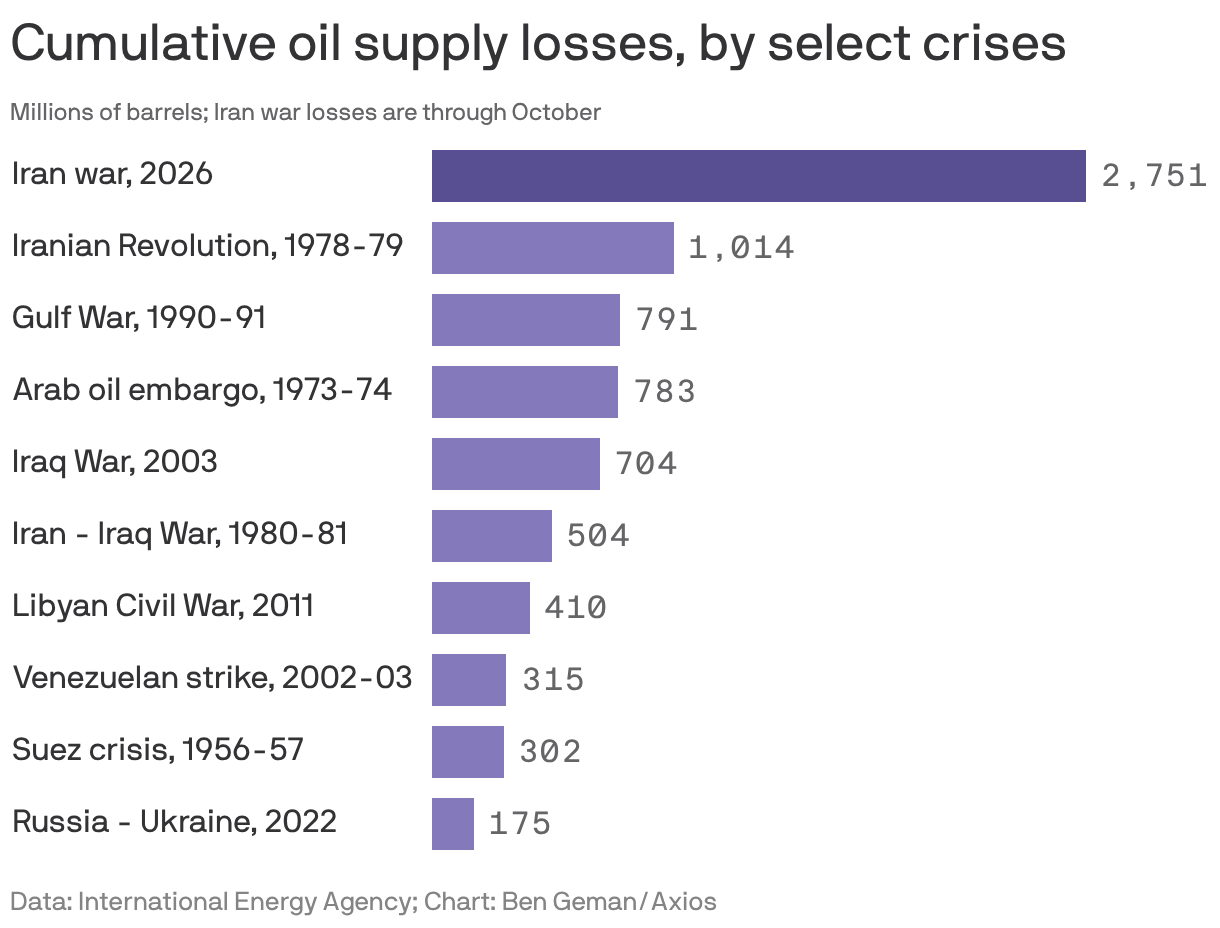
The throttling of the Strait of Hormuz caused a cumulative loss of nearly 2.8 billion barrels of oil through October, per the International Energy Agency.
Why it matters: It's the "largest energy supply shock that the world has faced," IEA's annual outlook this week states.
- The system has shown "considerable resilience" in the face of oil and gas losses.
- "[B]ut increasingly it is falling to consumers — and high prices — to absorb the impact as other buffers are run down," it states.
5. 👓 Hot Reads: Safety, solar, climate

Neglected repairs, chemical spills foreshadowed mill's deadly tank collapse (Seattle Times)
Amy says: Wow, such detailed, important reporting, presented in a digestible format.
- To me, the biggest takeaway from this story is the importance of government inspections, which is worrisome given the cuts to federal agencies tasked with things like this across the government.
The Michigan climate candidate courting opponents of Big Solar (Grist)
Amy says: I wonder if this represents a new kind of climate-concerned politician, one who acknowledges the urgency of the problem but also insists that the process is reckoned with too.
- That does not bode well for renewable energy, judging by this article about the then-candidate, who went on to win his race, by the way.
A Super El Niño Is Bearing Down. 'What Are We to Do?' (NYT)
Amy says: Oh man, an 8-hour bike ride — one way! — to try to make a living for his family as this unpredictable weather pattern makes things even worse.
- This is important on-the-ground reporting on how the world's poorest countries are facing the brunt of a warming planet.
📫 Did a friend send you this newsletter? Welcome, please sign up.
Sign up for Axios Future of Energy