Axios Future of Energy
January 26, 2026

π¨οΈ From schools to gas wells, a lot is closed down in this winter storm, but the newsletter cafe is still open and serving up 1,577 words, 6 minutes.
π Thanks to Chuck McCutcheon and Chris Speckhard for edits to today's newsletter, along with the brilliant Axios Visuals team.
π§ Happy birthday to singer-songwriter Lucinda Williams, whose talent shines through on today's intro tune...
1 big thing: Grid holds up β so far
This weekend's winter storm has caused widespread power outages in Nashville, Tennessee, and other areas of the South β but it hasn't severely strained the electricity grid.
Why it matters: Electric utilities across the country have seen heavy demand during the storm, with the possibility of power outages lasting multiple days.
- Officials were anxious to avoid a repeat of Winter Storm Uri, which left millions without power in Texas in 2021 and was responsible for at least 200 freezing deaths.
Driving the news: As of 7 a.m. today, more than 820,000 U.S. customers lacked power, according to poweroutage.us.
- But of that total, about 250,000 of the outages were in Tennessee, with most of those in the Nashville area. Nearly half of the city's residents were without power yesterday, Axios Nashville reported.
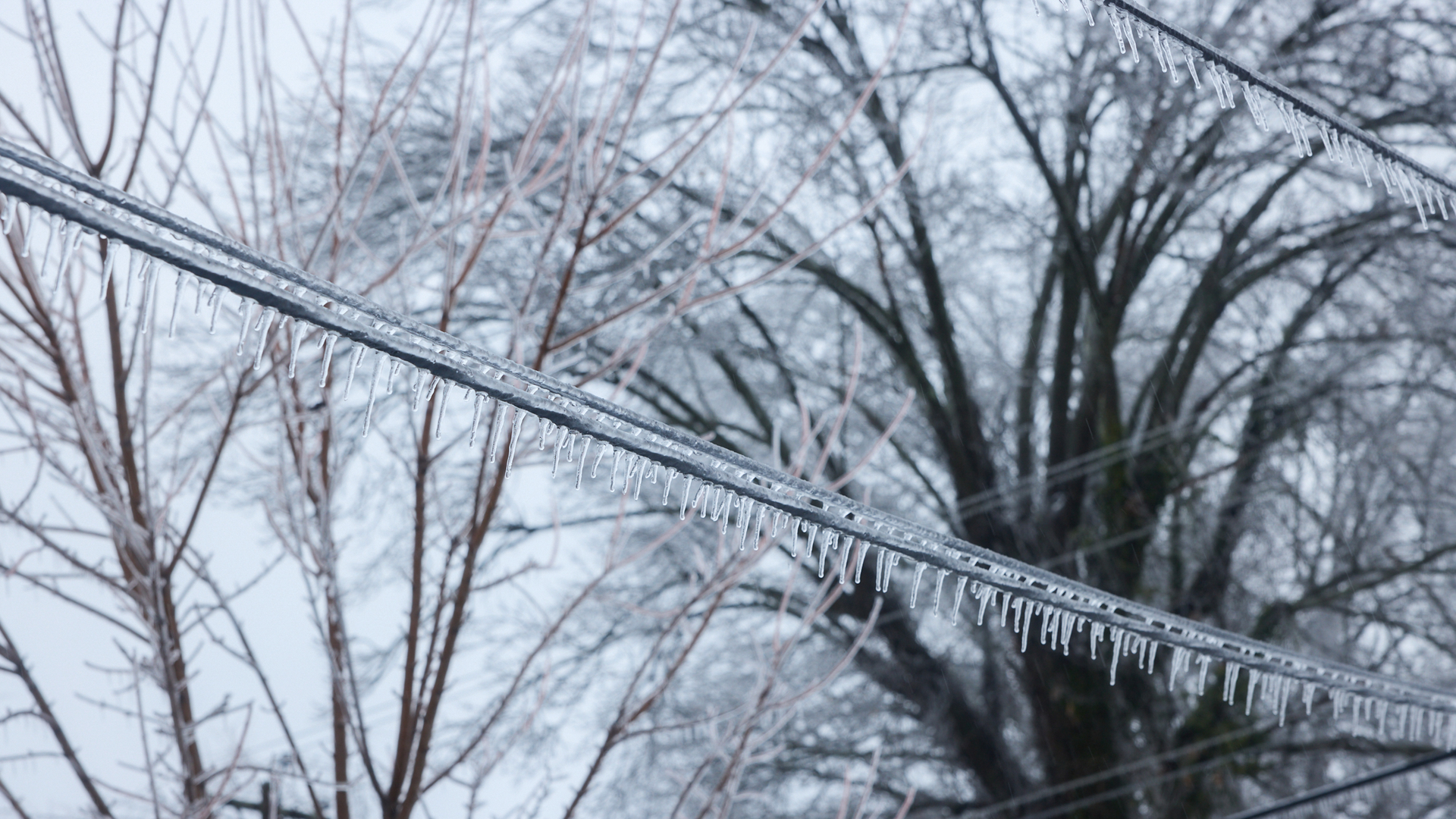
- In neighborhoods across the city, frozen rain caused trees to snap and take out power lines. The Nashville Electric Service warned power outages could "span over days or longer."
- In Texas, only about 60,000 of more than 15 million customers were without power. In Georgia, more than 80,000 people were without power yesterday after the storm moved through, Axios Atlanta reported, though that total was down by more than half this morning.
"The power grid is under stress ... But nobody's at the extreme level of stress," Georg Rute, founder and CEO of the grid intelligence company Gridraven, told Axios. "It seems that while it's not an easy ride, the grid is handling it."
- Rute said the U.S. was "lucky that the worst of the storm was over the weekend, when there's less [electricity] load."
- He also noted that the Energy Reliability Council of Texas (ERCOT) made improvements to Texas' grid that helped ease the strain.
- That included adding wind and solar capacity. Wind and solar combined for an hourly average of more than 23,000 megawatts at one point yesterday afternoon.
Threat level: But Rute and others warned that the grid isn't fully out of the woods yet as cold and ice continue to topple lines and freeze equipment.
- "The current US winter storm so far is less severe than prior storms such as Uri and Elliott of 2021, 2022, but the risk isn't over, with sustained cold lingering behind the storm," said Matthew Palmer, executive director and head of Americas Gas Research for S&P Global Energy, in a statement yesterday.
The most critical window for PJM, the grid operator for 13 states and the District of Columbia, will be tomorrow, consulting firm ICF said.
What we're watching: Energy Secretary Chris Wright said his agency has issued emergency orders authorizing PJM, ERCOT and ISO-New England to keep enough power running even if it means exceeding limits established by environmental rules or state law.
- The PJM and New England orders remain in effect until Jan. 31, while the ERCOT order runs through tomorrow.
2. π΅ Transition finance hits new global record β but growth is slowing

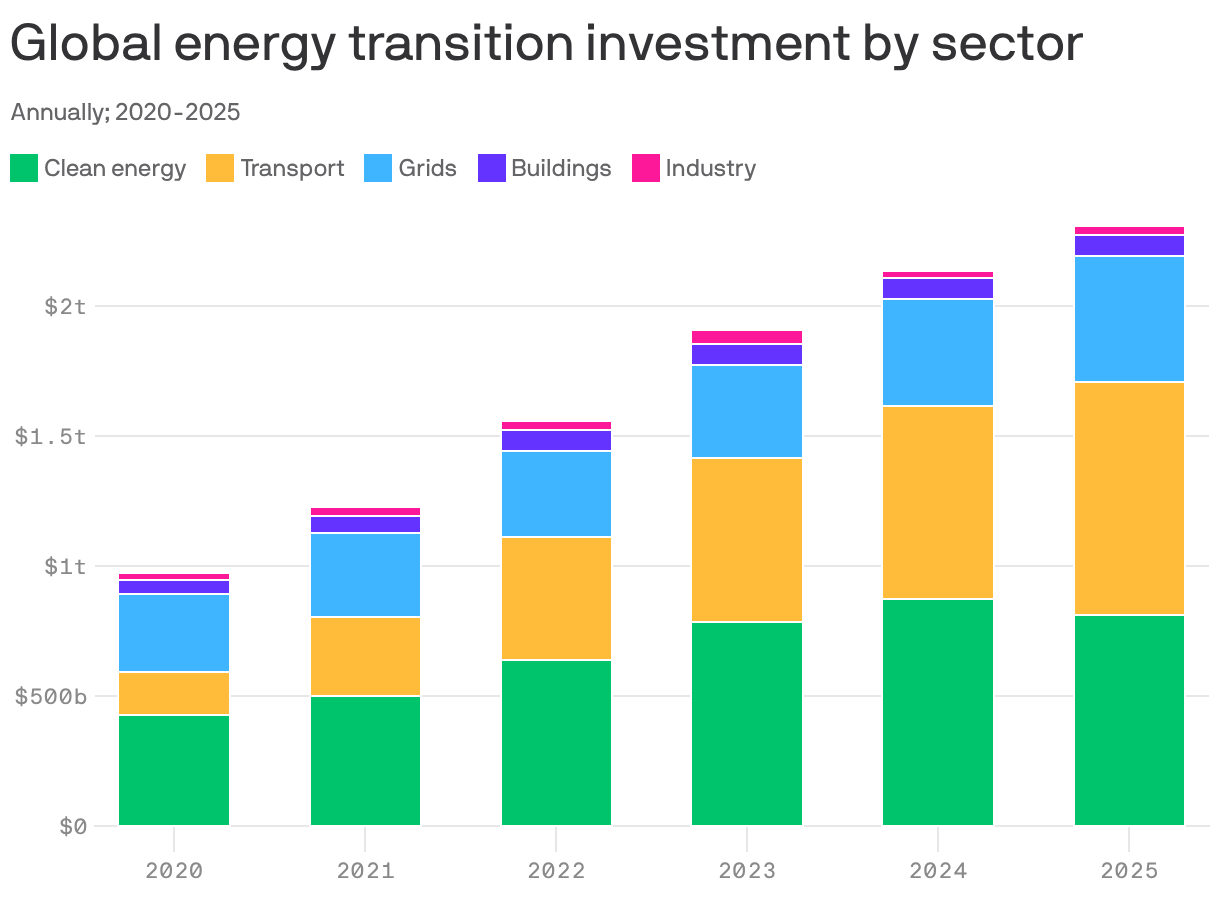
Aggregate spending to deploy low-carbon energy climbed 8% to a record $2.3 trillion last year, but annual increases are slowing, a new analysis finds.
Why it matters: The rise in both equity and debt finance, and other indicators, came despite trade disruptions and greater geopolitical tension.
- This underscores the "resilience of the energy transition," the report from research firm BloombergNEF states.
The big picture: Fortunes varied by tech area. Finance for electrified transport including EVs and charging grew 21% to $893 billion.
- Energy storage, electrified heat and several other sectors also grew.
- But renewables dropped "as market reform in China dampened activity," while hydrogen and nuclear finance saw slight dips.
The intrigue: The U.S. "held its own in a year of policy turmoil," BNEF finds, with investment edging up 3.5% to $378 billion and "defying expectations of a screeching halt in energy transition investment."
- "Renewables investment retreated slightly while EVs and grids were up on the year," it states.
What we're watching: U.S. financing as Trump 2.0 anti-renewables and EV policies take hold, yet power demand growth offers clean tech tailwinds.
The bottom line: Investment is slowing, with last year's 8% rise the first single-digit boost since 2019 and far below the 27% jump in 2021. But the upward trend will continue, BNEF said.
- "As many economies look to strengthen energy security and build domestic supply chains, clean energy investment will continue to rise, especially as it relates to global data center buildouts," deputy CEO Albert Cheung said in a statement.
3. π΅ Trump stakes U.S. rare earths firm in bid to break Chinese dominance
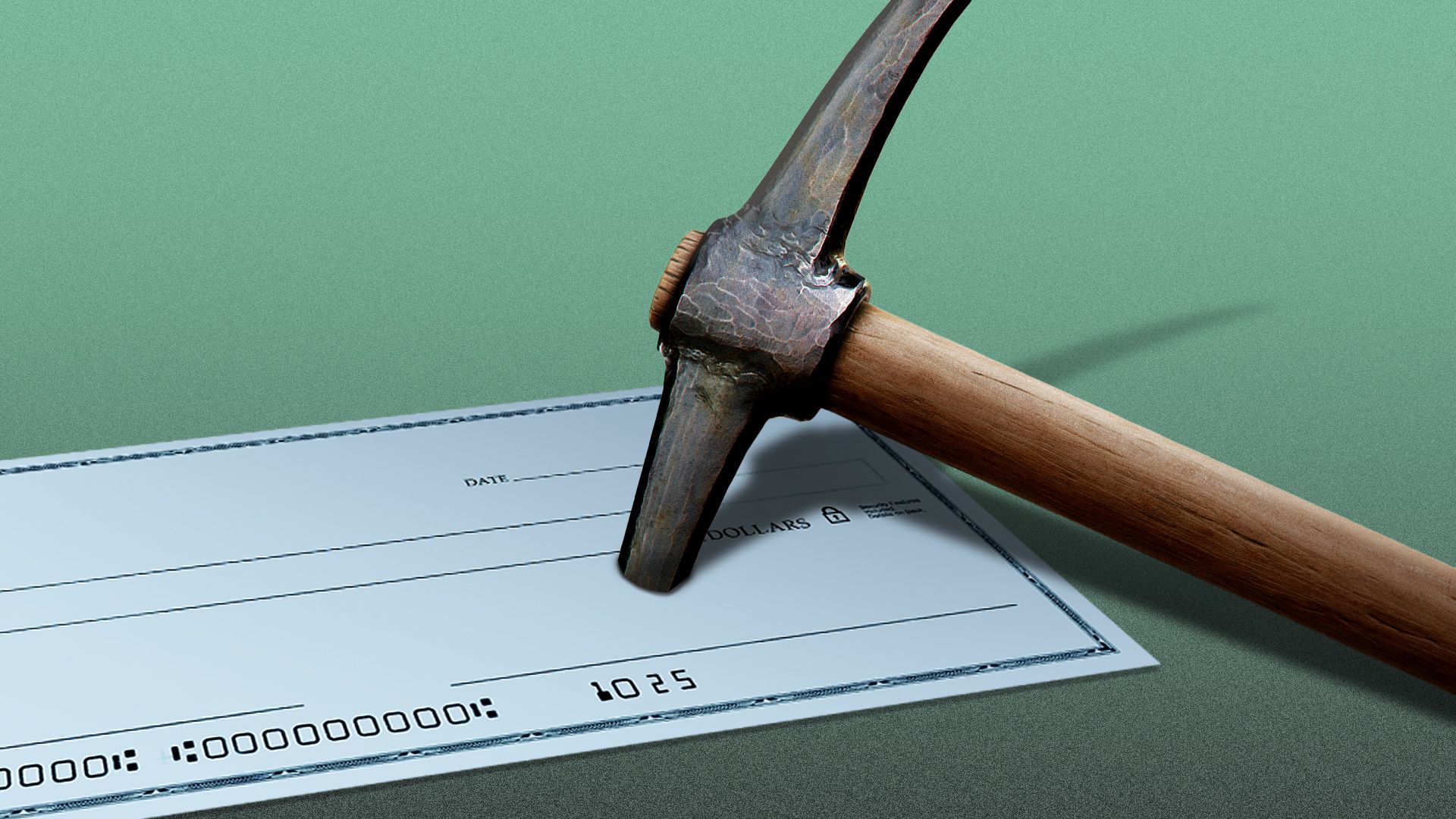
The Trump administration plans to provide USA Rare Earth with $1.6 billion in mostly loan financing to extract and process the materials and manufacture rare earth magnets.
- The agreement will provide the U.S. government a stake somewhere between 8% and 16%, depending on how the agreement is executed, a filing states.
Why it matters: Staking the Oklahoma-based firm is among the most aggressive Trump administration steps to ease China's stranglehold on supply chains for the materials needed in key defense and industrial applications.
- "This investment ensures our supply chains are resilient and no longer reliant on foreign nations," Commerce Secretary Howard Lutnick said in a statement.
Driving the news: The company has a letter of intent with the Commerce Department for $1.3 billion in loans and $277 million in direct funding under the 2022 CHIPS and Science Act, the announcement states.
- The agreements boost "U.S. national security and competitiveness by developing essential domestic supply of critical minerals, metals, and magnets currently unavailable outside China," it states.
- USA Rare Earth announced a separate $1.5 billion in private finance.
4. π€« How climate crept into Davos talks
You had to look hard for events on climate change and clean energy in Davos, but the topics permeated conversations about how to get more energy to power the AI boom.
Why it matters: The dynamic at the World Economic Forum reflected a kind of cognitive dissonance: The world's climate ambition has collapsed, but the clean energy transition is (still) more quietly persisting.
Where it stands: Organizers reportedly told President Trump they would nix coverage of "woke" topics, including climate change, to persuade him to attend.
- But official sessions still covered the topic, including under the theme: "How can we build prosperity within planetary boundaries?"
Some business leaders doubled down in defiance of Trump.
- "We are not senseless greenies. We are hard-edged business people with an understanding of the planet," said Andrew Forrest, founder and executive chairman of Australian mining giant Fortescue.
The intrigue: The impact of AI was mixed, though most attendees agreed that in the long run, it will help both in addressing climate change and innovating new technologies.
- "Near-term, it's a drag because of the consumption," said Hans Kobler, founder of venture capital firm Energy Impact Partners. "In the medium and long term, it will be positive."
Between the lines: Whatever the changes may be, Davos' value is the congregation of leaders from virtually every major part of our global economy. That helps everyone β including clean-energy companies.
What they're saying: "Davos has condensed two months of meetings into two days β and every one of them has been incredibly beneficial," said Andrew Ponec, co-founder and CEO of Antora Energy, which develops thermal batteries to provide zero-carbon heat and power for industry.
5. π’οΈ Petro-notes: Markets, Venezuela, offshore leasing
π΅ Crude prices jumped again late last week and into early trading after Trump said the U.S. is moving more forces toward Iran.
- Why it matters: His comment Thursday that "we have a big flotilla going in that direction, and we'll see what happens" comes after Trump had previously backed off threats to strike the regime.
- State of play: The U.S. benchmark WTI is at $60.66 this morning after falling below $60 again last week.
π»πͺChevron's Q4 earnings report Friday will get lots of attention, with analysts likely to ask about plans for near-term production increases in Venezuela.
- Why it matters: As the only U.S. producer currently operating there, it's among the few companies with capacity to boost output.
π Oil industry groups are urging Trump officials to hold firm on selling leases closer to Florida's Gulf shores.
- Why it matters: The Interior Department's draft leasing plan is drawing bipartisan pushback from Florida officials including Gov. Ron DeSantis (R).
- Catch up quick: The groups' appeal comes in newly filed comments on Interior's wider plan.
π±πΎ Via Reuters, Libya signed a 25-year oil development agreement on Saturday βwith TotalEnergies and ConocoPhillips, "involving more than $20 billion βin foreign-financed investment, Prime Minister Abdulhamid al-Dbeibah said."
6. π¬ Quote of the day: Oil culture shock edition
"The calibration of expectations will be hard ... The U.S. is a country in which taxes are low for the oil sector, in which property rights, mineral rights are private. [Venezuela] is such a different operating environment that I think they will have a little bit of a shock to understand how things work down there."β Francisco Monaldi, a Rice University oil scholar with deep knowledge of Venezuela's energy sector, speaking on the Oil Ground Up podcast
His comments about what U.S. companies can expect come as Wright plans to soon travel to Venezuela with executives.
- Wright has talked up opportunities for independents and "wildcatters."
- The wider interview is a lucid look at production potential β Monaldi's actually more optimistic than some analysts β and the wider landscape.
π¬ Did a friend send you this newsletter? Welcome, please sign up.
Sign up for Axios Future of Energy