Axios Future of Energy

September 02, 2026

๐งโ๐ณ Do we have an eclectic menu today? Yes chef! The first dish explores AI's evolving role in fighting wildfires, then we move on to...
- Analysis of the refined fuel crunch, Venezuela news, and LNG, all in 1,338 words, 5 minutes.
๐ Energy policy is a hotbed of complexity. "Simplify: Do 50% More with 50% Less," a new book by the Axios co-founders, shows how to delete what's clogging your life and work.
- Jim, Mike and Roy include lots of tips for making AI work for you rather than inflicting more bloat. Preorder "Simplify."
๐ป This week in 1984, the late, legendary Tina Turner ruled Billboard's Hot 100 with today's intro tune...
1 big thing: AI's growing role in wildfire response

AI is already helping detect and monitor wildfires. Now, researchers are exploring how it could help fire officials decide where to deploy crews across multiple fires.
Why it matters: Studies show climate change is contributing to longer, more intense wildfire seasons, forcing officials to make high-stakes decisions about how to prioritize limited resources. AI could help them process information to make those decisions faster.
State of play: Jason Fallon, the U.S. Wildland Fire Service's division chief for wildland fire intelligence, told Axios that AI is ingrained in many areas of wildfire management nationally, including monitoring, detection, information dissemination and data transfer.
- AI-powered cameras, satellite systems and weather-prediction tools are helping agencies in Western states detect wildfires and deploy crews sooner.
- For satellite data triage, AI can "help us quickly work through a workflow to separate noise from reality," Fallon said.
Zoom in: Lรฉonard Boussioux, an information systems professor at the University of Washington Foster School of Business, is part of a team researching how machine learning and optimization could assist fire officials in deciding where to send crews when multiple wildfires are burning.
- The approach predicts how multiple fires could evolve under different levels of suppression, then uses a mathematical model to recommend how crews could be deployed, according to a research paper that has yet to be peer reviewed.
By the numbers: Last year, 77,850 wildfires were recorded across the U.S. โ "noticeably higher than the five- and 10-year averages," according to the National Interagency Coordination Center.
- This year's wildfire season is surpassing the 10-year average for the number of fires and acres burned, according to the National Interagency Fire Center.
What they're saying: "What's hard to do is to predict which fire is going to blow up," Boussioux told Axios.
- "Which fire should we prioritize right now, knowing that we don't necessarily have [the] resources?"
- Boussioux's team is trying to anticipate how multiple fires could evolve simultaneously.
Reality check: AI's role is to augment firefighters, decision-makers and analysts โ not replace them, Fallon said. Fire officials remain "in control of directing the strategy and action," he said.
What's next: Researchers are developing more sophisticated tools for modeling complicated wildfire decisions, but their usefulness will depend on the quality and organization of the underlying data.
- "We already have technology to make things better, but we do not necessarily have data available, or it's not properly managed or organized," Boussioux said.
Amy Harder contributed reporting.
2. ๐ Catch up quick on oil: Prices, vibes, refining


๐ต Gasoline prices are almost certain to remain north of $4 per gallon over Labor Day weekend, with crude oil prices spiking again this week.
- Why it matters: It's the moment when political campaigns intensify. The chart above shows prices on Sept. 1 over the last decade.
- The latest: Oil prices jumped this week on fresh hostilities in the Strait of Hormuz, with Brent crude back around $95 per barrel.
- What's next: Prices on Labor Day are slated to be the highest on record, surpassing the 2012 mark, per market tracking firm GasBuddy.
๐ค That brings me to new analysis by San Francisco Fed researchers, who explored how gasoline price directions affect Americans' wider views about inflation.
- What they found: While rising pump costs bring expectations of higher inflation overall, it doesn't work the same way in reverse โ expectations of falling gas prices bring little change in peoples' inflation outlook.
- The big picture: The relationships are modest, but could be politically relevant even if gas prices are falling when people cast their ballots this fall.
- The bottom line: "Our results suggest that gasoline price pressures may leave a more persistent imprint on household inflation outlooks when prices climb than when they subside," it states.
๐ Let's turn to diesel markets in the throes of a worldwide crunch that's more acute than what's unfolding in oil markets more broadly.
- State of play: Scholars with Columbia's energy think tank have a lucid new primer on why, exactly, it has gotten so bad. Part of it is familiar โ Russian refining knocked offline by Ukrainian drones and damage to Middle East refineries, too.
- Yes, but: Other forces include shifts in where refining capacity is growing and shrinking, and the shrinking side of the ledger has included the U.S., Europe, and developed Asian nations outside China. Big releases from strategic crude reserves could not fix the problem.
- The bottom line: "The crisis rippling through fuel markets suggests refining capacity and petroleum product trade flows need to be treated as an energy security variable, not a downstream afterthought to crude oil availability."
3. ๐ต Chevron plans to double Venezuelan output

Chevron this morning said it's investing $7 billion in Venezuela over five years and hopes to double its production there.
Why it matters: It's the biggest post-Maduro move by an oil giant to lay the groundwork for a major output boost in Venezuela.
Context: The plan is separate from the Trump administration's unusual deal to gain control of 17 huge oilfields there (more on that below).
Driving the news: Chevron's agreement today with its joint venture partners provides "enhanced" commercial and legal terms to enable "durable" long-term investments, it said.
- The company plans to eventually produce 600,000 barrels per day from its Venezuelan operations, twice its 2026 output. AP has more.
- Overall, Venezuela produces roughly 1.2 million barrels per day, a far cry from the roughly 3.4 million in the late 1990s.
Reality check: Other U.S. oil giants' appetite to follow suit remains uncertain.
- Exxon and ConocoPhillips left the nationalized sector around two decades ago in a dispute with then-President Hugo Chรกvez's regime.
- But acting president Delcy Rodrรญguez, under pressure from Trump officials, has moved to make the oil sector friendlier to outside companies.
What we're watching: U.S. Energy Secretary Chris Wright said deals that companies are signing this week will bring more than a doubling of the country's production in the next few years, per Reuters.
4. ๐ข๏ธ U.S. officials defend deal with controversial Venezuelan oil baron

U.S. officials are defending their work with Venezuelan businessman Alejandro Betancourt in the unprecedented White House move to effectively gain control over huge oilfields in the country.
Why it matters: Betancourt is the colorful and controversial figure who heads North American Blue Energy Partners (NABEP), the oil company partnering with the administration in the agreement that gives the U.S. preferential access to output from 17 major fields.
- The Pentagon's Office of Strategic Capital is taking a 35% equity stake in the company.
Driving the news: At a briefing with reporters yesterday, a U.S. official talked up Betancourt as a "proven operator" in the country's oil sector that has been vetted by the administration.
- The official also bluntly acknowledged the realpolitik in the effort to boost output in the country, which has vast reserves but modest oil production after years of mismanagement and underinvestment.
"Geopolitics is often not the choice between the ideal and the imperfect. It is often, you're trying to navigate what's the best outcome, and you have to work with the factors that you have in place," the official said.
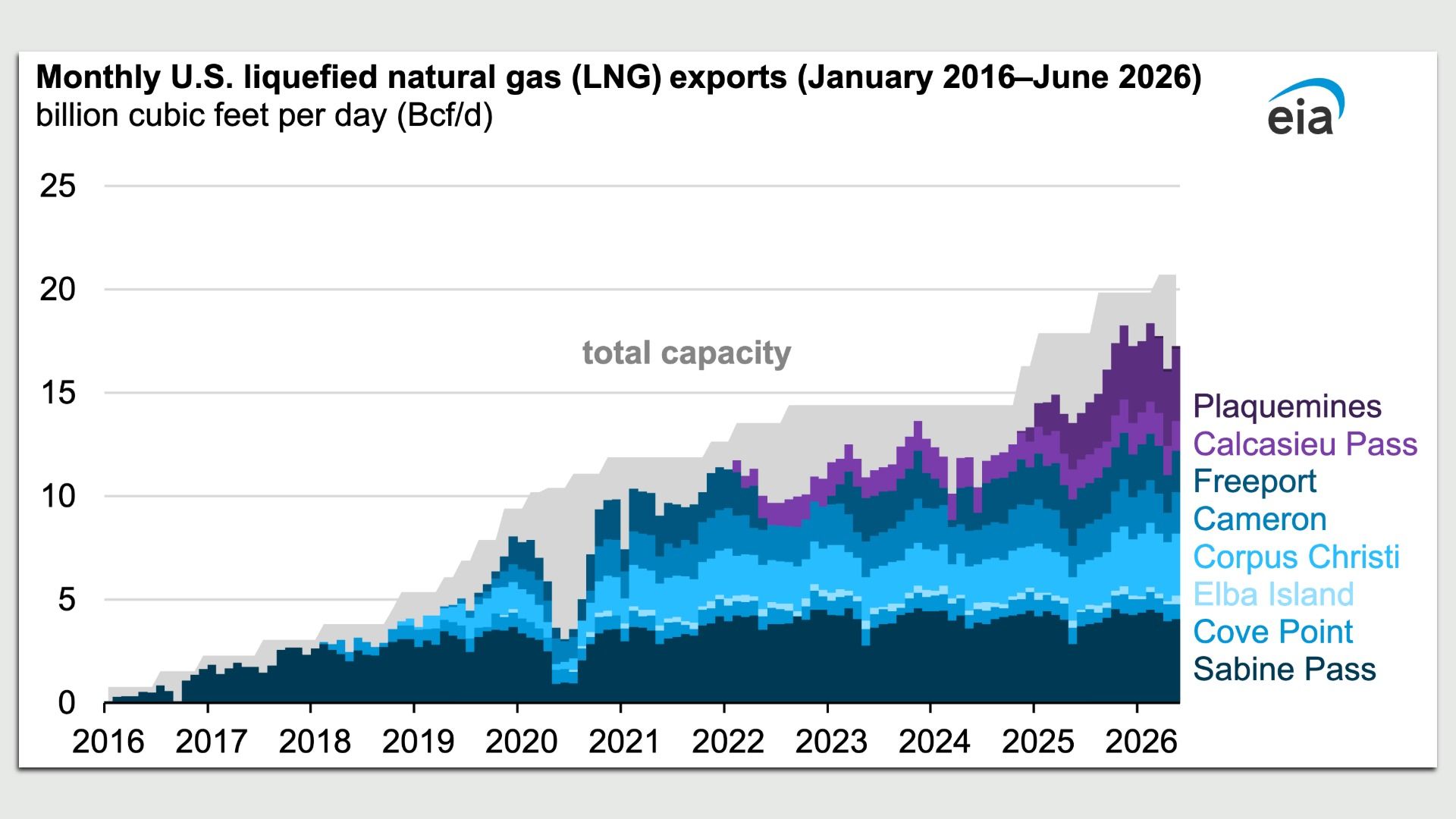
5. ๐งฎ Number of the day: 23% higher
That's the rise in U.S. liquefied natural gas exports in the first half of 2026 compared to the same stretch in 2025, per the U.S. Energy Information Administration.
- Exports from already world-highest levels rose at their fastest rate since major shipments began in 2016, the result of new or expanding terminals.
๐ Thanks to Mackenzie Weinger, David Nather and Chris Speckhard for editing and to our brilliant Axios visuals team.
๐ซ Did a friend send you this newsletter? Welcome, please sign up.
Sign up for Axios Future of Energy