Axios Future of Energy

March 18, 2026

🐪 Halfway. We're getting over the hump with newsy items on...
- The fallout from diesel's rise and more Iran notes
- A tech finance exclusive
- New investment data, lots of policy updates, a revealing EV stat and more, all in 1,276 words, 5 minutes
🚨 Situational awareness: The Israeli Air Force struck a natural gas processing facility in southwestern Iran, two senior Israeli officials said.
- It's the first time Israel has struck Iran's natural gas facilities, which are key to the country's economy. Full story
🎸 This week in 1978, REO Speedwagon dropped the album "You Can Tune a Piano, but You Can't Tuna Fish," which provides today's intro tune...
1 big thing: The diesel price surge will hit clean tech players


Clean energy companies will feel the pinch as diesel prices at four-year highs create new inflationary pressures across the U.S. economy.
Why it matters: Truck transport is vital for goods used by companies of all stripes, and diesel increases also boost costs of operating heavy equipment at construction sites, mining projects and beyond.
State of play: Diesel prices now average above $5 per gallon, per AAA and Energy Department data.
What they're saying: "The $5 a gallon mark is going to push up the prices of all energy projects in the U.S. at this point," Wood Mackenzie supply chain analyst Benjamin Boucher said, citing higher trucking rates.
- Fuel costs borne by freight and construction firms will start rippling outward.
- "They're going to pass down the operating costs down to the consumers, which in this case will likely be the people developing the renewable projects, or even traditional generation projects," he told Axios.
Friction point: There are multiple pain points.
- With some projects relying heavily on imported goods, higher marine fuel and jet fuel prices will also filter down. That includes solar and battery storage projects, Boucher said.
- But nobody is immune. Think, for instance, of drilling rigs that run on diesel power.
What we're watching: This is speculative for now, but whether the higher costs could cause delays — or even cancellations — of projects that are early in the planning stages.
- That will depend on how much further diesel goes up and the duration of the spike, Boucher said, adding that a six-month stretch could be consequential.
Threat level: The Iran war is squeezing renewables projects in other ways, too, even if it helps bolster the long-term energy security case for homegrown electrons.
- The throttling of transit through the Strait of Hormuz is affecting supplies of aluminum used in solar modules, Heatmap reports.
Zoom out: Analysts are also starting to weigh the economy-wide effects of diesel costs.
- At $5 per gallon, farming, trucking and construction companies will together spend $6.1 billion on the fuel this week, per estimates from the research firm BloombergNEF.
- The same amount of fuel would have cost just $4.5 billion ahead of the war, a 35% increase, its analysis states.
What's next: Higher diesel will shape the pricing decisions companies make in the weeks ahead — especially for heavy, bulky and inexpensive goods for which transportation is a large share of their total cost.
- That means that higher diesel prices could thus drive core inflation measures higher, not just the headline measures that include the direct cost of higher energy.
2. 🚨 Exclusive: Cleaner concrete startup nabs $15M
Cocoon Carbon, a startup developing climate-friendly building materials, just closed a $15 million Series A round to support a large planned U.S. demo plant.
Why it matters: Cement used in concrete is a huge CO2 source. Cocoon sees a growing market for its substitutes — even as tackling climate change has lost clout in boardrooms and governments.
- "Unlike other emerging alternatives to cement, Cocoon's product is cost competitive and doesn't demand a prohibitive 'green premium' that has historically limited uptake of new solutions in the market," the announcement states.
Driving the news: 2150 and Brick & Mortar Ventures led the round, which included TVC and existing backers Wireframe Ventures, Celsius Industries, Gigascale Capital, and SOSV.
The big picture: Cocoon's tech uses abundant byproducts from electric arc furnace steel mills, turning this "slag" into its product with a system "retrofitted directly into existing waste handling processes."
- It cuts the "embodied" CO2 of concrete by 40%, Cocoon said.
- And it sees an opening, noting that "supplementary cementitious materials" (SCM) to enhance durability and strength have long come from coal plants and iron blast furnaces that are increasingly shutting down.
3. 👟 Catch up quick on Iran: Markets, coal, politics

⛽ Average U.S. regular gasoline prices are up to $3.84 per gallon, per AAA tracking, compared to roughly $3 before the Iran war began.
🏭 Via Reuters, "Asian utilities are boosting coal-fired power generation to cut costs and safeguard energy supply" as the war stymies LNG supply and raises prices.
🇻🇪 Trump officials are planning new steps to enable companies to invest in boosting Venezuela's output, per Bloomberg, which reports that the Iran war is adding urgency.
😳 The SPR exchange could bring the U.S. stockpile to its lowest levels since 1982 before refilling efforts start taking effect, RBN Energy explains in a blog post.
🗳️ ICYMI: An open letter from Sen. Ruben Gallego, a potential Democratic White House hopeful, to DOE signals how the Iran war's energy fallout is flowing into U.S. politics.
4. 💵 Clean energy records — and warning signs
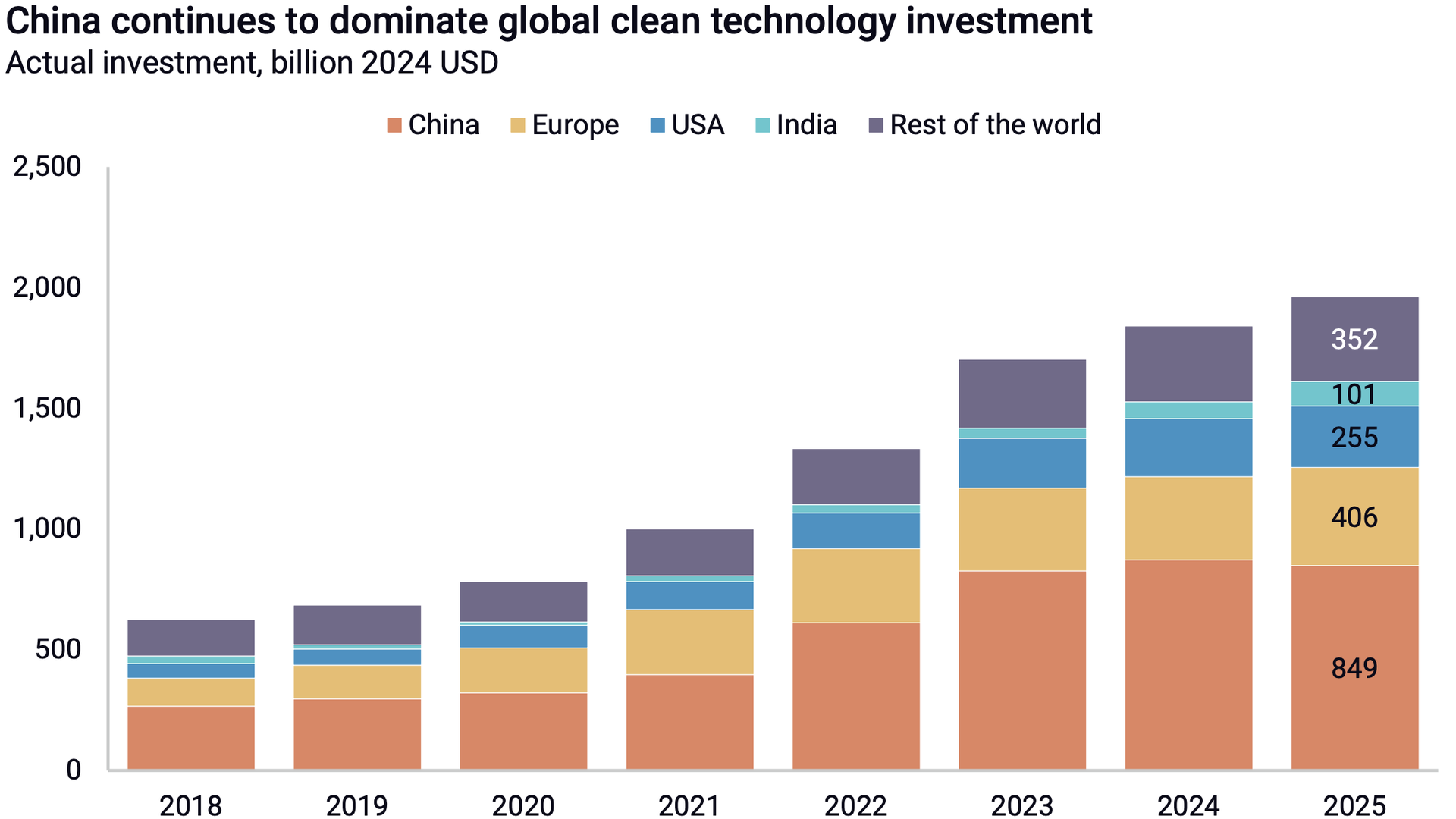
Global clean energy investment hit a new record last year — but growth is slowing and manufacturing outlays fell for the second straight year, new data shows.
Why it matters: "After a decade of rapidly rising investment in clean technology, the global picture has become significantly more complicated," the report from Rhodium Group and MIT researchers finds.
What's next: Take note, wonks! The joint Rhodium-MIT investment tracking project has gone global, expanding from its U.S. focus.
- It's a useful, wide-angle window on both manufacturing and uptake (deployment) of technologies by consumers and industries.
- Full analysis.
🛢️ And speaking of finance, Bloomberg reports on new BloombergNEF research.
- "The world's largest oil and gas companies ratcheted back investment in the energy transition in 2025, marking the first annual decline in eight years," it reports.
5. 🏃 Catch up quick on policy: Nukes, offshore wind, Congress

⚛️ NRC approval: Advanced nuclear company Oklo obtained a Nuclear Regulatory Commission license — its first — for its subsidiary Atomic Alchemy to handle, process, and distribute isotopes.
- Why it matters: Oklo is among the companies developing offshoot products stemming from scientific innovations — such as ingredients in cancer-treating drugs — to fund their primary businesses.
👀 Deal winds blow: Via the New York Times, TotalEnergies is negotiating with Trump officials on a settlement that would see the energy giant receive a roughly $1 billion while terminating offshore wind leases.
- What they're saying: This deal and potentially others could "re-raise concerns about the durability of federal approvals and therefore further erode, but not eliminate, the thin opportunity for bipartisan permitting reform on Capitol Hill," ClearView Energy Partners said in a note.
⚡ Grid woes: January's winter storm slamming much of the U.S. should serve as a wake-up call for maintaining the electricity grid, energy executives told a House Energy and Commerce panel yesterday.
- Why it matters: The "near-miss event" drove grid operators "to go to more and more extreme measures" of providing power, said Jim Robb, the North American Electric Reliability Corporation's president and CEO.
- The big picture: Lawmakers noted that coal-fired electricity generation surged from the week before the storm, outpacing wind and solar.
6. 🚘 Number of the day: +29%
That's February's year-over-year rise in used EV sales, per new Cox Automotive U.S. data.
Why it matters: While new sales have dropped sharply, EVs' mainstreaming in recent years means lots more used supply — and lower prices.
- Used EVs' average listing prices was $34,821 in February, down 8.5% year-over-year and 1.9% lower than January.
Disclosure: Cox Automotive, like Axios, is owned by Cox Enterprises.
🙏 Thanks to Chuck McCutcheon and Chris Speckhard for edits to today's newsletter, along with the brilliant Axios Visuals team.
📫 Did a friend send you this newsletter? Welcome, please sign up.
Sign up for Axios Future of Energy