Why the Iran crisis is a mixed bag for clean energy

Add Axios as your preferred source to
see more of our stories on Google.
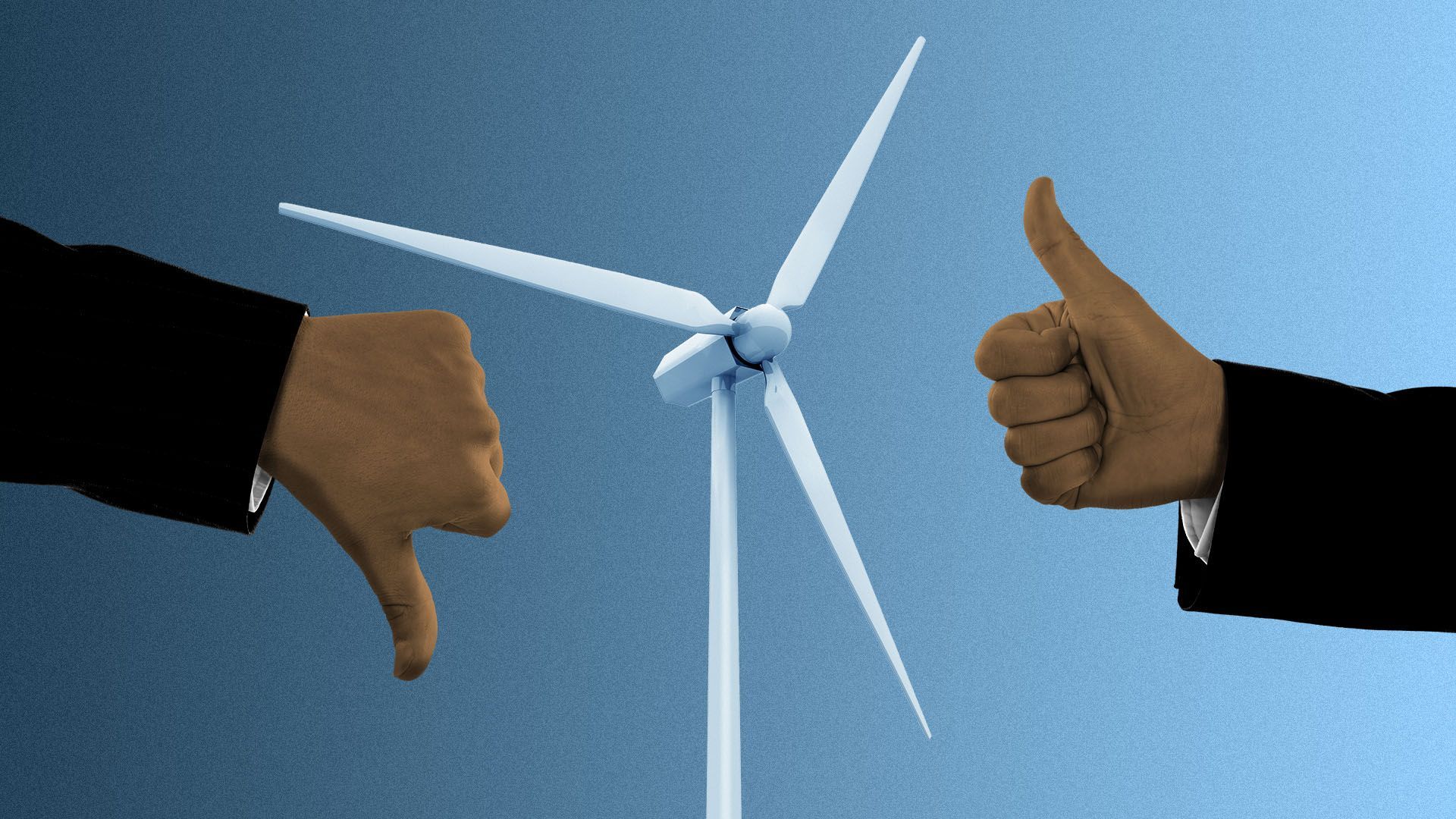
Illustration: Sarah Grillo/Axios
In theory, an emergency that's blocking petro-flows and spiking prices should boost the case for clean energy. But in practice, it's way more complicated.
Why it matters: The Iran war is the biggest energy crisis since Russia's 2022 invasion of Ukraine, if not longer.
- Various analysts and advocates say it could — or at least should — prompt governments and investors to prioritize fuels that don't have to move across oceans.
- The upheaval "highlights how energy security and energy transition go hand in hand," Raymond James Investment Strategy Analyst Pavel Molchanov said in a note.
The big picture: "Solar, wind, and nuclear are children of the 1970s oil shocks — with growth driven by security, not environmentalism," the Carlyle Group's Jeff Currie and Admiral James Stavridis, the former NATO commander, write in a new post.
- Today's impediments reflect the risks Currie covered in his buzzy March 2025 paper, The New Joule Order.
- It said rising geopolitical, financial and trade risks support homegrown electrons. "If trade is under threat, then so are fossil fuels," Currie argues.
What we're watching: By how much — and for how long — the conflict pushes up global oil and regional natural gas prices.
- Molchanov, the Raymond James analyst, writes that if oil prices stay high for a "prolonged period," higher gasoline prices could boost U.S. EV demand.
- He also notes that the EU's renewable electricity use grew a lot after the attack on Ukraine brought a sharp reduction in Russian natural gas supplies to the bloc.
- ClearView Energy Partners said in a note that it "would not yet rule out a scenario in which the Trump administration pivots to some clean energy as a pragmatic response to price increases."
Reality check: There are crosscurrents to spare.
- For one thing, higher energy prices could also boost inflation and bring higher interest rates, which makes clean energy deployment more expensive by raising borrowing costs, a nice Bloomberg look at the topic points out.
- And in China, already by far the world's biggest coal producer and user, the fuel can be a buffer against gas import disruption, it adds.
- Neither the S&P Global Clean Energy Transition Index nor the iShares Global Clean Energy ETF — two major ways to track low-carbon energy stocks — have gotten a lift since the military strikes, Heatmap notes.
Zoom out: Another crosscurrent is that supply interruptions from one area can provide a lift to fossil fuels from elsewhere.
- U.S. liquefied natural gas and crude exports to Europe shot up after Russia's invasion — along the way underscoring how the domestic oil and gas boom provides geopolitical and financial leverage.
- Huge domestic oil and gas supplies are one reason why the U.S. faces relatively less jeopardy right now than many other countries.
- And the Ukraine crisis arguably helped push climate change lower on the global agenda.
The bottom line: "While I agree that oil price spikes could revive interest in renewables, I'll say it again: high prices tend to usher out incumbent politicians faster than they usher in new technologies," ClearView's Kevin Book posted on X.
