Axios Future of Energy

February 24, 2026

💪 The state of our newsletter is strong ahead of tonight's State of the Union speech. We've got news and analysis on...
- Data center delays, politics and investments
- The next SCOTUS climate case
- A contrarian oil supply take, lots o' policy updates and more, all in 1,411 words, 5.5 minutes
🧑⚖️ Situational awareness: This morning, appellate judges will hear climate nonprofits' case against EPA killing of billions of dollars in Biden-era grants. Audio link ... NYT preview
🎸 This week in 1989, pop craftsmen XTC released the album "Oranges & Lemons," which provides today's intro tune...
1 big thing: Global AI data center boom hits delays
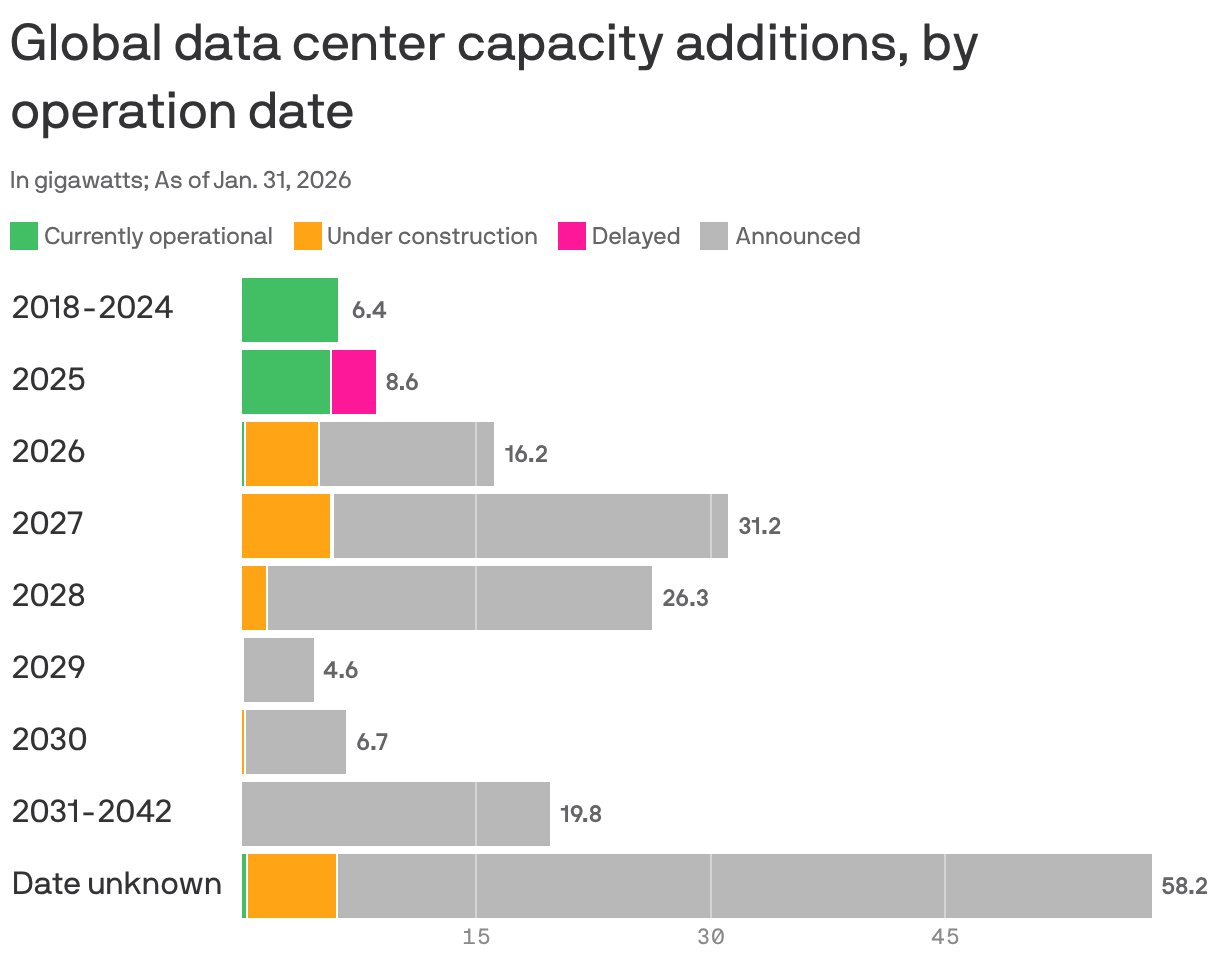
As many as half of the world's data center projects slated to come online this year could face delays, a report issued today finds.
Why it matters: It's a sign of mounting collisions in the AI race — from power constraints and grid equipment shortages to rising community opposition.
The big picture: As tech giants sprint to build AI infrastructure, the physical — and political — limits of the power system are starting to bite.
State of play: Up to 11 gigawatts of 2026 capacity "remains in the announced stage with no signs of construction," per the report by Sightline Climate, a data intelligence firm.
- With typical build times of 12 to 18 months, that capacity could still come online — but only with dramatic acceleration, the report states.
Yes, but: Development is still surging despite growing hurdles. Data center additions hit a record in 2025, and 2026 is on track to surpass it, Olivia Wang, a Sightline research analyst, told Axios.
By the numbers: Nearly six gigawatts came online last year, and five gigawatts are already under construction this year. (One gigawatt can power about 1 million U.S. homes.)
- "While power continues to be a constraint, developers that locked in power and equipment contracts early are rapidly bringing capacity online," the report says.
Driving the news: With midterm elections heating up, communities are growing restless over rising power prices — which many blame on data centers that increasingly require city-scale electricity.
Zoom in: Sightline has tracked more than 10 new moratorium proposals in the past month alone in U.S. states.
- This includes New York, Michigan, Virginia and Oklahoma, Wang says.
- "We expect this trend to continue and meaningfully increase the risk of projects being delayed, withdrawn, and ultimately canceled," Wang wrote.
- The firm is tracking nine canceled projects in its database, so for now, most are facing delays, not outright cancellations.
Flashback: More than one-quarter of the 110 data center projects that were slated to come online last year were delayed.
What we're watching: Whether high-profile cancellations rise along with the wave of moratorium efforts.
2. 🗳️Top '28 Dems retreat on AI amid energy price rise

The AI backpedaling has begun: 2028 Democratic contenders who bet big on data centers are suddenly retreating amid a growing voter revolt.
Why it matters: The politics of AI are evolving almost as rapidly as the technology.
Flashback: Just a few months ago, potential 2028 presidential candidates — including Illinois Gov. JB Pritzker, Pennsylvania Gov. Josh Shapiro and Maryland Gov. Wes Moore — were bending over backward to lure data centers, with offers of lavish tax breaks and other goodies.
- The projects seemed like no-brainers to many pols: They promised jobs, made building trade unions happy, took on China and pleased Silicon Valley execs.
Yes, but: Now those Democrats are abruptly retreating — and vowing to protect voters from the consequences of the AI revolution.
3. 🤔 The endangerment wrinkle in the new SCOTUS climate case
Look for EPA's endangerment finding repeal to surface in a new Supreme Court case about climate claims against Big Oil in state courts.
Why it matters: Many local and state governments have sued oil giants in recent years seeking damages for climate harms, with many cases still pending.
Catch up quick: Yesterday SCOTUS agreed to hear oil companies' petition to decide whether federal law precludes state-law claims for alleged injuries from greenhouse gas emissions.
- It will also explore whether the high court has jurisdiction over the matter.
What we're watching: How removing the endangerment finding — a legal pillar of federal climate rules — could complicate industry preemption claims.
- "It clearly weakens the defense, but there will be a lot of argumentation about whether it eliminates it," Michael Gerrard, who heads Columbia's Sabin Center for Climate Change Law, told Axios.
Yes, but: Look for opponents of the state cases, including major business groups, to argue the endangerment repeal doesn't erode federal preemption.
- "[A] federal decision not to regulate is not an authorization for States to impose their own regulation," the U.S. Chamber of Commerce said in a brief urging SCOTUS to take the case.
- And George Mason University law professor Donald Kochan tells E&E News that questions of federal preemption aren't affected by "ever shifting" agency decisions.
What we're watching: ClearView Energy Partners, in a note, cautions that SCOTUS could "focus on jurisdictional issues to resolve this case rather than on the merits of the energy companies' federal preemption claims."
4. 🧁 Bonus policy notes: Coal, NEPA, seabed mining
🏭 The amount of coal-fired power generation slated to retire this year is getting hard to pin down as DOE forces some plants to keep running.
- The big picture: "Last year, owners and operators planned to retire 12.3 GW of capacity but only retired 4.6 GW, the least since 2008, following emergency orders...to extend the operations of several coal-fired plants," an EIA primer notes.
- What we're watching: Beyond the emergency orders, whether various other Trump team policies — like having the military enter into power purchase agreements — also delay retirements.
🏁 The Interior Department finalized rules aimed at speeding up project reviews under the National Environmental Policy Act.
- Why it matters: NEPA has been used as a "weapon to block American energy, infrastructure, and conservation projects," Interior Secretary Doug Burgum said in a statement.
- The other side: Environmentalists say NEPA changes at Interior and other agencies prevent "informed, equitable decisions."
🌊 Interior's ocean energy branch floated rules to "eliminate outdated and unnecessary regulations" governing potential seabed mining projects in U.S. coastal waters.
- Why it matters: Trump officials are keen to enable emerging plans — in U.S. and international seas — to harvest polymetallic nodules containing nickel, cobalt, copper and other resources.
- The big picture: "America cannot afford to sit on the sidelines while the world races to secure critical mineral supply chains," Matt Giacona, acting head of the Bureau of Ocean Energy Management, said alongside the draft plan.
- The other side: "This dangerous proposal would harm fragile deep-sea animals and make it harder for states to fight back," Emily Jeffers, an attorney with the Center for Biological Diversity, said in a statement.
5. 🏃 Catch up quick on oil: Markets and sanctions
👀 Markets will watch President Trump's State of the Union address tonight for signs on what's next with Iran.
- Why it matters: Oil prices are at their highest levels since July amid risks of a military conflict that could affect regional supplies. Brent is trading above $71 per barrel this morning.
🤔 Is the global supply glut narrative overhyped? One top shale CEO says yes in his latest quarterly letter to shareholders.
- State of play: "The wave of oversupply that has been widely telegraphed for the better part of the last two years continues to get pushed to the right — at some point the market will slowly begin to find reasons to be less bearish as demand is strong and the global economy is growing," writes Diamondback Energy's Kaes Van't Hof.
💵 Russian revenues from crude oil sales fell 18% last year to roughly $101 billion, and volumes declined by 6%, per new analysis from the Centre for Research on Energy and Clean Air.
- Why it matters: The report tallies the limited impact of Western efforts to throttle the Kremlin's ability to keep attacking Ukraine since the invasion four years ago.
- The big picture: "Export volumes continued to remain 6% above pre-invasion levels, highlighting how G7+ sanctions on the 'shadow' fleet have failed to cut supplies, even while forcing deeper price discounts on their oil sales," it states.
🇬🇾Exxon said it's investing $100 million in STEM education in Guyana, where it's producing from a massive offshore oilfield.
6. 🧮 Number of the day: $12 billion
That's how much Amazon plans to invest in Louisiana to build new data center campuses.
Why it matters: It'll be an on-the-ground test of Big Tech vows to pay the check for energy services that power-thirsty AI infrastructure requires.
- Amazon said it's working with Southwestern Electric Power Company "to ensure we pay 100% of the costs associated with our new data center campus in Louisiana."
🙏 Thanks to Chuck McCutcheon and Chris Speckhard for edits to today's newsletter, along with the brilliant Axios Visuals team.
📬 Did a friend send you this newsletter? Welcome, please sign up.
Sign up for Axios Future of Energy