Axios Future of Energy

February 23, 2026

π· Welcome back! We're sledding into the week with items on...
- Fallout from the big tariff ruling
- A data center finance exclusive
- Policy news, storage trends and more, all in 1,396 words, 5.5 minutes
β‘οΈJoin us Wednesday at 6pm ET in D.C. for a reception on the evolving U.S. landscape with Natural Allies for a Clean Energy Future's Terry McAuliffe and acting Under Secretary of Energy Alex Fitzsimmons. RSVP here.
π§ Exactly 45 years ago, The Gap Band was No. 1 on Billboard's R&B charts with a funk gem that's today's intro tune...
1 big thing: What to watch after the tariff earthquake

The Supreme Court took gold in "policy and business news cycle domination," so let's weigh the fallout of Friday's decision thwarting key White House tariffs.
Why it matters: President Trump has aggressively used tariffs β real and threatened β to gain economic and geopolitical leverage.
- Multiple trade deals have featured pledges from partners to buy U.S. oil and gas.
- Trump has also threatened tariffs to pressure other countries not to buy Russian or Iranian oil.
Catch up quick: The high court on Friday ruled that the president lacks legal authority to impose tariffs under the International Emergency Economic Powers Act (IEEPA).
A few takeaways from the sprawling and evolving tariff landscape...
π’οΈ There's limited fallout for oil and gas. Steel tariffs under Section 232 of the Trade Expansion Act, which raise drilling costs, remain in effect.
- However, the broad new 15% global tariffs under the Trade Act of 1974, which the White House announced Friday, will exempt energy.
- And more broadly, major business and industry groups oppose tariffs in general.
π Watch Capitol Hill. The ruling "could increase momentum for Republicans to pursue legislative tariff-setting measures," ClearView Energy Partners said in a note.
- One bill to watch: bipartisan legislation sponsored by Sens. Lindsey Graham (R-S.C.) and Richard Blumenthal (D-Conn.) that would impose sweeping U.S. trade penalties on countries that buy Russian oil and gas.
- In the more distant future, who knows, maybe there's new mojo for setting carbon border tariffs. GOP Sen. Bill Cassidy (R-La.) said on X that his bill "levels the playing field" after the SCOTUS ruling.
π It's a mixed bag for low-carbon tech. A lot depends on Trump's vow to expand the use of non-IEEPA powers. And already, multiple Asian nations have tariffs or anti-dumping duties on solar equipment.
- Still, the research firm BloombergNEF sees "potential short-term winners among clean-tech exporters."
- "South Korean and Japanese battery makers see modest tariff relief and have the scope to export, given surplus operational manufacturing capacity relative to local demand," Bloomberg NEF's primer on the ruling states.
- Solar products from India, Indonesia and Turkey also face lower barriers, it states, while TD Cowen analysts, in a note, also point out that solar equipment from Southeast Asia faces lower "reciprocal" tariffs.
π‘οΈ The decision dulls Trump's energy weapon. "This absolutely will limit Trump's ability to wield tariffs for geopolitical pressure," said Trevor Sutton, a trade researcher with Columbia University's Center on Global Energy Policy.
- Trump can still use tariffs coercively, but the "scope and timeline of that coercion" is now more bounded, he said in an email.
What we're watching: How IEEPA potential rebates might work.
2. π¨ Scoop: Nvidia-backed Emerald AI raising $25M

Emerald AI, which develops software to curb data-center energy demand, is raising $25 million in seed extension funding, two sources familiar with the offer tell Axios Pro.
Why it matters: Nvidia started deploying Emerald's tech last fall.
Zoom in: Energy Impact Partners is among the lead investors through its Frontier Fund, with Shayle Kann as lead partner.
- The valuation of the "opportunistic" round is roughly $250 million post-money valuation, the sources say.
- Emerald AI and EIP declined to comment.
How it works: Emerald AI's software adjusts data centers' electricity consumption to ease grid strain, shorten grid-connection waits, and avoid higher prices during peak demand.
Follow the money: The current fundraising round is at least the third raise for Emerald AI, which has raised about $42.5 million to date.
- The D.C.-based startup emerged from stealth last summer with $24.5 million in seed funding from backers including Nvidia, former climate envoy John Kerry, Kleiner Perkins chair John Doerr, Google chief scientist Jeff Dean, and AI scientist Fei-Fei Li.
- Then it closed another $18 million in extension funding in October, led by Radical Ventures and Lowercarbon Capital.
Talk to our sales team about Axios Pro Deals for a steady diet of exclusives and smart analysis.
3. π Catch up quick on policy: Venezuela, EPA, Congress
π’οΈ Trend to watch: U.S.-based firms Salamander Solutions and EthosEnergy have both registered outside lobbyists for Venezuela-focused work.
- Why it matters: Look for more K Street business as Trump officials work to open Venezuela's energy sector to more outside investment and contracts.
- Driving the news: Salamander, which makes heater cables for the oil and gas industry, retained Brownstein Hyatt Farber Schreck for work on "issues related to oil developments and production in Venezuela," a filing shows.
- State of play: EthosEnergy, which repairs and overhauls gas turbines and other energy equipment, brought on Diroma Eck & Co. for work on sanctions-related topics.
- Of note: It's likely that not all Venezuela-related work β via new or existing lobbying relationships β will show up in the mountains of regular corporate filings. Some of these filings are more granular than others.
π ICYMI: EPA repealed a 2024 rule that tightened mercury and air toxics emissions requirements for coal-fired power plants, calling 2012 standards sufficiently protective. Green groups strongly disagree and will sue.
- What we're watching: Whether Trump 2.0's constellation of pro-coal policies will meaningfully prolong coal's role in the power mix (it's now down to about 16%), even as new projects remain unlikely.
- Go deeper: S&P Global coverage...EPA documents.
πHouse Republicans opened a probe into six environmental groups' work against ConocoPhillips' Willow oil project in Alaska's Arctic, demanding all kinds of private communications.
- Friction point: Senior members of the Natural Resources Committee allege "ethically dubious" legal tactics by the groups and "disdain for established essential multiple use principles."
- The other side: The Center for Biological Diversity said the inquiry "fails to identify or even allege a single illegal action" and is "abusive weaponization of government" against political opponents. Go deeper.
π¨ A coalition of business groups led by the U.S. Chamber is trying to break a deadlock in the Senate over a permitting overhaul, urging all senators in a new letter to pass it this year.
4. π΅ Energy deal exclusives you may have missed

βοΈ Metafuels, a Swiss sustainable aviation fuel startup, has raised $24 million in Series A funding to get closer to commercializing its methanol-based jet fuel. Go deeper
π Zero Homes, a home upgrade marketplace startup, raised a $16.8 million Series A for product development and expansion. Its app combines photos with utility data and AI to create a digital twin of the home's interior. Go deeper
π·πΌββοΈ Fyld, a U.K. startup that makes software to manage frontline workers, closed a $41 million Series B. Infrastructure companies on energy and other matters are increasingly adopting digital tools and AI to make operations safer and more efficient. Go deeper
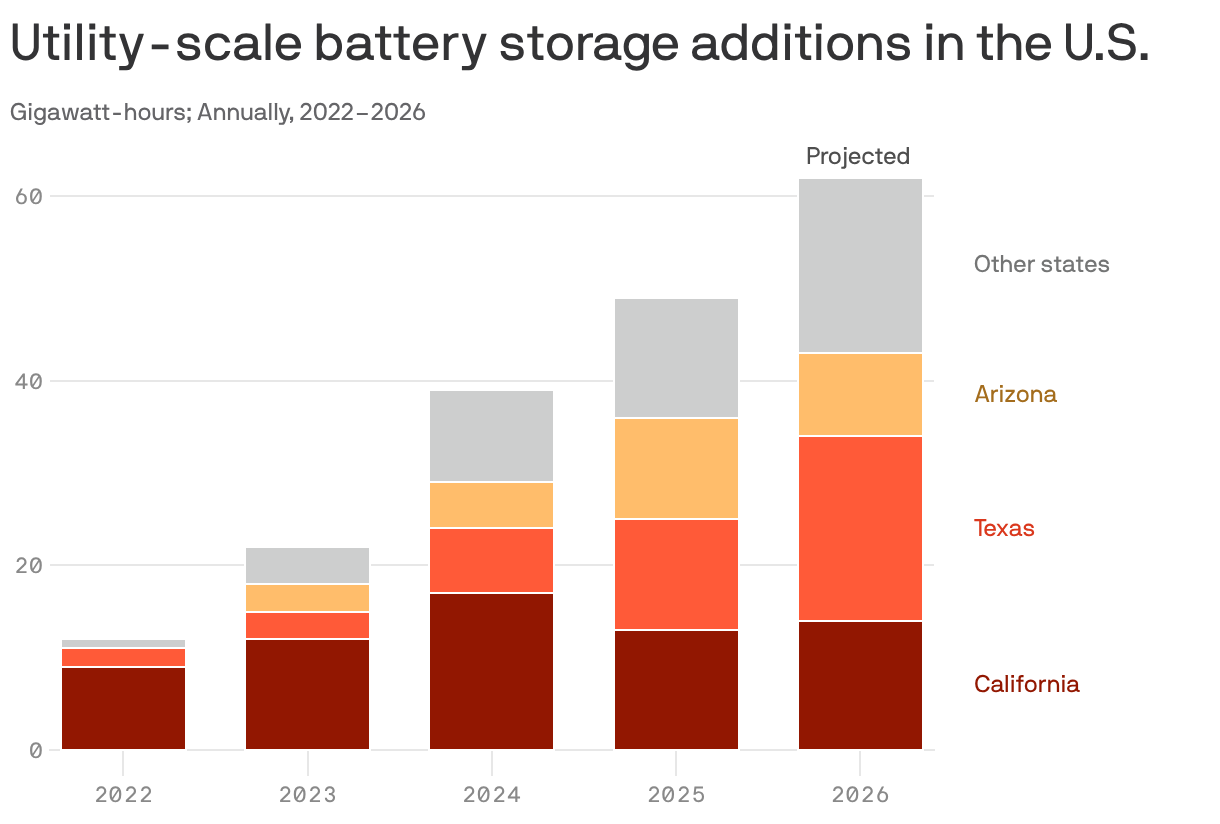
5. π Charted: Rising battery deployments

U.S. battery storage installations rose 29% last year, driven by strong utility-scale growth in Arizona and Texas, per new data from the Solar Energy Industries Association and Benchmark Mineral Intelligence.
Why it matters: Storage is a flexible resource that helps meet demand peaks and enables higher levels of renewables on grids.
The intrigue: While utility-scale storage is by far the biggest market right now, behind-the-meter (BTM) installations generating or storing electricity for on-site use are growing too β and data centers are increasingly a reason.
- "Given the tightening of grid capacity and short supply of gas turbines, developers will be forced to consider other forms of on-site generation that can help facilitate projects coming online," the report finds.
What's next: Benchmark estimates that by 2030, data centers will account for 83% of commercial and industrial BTM deployments.
6. π’οΈ Number of the day: Roughly 80%
That's the amount of Russian oil and petro-products moved via "shadow fleet" vessels used to avoid sanctions and seizures, per this masterful, graphics-rich WSJ deep dive on the topic.
Why it matters: Despite tougher Western measures, it's still a cat-and-mouse game.
- "[A]s the number of tankers carrying Russian, Iranian and Venezuelan oil has expanded over the past four years, the methods used to disguise their routes, identities and cargo have become more elaborate β making shutting down the network completely a gargantuan task," the paper reports.
π Thanks to Chuck McCutcheon and Chris Speckhard for edits to today's newsletter, along with the brilliant Axios Visuals team.
π¬ Did a friend send you this newsletter? Welcome, please sign up.
Sign up for Axios Future of Energy