Axios Future of Energy

January 14, 2026

πͺ Halfway! We're getting over the hump with a newsy 1,435 words, 5.5 minutes.
π Thanks to Chuck McCutcheon and Chris Speckhard for edits to today's newsletter, along with the brilliant Axios Visuals team.
πΆ Happy birthday to rap pioneer LL Cool J, who has today's intro tune...
1 big thing: What's ahead for U.S. oil and power in 2027 (really!)
The Energy Department's stats and analysis arm just dropped its first look-ahead to 2027.
Why it matters: Sure, these estimates are written in faint pencil, but they're a useful and closely watched snapshot of federal analysts' current thinking.
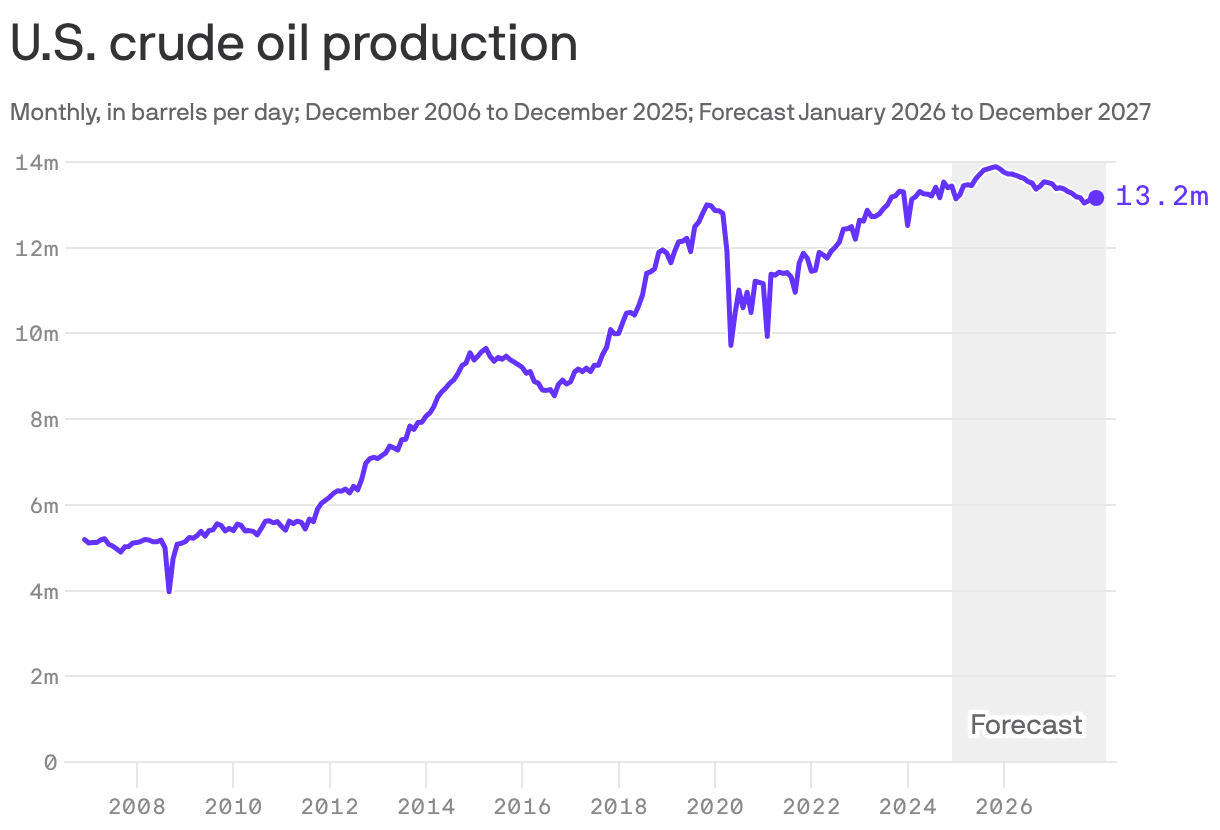
The big picture: EIA forecasts a slight decline in U.S. oil production in 2027, with this year's levels basically flat compared to 2025.
- "With sustained lower crude oil prices, we expect crude oil production will decrease as the slowdown in drilling activity will outpace increases in drilling productivity," it states.
Quick take: It's the latest sign that low prices (which the White House covets) are now working against a drilling surge (which the White House also covets).
- EIA projects that prices will remain quite modest this year and next.
- The latest outlook sees Brent crude oil averaging $56-per-barrel this year and a tad lower in 2027.
- It forecasts average gasoline prices under $3 per gallon this year and next.
The intrigue: The situation in Venezuela is a "key uncertainty." The analysis assumes sanctions remain in place.
- But if they're relaxed β which Trump officials seem to be planning β it could bring higher production and hence even lower oil prices.
What we're watching: On the electricity side, EIA projects U.S. consumption rising 1% this year and then jumping 3% in 2027, with β you guessed it β data centers adding upward pressure.
- Power prices are slated to rise again alongside demand, though the amount depends on whether we're talking about residential, commercial or industrial customers.
- The agency sees residential prices rising roughly almost 4% this year and another nearly 3% in 2027.
2. π¬ Oil markets weigh Trump's potential Iran strike


Oil prices have risen to their highest levels since last fall as traders weigh the prospect of the U.S. striking Iran amid the regime's bloody crackdown on protesters.
Why it matters: Iran is OPEC's fourth-largest producer, pumping well over three million barrels per day and exporting over 1 million barrels per day despite U.S. sanctions, with most flowing to China.
- "The prospect of Iranian retaliation against regional energy production and transportation poses a significant upside risk to crude prices, and traders may already be pricing in a non-trivial degree of disruption," consulting firm ClearView Energy Partners said in a note.
State of play: The global benchmark Brent crude is trading around $66 per barrel this morning.
- Reported drone strikes on oil tankers in the Black Sea are compounding upward pressure from tensions with Iran.
- Prices have also climbed higher since the U.S. toppled Venezuelan President NicolΓ‘s Maduro earlier this month.
- But Trump officials are keen to boost Venezuelan flows by easing U.S. restrictions, which would be bearish for the market.
Catch up quick: Crude prices jumped yesterday after President Trump called on the Iranian people to "keep protesting" and "take over" government institutions.
- It's the most explicit backing Trump has given to the idea of toppling the Iranian regime since the protests started more than two weeks ago, Axios' Barak Ravid reports.
- Trump was largely noncommittal on U.S. plans in a CBS News interview yesterday evening as the White House weighs options.
What we're watching: A U.S. strike against Iranian leaders would likely send prices higher still as traders assess risks of supply disruption there or elsewhere in the region.
- But the global market is awash in oil, with production outstripping demand growth, which limits price spikes.
3. π Catch up quick: Climate, BP, offshore wind
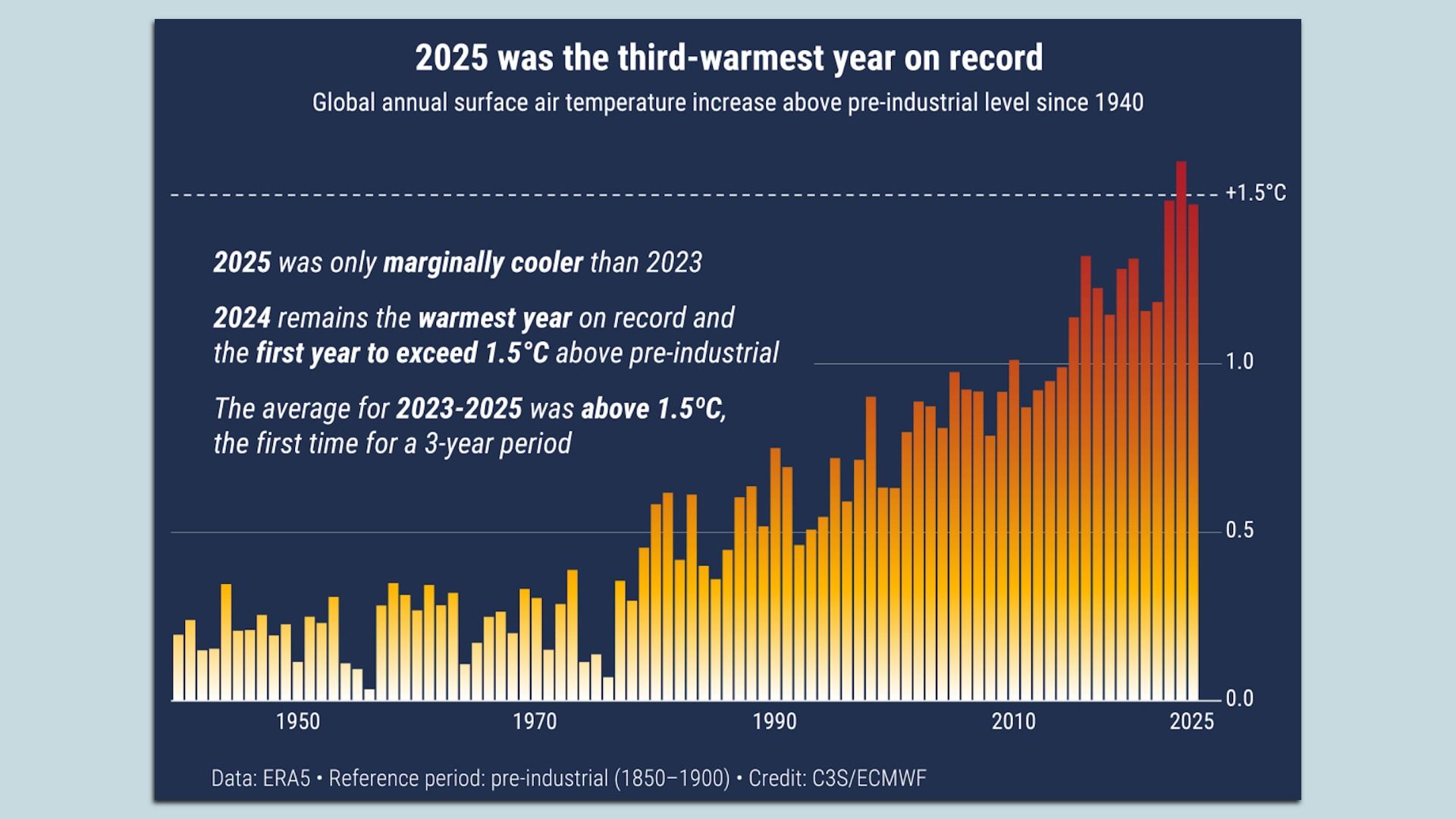
π‘οΈ 2025 was the third-warmest on record based on data that extends back to the 1800s, the EU's Copernicus Climate Change Service said.
- Why it matters: The past 11 years have been the 11 steamiest on record, and last year's average was 1.47Β°C above preindustrial levels.
- Threat level: The three-year average, taking into account the very warm 2024, marks the first time a three-year period has exceeded the 1.5Β°C threshold. That's a barrier the Paris Agreement has sought to avoid breaching but now looks inevitable.
- What's next: "Based on the current rate of warming, the Paris Agreement's limit of 1.5Β°C for long-term global warming could be reached by the end of this decade," Copernicus said. Full analysis.
π BP is taking a $4 billion to $5 billion write-down that's "primarily related" to its energy transition business, the energy giant said in a filing today.
- The big picture: The company, which recently replaced its CEO, is pivoting back toward its core fossil fuel business and paring back clean tech plans. The WSJ has much more.
β οΈ Halting Dominion's big wind project under construction off Virginia's coast will block energy needed to meet rising data center demand, grid operator PJM said in a court filing.
- State of play: PJM filed an amicus brief yesterday supporting Dominion's litigation against the Interior Department, which recently forced developers to stop construction of several Atlantic Coast projects.
4. βοΈ Legal fight over air pollution rule brewing
Green groups are signaling potential lawsuits over EPA's decision not to put monetary estimates on the health benefits of curbing critical forms of air pollution.
State of play: EPA revealed its approach in publishing a new rule for power turbines, which shies away from "monetizing benefits" of avoiding fine particulate and ozone pollution.
Friction point: Multiple groups call the approach harmful, saying EPA is failing to properly consider benefits of avoiding premature death, preventing asthma and more.
- "The Trump EPA's policy that assigns no value to protecting the health of the American people from deadly soot and smog is unlawful," Vickie Patton, general counsel for the Environmental Defense Fund, said in a statement to Axios.
- Groups including the Sierra Club and Natural Resources Defense Council also called the approach illegal.
The other side: The turbine rule says EPA will hold back from calculating monetary benefits until it's "confident enough in the modeling" to do it properly.
- "Not monetizing DOES NOT equal not considering or not valuing the human health impact. EPA is fully committed to its core mission of protect[ing] human health and the environment," an EPA spokesperson said via email.
- The agency is working to enhance its methods, it said.
What we're watching: Whether this fight moves from the regulatory into the legal realm.
- But attorney Jeff Holmstead, a senior air official in the George W. Bush EPA, says the Clean Air Act doesn't force EPA to monetize benefits, nor do any court decisions.
- "I don't think the decision to stop this practice will create any legal problems for them, as long as they provide a reasoned explanation for their decisions and a discussion of the benefits," Holmstead, a partner with Bracewell LLC, said via email.
5. π EPA opens a new front in permitting battles

With permitting overhaul talks on Capitol Hill stalled, the EPA is pushing ahead with a new attempt to help pave the way for green-lighting energy projects.
Why it matters: Overhauling federal agencies' processes for approving industries' projects is of paramount importance for many business groups.
Driving the news: The EPA floated draft rules yesterday to limit states' ability to block the construction of oil and gas pipelines and other projects because of concerns over water contamination and other problems.
- Its proposal would narrow the scope of Section 401 of the Clean Water Act. It also would give states and tribes a one-year maximum to act on federal permit requests.
Friction point: Several Democrats, notably former Govs. Andrew Cuomo of New York and Jay Inslee of Washington state, have incensed Republicans by using Section 401 to block big projects in their states.
- "Today's proposal restores the Clean Water Act to its intended purpose, protecting America's water quality and ending the weaponization of the law that has been obstructing infrastructure and energy projects vital to our nation's economy," EPA Administrator Lee Zeldin said in a statement.
What they're saying: "GREAT NEWS: The EPA is tackling permitting reform!" Rep. Pete Stauber (R-Minn.) said in an X post.
- Stauber is a cosponsor of a bill the House passed last month β largely along party lines β that would limit states' authority to block projects over environmental concerns.
What's next: Lawmakers are awaiting bipartisan permitting talks to resume after two key Democrats announced last month they would stall them until the Trump administration reconsiders its halt of offshore wind projects.
6. π¬ Quote du jour: Evolving landscape edition
"In 2025, data centers dominated the energy conversation. In 2026, the narrative will shift from headline gigawatts to execution: construction, commissioning, interconnection, and the hard realities of cost, timelines, and reliability. It won't be pretty."β Leaders of the climate-focused VC firm Congruent Ventures in a wide-ranging new outlook.
π¬ Did a friend send you this newsletter? Welcome, please sign up.
Sign up for Axios Future of Energy