Axios Future of Energy

December 01, 2025


🔥 We're touching a hot stove today with a look at Bill Gates' take on geoengineering, then roaming around, all in 1,280 words, 5 minutes.
🙏 Thanks to Chuck McCutcheon and Chris Speckhard for edits to today's newsletter, along with the brilliant Axios Visuals team.
🎹 This week in 1977, soul virtuoso Al Green released "The Belle Album," which provides today's intro tune...
1 big thing: Where Bill Gates draws the line on dimming the sun

Bill Gates says he would support deploying artificial cooling technologies to lower global temperatures — but only if the planet hits so-called climate tipping points.
Why it matters: The Microsoft co-founder and philanthropist is a major funder of research into this controversial technology known as geoengineering.
- His comments in a recent interview with Axios are among his most expansive yet.
The big picture: Solar radiation management — reflecting more of the sun's energy back into space — is a subset of geoengineering that's shifting from fringe science and conspiracy theory into mainstream policy debate.
- The idea could help blunt extreme weather, but its risks remain uncertain and likely significant.
How it works: Solar radiation management, or solar geoengineering, aims to cool the planet by reflecting sunlight.
- The most-discussed method involves injecting sulfuric-acid particles into the upper atmosphere, mimicking the cooling effect of volcanic eruptions.
Driving the news: Gates' comments, made during an interview last month at Caltech, are significant because he makes a distinction between what's become a more common position — supporting research into geoengineering — versus actually deploying it.
Zoom out: In the interview, Gates said the world is largely on track to avoid the worst climate impacts thanks to rising clean-energy deployment.
- But he emphasized there's still an outlier chance of especially dire consequences driven in part by tipping points — scenarios in which warming triggers reinforcing feedbacks, or secondary effects, which accelerate climate change.
- You "would then need to reach for some other type of intervention," Gates said.
When asked whether that meant geoengineering — and whether he would support its deployment in such a scenario — Gates replied: "Yes, I've been a funder of trying to understand geoengineering."
- Much of his funding isn't publicly disclosed, but what is known includes past support for Harvard University's solar geoengineering program.
Context: Gates stressed the difference between supporting research and advocating deployment.
- "No way am I pushing the world in that direction," he said, before adding that having knowledge about it could be "quite valuable."
Friction point: "There are two big arguments against it, which are both legitimate and need to be considered," Gates said.
- Political: Relying on solar geoengineering could undermine efforts to cut fossil-fuel use. "That's terrible if that slows that down," he said.
- Scientific: Researchers need a clear understanding of how injected particles would affect communities, including risks of altered rainfall or drought.
What we're watching: Activity by startups — including Stardust Solutions that just announced it raised $60 million — has sparked a wave of scrutiny and media attention to the tech.
Disclosure: Amy Harder is the former founding executive editor of Cipher News, an independent news outlet supported by Bill Gates' climate and energy initiative Breakthrough Energy.
2. 👀 The data center boom, upwardly revised
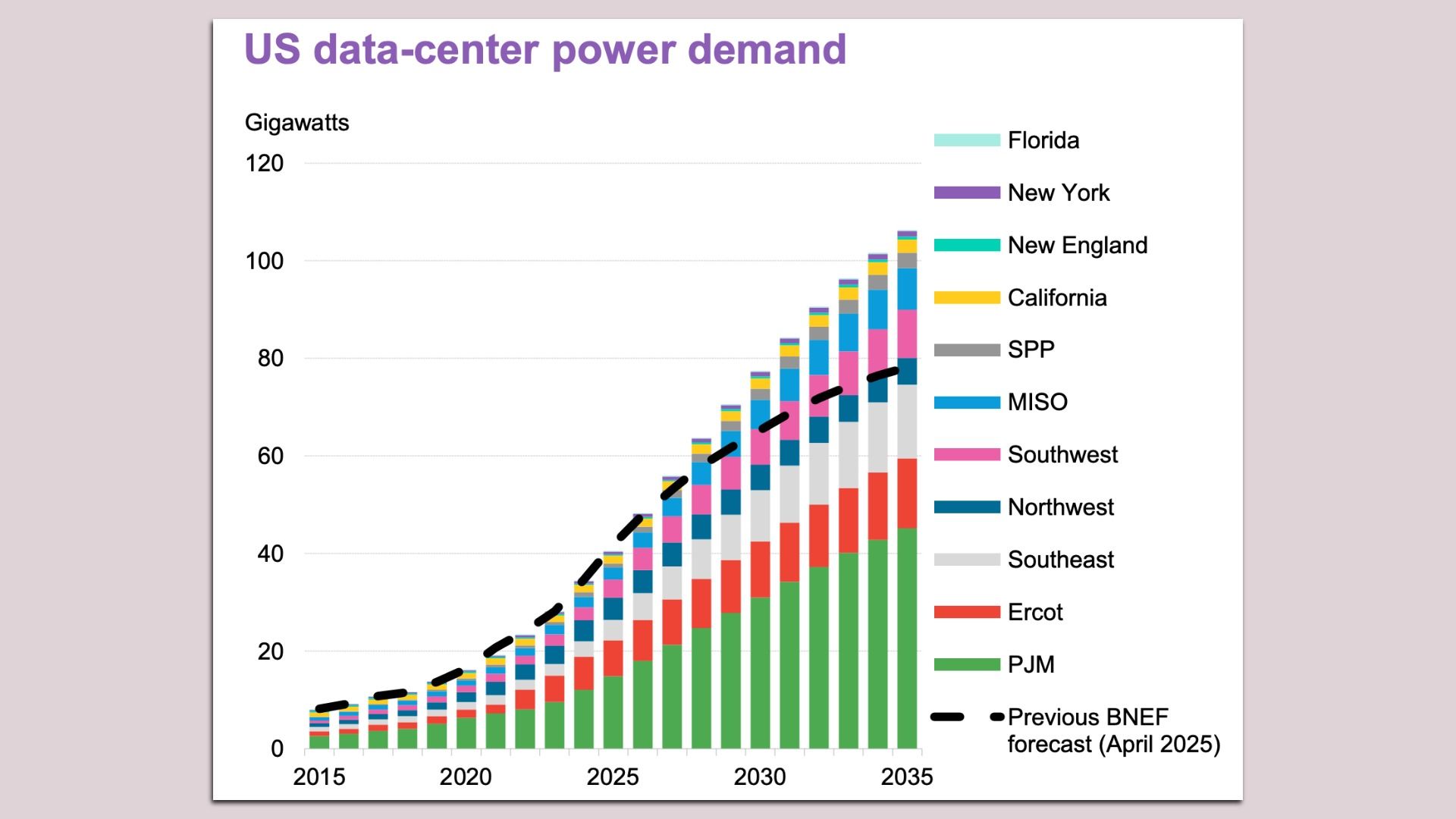
Breaking: Research firm BloombergNEF sees U.S. power demand from data centers reaching 106 gigawatts by 2035, per new analysis this morning.
Why it matters: That's a 36% upward revision from its April outlook, "illustrating just how quickly the sector is expanding."
Yes, but: Even that bigger 2035 projection is still pretty conservative compared to estimates from Goldman Sachs, BCG, McKinsey and several others.
The big picture: The study highlights big, interlocking trends.
- Development is moving away from urban areas as facility sizes grow. "Today, US data centers are typically located in suburban areas within 30 miles of major cities," it finds.
- Just 10% of existing data centers exceed 50 megawatts of capacity, yet most in development are north of 100 MW. A handful of gigawatt-scale sites are coming online in the next few years, with more to come later.
What we're watching: The simmering backlash in some regions, which the NYT explored over the weekend.
3. 🏃 Catch up quick on oil and gas: Markets, Canada, EPA

📊 Crude prices are up slightly after a very busy weekend on the oil front, with Ukraine's reported attacks on Russia-linked infrastructure and OPEC+ affirming plans to pause output hikes in Q1 2026.
- Catch up quick: Ukrainian drones, per multiple reports, hit tankers and the Black Sea terminal for the CPC pipeline that moves Kazakh oil via Russia.
- Why it matters: It comes as diplomatic talks reach a critical phase. RBC Capital Markets' Helima Croft, in a note, said the combo of U.S. sanctions and Ukrainian attacks could shut in some Russian barrels.
- Yes, but: She cautioned that it's unclear whether attacks in the Black Sea region signal a new tactical phase, and when it comes to peace talks, she's skeptical that Moscow will give up its "maximalist territorial ambitions."
🇨🇦 Canadian PM Mark Carney reached a deal with leaders from Alberta, the main oil-producing region, that relaxes some climate rules and envisions a potential — emphasis on potential — new pipeline to the nation's west coast.
- Why it matters: It's part of a wider climate rethink by some industrial powers, and immediately roiled politics north of the border, with one of Carney's cabinet ministers resigning in protest.
🛑 ICYMI: EPA finalized rules that delay Biden-era mandates for the oil industry to cut emissions of methane, a strong planet-warming gas.
- Why it matters: Oil and gas industry equipment and operations are a major source. Green groups slammed the move and noted the rules would also cut dangerous localized pollution.
- State of play: EPA said the delay will create more "realistic" timelines and help boost U.S. production. It saves an estimated $750 million over 11 years in compliance costs, EPA said.
- What we're watching: EPA also signaled plans to rewrite what it calls onerous rules.
4. 🚚 EV startup with big backers chases narrow lane


The list of failed EV startups is lengthy, and the founders of Harbinger Motors have the scars to prove it, which helps explain the company's laser focus on one particular slice of the commercial truck market.
Why it matters: Business fleet owners are getting crushed by higher costs on everything from tariffs to fuel and labor. Reducing operating costs is essential to protecting margins.
- Replacing medium-duty diesel trucks with more efficient electric ones can bring annual savings of $6,000 to $10,000 per truck, Harbinger says.
The big picture: FedEx aims to replace its entire pickup-and-delivery (PUD) fleet with electric vehicles by 2040.
- It has already deployed EVs from Brightdrop, Mercedes-Benz, BlueArc and Workhorse into its U.S. operations.
- Early analysis shows a cost savings of as much as 30% compared to their combustion-engine counterparts, according to FedEx's 2025 Corporate Responsibility Report.
Catch up quick: FedEx, which has ordered 53 Harbinger trucks, was among the lead investors in the startup's recent $160 million Series C fundraising round.
- Capricorn's Technology Impact Fund, an early Tesla investor, and RV giant Thor Industries also led the round, and many existing investors participated as well.
- To date, Harbinger has raised $358 million.
The intrigue: Instead of aiming to be the next Tesla, Harbinger execs are satisfied trying to electrify the $20 billion medium-truck market, where only Freightliner and Ford compete today.
- Harbinger's product isn't even a truck. It's a rolling electric chassis — essentially an aluminum frame with four wheels, a battery and an electric or hybrid drive train.
5. 🛢️ Number of the day: 13.84 million barrels per day
That's U.S. crude oil production in September, per new data from the Energy Department's independent stats arm.
Why it matters: The latest record shows that U.S. shale is more resilient to modest prices than some analysts predicted earlier this year.
- That said, the Energy Information Administration has noted some Gulf of America (renamed from the Gulf of Mexico) projects are ramping up faster than expected.
📬 Did a friend send you this newsletter? Welcome, please sign up.
Sign up for Axios Future of Energy