Axios Future of Energy
October 08, 2026


🥐 Good morning! We're diving into what the big permitting bill would mean for data centers, then exploring...
- New AI battery tech, lots of other permitting and data center updates, and oil prices, all in 1,259 words, 5 minutes.
🛢️ Situational awareness: Brent crude prices jumped nearly 5% to $105.15 per barrel this morning.
- Upward pressure is coming from President Trump weighing escalation in Iran, Hurricane Isaias shutting in some U.S. Gulf production, and attacks on Middle East shipping.
🎶 This year marks a decade since singer-songwriter Mason Jennings released the album "Wild Dark Metal," which provides today's intro tune...
1 big thing: Data centers face a sweeping new power regime
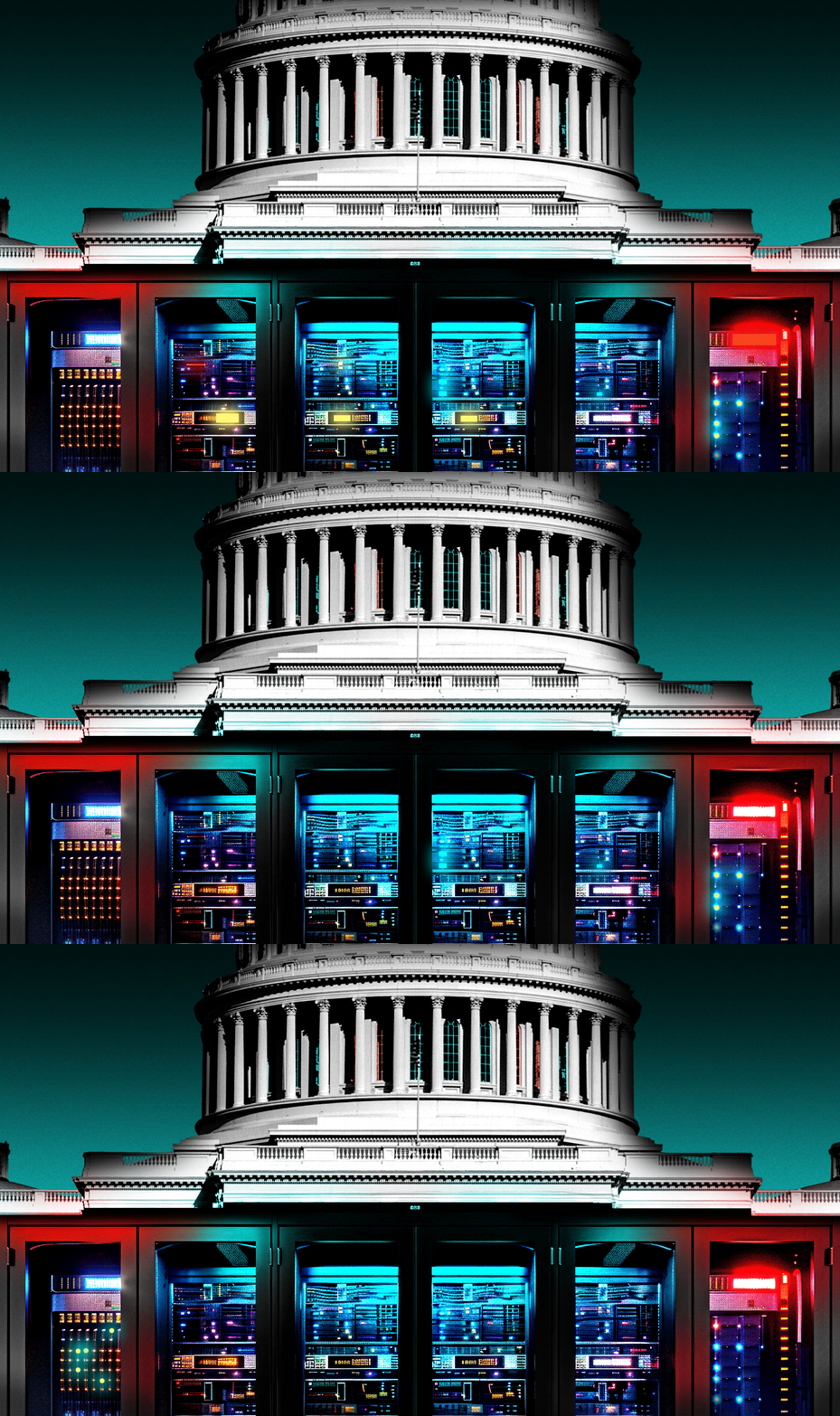
Lawmakers are considering forcing data centers to shoulder new costs and restrictions while speeding up the energy infrastructure needed to power the AI boom.
Why it matters: The draft legislation, unveiled last week, represents the most aggressive response yet from Washington to data centers amid growing backlash over their energy and environmental impacts.
Driving the news: The provisions are part of broader Senate legislation aimed at speeding up permitting for energy — but make no mistake: The data center measures are significant and would go far beyond Washington's largely voluntary efforts to date.
"I don't think we've seen it before," said Ari Peskoe, director of the Electricity Law Initiative at Harvard Law School, about the proposed additional costs and restrictions.
- "But I don't think we've seen growth that's comparable to data centers today, and I certainly don't know any industry whose electricity usage has captured so much political attention."
Between the lines: For tech companies, the bill cuts both ways. Congress would make it easier to build the energy infrastructure they need while erecting a sweeping framework aimed at keeping other electricity customers from footing the bill.
"Just to be candid, having some teeth on data center accountability and ratepayer protection is just table stakes to getting a deal done," said Jane Flegal, a former White House official under President Biden and now a senior fellow at the nonprofit Searchlight Institute.
How it works: The bill reaches deep into the relationship between large data centers and the electric grid — while giving states even more power.
- Data centers would have to pay their share of the existing transmission grid plus the new transmission and broader power-system costs their enormous electricity demand triggers.
- Federal and state regulators could go further, charging large data centers more than those incremental costs and using the excess to reduce other customers' bills.
- Go deeper on the changes in our full story.
What they're saying: Not much publicly, yet. The Data Center Coalition, which represents companies across the sector, said it is still reviewing the legislation.
The intrigue: One tech industry official called some provisions an "unprecedented level of discriminatory treatment" for a single industry.
- The official, who spoke anonymously to discuss industry deliberations, said tougher grid-connected requirements could encourage some developers to build more power systems completely off-grid instead — potentially undermining the overarching purpose of the bill.
The other side: Travis Fisher, a former Trump White House energy official now at the libertarian Cato Institute, said he has "mild support" for the approach despite concerns about setting a discriminatory precedent.
- He said the provisions "break new ground" at the Federal Energy Regulatory Commission but are consistent with the White House's ratepayer-protection pledge many of the largest data center companies have already signed.
What we're watching: Flegal said she would be "incredibly surprised" if tech companies ultimately oppose the broader package.
2. 🔋 QuantumScape makes its move on data centers

Solid-state battery company QuantumScape is today announcing its first product for data centers.
Why it matters: It's a key moment in the firm's diversification beyond the automotive market and into AI, defense and other applications.
Driving the news: It's unveiling the QS PowerBlock for AI data centers, touting high power density, long runtime, and greater safety than conventional lithium-ion batteries.
- The design can be configured to work with a large variety of data center equipment sizes and formats.
Stunning stat: The cells have demonstrated stability in conditions far above 300°C in third-party tests, QuantumScape said in describing the tech's reduced fire risk.
- That's vastly higher than conventional lithium-ion batteries that can go into "catastrophic thermal runaway" around 180°C, it said.
"Insurability of the data center gets better because of the QuantumScape battery. Permitting of the data center gets better. You can shave months off of permitting just because the battery is safer," CEO and president Siva Sivaram said in an interview.
What's next: Sivaram said talks are underway with potential customers.
- "Anywhere there is a GPU rack, this can go right next to it, and I expect that it'll get used everywhere. But first, it'll probably go into large training data centers," he said.
3. 🧁 Bonus data center notes: Google, Gallego, Duke

🎨 This week brings fresh evidence that tech giants are choosing gas and zero-carbon sources to meet their growing power needs.
- State of play: Google's deal with Constellation to boost output at existing nuclear plants got plenty of attention. But Google also has a new agreement with the utility Black Hills Corp. for new gas-fired generation to supply a planned Wyoming data center.
- Catch up quick: Meanwhile, Data Center Dynamics reports on the progression of Amazon's plans for a data center campus to be served by gas generation from a large former coal plant site in Homer City, Pennsylvania.
🗳️ Sen. Ruben Gallego (D-Ariz.) is calling for new taxes on data centers as part of his wider economic platform.
- Why it matters: He's eyeing a 2028 presidential run.
- State of play: It calls for excise taxes on data center revenues to fund community investments. And a "New Deal-style public service jobs program" for AI-displaced workers could be partially funded by a data center tax.
- The bottom line: On data center energy, he's very much in the Dem mainstream. Data centers should be required to fund new generation and grid upgrades, and be required to "sustain energy investments even if they abandon the project," the plan states.
🤝 Duke Energy said it inked a deal with Amazon, Google, Meta, Microsoft and others to insulate ratepayers from data center-related costs.
- How it works: It includes "nonrefundable, upfront payment for electric grid facilities serving only that customer," as well as special rates for these large energy users. The News & Observer has more.
4. 🏃 Catch up quick on permitting

A few updates on the evolving battle lines around the bipartisan Senate permitting bill...
👍 The Electric Power Supply Association — which represents big independent power producers like Constellation, Vistra, and NRG — has come out in support of the bill.
- What we're watching: The Edison Electric Institute, which represents regulated investor-owned utilities, has been more equivocal.
- State of play: The bill includes provisions that open new competition in transmission development and expands government oversight of utility planning.
↕️ A new statement from the National Association of Regulatory Utility Commissioners, which represents state power regulators, has some nice things to say about the bill.
- Yes, but: It cautions that it's still reviewing the transmission provisions. More broadly, it says states "stand ready to share their expertise" as Congress "considers refinements."
- What we're watching: Via Punchbowl News, House Energy and Commerce Chairman Brett Guthrie (R-Ky.) is seeking changes to the bill.
5. 🛢️ Quote of the day: What do prices even mean anymore edition
"Not only are futures increasingly unreliable as a proxy for genuine supply and demand, they are also no longer useful as a hedge either and further disconnected from the fuel prices that drive inflation."— Amrita Sen, co-founder of the market intelligence firm Energy Aspects, writing in the FT about what widely-cited futures prices don't tell us
🙏 Thanks to Mackenzie Weinger and Chris Speckhard for editing, and to our brilliant Axios visuals team.
📫 Did a friend send you this newsletter? Welcome, please sign up.
Sign up for Axios Future of Energy