Axios Future of Energy
October 01, 2025


🐪 Hump day is a doozy this week, but we've got you covered in just 1,458 words, 5.5 minutes.
🚨 Situational awareness: BlackRock's Global Infrastructure Partners is "nearing" a $38 billion deal to buy electricity heavyweight AES "in what would be one of the largest infrastructure takeovers of all time," the FT reports.
🎧 At this moment in 2008, Jazmine Sullivan was No. 1 on Billboard's R&B charts with today's intro tune...
1 big thing: A new electric vehicle era is here

Welcome to the next — and probably slower — phase of U.S. EV adoption after yesterday's demise of federal purchase and lease subsidies.
Why it matters: The future of EV sales affects automakers' strategies, battery and mining companies, and planet-warming emissions from transportation.
🗞️ Driving the news: Credits up to $7,500 for many new EVs — initially put in place until 2032 under the Biden climate law — are gone under the quick phaseout in the GOP budget law.
- So are credits up to $4,000 for used models.
- Analysts expect sales to decline, or at least plateau, after consumers rushed to tap vanishing incentives.
The big picture: Like that earworm of a '70s PSA, automakers are in "be prepared" mode.
- Many have revised EV production targets downward but are still investing in battery development, ING analyst Coco Zhang notes.
- They're "betting on the ability to produce more efficient, affordable models," Zhang, the bank's VP of ESG research, said in an email.
- For instance, Ford is pushing ahead with development of lower-cost models, starting with a midsize four-door electric pickup with a $30,000 base price in 2027.
🏈 State of play: Fully electric vehicles were roughly 10% of U.S. sales in August, per Cox Automotive and S&P Global Mobility.
- S&P tallies similar sales last month.
- Some states, such as New York and California, are still offering incentives for EV buyers.
👀 What's next: Look for sales to hover below 10% for the balance of 2025, Cox's Stephanie Valdez Streaty said in an analysis.
- "However, we still believe the EV mix of sales can climb to near 25% by 2030, well short of the 50% once envisioned, but certainly moving out of the 'niche' category," she writes.
The intrigue: BloombergNEF also slashed its outlook to account for the tax credits' demise and the regulatory pullback.
- The research firm's latest outlook, which includes plug-in hybrids, sees EVs at 27% of U.S. sales in 2030, down from the high-40s in its prior look-ahead.
- And this doesn't even account for EPA's effort to remove California's authority to set rules that some other states follow.
Yes, but: The policy landscape is fluid.
- In addition to pulling back tailpipe emissions rules, EPA's plan to rescind the "endangerment finding" would make it harder for successors to impose new ones.
The bottom line: "Continuously declining battery and production costs will improve the business case for EVs, though the speed of transition will now be left to the market," writes Zhang.
Disclosure: Cox Automotive and Axios are both owned by Cox Enterprises.
2. 🕰️ A lull in EV sales? More time to build charging

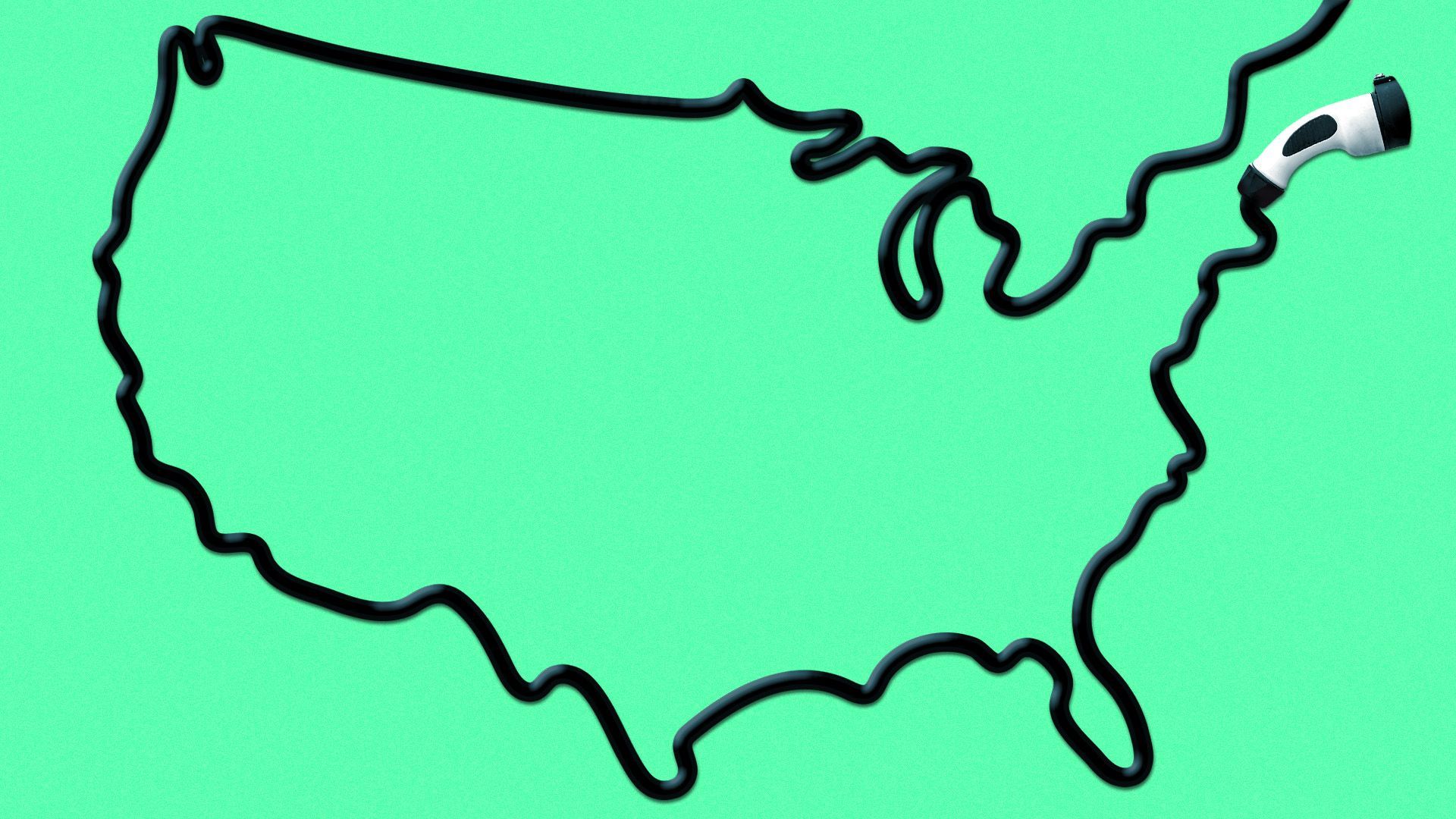
The expected drop in EV sales sans credits could have a silver lining: an opportunity for charging to catch up with demand.
Why it matters: Worries about where to charge have long hindered EV adoption.
State of play: A major 2023 DOE study estimated the U.S. will need 28 million charging ports by 2030 in order to support 33 million EVs.
- Most would be private — Level 1 and 2 ports at houses, apartments and workplaces.
- Also needed: 182,000 DC fast-chargers along highways and in metro areas to accommodate road trips, ride-share drivers and others needing quick juice.
The bottom line: There's a long way to go. The U.S. currently has about 228,000 public charging ports. Of those, roughly 62,000 are DC fast-chargers.
3. ⛏️ What to watch now that Trump's lithium deal is official

The U.S. government is taking an equity stake in Lithium Americas as part of a restructured loan that aids a big Nevada mining project, the Energy Department said.
Why it matters: The agreement with the company and joint venture partner GM is the latest case of the government taking stakes in companies that produce key materials.
- It follows Trump team deals with rare earths miner and processor Mountain Pass Materials and chip giant Intel.
🏃Catch up quick: The agreement provides a 5% stake in the company and a 5% stake in its Thacker Pass joint venture with partner General Motors, per DOE's announcement.
- The pact strengthens domestic supply chains and "ensures better stewardship of American taxpayer dollars," Secretary Chris Wright said.
State of play: It enables the first tranche of the $2.26 billion loan agreed to in 2024, Lithium Americas and GM said in a joint statement.
- The "non-binding agreement in principle" also includes DOE deferring $182 million of debt service over the first five years of the loan, it states.
- As part of the deal, GM is amending its existing offtake agreement for lithium, which enables the JV to sell to other parties too.
What we're watching: Many things, like...
📈 The market. Lithium Americas stock soared 33% pre-market, but movements during formal trading hours will be a better gauge of the response.
🧭 The trend. A good CNBC piece a couple days ago explores other Trump 2.0 mineral deals that could be in the offing.
💵 The money. Keep an eye on other DOE loans approved in the Biden era that are now under review.
4. 🏃Catch up quick on policy: shut it down edition
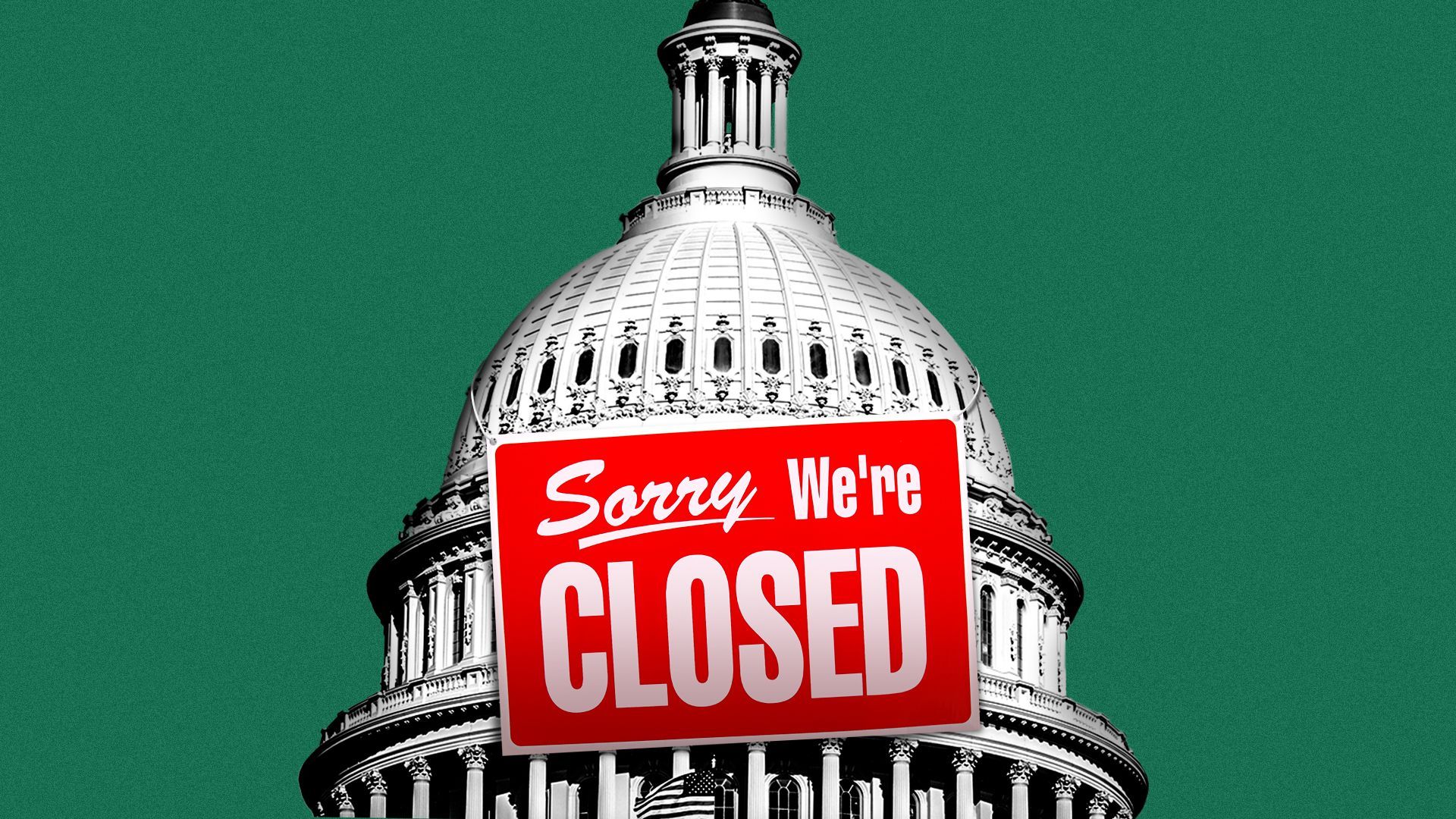
The government shutdown will pare back lots of work at energy and environmental agencies.
State of play: EPA will scale back from 15,166 employees to 1,734 who keep working for various reasons, it said. Think activities needed to "protect life and property" or jobs financed outside of annual appropriations, it notes.
Zoom in: What's paused? The agency's summary document lists "issuance of permits, guidance, regulations, and policies unless necessary for exempted or excepted activities" and lots more.
Threat level: While weather forecasting will continue, Bloomberg warns the shutdown will "curtail or halt some US climate disaster preparedness...and even potentially delay real estate transactions within the nation's flood zones."
What's next: Expect delays to work on energy infrastructure, TD Cowen analysts said in a note ahead of the shutdown.
- "The bulk of federal staff undertaking permitting work...lacks an 'essential' designation and will be unable to work during a shutdown," it states.
- Treasury Department work on sourcing Chinese restrictions in energy and manufacturing tax credits could also be delayed, it said.
Two non-shutdown policy notes...
⏰ EPA plans to extend deadlines for various industries to phase out hydrofluorocarbons, which are commonly used in air conditioning and refrigeration. Summary ... full proposal.
⚛️ The Energy Department tapped four more companies to take part in a pilot program for R&D on new domestic nuclear fuel lines. It's also designed to "provide a fast-tracked approach to commercial licensing."
- Why it matters: The U.S. is heavily reliant on imports at a time when officials want to spur construction of emerging and existing reactor designs.
- State of play: The new selections are: Oklo Inc., Terrestrial Energy Inc., TRISO-X LLC and Valar Atomics.
5. 💬 Shutdown won't kill permitting push, energy groups say


Acrimony over a government shutdown shouldn't poison the well for a bipartisan congressional overhaul of the permitting process, leaders of several energy groups predict.
Why it matters: Cutting red tape so that energy projects can break ground more rapidly is one of the few areas of widespread agreement on the Hill.
- Unlike other actions that have been done through executive orders, many of those involved say a successful overhaul must be bipartisan and have the force of law.
Driving the news: Top officials at the Center for Climate & Energy Solutions, ClearPath and The Nature Conservancy said on a webinar yesterday that the timing is right for Congress to pass a bill.
- After President Trump's sweeping tax overhaul became law in July, "you heard a lot of folks saying, 'Well, I don't know if we can get past this moment to continue the permitting conversations," ClearPath CEO Jeremy Harrell said.
- Nevertheless, he said, "We saw an influx of [permitting] activity over the last month and a half."
Despite "a lot of hubbub around the government shutdown," C2ES President Nat Keohane predicted that "Congress, at some point, is going to need to get back to work."
- Harrell said one reason for optimism is that two key lawmakers — Sen. Sheldon Whitehouse (D-R.I.), the Environment and Public Works Committee's top Democrat, and House Natural Resources Chair Bruce Westerman (R-Ark.) — are eager for a "legacy item" before likely leaving those positions after this Congress.
Reality check: Democrats and Republicans currently remain far apart on specifics.
What's next: Lawmakers are mulling an assortment of permitting proposals.
6. 🧮 Number of the day: 26%
That's the percentage of registered voters who say rising electricity prices are affecting their household finances "a lot," a Heatmap-commissioned poll finds.
📪 Did a friend send you this newsletter? Welcome, please sign up.
🙏 Thanks to Chuck McCutcheon and Chris Speckhard for edits to today's edition, along with the brilliant Axios Visuals team.
Sign up for Axios Future of Energy