Axios Future of Energy

July 14, 2026

📈 With oil prices soaring again, look for future efforts to bypass the Strait of Hormuz to get even more intense. We're starting there and then exploring...
- Data center politics, fusion finance, other tech deals, utility rates and more, all in 1,335 words, 5 minutes.
🙏 Thanks to David Nather, Mackenzie Weinger and Chris Speckhard for editing and to our brilliant Axios visuals team.
📻 Exactly 45 years ago, Kim Carnes was No. 1 on Billboard's Hot 100 with today's intro tune...
1 big thing: The push to bypass Hormuz

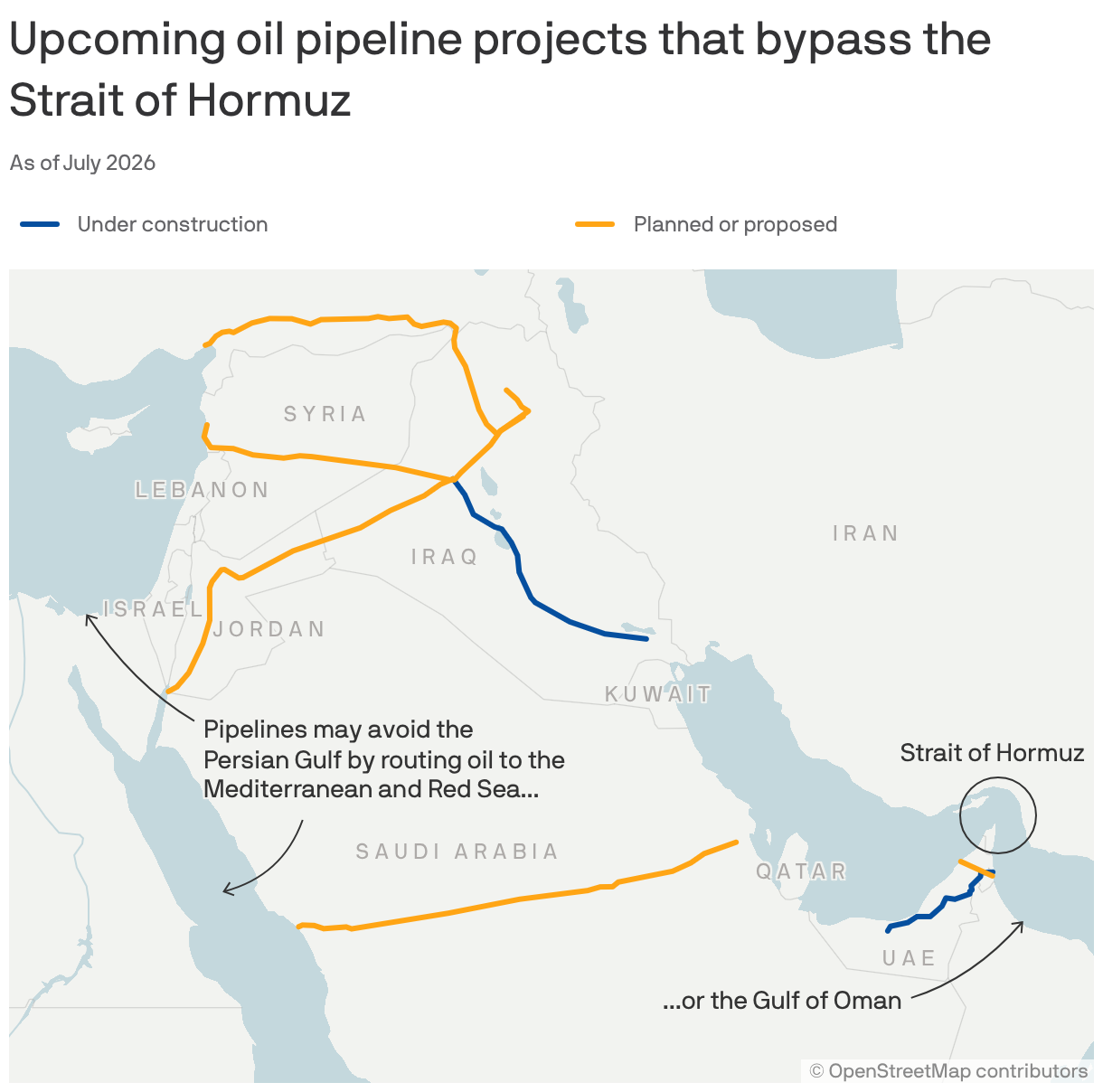
The oil market's top players aren't waiting around to see who winds up with control over the Strait of Hormuz — countries and companies are scrambling to bypass the waterway.
Why it matters: The Iran war threw a spotlight on the strait as the longtime center of the global energy trade, and the industry now has a huge incentive to reduce its dependence, regardless of the war's outcome.
- "The 2026 U.S.-Iran war and Strait of Hormuz disruption may ultimately be remembered less for triggering an immediate oil crisis than for accelerating global efforts to reduce dependence on the world's most important energy chokepoint," Bloomberg Intelligence analysts wrote in a report.
The latest: The ceasefire agreement between the U.S. and Iran is quickly unraveling.
- The price of a barrel of benchmark Brent crude oil is at $86.71 — it fell below $70 after the ceasefire was announced.
- Still, this is far below the levels reached in the first weeks of the conflict.
What we're watching: Commodity analysts at Goldman Sachs looked at seven pipeline and export-infrastructure projects that are under construction, planned or considered potentially feasible.
- By the end of next year, that capacity — plus existing pipelines — could insulate more than 45% of the pre-war level of Persian Gulf producers' exports from any potential future Hormuz shocks, they estimated in a note out Sunday night.
- By the end of 2028, the number rises to more than 60%.
Zoom in: Two projects are already under construction: the West-East pipeline in the UAE and the Basra-Haditha Pipeline in Iraq.
- And a Dubai-based port operator is in talks to develop a new port on the coast of the UAE to reduce the country's dependence on the strait, the Financial Times reported yesterday.
Reality check: For now, the world still needs the strait. The Bloomberg analysts noted that 7 million to 9 million barrels of crude and refined products per day would remain exposed to its risks even after a rerouting buildout.
The big picture: Roughly 20% of the world's oil flowed through the waterway at the outset of the war, and analysts forecast dire outcomes for the energy market with its disruption.
- Those proved overly apocalyptic, to say the least. To paraphrase Jeff Goldblum's character in "Jurassic Park," oil found a way.
The bottom line: The outcome of the war remains uncertain, but the global trade in oil is sure to be reshaped as a result.
2. 🛑 N.Y. gov. to sign data center moratorium executive order

New York Gov. Kathy Hochul (D) today will sign a data center moratorium executive order, delaying new construction for up to one year.
Why it matters: New York is becoming the first state to impose a statewide data center moratorium as backlash against the industry escalates.
Driving the news: The order immediately pauses environmental permits for projects at the 50 megawatt level or more for up to one year while a regulatory framework is developed.
- That framework includes a "Generic Environmental Impact Statement" to create consistent standards for companies, according to a press release.
- The impact statement will assess data center energy demand, water use and quality, and air quality, the release states.
- The order will also provide, within 60 days, guidance for local entities to negotiate community benefits with companies.
3. ⚛️ A bright day for fusion, but clouds may loom
General Fusion became the first fusion company to begin trading publicly yesterday — and its stock jumped 21% on its first day on the NASDAQ.
Why it matters: The initial performance suggests investors see potential.
Yes, but: While the SPAC merger with Spring Valley Acquisition Corp. III brought in another $150 million, General Fusion lags behind a number of competing fusion companies in capital.
- CEO Greg Twinney, in an interview with Axios Pro's Alan Neuhauser, did not say when the company expects to begin generating revenue.
- It hopes to have its first commercial plant running in 2035, but has faced skepticism about its tech. The company had substantial layoffs in mid-2025, TechCrunch reported.
Zoom out: There's growing support for fusion as a long-term way to meet rising power demand and AI's voracious energy needs.
Driving the news: Fifty-six fusion companies raised a combined record of $4.48 billion in the last 12 months, a huge jump over the prior 12 months, per a new report from the Fusion Industry Association.
- Major rounds include Commonwealth Fusion Systems' $863 million extension and Helion's $465 million Series G, and a similarly sized raise by Proxima Fusion.
- Five companies now have power purchase agreements with customers, or some other form of "offtake" agreement to buy power before it's available, it finds.
The big picture: There's new money and mojo — yet still a long, uncertain road ahead to fusion becoming a viable power and industrial heat source.
- Most companies are eyeing the 2030s for beginning to deliver electricity.
- The industry association surveyed companies on how much more funding they need to deliver a commercial plant, and the average across 23 responses was $2.7 billion.
The bottom line: The Fusion Industry Association report is optimistic — and realistic about how many viable companies will emerge.
- "When we emerge into a fully commercial fusion industry, few expect there to be 56 companies in it. The race is on," Andrew Holland, the group's CEO, writes in the report.
4. 🧁 Bonus tech finance notes: Google, deal tallies, infrastructure, CO2 removal

📈 "Megadeals" in the low-carbon data centers space drove climate tech VC funding up 55% in the first half of 2026 compared to January-June of 2025, per a new report from the market intelligence firm Currence.
☀️ Via the FT, Google will purchase the entire output from Cypress Creek's Steel River Energy Center in Arkansas when the initial phase — 1.6 gigawatts of solar and 2 gigawatt hours of battery storage — starts operating in 2029.
- How it works: It's a "virtual power purchase agreement" — the kind of deal where buyers help finance new renewables that don't directly power their operations.
💵 The giant California State Teachers' Retirement System will invest $2 billion in sustainable infrastructure — including renewables and storage — via asset manager Nuveen. Axios Pro Deals has more.
🤝 British direct air capture startup (DAC) Airhive is merging with Netherlands-based DAC player Carbyon under the Airhive name, the companies said today. (H/t Bloomberg.)
- Quick take: Look for more consolidation in the wider carbon removal space, which is stuffed with startups chasing limited dollars and trying to overcome high costs.
5. 💵 Charted: Utilities seeking higher rates


Electric and natural gas utilities asked state regulators to approve a combined $9.2 billion in rate increases in filings made between April and June, per the affordability research group PowerLines.
Why it matters: It's the largest Q2 amount on record.
- Utilities are facing rising infrastructure investment needs amid higher demand, data centers coming online, extreme weather and more.
What we're watching: "While these newly filed requests won't affect bills this summer, since rate cases typically take months to move through state regulatory review, they place more than 56 million U.S. customers in proceedings that could lead to higher bills ahead," a spokesperson said.
- The group doesn't call for specific outcomes in these cases, but the report says state utility commissions should carefully consider the requests while weighing "infrastructure investments that a modernizing grid genuinely require."
6. 🌳 Number of the day: -15%
That's the decrease in the world's "intact forest landscapes" from 2000 to 2025, with an area roughly the size of Mexico lost, per new data from the World Resources Institute's Global Nature Watch.
Why it matters: These areas are "critical" for sucking up and storing CO2, the analysis states.
- "Increasingly, human-caused fires and mining, drilling and exploration are prominent drivers of the reduction in the extent of intact forest landscapes."
📫 Did a friend send you this newsletter? Welcome, please sign up.
Sign up for Axios Future of Energy