Axios Future of Energy

January 15, 2026


🧑🍳 Do we have tasty bites on mining, oil, Congress and climate this morning? Yes, chef! You'll get through the light menu in just 1,483 words, 5.5 minutes.
🚨 Situational awareness: A federal judge will rule today on whether Equinor can resume construction of the Empire Wind project off New York, Reuters reports. It's among several offshore wind projects Trump officials have halted.
🎸 The late Warren Zevon released the album "Excitable Boy" this week in 1978, and his storytelling animates today's intro tune...
1 big thing: Amazon, Rio Tinto team up on cleaner data center copper
Amazon is the inaugural buyer of copper cathode that mining giant Rio Tinto is producing with a special process it calls way more climate-friendly than traditional methods.
Why it matters: Data centers need lots of copper, and tech giants are looking to make powerful computing more sustainable as the AI boom complicates their climate goals.
Driving the news: Amazon has a two-year deal with Rio Tinto for its new Nuton copper product, while Amazon is providing cloud-based data and analytics support to help produce it. Terms weren't disclosed.
- "It's a phenomenal meeting of minds," Rio Tinto copper chief executive Katie Jackson told Axios.
- She touted Nuton's ability to bolster the domestic supply chain of copper — which the Trump administration classifies as a "critical mineral" — without the many years needed to permit new mines.
State of play: Rio Tinto late last year began using the process to extract copper from U.S. ores that are traditionally hard to process and often become waste.
- It involves using microorganisms — or "bioleaching" — to remove copper from sulphide ores.
- Rio Tinto is initially working at a once-dormant Gunnison Copper Corp. site in Arizona and hopes to deploy the tech elsewhere in North and South America.
The intrigue: The process "removes the need for traditional concentrators, smelters and refineries, significantly shortening the mine-to-market supply chain," today's announcement states.
- It also uses far less water — about 55% as much per unit of copper as the global industry average.
The big picture: Chris Roe, Amazon's director of worldwide carbon, called the deal a new frontier for his company's sustainability work.
- "We've spent a lot of time so far on steel and concrete, and so we're really excited to jump into copper, which is obviously a core commodity that feeds not only our data centers, but a lot of our operations across the world," he said.
Yes, but: Nuton is initially a tiny slice of Rio Tinto's output.
- The company expects to produce about 14,000 tons of Nuton over four years from Gunnison's Johnson Camp mine, Jackson said.
- Rio Tinto's global copper output was nearly 900,000 tons last year.
The bottom line: While the initial volumes are small, Jackson calls it a potentially transformative moment.
- "There's a huge amount of interest in this technology, because I think many in the industry see success as being something that's game changing," she said.
- Adds Roe: "Sending those demand signals early — if you build it, we will come — is a really important piece of this puzzle to unlock the scale that we know we all need for the climate crisis."
2. 🧁 Bonus: Data centers add to copper demand stress
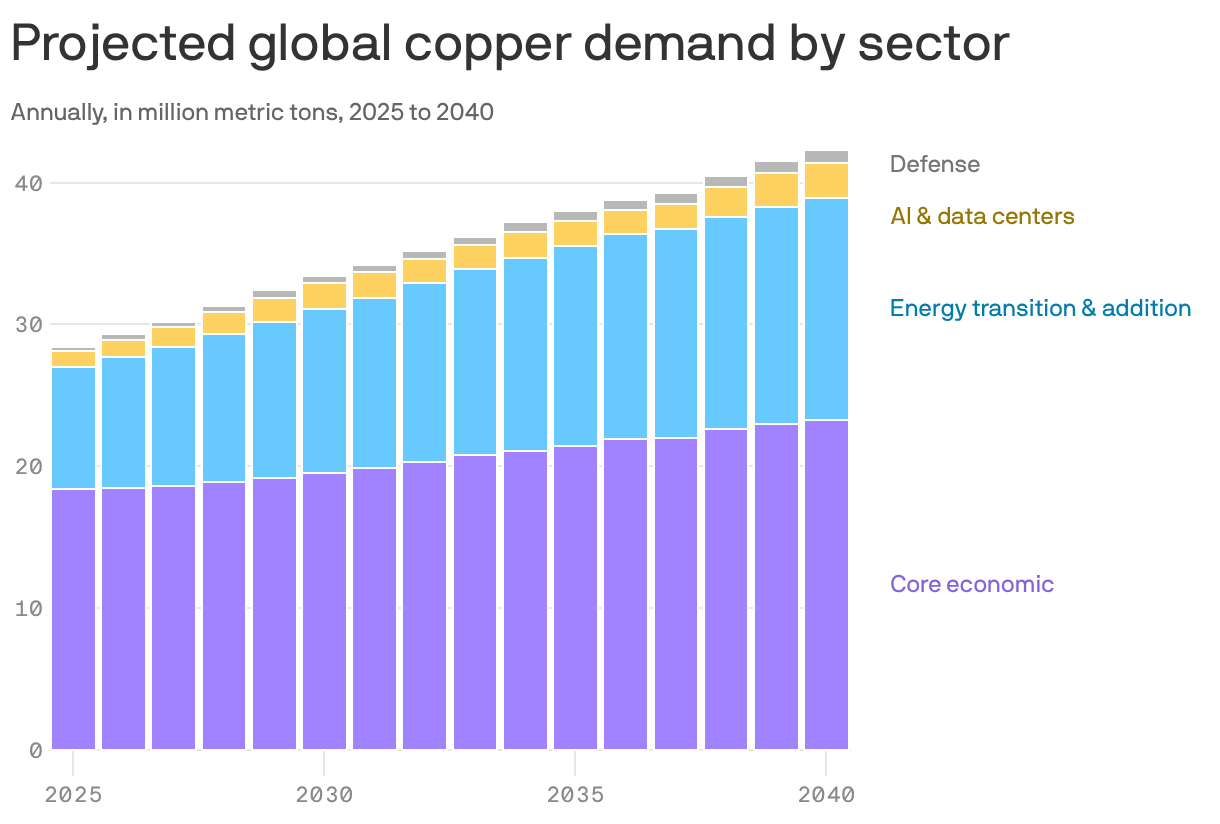
The Amazon-Rio Tinto deal comes as overall copper demand is rising, and growth of data centers could worsen what's already a looming shortfall in decades ahead, a recent S&P Global report found.
3. ⛏️ Bipartisan plan seeks U.S. critical mineral reserve

A bipartisan group of lawmakers will introduce new legislation today to establish a $2.5 billion Strategic Resilience Reserve (SRR) for critical minerals, Axios has learned.
Why it matters: President Trump is bringing his prospector's pick to nearly every corner of the globe — including Ukraine, Venezuela and Greenland — in a push to boost the U.S. supply of minerals that are critical to the tech industry's growth.
- Now Congress wants to join the minerals rush by helping to secure — and stabilize — the domestic market for rare-earth and critical materials.
Threat level: Much of the world's supply is controlled by China, leaving the U.S. vulnerable to price swings and supply-chain disruptions for minerals needed to make advanced semiconductor chips and EV batteries.
Driving the news: Sens. Jeanne Shaheen (D-N.H.) and Todd Young (R-Ind.) — along with Reps. John Moolenaar (R-Mich.) and Rob Wittman (R-Va.) — will introduce the SECURE Minerals Act this morning.
- The legislation would create a clearinghouse for critical minerals and resemble a hybrid between the Strategic Petroleum Reserve and the Federal Reserve.
4. 🏃 Catch up quick: Venezuela, Iran, nukes

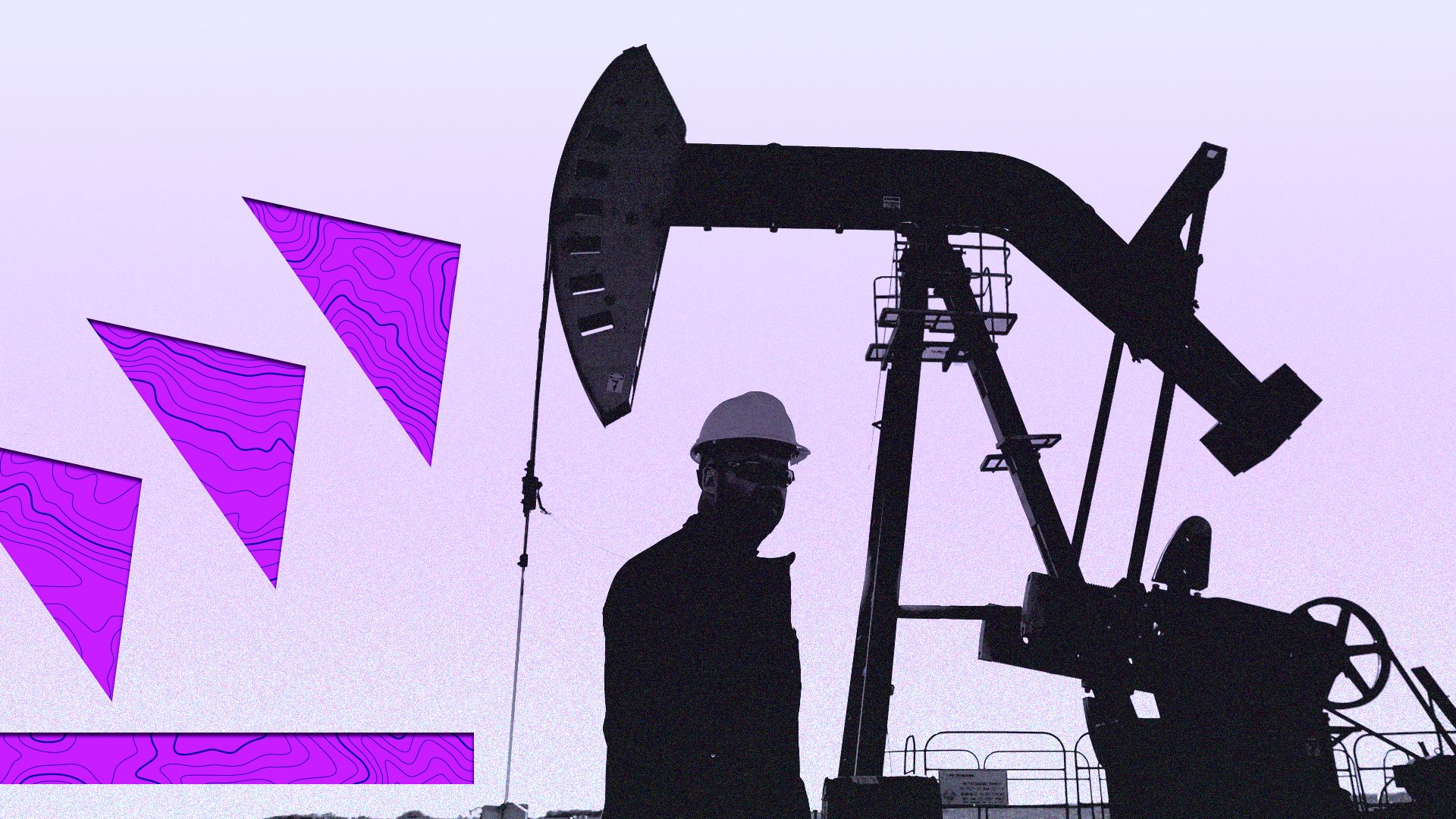
💵 The Trump administration has completed its first sale of Venezuelan oil, with a value of $500 million, and more are expected in "coming days and weeks," a senior U.S. official told Axios and other outlets.
- Catch up quick: The U.S. is directly handling sales of Venezuelan barrels now, with proceeds landing in U.S.-controlled accounts at "globally recognized banks," per DOE.
- State of play: The sales will benefit Americans and Venezuelans alike, White House spokeswoman Taylor Rogers said. Semafor first reported this initial transaction.
📉 Oil prices fell steeply on signs the White House does not plan to imminently strike Iran.
- Why it matters: The fluid White House plans are whipsawing the market. Prices jumped to their highest levels since last fall in recent days, with President Trump telling protesters on social media that "help is on its way."
- State of play: The global benchmark Brent crude is trading around $63 this morning, down from over $66 earlier in the week.
👀 The CEO of oilfield services giant Halliburton tells the Financial Times that it plans to swiftly re-enter Venezuela to help rebuild its oil sector.
- The intrigue: He notes that contractors have more flexibility than oil and gas companies, which must weigh investments in projects that span many years.
☢️ A group of nuclear veterans — including former NRC Chair Allison Macfarlane and former NRC and DOE official Lake Barrett — put out a report calling for a reactor owner-led corporation to manage and dispose of nuclear waste.
- Why it matters: With nuclear soaring in popularity, experts say more attention must be paid to its waste.
5. 👓 Hot reads: Climate, the moon, coal

The Climate Question That Economists Cannot Answer (The Atlantic)
Ben says: Economist Noah Kaufman penned a refreshingly humble look at how his profession should — and shouldn't — inform policy goals.
- Economists have "helped fuel the extremes of this dysfunctional debate" about future damages, he writes, via unsupportable claims that either feed complacency or alarm. The piece offers a way out of the morass.
US to build nuclear reactor on moon by 2030: NASA (New York Post)
Chuck says: Nukes on the moon? It's certainly one way to avoid NIMBY concerns. In all seriousness, generating power in space has long been a goal of some Republicans.
Trump admin's must-run orders put broken-down coal plants in a bind (Canary Media)
Amy says: I think it would be fascinating to be a fly on the wall in the private meetings of these coal plant operators when they receive the news from the Trump administration that they need to keep running.
6. 🤝 The BYOP movement is driving deals


In the face of rising electricity rates and local backlash, data centers face pressure from all sides to embrace the "bring your own power" movement.
Why it matters: The opposition to data centers is turning into a headache for hyperscalers and politicians, and could impede an AI buildout.
- Microsoft released a five-point plan Tuesday that pledged to pay its fair share of electricity bills by asking for rates high enough to cover the costs of adding infrastructure and covering utility operations.
Follow the money: The BYOP movement is driving deals as Big Tech races to secure new power.
- Google announced last month it's buying solar and storage developer Intersect Power for roughly $4.75 billion in cash, plus the assumption of debt.
- Meta is the latest to buy nuclear power from advanced reactors, unveiling deals last week with TerraPower and Oklo.
Yes, but: For hyperscalers, it's been an evolution to BYOP.
- Meta's recent nuclear announcement also contained a deal to buy power from two existing nuclear reactors.
- Those deals to buy existing power are "deeply problematic" and "a very dangerous precedent for the whole industry," Jesse Jenkins, an associate professor of energy and policy at Princeton, wrote on LinkedIn.
- Buying existing capacity can drive up rates.
The intrigue: Some hyperscalers have previously fought against proposed rules that would require BYOP.
- Big Tech doesn't like regulation but wants to voluntarily meet those goals.
The bottom line: Local opposition is impeding key data center projects, and Big Tech and politicians need the BYOP movement to help solve it.
Catch up on everything the Pro Deals team is reporting at axios.com/pro.
7. 🧮 Number of the day: 2.85 million
Microsoft is buying 2.85 million metric tons worth of CO2 removal credits from Indigo Carbon over 12 years, with a value in the $171 million to $228 million range.
Why it matters: The agreement that uses regenerative agriculture to trap CO2 is "one of the largest soil carbon deals to date," the companies said. Reuters has more.
🙏 Thanks to Chuck McCutcheon and Chris Speckhard for edits to today's newsletter, along with the brilliant Axios Visuals team.
📬 Did a friend send you this newsletter? Welcome, please sign up.
Sign up for Axios Future of Energy