Axios Future of Defense
November 10, 2026

Good morning. Welcome back.
- We're getting real close to the third annual Future of Defense Summit. Stay tuned!
💎 Situational awareness: Nominal raised $240 million and is now valued at $3 billion, up three times since March. The company's software is used by Anduril Industries, Hermeus, Regent and HII, among others.
Inbound: Lasers, metal-ceramic specialties and North Korean clone drones.
Today's newsletter is 1,491 words, a 5.5-minute read.
1 big thing: Breaking the silence

The U.S. Defense Department will likely break a half-year press briefing dry spell today.
Why it matters: It seems only the gravest circumstances can revive what were once regular Pentagon get-togethers.
- America is at war in the Middle East, with handfuls of troops dead and hundreds more injured.
- Secretary Pete Hegseth is facing articles of impeachment in Washington.
- And some of the White House's highest-profile projects, like Golden Dome, are at risk of funding failure.
Driving the news: Hegseth hinted at the upcoming press conference yesterday, while traveling with media in Rhode Island.
- "I hope you all come loaded for bear with your questions," he said.
- The Pentagon later confirmed the logistics.
Catch up quick: The last briefing was held in early May — after badging rules changed, after the "new press corps" was credentialed and after the Iran war kicked off.
To put that time frame in perspective, over the course of six months:
- A baby can learn to roll around and sit up.
- A person can hike the entirety of the Appalachian Trail.
- An MLB regular season can run its course.
Zoom out: A peculiar, offbeat podcast published last week by U.S. Central Command renewed questions about how, when and where the military is messaging and who, exactly, the intended audience is.
- Comments on the YouTube version are turned off. Clips on X, meanwhile, are getting shellacked.
The bottom line: "It's such a strong juxtaposition," one person familiar with Pentagon dynamics told me.
- "The president literally gives his personal number to reporters and takes calls. And certain military leaders are literally terrified of the press."
Go deeper: Pentagon names new acting Stars and Stripes publisher
2. Exclusive: Primordial powers up

Primordial Labs raised $18 million in equity and will use the money to deepen its engineering, product and growth teams as well as speed deployment of Anura, its human-machine interface, CEO Lee Ritholtz told me.
Why it matters: Success on the battlefield is increasingly defined by how smoothly troops interact with and operate alongside robotics, whether that's on land, in the sea or in the air.
Follow the money: The Series A financing, announced this morning, was led by Ballistic Ventures.
- Squadra Ventures and Lockheed Martin Ventures participated.
How it works: Anura turns plain-English voice commands into action. So far, it's aboard more than a dozen crewed and uncrewed systems.
- Users can execute simple adjustments, like climbing a small drone to a higher altitude, or complex tasks, like repositioning an armored vehicle's sensors to a new point of interest.
- Neither requires memorized lines or special syntax. That reduces mental burden, especially on the front line.
What they're saying: "Warfare has changed. The battlefield has changed. Systems can't be stagnant," Ritholtz said.
- "We want soldiers that can move between platforms," he added, "and from anywhere in a human-machine-integrated formation, they should be able to interact with that machine without having to go through a training course."
Flashback: Primordial and General Dynamics Land Systems, maker of the Abrams and Stryker, in October announced a "master teaming agreement."
What's next: The startup is eyeing office space in Detroit and Huntsville, Alabama, as well as an "expansion" overseas, according to Ritholtz.
- "A lot of these platforms are used internationally," he said. "Apache is used around the world. Abrams? Used around the world, like in Taiwan."
Go deeper: Primordial Labs is translating human voices into drone commands
3. Exclusive: Launching lasers

Allen Control Systems, maker of the Bullfrog autonomous turret, is opening a directed-energy division.
Why it matters: The $2.2 billion startup is diversifying, as demand skyrockets for drone countermeasures and the Pentagon doubles down on microwaves and lasers.
State of play: Amanda Clark was tapped as vice president for directed energy and John Mason was tapped as program director for high-energy laser.
- They will together lead the division. Both come from U.S. Army Space and Missile Defense Command in Huntsville, Alabama.
The intrigue: ACS lists in-development dazzler and 3-kilowatt laser variants of its Bullfrog online, alongside the already available M240 (using 7.62 mm) and M2 (using .50 cal) versions.
What they're saying: "The defense industry has invested heavily in directed energy, but generating a powerful beam is only part of the challenge," CEO Joe Bingold told me in a statement.
- "You still have to find a fast-moving threat, stay on target and engage it with precision."
Zoom out: Laser weapons are guarding — or will be guarding — everything from Cape Canaveral to Mar-a-Lago to nuclear-materials convoys.
- An Emerging Technologies Institute study published in 2024 logged more than two dozen directed-energy projects underway across the Army, Navy, Air Force and Marine Corps.
Flashback: ACS in September announced a manufacturing expansion in Austin, Texas, and plans for an engineering hub in Silicon Valley.
More from Axios:
Why this summer was defined by laser weapons
4. Exclusive: Intalus expansion plans

Intalus, an advanced materials company, is expanding its production footprint with financing from Rochefort, a firm licensed under the Small Business Administration and the Pentagon's Office of Strategic Capital.
Why it matters: "We're turning myths about American manufacturing on their head," Steve Place, the company's head of corporate strategy, told me.
- "We can still make world-class manufacturing technology in this country."
Zoom in: The financing, which the company declined to put a specific number on, will fund facilities and machines that:
- Use heat and pressure to close internal voids and reduce defects in metal parts;
- Infuse components with ceramic-metal material that improves heat, wear and corrosion resistance.
Zoom out: These processes, dubbed HIP+ and TPI, are relevant for turbines and reactors in submarines, aerospace engineering, and munitions and energetics production.
- "What the future looks like is net-new capabilities," Place said. "We regularly talk to companies building the future that are limited by current manufacturing technology."
Follow the money: Intalus has raised more than $30 million thus far. Backers include Scout Ventures and Lockheed Martin Ventures.
What's next: The company has plans for six "major locations across the country," chief executive and co-founder Gene Skiba told me.
- "We need to scale and think differently," he said. "How do we actually provide improved capabilities to the engineers, so we can make better products?"
Go deeper: Why American reindustrialization feels like "jazz and rock and roll"
5. Quick hits

🤖 Machina was selected to develop and qualify a robo-crafted, metal-based airframe for LUCAS drones and plans to deploy two expeditionary factories to support production.
- Why it matters: "This program brings our 'build anything, anywhere' mission to life," CEO Ed Mehr said in a statement, and brings "production capacity closer to the point of need."
- 💭 My thought bubble: Machina early this year raised $124 million and eyed the reinvigoration of "a different blue collar." More on that, here.
‼️ Nvidia CEO Jensen Huang admitted to having a romantic relationship with a suspected Chinese spy, and U.S. House committee chairmen have summoned him to brief lawmakers behind closed doors.
- Why it matters: The potential geopolitical, technological and financial consequences are astounding.
- 💭 My thought bubble: My colleague Madison Mills has more here and here. Another colleague, Donica Phifer, has additional reporting here.
📈 CesiumAstro raised $730 million. The round, led by Janus Henderson, brings the company's total capital announced this year to more than $1.2 billion. It's now valued north of $4.5 billion.
- Why it matters: Whopping numbers. No other way to put it.
- 💭 My thought bubble: CesiumAstro has made some interesting acquisitions, including Jariet Technologies, 1Aardvark and Vidrovr.
⚓ France's Naval Group unveiled a warship concept dubbed SCX 26, described in videos as "collaborative-combat ready," "drone-centric," "heavily armed" and "hyperconnected."
- Why it matters: "The return of high-intensity conflict and the emergence of hybrid naval warfare" requires a "new vision," the company said on X.
- 💭 My thought bubble: Is Euronaval worth attending? Reply here and let me know!
6. Check this out
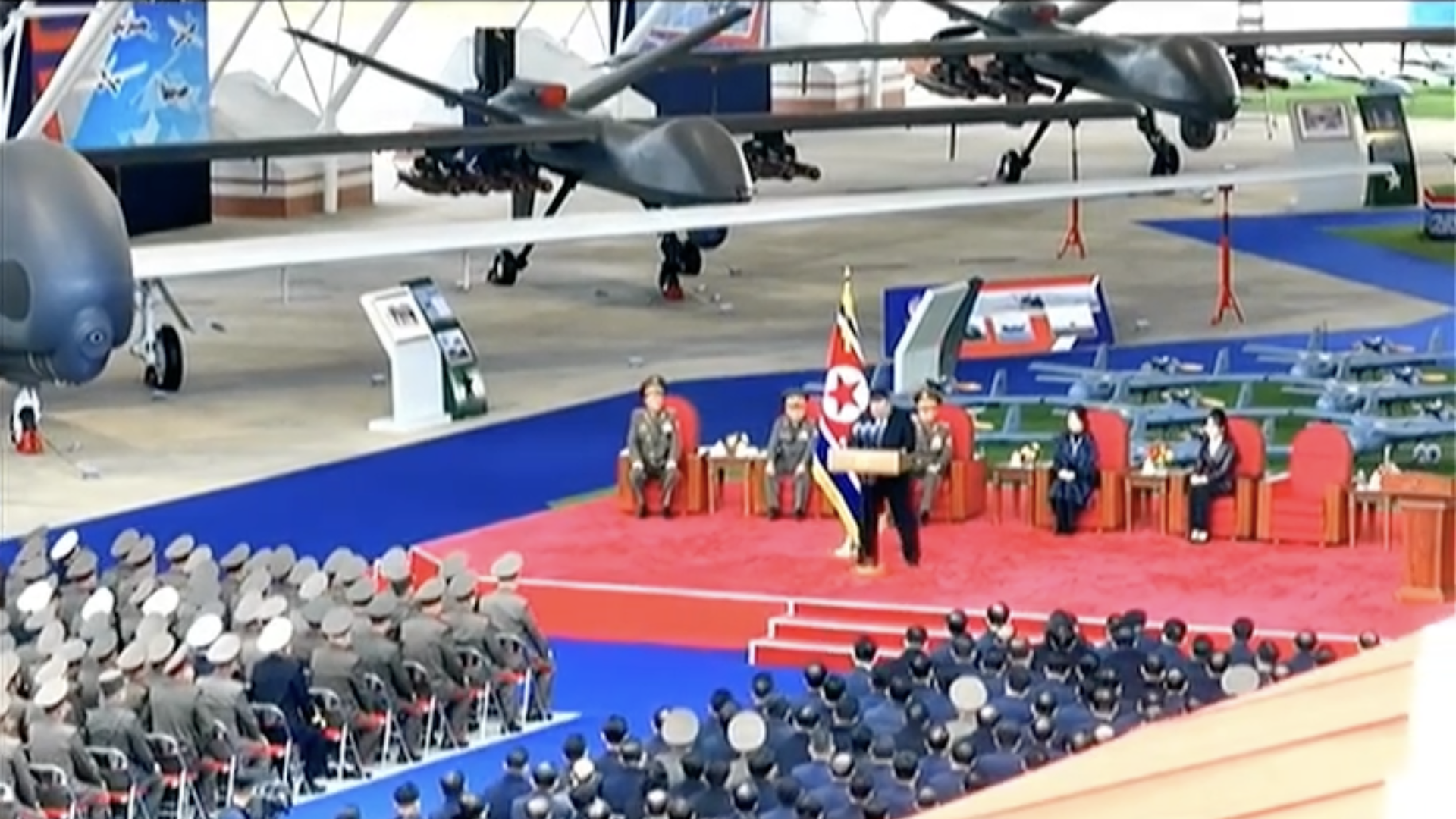
Looks familiar, huh?
The big picture: North Korea recently put on the Unmanned Aeronautical Technology Development-2026 exhibition.
- It featured plenty of drones big and small — including Global Hawk and Reaper lookalikes, a previously unseen uncrewed combat air vehicle, and quadcopters.
Zoom in: State media, citing leader Kim Jong-un, said seizing "absolute superiority in the drone technology is an indispensable option in the light of the ever-changing patterns of modern warfare."
More from Axios:
South Korea sets sights on nuclear submarine
Trump's perplexing North Korean nukes assessment
North Koreans gaining "experience" in Ukraine war, says U.S. commander
Shoutout to Jeffrey Cane for editing and Matt Piper for copy editing.
👋🏼 Thanks, as always, for reading and sharing. Tell your friends to subscribe here.
Sign up for Axios Future of Defense