Axios Future of Defense
May 14, 2025

Hello from Orlando International Airport, where I put the final touches on this newsletter.
- An evergreen reminder as militaries pop off: Don't fall for Arma 3 footage!
💸 Situational awareness: The U.S. on Tuesday agreed to sell Saudi Arabia an arms package worth some $142 billion. The White House said it spans five categories, including communications kit, maritime security and air and missile defense.
- My thought bubble: Also worth noting is the potential sale of CH-47F Chinook helicopters and equipment to the United Arab Emirates. That's worth $1.3 billion.
Here we go: TurbineOne's game plan, a look at StormShroud (not the World of Warcraft armor set), and African Lion details.
Today's newsletter is 1,928 words, a 7.5-minute read.
1 big thing: Nukes' $1 trillion price tag

It's going to cost nearly $1 trillion to operate, maintain and upgrade America's nuclear arsenal over the next decade — more per year ($95 billion) than what's spent on many federal agencies.
Why it matters: That eye-popping estimate from the Congressional Budget Office is catnip for critics, who argue Washington is spending blindly or that portions of the triad are vestigial.
Driving the news: The combined 2025-34 nuke plans of the Defense and Energy departments amount to $946 billion.
- In what have been a few wild days for the nuke-watching world — including India-Pakistan clashes and the U.S. Air Force saying it needs new silos for its already delayed and over-budget Sentinel missiles — the dollar figures jump out.
What they're saying: "The huge expenses tallied in this report were not anticipated at the outset of the nuclear modernization program," said Greg Mello, the director of Los Alamos Study Group, which monitors National Nuclear Security Administration sites and activities.
- "There will be no return to the 'heroic mode of production' for nuclear weapons," he added.
- "Even if Congress dumped $100 or $200 billion more on nuclear weapons, the system that produces them would not 'jump to the task' for years, if at all."
My thought bubble: There's a lot on the table, even if you ignore requisite infrastructure upgrades at places like the Savannah River Site. Sentinel. B-21 Raider. Long-Range Standoff Weapon. Columbia-class submarines.
What we're watching: Where today's obsession with cheap mass (drones and artillery shells, for example) clashes with revered and rarely used stockpiles.
- Nuclear acquisition programs represent almost 12% of the Defense Department's planned buying costs over the next decade, according to the CBO. That means DOD will have to make "difficult choices about which programs to pursue."
- Arms Control Association executive director Daryl Kimball in a piece this month said "skyrocketing" prices siphon resources from "other more pressing human needs and national security priorities."
Yes, but: There are businesspeople who think it can be done more effectively.
- "What we see here is the really strong need for the U.S. government, specifically on the topic of nuclear deterrence, to look at opportunities to work with" the private sector, JC Btaiche, the founder of Fuse, told me.
- Fuse seeks to be the "new nuclear-security prime," as Btaiche put it. Its advisers include Lisa Gordon-Hagerty, the former NNSA boss, and retired Adm. Charles Richard, once the head of Strategic Command.
The bottom line: "The current trend is only going to continue to increase costs and delay timelines," Btaiche said, "and we just cannot afford to do that as a country."
Go deeper: A new nuke wave washes over the world
2. Exclusive: TurbineOne eyes intel

Software specialist TurbineOne plans to expand into the U.S. intelligence community and build an overseas footprint on the heels of a $36 million funding round, CEO Ian Kalin told me.
The big picture: The company is already working with the Army, Air Force, Navy and Marine Corps in the Indo-Pacific.
- It's now angling toward the National Geospatial-Intelligence and Defense Intelligence agencies of the world.
- Five Eyes countries — U.S. allies Australia, Canada, New Zealand and the U.K. — are especially attractive, according to Kalin.
State of play: TurbineOne's flagship offering, the Frontline Perception System, works like a search tool, streamlining surveillance and targeting at a time when militaries are awash in data and seeking improved connectivity.
- "Our biggest competition is manual labor," Kalin said. "If you have enough bodies to throw at more screens, and you can just keep throwing 25-year-olds to zoom and scroll all day, you don't need me."
- He does not anticipate making major alterations to FPS as the company hops between sectors.
- "That's the difference from the manufacturing companies of national security: If you're going to sell more missiles, you have to get a new factory. We're not like that."
What they're saying: TurbineOne's approach to "AI-enabled threat detection and classification, which can operate without relying on cloud infrastructure, has proven to be highly effective and is the type of capability we need for multi-domain operations," said Jessica Todd, who leads the Joint Staff J7's future technology office.
Follow the money: The company, founded in 2021 and headquartered in California, is valued at $300 million.
- This most recent funding round was led by The General Partnership. Other backers included Bessemer Venture Partners and XYZ Ventures.
Go deeper: Tech race spurs U.S. investment in new defense suppliers
3. Across-the-pond CCAs
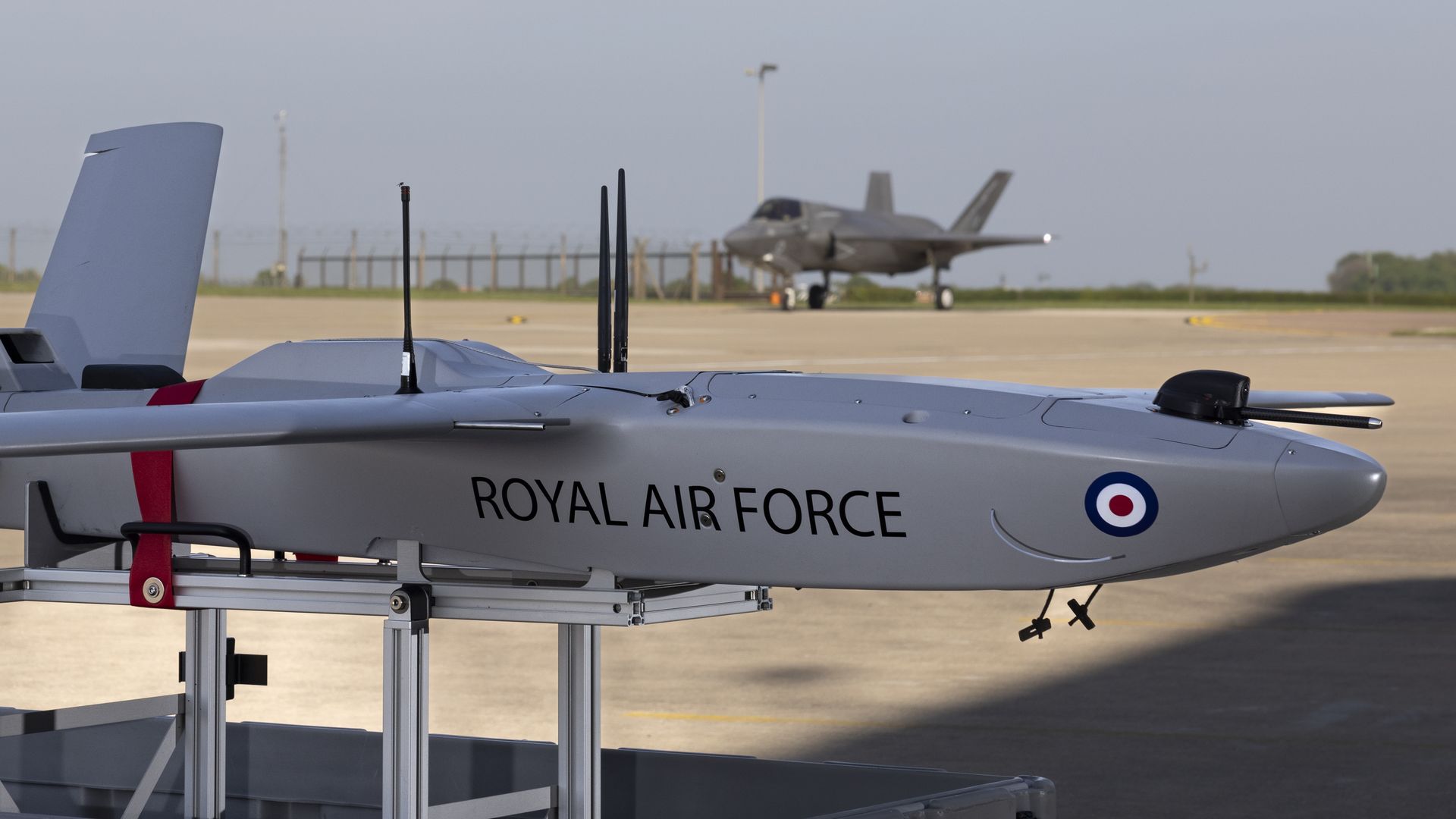
The U.K. launched StormShroud, drone wingmen designed to blind radars and draw fire away from far pricier, manned aircraft like the F-35 and Typhoon.
Why it matters: Human-machine innovation bounds ahead outside the U.S.
- The Royal Air Force will for the first time "benefit from high-end electronic warfare without needing crew to man it," the defense ministry and prime minister's office said in a joint statement.
State of play: StormShroud combines the Tekever AR3 unmanned aerial vehicle with the Leonardo U.K. BriteStorm electronic warfare payload.
- The AR3 has more than 10,000 hours of flight time in Ukraine.
- Research and development for the jammer began in 2017. Leonardo said it can also be mounted to missiles.
- Together, it's the first in a line of autonomous collaborative platforms (ACP) the military is anticipating.
Air Chief Marshal Sir Rich Knighton, chief of the Air Staff, in a statement described StormShroud's arrival as a "seminal moment."
- ACPs will "revolutionize how we conduct a range of missions," he added, "from intelligence gathering to strike and logistical support."
Zoom out: The U.S. Air Force is in pursuit of its own robo-wingmen known as collaborative combat aircraft.
- Ground tests for YFQ-42A, made by General Atomics, and YFQ-44A, made by Anduril Industries, are underway.
4. Exclusive: Zeno powers up

Zeno Power secured $50 million in its latest funding round. The nuclear-battery maker now plans to roughly double its workforce and do full-scale system demonstrations next year.
Why it matters: Energy is the chokepoint for so many national-security competitions. Persistent surveillance. Artificial intelligence. Troop wellbeing.
- "With great power competition rising, the ocean floor, Arctic, and lunar surface are becoming the front lines of global security and economic progress — but they remain energy deserts," CEO Tyler Bernstein told me.
Follow the money: The Series B was led by Hanaco Ventures. Other backers include Seraphim, Balerion Space Ventures and Vanderbilt University.
- The company's inked contracts with the U.S. Defense Department and NASA totaling tens of millions of dollars.
How it works: Zeno's batteries convert the decay of radioactive material into thermal and electrical power.
- It showcased a prototype at Pacific Northwest National Laboratory.
- It also locked in a strontium-90 fuel supply from the Energy Department. Applications range from subsurface operations on Earth to satellites in space.
The intrigue: John Richardson, a former chief of U.S. naval operations, joined Zeno's board of directors.
Go deeper: U.S. Army seeks better batteries as it battles the cold
5. Quick hits
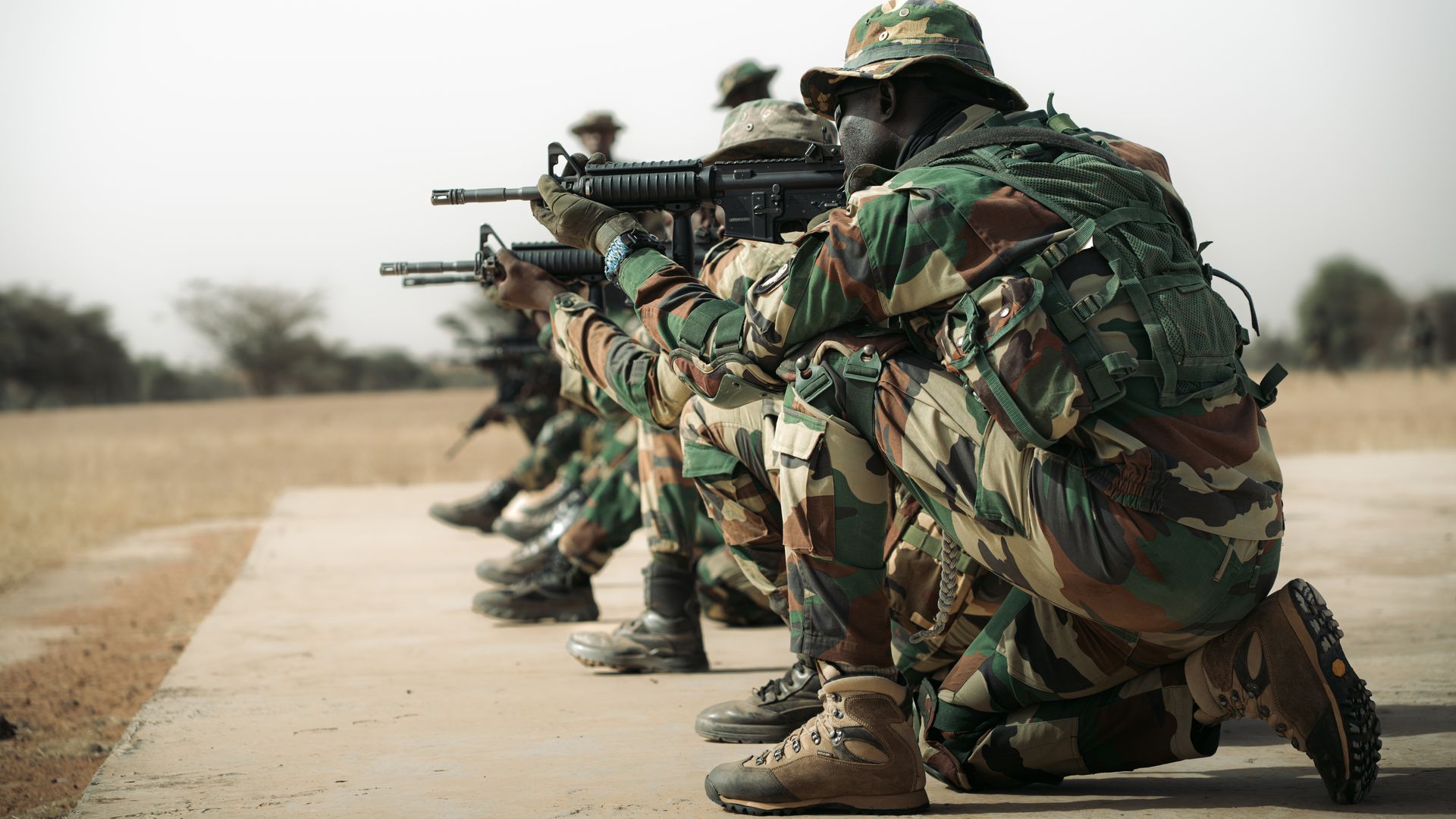
🦁 The African Lion exercise, led by U.S. Africa Command, is underway. It takes place in Morocco, Tunisia, Ghana and Senegal, and welcomes more than 10,000 troops.
- Why it matters: "African Lion demonstrates our ability to project combat power across Africa," U.S. Army Lt. Col. Hannah Williams said in a statement. "We don't just move — we position ourselves to respond rapidly and decisively alongside our partners."
- 💭 My thought bubble: Don't sleep on AFRICOM. Russian and Chinese influence courses through that continent.
🏭 Teledyne FLIR Defense cut the ribbon on a 13,000-square-foot facility in Kentucky.
- Why it matters: The new site will service Black Hornet nano-drones, which are employed by the U.S. Army, among dozens of other users.
- 💭 My thought bubble: I've been tracking Black Hornet for years. Proof? Click here.
📶 RTX completed the first flight test of its PhantomStrike radar. The company said it tracked "several airborne targets" and "accurately mapped" terrain while aboard the Multi-Program Testbed aircraft.
- Why it matters: A promotional video for PhantomStrike shows it embedded in fighters and drone wingmen. Hint, hint.
- 💭 My thought bubble: I'm always on the hunt for radar-related news. Send your stuff my way!
6. Axios interview: Tyler Sweatt

This week's conversation is with Tyler Sweatt, the chief executive at Second Front.
- He was the only person dressed more casually than me at the Atlantic Council's software-defined warfare event. Respect.
Why he matters: Sweatt's a former U.S. Army officer. He previously helmed national security work at CalypsoAI.
- His company's Offset Symposium kicks off Thursday.
Q: When you hear "future of defense," what comes to mind?
A: You do.
Q: When will wars be waged solely by robots?
A: I think that probably depends on how you define war and the waging of it. You could probably make a pretty convincing argument that, in certain aspects, we are already seeing it happen.
Q: What's a national security trend we aren't paying enough attention to?
A: It's domestic and it transcends party: The food, information, and energy that our younger generations consume, combined with how America views the passage of time. I think there is a very real chance we think we are playing a different game with a different clock than our adversaries.
- Reminds me of the quote about watches and time that we heard in Afghanistan — that the Americans have the watches but the Taliban has the time. I worry we are using the wrong time horizon for some conflicts.
Q: What region of the world should we be watching? Why?
A: Latin America. The amount of capital generated by cartels, connectivity to transnational criminal and terrorist orgs, mineral-rich soil and a limited focus from most national security news makes it the place I would watch.
Q: How many emails do you get a day, and how do you deal with them?
A: Entirely too many. I think about deleting all of them for about 15 minutes every morning and night, and then I read them. I use my inbox and calendar as my task management check, and zero inbox every Sunday.
Q: What time do you wake up? What does the morning routine look like?
A: 4:05 every morning I am home, which, unfortunately, hasn't been as much as I'd like the past few months.
- Look at the phone to make sure nothing caught on fire while I was sleeping. Have an Americano, and then I walk into the gym at 5, do a powerlifting class at 5:30, and by 7:30 I am dressed and ready for whatever comes next.
Q: What advice would you give your younger self?
A: Honestly? Probably to have more fun, make more mistakes. That and to come back like 10 minutes earlier on my 21st so I didn't get caught sneaking out at West Point.
7. Check this out

Missed our supply chain event last week? No sweat.
The big picture: We hosted Rep. Jack Bergman, a Michigan Republican; Rep. Jill Tokuda, a Hawaiʻi Democrat; and Gracelin Baskaran, the director of the critical minerals security program at the Center for Strategic and International Studies.
- Some key takeaways ...
✂️ Bergman believes the federal government is "morbidly obese," with red tape encroaching "upon the private sector's ability to do the things we need" to get done. On regulations, he wants to "kill them all."
⚒️ President Trump's deep-sea mining executive order "caused quite a splash back at home," according to Tokuda. "Our resources — our ocean — is very personal to us in Hawaiʻi."
🇨🇳 China developed an advantage through decades of effort, Baskaran said. "Growing up, when things said 'made in China' on the box, you kind of laughed and you were like, 'Oh, another thing made in China.' But what they really did was master the mine-to-market supply chain."
Shoutout to David Lawler for editing and Matt Piper for copy editing.
👋🏼 Thanks, as always, for reading and sharing. Tell your friends to subscribe, here.
Sign up for Axios Future of Defense