Axios Future of Defense
January 22, 2025

G'morning, everyone. Somehow it's still January.
- Soon it'll be time for WEST in San Diego. I'm going. Got pitches? Know the best spot for tacos de lengua? My inbox awaits.
💶 Situational awareness: The Estonian economic affairs and communications ministry announced a €100 million defense fund designed to springboard domestic tech and NATO-aligned companies.
- My thought bubble: This is good news for a country already considered a cyber hotbed. Ukraine, too, will benefit.
Available: SPY-7s for Spain, a letter to DOGE and a chat with General Catalyst's Paul Kwan.
Today's newsletter is 1,680 words, a 6.5-minute read.
1 big thing: Directionless energy

After wandering the halls of the Surface Navy Association's conference last week, there is one thought I can't shake off.
- The U.S. Navy seems stuck when it comes to directed-energy weapons, which have their limitations but can help fend off unmanned aircraft, missiles, mortars and more.
Why it matters: Those munitions are already pounding the Red Sea and Ukraine, and would figure prominently in any conflict with China over Taiwan.
- The Pentagon cannot afford to always blast $20,000 drones slapped together in a garage with multimillion-dollar missiles that take weeks to manufacture.
- The polite way of discussing this is by citing the "cost curve."
Driving the news: At a breakfast on the sidelines of the conference, Fleet Forces Command boss Adm. Daryl Caudle told reporters he was "embarrassed" by the absence of directed energy on U.S. warships.
- "We've literally been messing with this since I was in postgraduate school, since the Strategic Defense Initiative under" former President Reagan, he said.
- Pressed, Caudle offered: "I just think sometimes something can stare us right in the face, but we just don't go do it."
- It's "one of those things that either industry, politically, leadership — we're just not on the same page of getting behind it with a sense of urgency and making it ready to go."
My thought bubble: The candor is appreciated.
- Directed-energy success requires, much like other products, clear and consistent demand from buyers.
- It also wants for a shored-up supply chain. These weapons require pricey components and specialty materials, such as germanium and gallium.
State of play: The Pentagon has recently spent $1 billion annually developing directed-energy weapons, sometimes shortened to DEW.
- Dozens of projects are underway, according to an Emerging Technologies Institute study published last January.
- Eight were publicly traced to the Navy; nine to the Army (including the closely watched Directed Energy Maneuver-Short Range Air Defense and Indirect Fire Protection Capability-High-Power Microwave); and another nine to the Air Force.
- The Marine Corps recently pulled the plug on its Compact Laser Weapons System, according to the Laser Wars blog, written by Jared Keller.
What they're saying: "I stood here last year and said I was not satisfied with the progress on directed energy, and after a year of repairs, fleet experiments, site visits and lots of learning, I'm still dissatisfied," Vice Adm. Brendan McLane, the top surface warfare officer, told conference attendees.
The other side: The U.K. defense ministry last year announced successful tests of the DragonFire laser, said to cost £10 per shot, and a separate laser mounted to a Wolfhound troop carrier.
- MBDA and QinetiQ are involved with the former. Raytheon UK is involved with the latter.
What's next: Lockheed Martin this year hopes to squeeze in at-sea trials of its High-Energy Laser with Integrated Optical-dazzler and Surveillance. It's installed on the guided-missile destroyer Preble, based in Japan.
- "We've tested it on land. We believe it works really well," Paul Lemmo, vice president of integrated warfare systems and sensors, told me.
- "We shot down some simulated cruise missiles."
The bottom line: This juggle is at the heart of this newsletter's existence.
- The future of defense is a tug of war between comfortable tradition and shocking sci-fi.
2. Exclusive: Japan wants the V-BAT
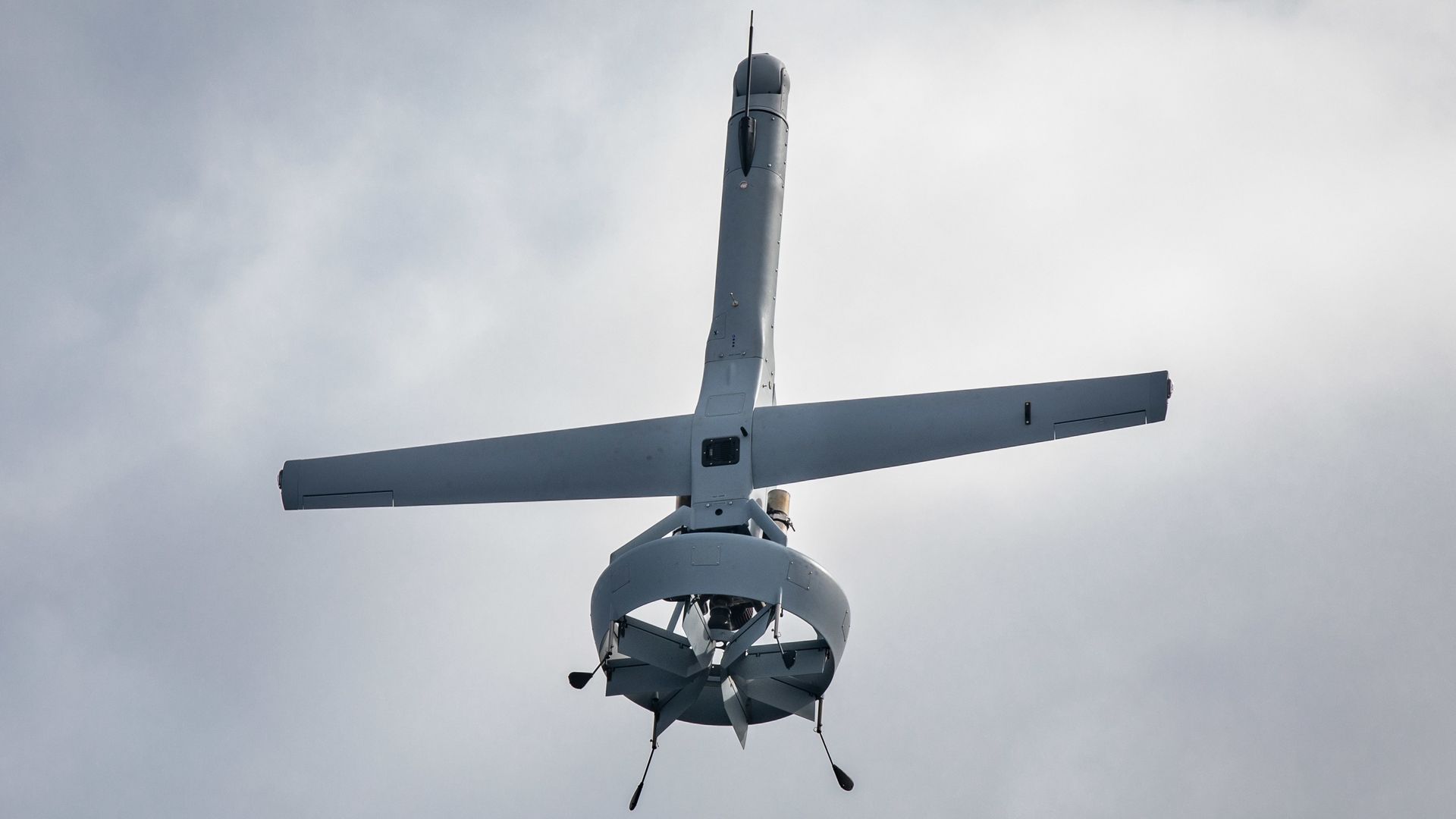
Shield AI's V-BAT will be the first-ever shipboard drone used by the Japanese navy to collect intelligence and surveil faraway targets.
Why it matters: Shield is placing big bets on the international board. It opened an office in Kyiv, Ukraine, and months ago announced V-BAT production plans in India alongside a $90 million investment from JSW Group.
- Meantime, the U.S. and Japan are drawing closer, despite recent beef over U.S. Steel.
Zoom in: The Japan Maritime Self-Defense Force is buying multiple V-BATs for its program of record, with deliveries beginning early this year, Shield cofounder Brandon Tseng told me.
- "They're building out their forces again," he said. "You can't be a $40 million drone in this day and age ... because those things are vulnerable."
- The vertical-takeoff-and-landing drone can carry dozens of pounds, fly for hundreds of nautical miles and pack into the back of a pickup truck or Black Hawk helicopter.
Flashback: The U.S. Navy launched a V-BAT off a Seahawk autonomous vessel during the Integrated Battle Problem exercise in 2023.
What's next: This deal could snowball in Shield's favor. Success with naval forces could easily garner attention elsewhere.
- Tseng said the deal feeds into the company's "campaign to support the Indo-Pacific region" amid China's ballooning ambitions.
3. Next-gen networks
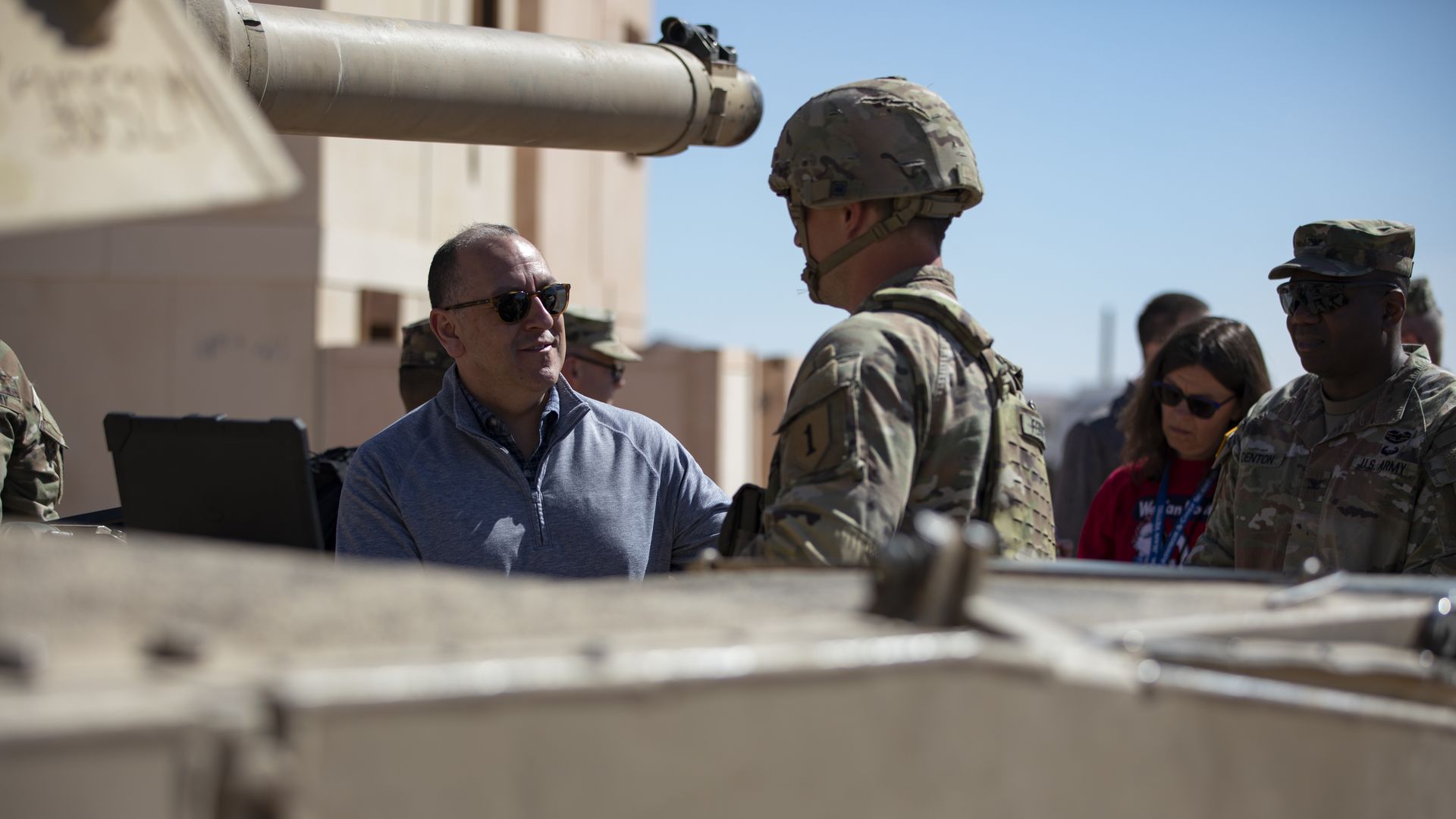
Few people get as animated about the U.S. Army network as Gabe Camarillo.
- It comes as little surprise, then, that on his last day in the undersecretary's office, he told me Next-Generation Command and Control is what he's most excited about.
Why it matters: The service has for years sought to make more intuitive its software while also insulating its precious data from interception, hijacking and other interference.
- "We know that we're going to have to become much more mobile in the future on the battlefield," Camarillo told me in the exit interview. "We have to reduce our electromagnetic signature."
- Success has been fleeting. Years of siloed projects and one-offs are partially to blame.
The latest: The Program Executive Office for Command, Control, Communications and Network on Jan. 13 published a request for information for NGC2.
- It emphasized that there will be no single, overbearing winner. Instead, it wants competing teams and point people that can be held to account if and when deliveries slip.
This different approach, Camarillo told me, "is going to be a game-changer" that not only lets the Army "very quickly field modern capabilities in the next year" but also "continuously upgrade these tools moving forward."
- In 2022, he pushed for a review of the network portfolio, including cybersecurity, cloud adoption and tactical radios.
My thought bubble: Chief of Staff Gen. Randy George was right to prioritize networking and underline its importance at the annual Association of the U.S. Army conference.
- So much hinges on the ability to collaborate, both on the front lines and back home.
Zoom out: Camarillo leaves after serving as the Army's civilian No. 2 for three years.
- He told me the service is more ready, better armed and overall healthier than when he first showed up, all while contending with flat budgets.
- "There are game-changing technologies, whether it's the use of AI, machine learning, autonomous systems — all these things that we have talked about for many years and have shown up on briefing charts," he said.
What's next: An NGC2 request for proposals is expected next month. Contracts could come in May.
- Camarillo, meanwhile, will be hanging out with his 7-month-old child. Don't expect him to stray too far from defense, though.
4. Quick hits

🛬 President-elect Trump picked Troy Meink for U.S. Air Force secretary, breaking with prior selections. He currently serves as the principal deputy director at the National Reconnaissance Office.
- Why it matters: Meink is a Defense Department and intelligence community insider with deep technology and acquisition know-how.
- 💭 My thought bubble: Selecting someone with so much space flair is no accident. Trump created the Space Force years ago. Now he's beefing it up.
📡 Lockheed Martin in testing successfully tracked airborne objects using a SPY-7 radar developed for Spain's five-ship F-110 Multi-Mission Frigate project.
- Why it matters: This is a critical benchmark for the program and Spain's seapower, more broadly.
- 💭 My thought bubble: Interested in radars? Then it's also worth monitoring Lockheed's work with Japan on Aegis System Equipped Vessels.
📬 In an open letter to the Department of Government Efficiency, L3Harris Technologies CEO Chris Kubasik lamented government bloat and floated four policy recommendations, including reforming contract protests.
- Why it matters: This is an opening salvo. Companies will be vying for the Trump administration's goodwill for the next four years.
- 💭 My thought bubble: DOGE is already in turmoil, with the departure of Vivek Ramaswamy. In December he told Axios' Mike Allen the U.S. needed more drones and hypersonic missiles.
5. Axios interview: Paul Kwan

This week's conversation is with Paul Kwan, a managing director at General Catalyst.
Why he matters: Kwan leads the investment firm's global resilience team focused on defense, energy and industry.
- Companies he's worked with include software-and-drone maker Helsing and information warfare specialist Vannevar Labs.
Q: When you hear "future of defense," what comes to mind?
A: The urgent need to modernize America's defense and industrial base to face a military, economic and technological superpower the likes of which we haven't seen since the British Empire.
Q: When will wars be waged solely by robots?
A: It's going to be longer than we expect on the robot dogs, robot drones fighting each other. What I'm much more worried about is AI fighting AI, which may not be as clear-cut. Who's fighting who?
Q: What's a national security trend we aren't paying enough attention to?
A: Biodefense. Most venture capitalists, myself included, don't spend enough time on it.
Q: What region of the world should we be watching? Why?
A: Everyone talks about Asia and Taiwan. I think what you want to be watching is possible conflict — stress — around Southeast Asia.
Q: What's your secret to a successful overnight flight?
A: Find a really nice gym and buy a day pass. It's the best way to get a free shower. That is a critical hack.
- I'm not going to tell you the one I go to, because then you'll grab my day pass, right?
Q: What time do you wake up? What's the morning routine look like?
A: 6:45am, and it's not that exciting, because I'm dealing with dogs and teenagers.
Q: What are you currently reading, or what's a book you'd recommend?
A: This is an awesome read. I feel really good about recommending this to everyone.
- "By All Means Available." Mike Vickers. CIA. An insane book about military strategy in the modern era.
6. Check this out

Name something more D.C. than this. I'll wait.
By the numbers: Roughly 7,800 National Guard troops were tapped for President Trump's second inauguration.
Zoom in: They rocked colorful patches displaying a minuteman in front of the Capitol.
- Stitched beneath: "Always ready, always there!"
Shoutout to Nicholas Johnston for editing and Matt Piper for copy editing.
👋🏼 Thanks, as always, for reading and sharing. Tell your friends to subscribe, here.
Sign up for Axios Future of Defense