Axios Future
November 06, 2021

Welcome to Axios Future, and happy birthday on Sunday to my wife Siobhan!
- This year I promise the celebration won't involve an unplanned oil change in Great Barrington, Mass.
If you haven't subscribed, wait no longer.
- Send feedback, tips and alternate words of the year (see item No. 6) to [email protected].
Today's Smart Brevity count: 1,674 words or about 6½ minutes.
1 big thing: The obstacles to building our way out of climate change
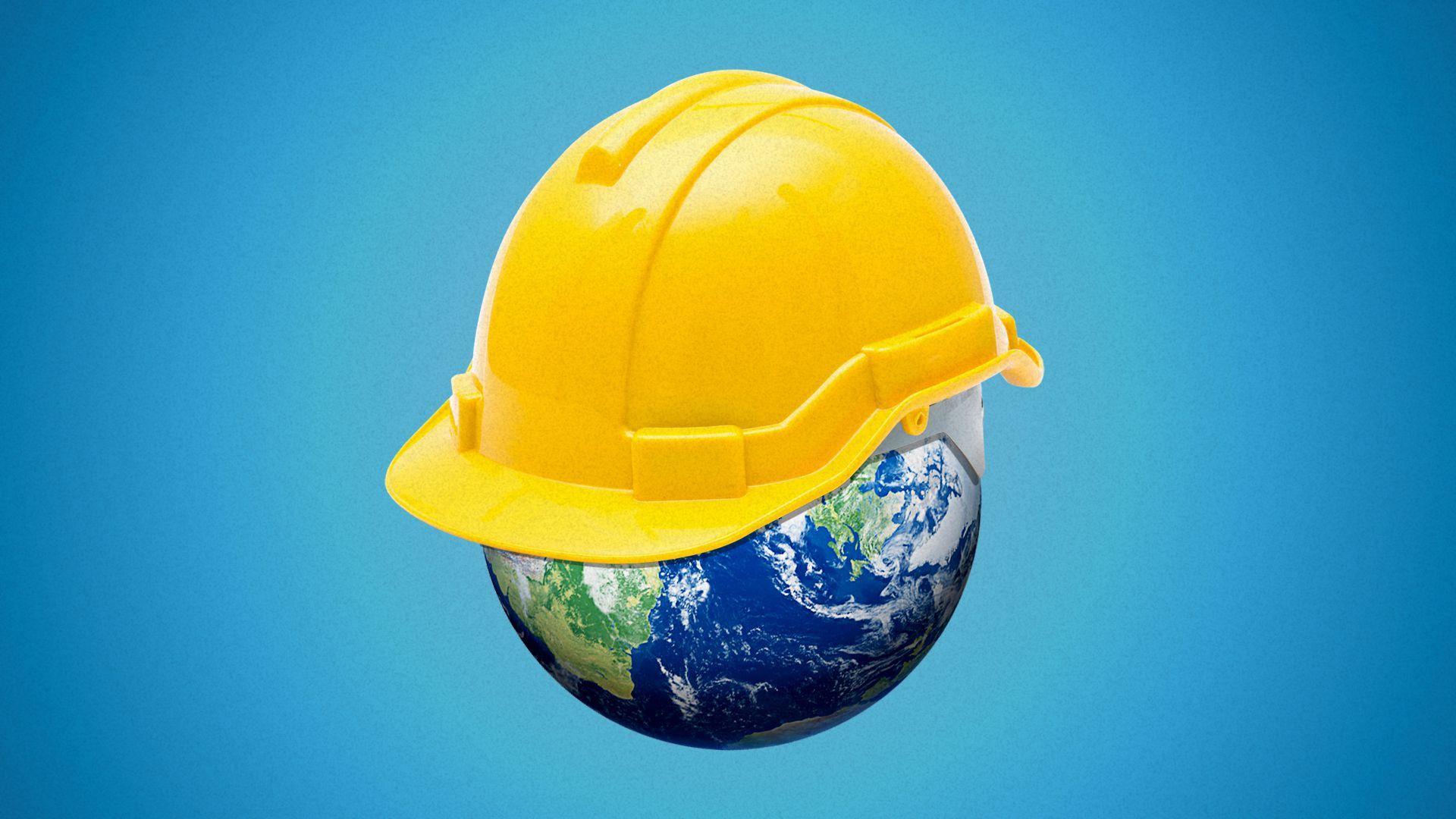
Illustration: Megan Robinson/Axios
Averting catastrophic climate change — while ensuring economic growth for the world — will require renewable energy and carbon removal projects on a massive scale.
Why it matters: There's strong ingrained public resistance to big infrastructure projects, including among many environmentalists.
Driving the news: On Friday at the UN climate summit in Glasgow, the U.S. Department of Energy announced it will launch a major research effort to bring the cost of carbon removal below $100 a ton by 2030.
- That's good news for the climate, as the UN Intergovernmental Panel on Climate Change has calculated the world may ultimately need to remove 100 billion to 1 trillion tons of CO2 by the end of the century to keep temperature rise below 1.5°C.
- But beyond the scientific challenge of vastly reducing the cost of effective carbon removal — which is currently as much as $2,000 per ton — achieving it on a massive scale would require building out an entirely new kind of energy infrastructure.
- An academic consortium last year calculated that using nature-based solutions would require setting aside land several times the size of Texas, while relying on direct air-capture of CO2 would demand as much as a third of today's global energy use.
By the numbers: A study last year found that reaching net-zero emissions in the U.S. by 2050 using existing technology would potentially require tripling electricity transmission systems and it would take up 10% of the country's continental land.
- When the U.S. and other countries make their pledges at Glasgow to sharply cut carbon emissions, they're implicitly promising to embark on the massive building spree needed to remake a 150-year-old grid in just a few decades.
- "You're creating whole new supply chains that don't exist, and you're trying to do it in a very fast time," says Daniel Yergin, author of "The New Map: Energy, Climate and the Clash of Nations. "That means transitioning from Big Oil to Big Shovel."
The catch: The development required for net-zero carbon is increasingly meeting local resistance on the ground, including from people who identify as environmentalists.
- On Tuesday, people in Maine voted against a $1 billion, 145-mile energy transmission project that would bring clean Canadian hydropower to New England, on the grounds it would disrupt the state's woodlands.
- That vote came a few months after plans for what would have been the U.S.'s largest solar plant — providing enough daytime electricity to power 500,000 homes — were scrapped because of complaints the 14-square-mile project would damage the Nevada desert.
- Expanding offshore wind development is a key part of the White House's climate plans, but actually building it has repeatedly run into local resistance.
- Making it easier and cheaper to live in dense urban areas is an immediate way to shrink carbon footprints, but NIMBY movements ("Not In My Backyard") and regulations have helped keep the most productive U.S. cities from sufficiently expanding housing supply.
What they're saying: "Sooner or later, you need to start building things," Ted Nordhaus, executive director of the Breakthrough Institute, wrote last year.
- "And those things will have impacts — on people and places and wildlife — that can’t be hidden away behind all those distributed solar home systems."
2. New COVID pill shows the need for widescale testing

Illustration: Eniola Odetunde/Axios
Pfizer's new COVID-19 antiviral is highly effective when given early in the course of an infection — underscoring the importance of cheap, easily accessible COVID-19 tests, including at-home rapid versions.
Driving the news: Pfizer's oral antiviral drug reduced the risk of hospitalization or death from COVID-19 by 89%, according to interim results from a mid-to-late-stage study announced by the company on Friday, my colleague Rebecca Falconer writes.
- Notably, that protection came when treatment began within three days of developing symptoms.
- Other treatments have shown success in preventing death among hospitalized COVID patients, but Pfizer's pill keeps them out of the hospital altogether — provided it's given in time.
The big picture: Getting the most out of treatments like Pfizer's will require ensuring that people can easily and regularly get tested — or test themselves — for COVID-19.
- The catch: More than 18 months into the pandemic, the U.S. is still struggling to manage testing — both lab-based PCR tests and rapid, at-home diagnostics.
Between the lines: An investigative piece published by ProPublica this week outlined the regulatory failures and lack of public support that delayed at-home tests in the U.S. for months and have kept them expensive and hard to find since.
- The U.K., by contrast, provides up to seven free at-home tests for people who can't get tests at work or home, while Germany long provided such tests free of charge.
- While the Biden administration has invested billions to expand the supply of rapid tests, diagnostics are still limited and costly, and vaccine mandates — which often include a regular screening option — will further stress supplies.
3. Study: Benefits of in-person school outweigh COVID risks

Illustration: Sarah Grillo/Axios
A new study looked at COVID-19 spread among schools and found that kids can safely remain in class with the proper mitigation measures.
Why it matters: The toll of learning loss due to the pandemic has been enormous.
- With vaccines now approved for almost everyone older than 4 — and clear evidence that spread can be controlled in schools — classes should be able to remain open.
What's happening: In a perspective published in Science on Thursday, researchers in the U.K. reviewed studies from around the world on the impact of COVID-19 on children and the extent of spread in classrooms.
- The researchers noted initial research found children "represented only a tiny fraction of total cases, hospitalizations, and deaths due to COVID-19 and invariably developed mild, transient, and self-limiting illnesses."
- Further research found children were as likely to be infected as adults but less likely to transmit, and studies of schools that reopened with mitigation measures like masks and social distancing found outbreaks were limited both in classrooms and in the wider community.
What they're saying: "Although school closures may contribute to reducing transmission, by themselves, they would be inadequate in preventing community transmission and, consequently, the benefits of in-person schooling outweigh the risks," the researchers wrote.
By the numbers: A McKinsey analysis from July found the pandemic left students on average five months behind in math and four months behind in reading by the end of the 2020-21 school year, with worse effects on students in majority Black schools.
4. How to predict the future(s)

Illustration: Sarah Grillo/Axios
We live in interesting times, but scenario planning can help us make sense of the uncertainty to come.
Why it matters: Accurately predicting the future is impossible — who do you think you are, Hari Seldon? — but scenario planning can help governments and businesses prepare for the different possibilities that could be coming our way.
How it works: Scenario planning is a forecasting method that involves not making predictions per se, but "making decisions in the face of uncertainty," says Peter Schwartz, senior vice president of strategic planning at Salesforce.
- Instead of locking in on one possible future, scenario planners develop multiple different possibilities and try to tease out how decisions made in the present can make those scenarios more or less likely to come true.
- "It gives me guidance for making my decisions in the face of really fundamental uncertainty," says Schwartz, who has worked in the field for nearly 50 years.
Context: In September, Schwartz worked with Accenture Research and economic, policy and health experts to develop scenarios for navigating what he calls "the pandemic era."
- The top line scenario is "the uplift": a return to robust global economic growth, assuming COVID containment improves, inflation doesn't spiral out of control, no variant worse than Delta emerges, and geopolitical tensions don't tighten.
- Schwartz views the uplift scenario as "quite plausible" — in part because of continued progress against the pandemic — though he worries about the X-factor of inflation.
The other side: Should inflation keep rising, it could lead to a global shakeout, and possibly a recession — though even here, Schwartz and his colleagues foresee an ultimate recovery.
5. Worthy of your time
Did COVID change how we dream? (Brooke Jarvis — New York Times Magazine)
- Hold on — everyone else has actually managed to sleep over the past 18 months?
Drone used in attack on U.S. electrical grid last year, report reveals (David Hambling — New Scientist)
- In which physical attacks on the grid get an upgrade from simply shooting at it with an AK-47 (which has also happened).
"Yeah, we’re spooked": AI starting to have big real-world impact, says expert (Nicola Davis — The Guardian)
- It's never a good thing when AI scientists start comparing their field to nuclear physics in the run-up to the Manhattan Project.
Questionable decisions in the metaverse (Damon Beres — Unfinished)
- My former Medium colleague has launched an excellent newsletter around tech and society. This week: Why the metaverse is about money.
6. 1 lexicographer thing: Words of "an unprecedented year"
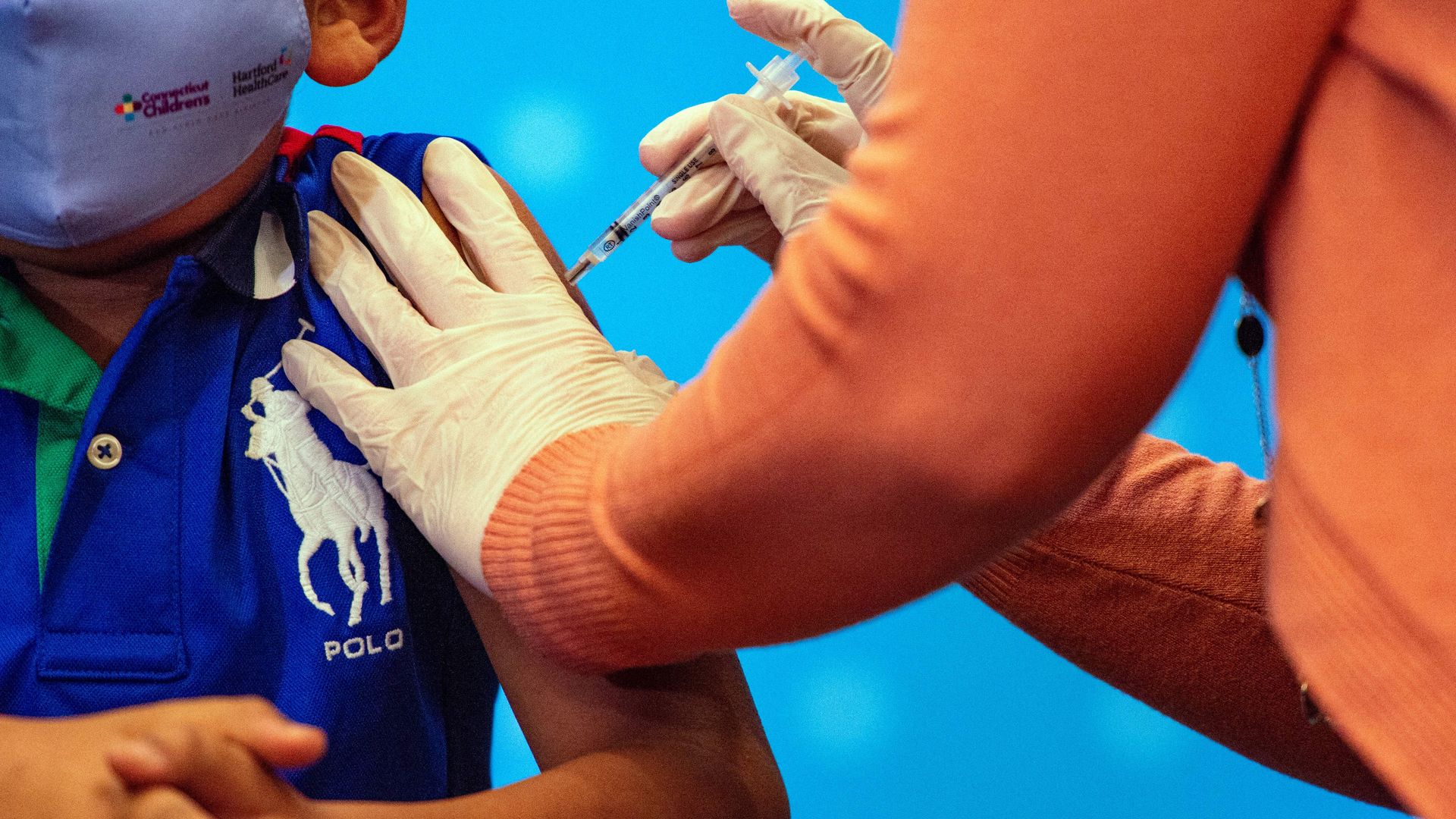
A 6-year-old child gets the Pfizer COVID-19 vaccine in Hartford on Nov. 2. Photo: Joseph Prezioso/AFP via Getty Images
The company that publishes the Oxford English Dictionary has named "vax" 2021's word of the year.
Why it matters: It seems the least that could be done for one of the most important health innovations in recent time.
By the numbers: The word "vaccine" — already very common — more than doubled in frequency between September 2020 and September 2021, while usage of "vaccinate" and "vaccination" increased 34-fold and 18-fold, respectively.
- The word "vax" — which first appeared as a noun in the 1980s before primarily becoming a verb in the early 21st century — was relatively rare until 2021, but usage increased 72-fold over the past year.
Between the lines: The vaccination debate also gave rise to an array of neologisms, including new coinages like "the inoculati," "anti-faxxers," "vaxxies," and, unfortunately, the "Fauci ouchie."
- International differences abound — the English primarily use the term "jab" for a vaccine shot, though American usage of the word rose this year, while Scots like to use the term "jag," I guess to be different.
Please use these words in a sentence: "Now that I've gotten my second jab and my Fauci ouchie has healed, I'm officially double-jagged, allowing me to join the ranks of the inoculati."
Sign up for Axios Future

Spot the mega-trends impacting our world