Axios Future
October 04, 2018

Welcome back to Future. Thanks for subscribing. Consider inviting your friends and colleagues to sign up. And if you have any tips or thoughts on what we can do better, just hit reply to this email or shoot me a message at [email protected].
Okay, let's start with ...
1 big thing: Machine debate
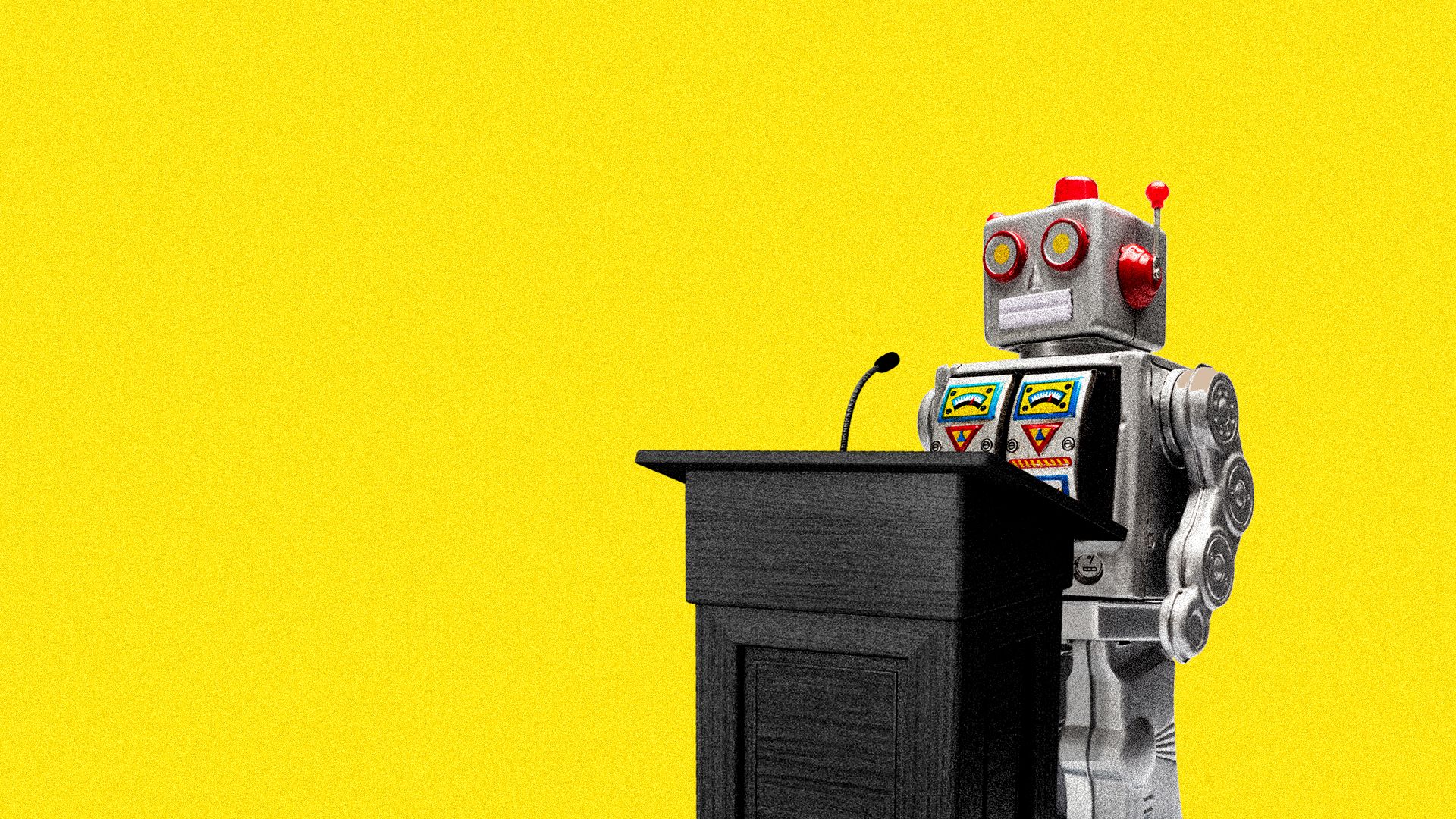
Illustration: Sarah Grillo/Axios
Siri or Alexa can get you the weather, but don’t expect a conversation. Neither can chatbots, once the next big thing, hold a back-and-forth. But researchers are now developing systems that leapfrog chit-chat to the next frontier: They can argue and play devil's advocate, Axios' Kaveh Waddell writes.
Why it matters: Researchers are striving to make machines that can converse knowledgeably with humans and explain how they reach their conclusions. In the absence of advanced AI that can think intelligently, this system is another step in that direction.
What's going on: The field that works on such systems is called "computational argumentation." This summer, a roomful of journalists watched a demonstration in which two human debaters argued with a talking computer, produced by IBM, that used AI-infused computational argumentation to deliver speeches and rebut its opponents’ claims.
Axios spoke with six researchers behind IBM's "Project Debater" to learn how it works, and to track the state of the art in language understanding.
- IBM has gotten a black eye in recent years for — in its critics' view — hyping the promise of its AI in flashy demos, then underdelivering. A particular target has been Watson Health, which IBM sells to hospitals.
- But IBM says the debater is more of a proof-of-concept at this stage, without a current marketing plan.
The context: AI researchers are prone to using games to measure their progress. In 2011, Watson beat a pair of humans at Jeopardy. In 2016, a Google-developed AI system beat the reigning human champion at Go.
- This summer's live debate was a test in the same tradition — but differed in some meaningful ways, said Noam Slonim, who leads the six-year-old IBM debate project.
- A live debate has no clear rules, nor a point system to determine a winner. At best, you can poll a human audience to see which side was most convincing.
- Plus, the art of arguing is built around the subtleties of human speech, a complex beast that computers still have trouble parsing.
"Humans invented language and it's probably the most sophisticated thing we've done so far," said Salim Roukos, an IBM researcher focused on natural language processing.
- To teach the machine, the researchers fed it millions of articles, hundreds of recorded speeches, countless hours of crowdsourced work, and a network of background knowledge.
How it works: The IBM machine picks out factual statements from academic journals and news stories, and arranges them into themes and whether they support or oppose a particular stance.
- Once it’s assigned a debate question, the system assembles a short speech comprised of what — according to the algorithm — are the best arguments and evidence for its side.
- Then, after human opponents make their argument, it identifies the main claims and rebuts.
The entire system is a hodgepodge that combines AI techniques with an extensive collection of knowledge and rules. Some experts say such hybrid systems are the future of AI.
- To make its case, Project Debater can choose from a long list of "principled arguments" that supposedly appeal to human nature. For instance, when the question at hand is about banning something, it can argue that it would spark a black market. If it’s about requiring that people do something, the debater can warn of a resulting backlash.
- The result can seem mechanical and reflexive. To know when to deploy which argument, the system relies on pattern-matching, reaching into its database of recorded debates to guess which argument a human would choose in each situation.
- It should know, for example, that it doesn’t make sense to argue that a ban on public breastfeeding could lead to the creation of a black market, said Ranit Aharonov, the global manager of Project Debater.
IBM’s work on detecting claims and points of view is promising, said Sean Gourley, a former NASA engineer who founded a company focused on natural language.
- These are two difficult problems "right at the edge" of the field, he said.
- But he questioned whether the the work would ever go beyond "performance art pieces."
Reality check: The debater, while handy at marshaling and conveying arguments, is not "intelligent" in a human sense. It does not reason. Like the machine that beat Garry Kasparov, it rather muscles its way through mounds of data, without any real thinking at all.
Editor’s note: An earlier version of this article said Project Debater was developed by IBM Watson. It was developed by IBM Research.
2. A ground view of youth voting
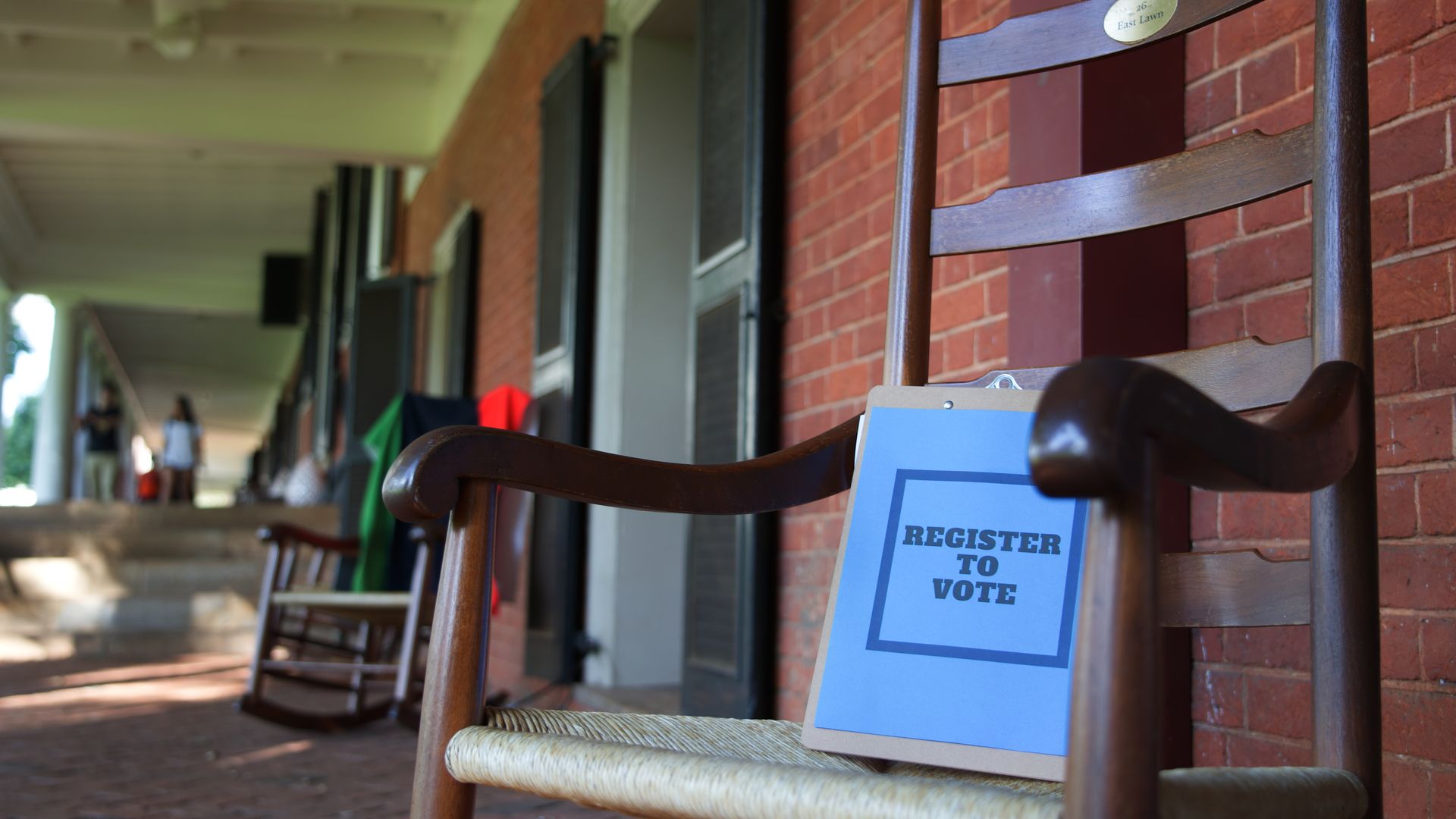
Today near the central lawn at the University of Virginia. Photo: Max Patten
Last week, we wrote about a reported surge in youth voting in U.S. battleground state primaries — at least in part due to the "Parkland effect," a result of the registration campaign by high school students seeking stricter gun laws.
Driving the news: How energized voters aged 18–29 are is a major preoccupation. If they turn out on Nov. 6 in larger numbers than usual, they could be decisive in close races.
- For an early snapshot of the landscape, Max Patten, a freshman at the University of Virginia, did a survey for Axios on the campus' central lawn on Sept. 25, National Voter Registration Day.
- The location is important: Virginia is a key battleground state, and Charlottesville — the scene of a deadly August 2017 march by white supremacists — is a major fault line in the divided nation.
- It's also in a congressional district that could flip: President Trump won the district by 5 points in 2016, but Real Clear Politics rates it a toss-up.
Patten writes of his thinking prior to the survey: UVA "is known for a strong emphasis on tradition and conservative values. ... Will students here be likely voters in midterms, and will they even vote left?"
Riley Creamer, secretary of College Republicans in Virginia, told Patten in an email that “most newly registered voters will be Democrats.”
By the numbers: What Patten actually found:
- 28 of 31 students surveyed were registered to vote.
- 21 — 75% of those registered — said they will probably vote Nov. 6.
- In terms of leanings, 16 of 31 students — just over half — identified as Democrats, and all but one said they would probably vote. Just four said they were Republican. The eight who saw themselves as moderates or independents identified as the least likely to show up.
The bottom line: Patten said he expected to hear much of President Trump. But, he said, "[t]he students never (with the exception of 1) mentioned Trump by name but took views strongly contrary to him on the issues they mentioned."
3. Mailbox: The triple wave
Illustration: Sarah Grillo/Axios
Monday's special report on the world's uncertain new age resulted in unusually high reader response. Here are excerpts from a sample of them.
The "anger" across the West is a created thing, with malice aforethought. Large numbers of people don't just get angry. Though things have not been perfect and we in the West do have challenges for the future, we have had it pretty damn good. And generally it takes a helluva lot to get up in arms about anything. One could easily say complacent. But again, complacent people don't all of a sudden begin spewing hatred and bigotry at each other without a lot of work to make them that way. What's being stoked is not just discontent. It is rage. And it's artificially produced.
But don't take my word for it. I strongly recommend that you watch the documentary Active Measures.
—Martin Maudal, Wrightwood, California
The three forces are looking at only the right wing’s concerns. The Left, internationally, would argue that widening economic gaps between classes, environmental devastation, and austerity are the driving forces. Would there be an immigrant/refugee crisis in a climate-stable world? Would globalization be an issue if the benefits of economic growth were shared in the West? Would anger at the establishment be as severe if governments had expanded social safety nets in the wake of the ‘08 crash? Many would argue that the three issues you’ve ID’d are simply symptoms of these larger issues.
—Ryan Tobias, Portland, Oregon
Much of this uncertainty stems from mistrust, which stems from either deliberate misinformation or simply an overwhelming amount of information. Everyone contributes to this and also suffers the consequences of it.
The solution is beyond politics and instead in blockchain or similar technology which will in some way help us to establish truths which are outside of bias, or at least where biases are transparent, and with less focus on pure opinion. Once this becomes a mainstream technology, easily accessible and useable by the masses, we will be in a better place. Until then, it’s going to get worse.
—Julian Rosser, Palmerston North, New Zealand
We the people are demanding order, but there is no supply of order. That is why when driving through what appears to be a perfectly safe neighborhood, I see a man raking the leaves and wearing a pistol. Personally, I never found fallen leaves to be that dangerous.
—Jim Poole, Colorado Springs, Colorado
4. Worthy of your time
The Parkland generation goes to college (Moriah Balingit, Sarah Larimer — WaPo)
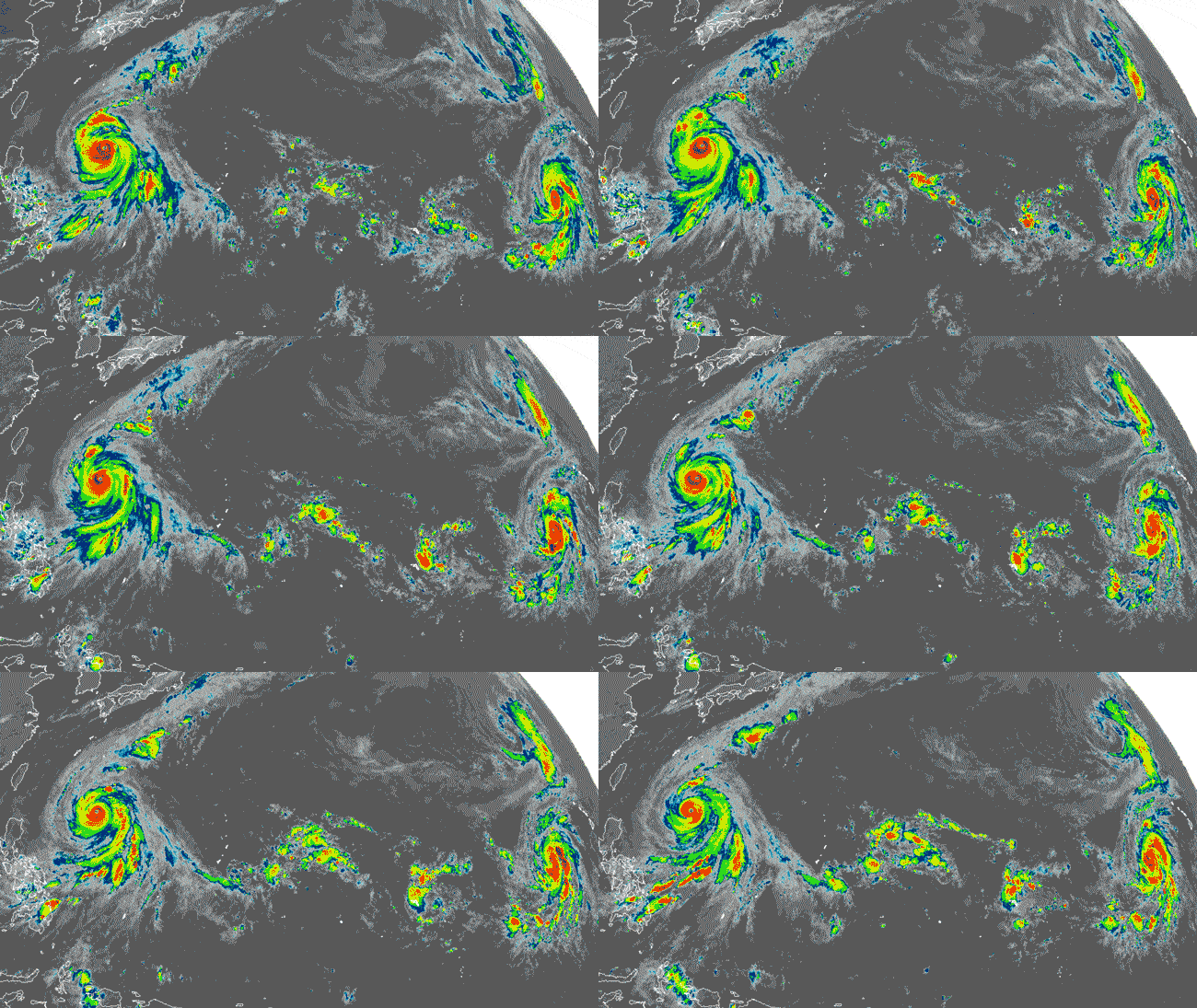
Big storms in the Pacific (Andrew Freedman — Axios)
Insurers estimate the cost of climate change (Bradley Hope, Nicole Friedman, Jess Kuronen, Tyler Paige — WSJ)
Evidence of Planet 9 (W. Wayt Gibbs — IEEE Spectrum)
E-commerce isn't the only thing killing retail (Daphne Howland — Retail Dive)
5. 1 fun thing: Disruptive cannabis
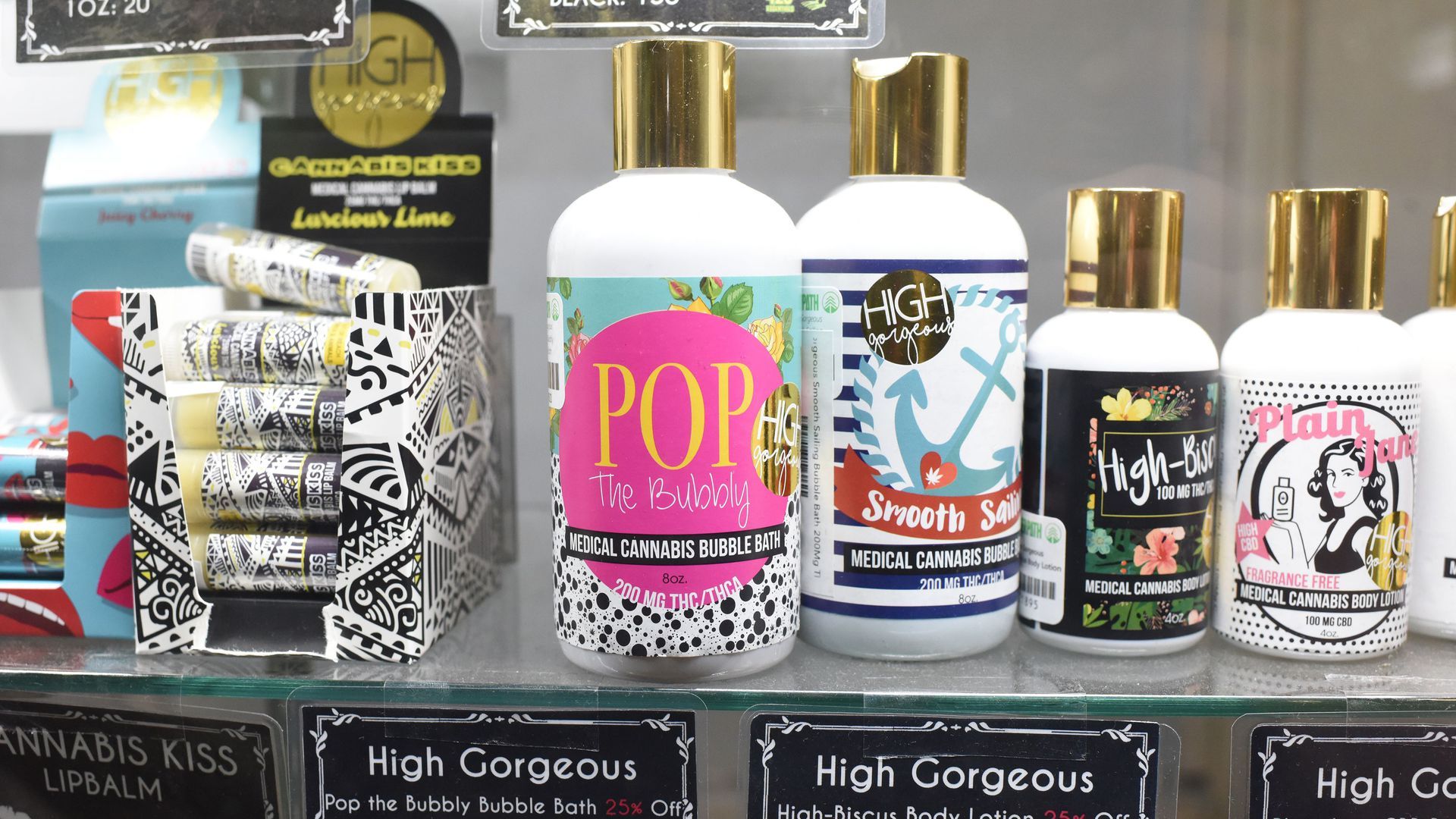
Weed bubble bath and body lotion for sale in Los Angeles. Photo: Robyn Beck/AFP/Getty
We previously reported that big alcohol companies are hedging against a global decline in the booze industry by partnering with cannabis firms for weed-infused drinks, Axios' Erica Pandey writes.
Yes, but: Beverages aren't the only status quo that legal weed is challenging. Food, fashion, beauty and even paper are seeing cannabis rivals.
The big picture: The global legal marijuana industry is projected to top $20 billion by 2025, writes Anand Sanwal of market research firm CBInsights. And that has unleashed a slew of potential disruptors:
- Beauty and wellness products are incorporating cannabinoid oil, known to reduce post-exercise inflammation and general anxiety. Movie stars already work cannabis-infused lotion into their feet as prep for long red carpet walks in high heels.
- Clothing and paper companies will start to use hemp in the pursuit of sustainability.
- Cannabis snack-making is becoming a thing, including chocolate cupcakes and potato chips.
Smaller banks are preparing to finance this activity — a move bigger banks might avoid due to risk.