Axios Detroit

November 04, 2026

😮💨 We did it, everyone. We survived the election.
- Michigan Democrats scored major victories last night, part of a nationwide blue wave.
🌧️ Today's weather: Light rain with a high of 68 and a low of 53.
🎂 Happy birthday to our member Sheila Cockrel!
Situational awareness: Axios has more on the GOP's nationwide losses and what the results mean for President Trump and his party.
Today’s newsletter is 1,070 words — a 4-minute read.
1 big thing: Historic win for El-Sayed
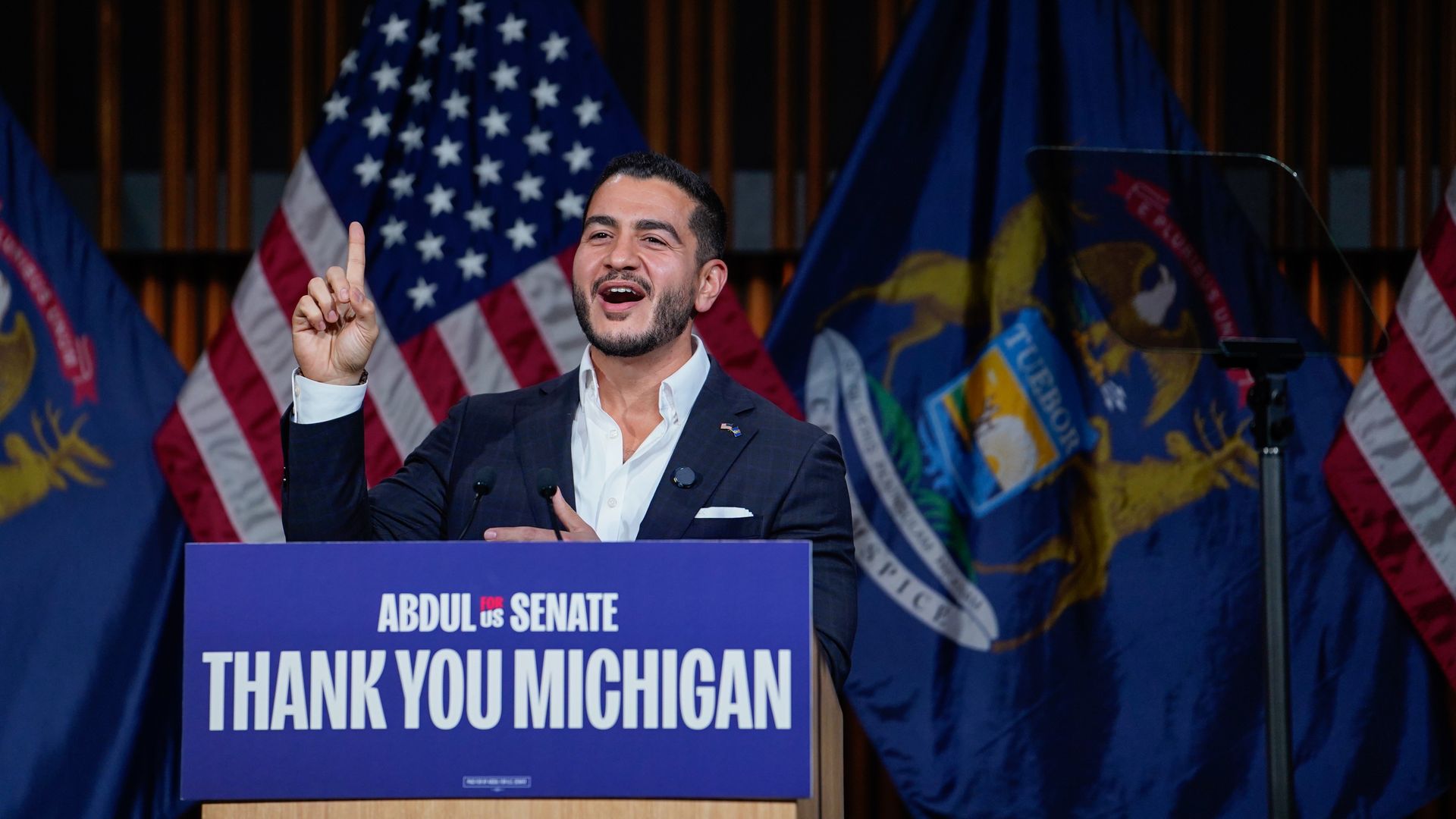
Democrat Abdul El-Sayed defeated Republican Mike Rogers in Michigan's closely watched U.S. Senate race, the Associated Press projected. He will become the nation's first Muslim senator.
Why it matters: El-Sayed's win — 52.4% to 45.6%, with 96% of votes counted early this morning — shows how an unapologetically progressive candidate can win in a battleground state President Trump carried just two years ago.
- The two candidates competed for the seat vacated by retiring Democratic Sen. Gary Peters, with Republicans hoping to flip a seat Democrats have held for decades. But the GOP failed — and lost its Senate majority.
- The race took a stunning turn in its final days, when Democratic U.S. Rep. Haley Stevens, who narrowly lost the August primary to El-Sayed, endorsed Rogers.
- The move sparked furious backlash from Democrats and prompted several of Stevens' staffers, including her chief of staff, to resign.
What he's saying: El-Sayed declared victory before the race was called, celebrating with a reference to his Muslim faith.
- "Up until about now, you might have noticed how we say, inshallah, or God willing, whenever the outcome of this race was mentioned. But today, tonight, we can turn that inshallah into alhamdulillah," he said, adding, "For the right-wing opps: That just means praise be to God."
Context: El-Sayed, a former Detroit health director, ran on a progressive platform centered on Medicare for All, taxing billionaires and reducing corporate influence in politics.
- His victory comes after a contentious Democratic primary and a bitter general election campaign that featured personal attacks over his background, medical credentials and Muslim faith.
- Rogers, a former congressman and FBI agent who narrowly lost a 2024 Senate bid, portrayed El-Sayed as too extreme for Michigan. El-Sayed cast Rogers as a Washington insider aligned with Trump.
- Trump escalated the attacks in the final stretch of the race, questioning El-Sayed's loyalty to the U.S. and making unsubstantiated allegations of extremist ties. El-Sayed rejected the accusations.
Between the lines: El-Sayed's win offers progressives a powerful new argument in the Democratic Party's debate over how to win back voters.
- His victory also gives progressives a new national figure as Democrats begin looking toward the 2028 presidential election.
What's next: El-Sayed will arrive in Washington with an ambitious progressive agenda — but turning campaign promises into legislation will be a different challenge.
- His signature Medicare for All proposal faces steep political obstacles, despite Democrats' new control of the Senate.
2. Benson wins governor race
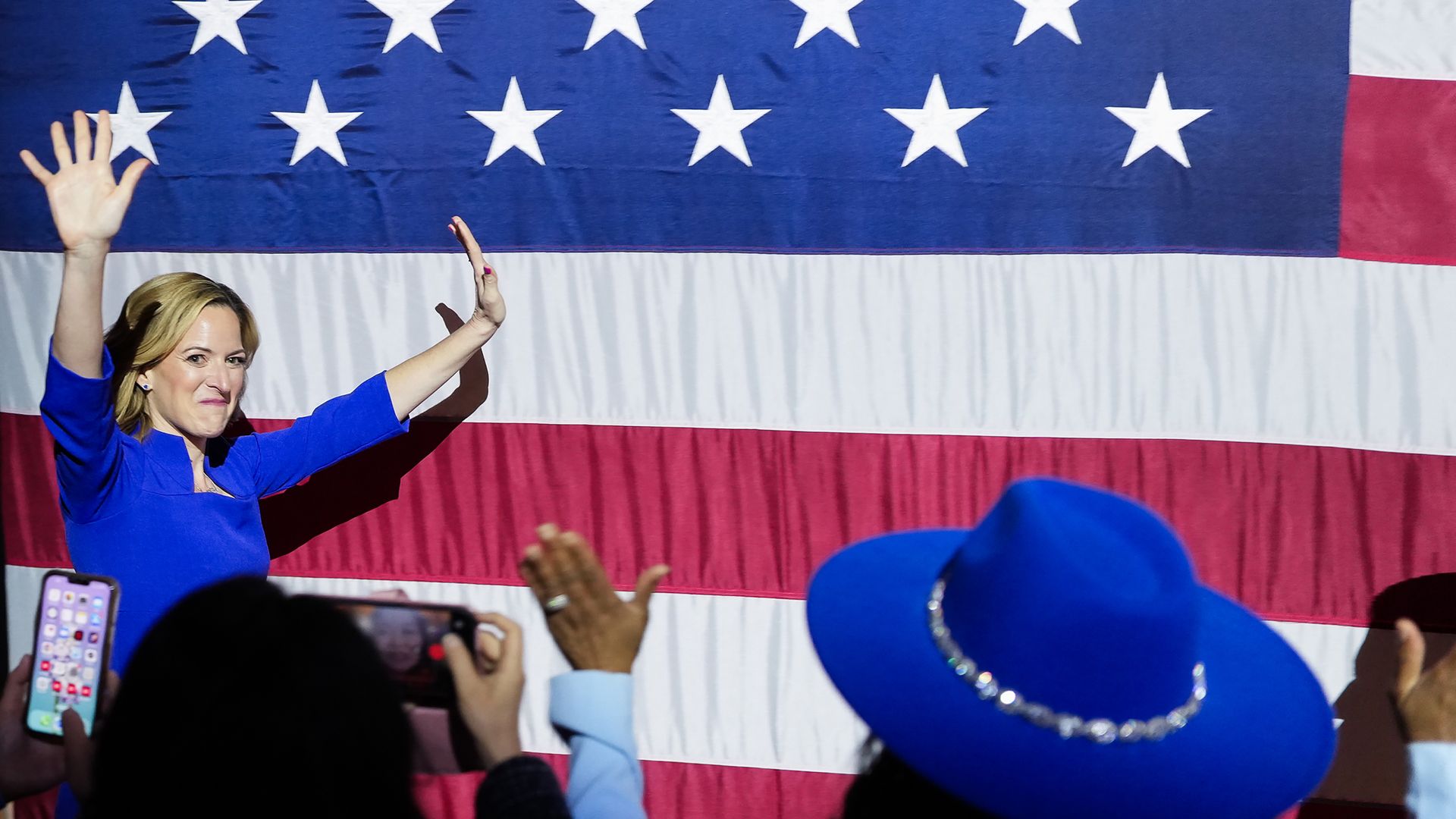
Democrat Jocelyn Benson won the Michigan governor's race last night over Republican John James.
Why it matters: The purple-state victory is a show of strength for Democrats, with Benson up 54.4% to James' 43.9% as of early morning, per AP.
- Benson will succeed term-limited Democrat Gretchen Whitmer, extending blue leadership after decades of flipping between Democrats and Republicans about every eight years.
What she's saying: Benson vowed to stand up to powerful interests in her victory speech after 1am in Detroit.
- "Make no mistake, I will be unafraid to stand up to any bully, no matter how powerful," she said.
Context: The result isn't unexpected — Benson and her backers vastly outspent James on TV ads, and sources told Bridge Michigan in mid-October that her team's transition planning began weeks ago.
Zoom in: Benson, Michigan's secretary of state since 2019, campaigned on lowering housing, health care, child care and utility costs.
- She also wants to raise teacher pay, reform utility rate-setting and put a moratorium on new data centers until new safeguards are in place.
The bottom line: Benson inherits a state facing economic headwinds, from its struggles to boost population to uncertainty in the auto industry and a federal trade war with Canada.
3. The Grapevine: You heard it here
👀 U.S. Rep. Haley Stevens requested U.S. Marshals protection after receiving death threats in the wake of endorsing Rogers for Senate.
- Because she's a member of Congress, her request is expected to be granted, according to a senior Trump administration official. (Axios)
🏳️🌈 State Sen. Jeremy Moss (D-Bloomfield) won his U.S. House race to become Michigan's first out LGBTQ+ member of Congress. (Detroit News, The Advocate)
☑️ Democrat Donavan McKinney, who beat two-term incumbent Rep. Shri Thanedar in the August primary, won Michigan's 13th Congressional District seat. McKinney, a state representative since 2022, is a member of the Democratic Socialists of America.
- His win restores Black representation in Congress for Detroit. (MLive)
🗳️ More statewide victories for Dems: Lt. Gov. Garlin Gilchrist II won his race to become Michigan's next secretary of state over Republican Anthony Forlini, according to AP.
- AP also projects a win for Eli Savit as Michigan attorney general over Republican Doug Lloyd, and a Democratic majority in the state Legislature. (Free Press, WXYZ, Michigan Advance)
4. "Money out of Politics" proposal passes

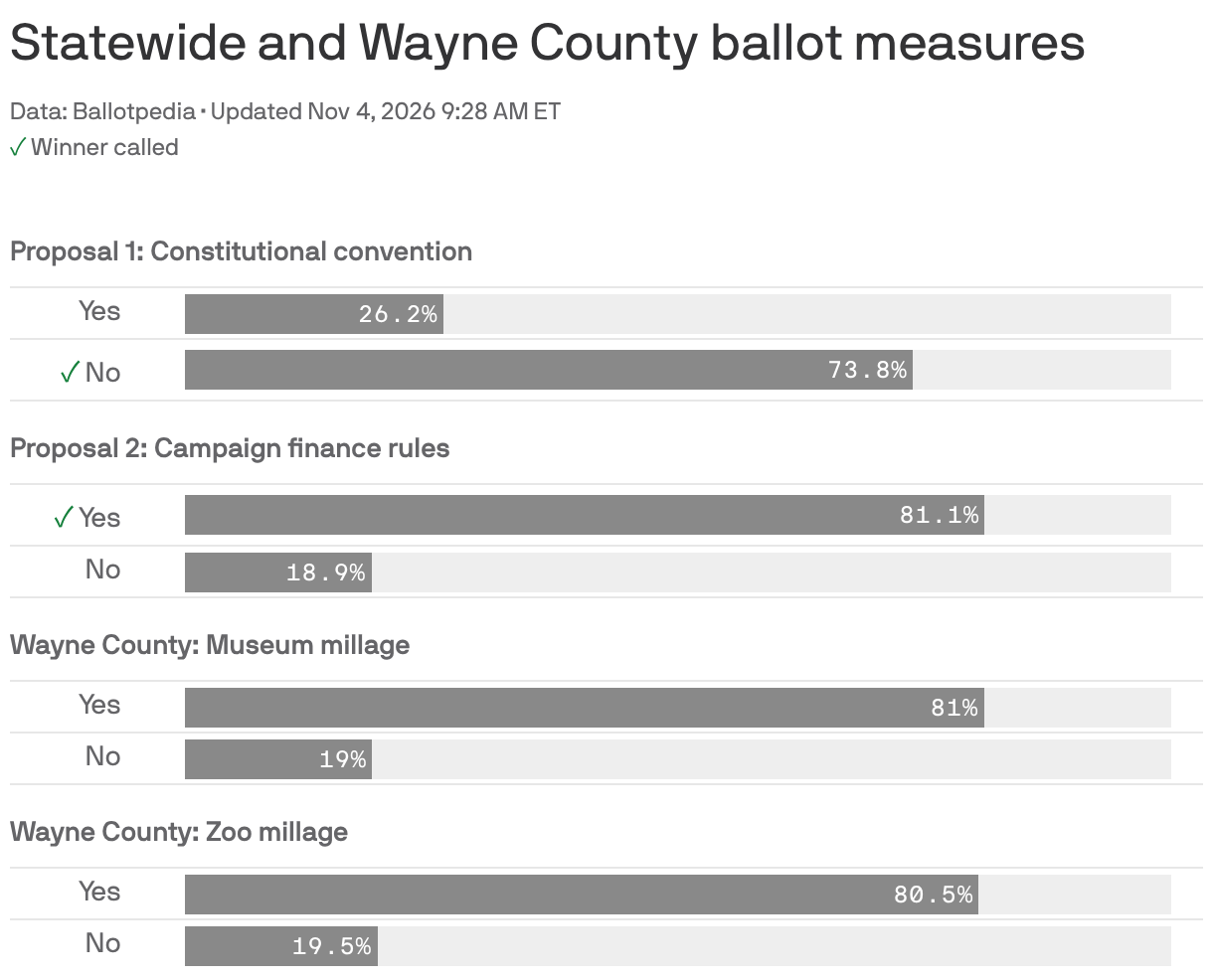
Michigan voters have approved Proposal 2, The Associated Press projects, restricting campaign contributions from major utilities and government contractors.
Why it matters: The measure marks a major change to Michigan's campaign finance laws, restricting political contributions from some of the state's most powerful companies.
The big picture: The measure will bar regulated utilities such as DTE and Consumers Energy, along with certain government contractors and their affiliates, from making campaign contributions to candidates and officeholders whose positions affect them.
- It will also expand campaign finance disclosure requirements to more political advertising, including online ads.
Supporters argued the measure would curb the political influence of powerful corporations and bring greater transparency to campaign spending.
Opponents warned the restrictions would infringe on free speech and political participation.
What's next: The Mackinac Center for Public Policy, a nonprofit supporting limited government, filed a federal lawsuit last night to block Prop 2's provisions from being enforced.
- The center argues the proposal's changes violate the First Amendment by regulating speech and violating privacy.
Go deeper: Voters turned down Michigan's other proposal on hosting a constitutional convention.
Our picks:
🤝 Joe always enjoys catching up with other local reporters at election night festivities.
🍳 Annalise is planning to treat herself to a big Clique breakfast.
Edited by Larry W. Graham.
Sign up for Axios Detroit