Axios Des Moines

July 30, 2025


Hi, Wednesday, and welcome to our water quality takeover.
⚡️ Weather: Flood watch until noon with a high of 77°.
🎂 Happy birthday to our Axios Des Moines members Lisa Veach, Hardin Whiteman and Tim Burgess!
Today's newsletter is 1125 words — a 4.5-minute read.
1 big thing: Des Moines' nitrate standards
Central Iowa Water Works (CIWW) runs one of the world's largest public nitrate filtration systems, but research increasingly suggests that levels well below the current federal standards it follows may be unhealthy.
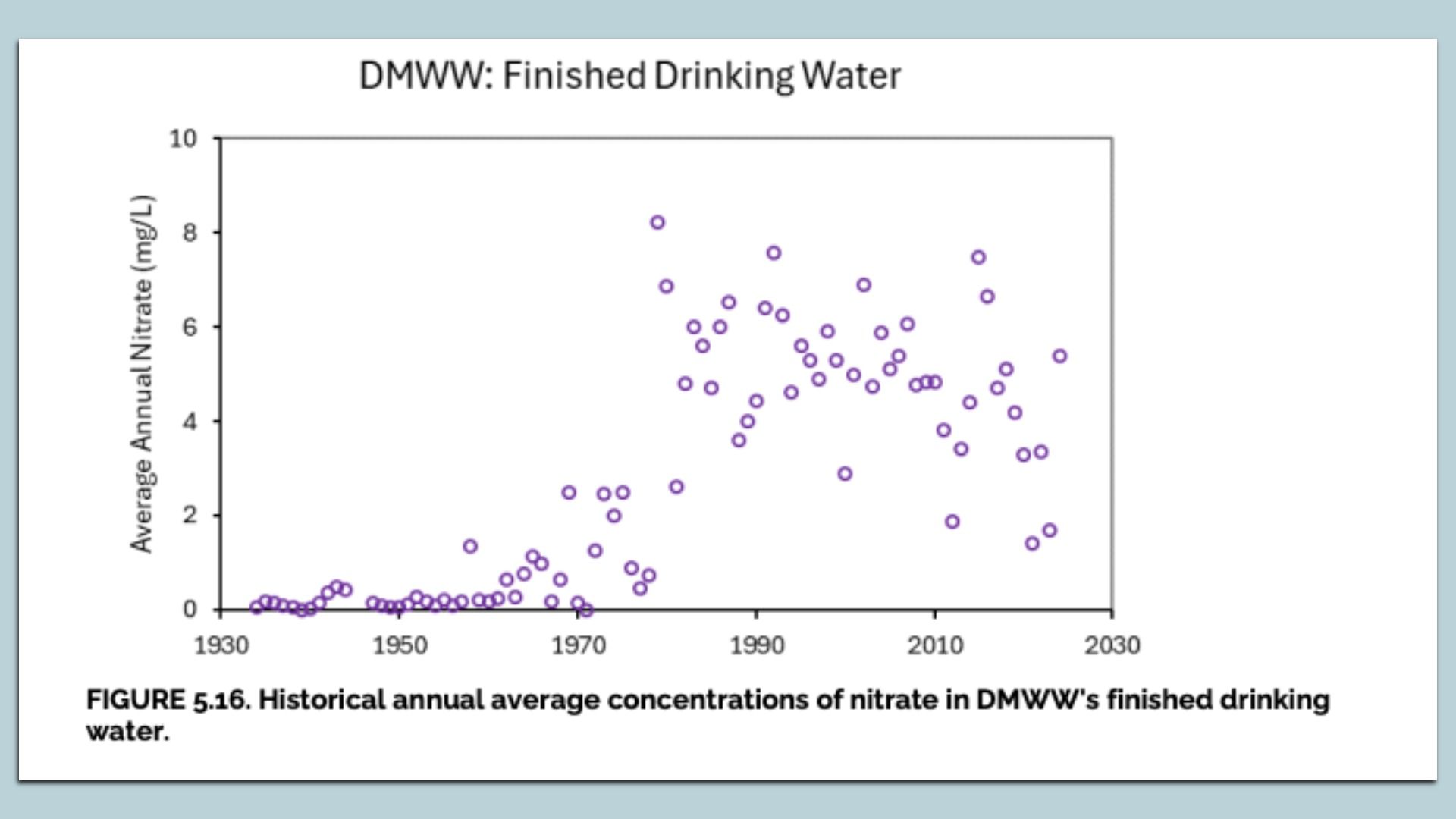
Why it matters: The metro's tap water has frequently exceeded 5 mg/L of nitrates for decades — only half the 10 mg/L federal limit that the metro is already struggling to stay under.
Driving the news: A scientific report commissioned and released by Polk County recommends that the metro's drinking water utilities adopt more stringent standards, specifically noting the 5 mg/L threshold.
- The report was released less than a month after the metro's first lawn-watering ban started when utilities couldn't keep up with nitrate removal to meet demand.
- Many of the scientists behind the project will participate in their first public forum about the report on Monday.
State of play: From 2006 to 2023, nitrate levels in the metro's drinking water were at or above 5mg/L about 40% of the time.
- It reached 8mg/L on roughly 9% of days, per Polk County's report.
Zoom in: Des Moines University professor Jason Semprini says the EPA's 10 mg/L standard, which was set in 1992, focuses on blue baby syndrome, but it doesn't address other prenatal concerns.
- Semprini, who specializes in cancer research, studied 360,000 Iowa birth records from 1970 to 1988. He found that exposure to nitrate levels at even 5 mg/L was associated with low birth weights and preterm births.
Iowa State researcher Lu Liu expressed similar concerns to Axios. Several studies show concentrations as low as 3 mg/L can hurt more vulnerable populations and contribute to adverse births, colorectal and bladder cancers and thyroid dysfunction.
Between the lines: Iowa has the second-highest rate of new cancer diagnoses in the U.S. and is one of only two states with rising cancer rates (second to Connecticut), which has prompted concerns that the rise is linked to farming.
- While cancer is difficult to trace to one cause, Semprini says agricultural exposure, including nitrates, is likely contributing to some portion of the state's elevated cancer rates and compounds with other environmental risks.
Friction point: If the threshold were cut in half, there would be times when meeting a 5mg/L standard would be difficult, Tami Madsen, executive director of CIWW, tells Axios.
- "In order to do that, we would have to implement a significant investment in infrastructure that may not even be possible," Madsen said.
Yes, but: The members of CIWW — a regional water production authority created last year that includes DSM Water Works — remain open to conversation about the threshold, Madsen said.
The bottom line: Water utilities should prepare for the possibility of lower nitrate standards in the future, but ultimately, people should be looking at the root cause and work to reduce that, Semprini says.
2. Ethanol's role in Iowa's nitrate crisis
The state is at a crossroads of having some of the world's best farmland, but also the pollutants that come from working it.
Why it matters: Polk County's report shared that 80% of the nitrates entering the Des Moines and Raccoon rivers come from agricultural sources.
Driving the news: A buildup of nitrates in farm fields following Iowa's record drought set the stage for an uptick in stream pollution due to this year's heavy rainfall.
- And climate change is expected to continue these extreme events and cause extended droughts as well as flash floods across the Midwest.
What they're saying: Austin Frerick, a local author on agriculture and antitrust policy, believes ethanol has been a major driver of Iowa's polluted waters.
- "You can have clean water or you can have ethanol, but you can't have both," Frerick says.
How it started: The 1996 Farm Bill and 2005 Renewable Fuel Standard (RFS) offered more subsidies for corn and created artificial demand for it through federal ethanol blending mandates, Frerick says.
- That's resulted in an overproduction of corn as farms try to profit, resulting in excessive fertilizer use and nitrate runoff.
- Today, the majority of U.S. corn crops are used for ethanol or alcohol.
The other side: Monte Shaw, executive director of the Iowa Renewable Fuels Association, argues that supporting the ethanol industry helps farmers, which results in improved conservation practices.
- Earlier this month, Gov. Kim Reynolds said she does not believe the state needs to regulate farmers, saying they're already voluntarily using conservation practices, per The Gazette.
- "When farmers are scared of losing the farm, that's when you see bad environmental practices," Shaw says.
Zoom in: Shaw says farmers are planting fewer acres of corn now in comparison to 1930, even with the implementation of RFS.
- Since 1930, the U.S. is producing 20% more corn on 25% fewer acres, due to hybrid corn breeds and improved technology, but there's also increased fertilizer and pesticide use, per the USDA.
Between the lines: An ISU study published this year shows the total amount of fertilizer needed for profitable corn production in the Midwest has increased by 1.2% annually over the last three decades, due to higher yield demands and wetter springs that wash it out.
- At the same time, farmers have also become more efficient in applying fertilizer, using 0.7 pounds of nitrogen or less per bushel — down from ISU's recommendation of 1 pound per bushel 20 years ago.
- While more efficient practices help reduce excess nitrogen, there's still an overall rise in needed fertilizer.
The bottom line: Despite conservation practices, Frerick argues the pollutants caused by the overproduction of corn outweigh the efforts.
- "You're taking the best farmland in the world, and you're just wasting it," he says. "Instead of growing food, you're wasting it in your car."
3. What's next: Monday's first presentation

More than 600 people have booked seats for Monday's first presentation by some scientists behind Polk County's river study.
Why it matters: The event seeks to encourage dialogue among residents and community leaders about the findings and to discuss the next steps in cleaning up the metro's water.
Zoom in: The Harkin Institute, a nonpartisan policy research organization, is hosting the event.
What they're saying: The report's findings should be used to promote community conversation and improve water, rather than just being filed away and forgotten, Adam Shriver, the institute's director of wellness and nutrition policy, tells Axios.
- "We just want to follow the science and make sure people see it," Shriver said.
The intrigue: The institute previewed the report in a podcast episode released this week.
If you go: The event is at Sheslow Auditorium at Drake University, starting at 6pm.
- Tickets are free but require registration.
- There is also a virtual option.
💧 We're continuing our water quality coverage next week! Got any questions about what's happening? Hit reply and let us know.
This newsletter was edited by Chloe Gonzales.
Sign up for Axios Des Moines
