Axios Denver

May 25, 2021

It's Tuesday.
- Today's weather: Sunny, with a high near 79°.
🔔 This is a somber week as the nation reflects on the anniversary of George Floyd's murder in Minneapolis.
- Look for more coverage this week about what changed — and didn't — in Colorado.
Situational awareness: A supermoon will go into eclipse as it sets over the mountains from 5:11am to 5:25am Wednesday just before sunrise. Look to the southwest sky.
Today's newsletter is 862 words — a 3.5-minute read.
1 big thing: Denver outlines competing vision for policing
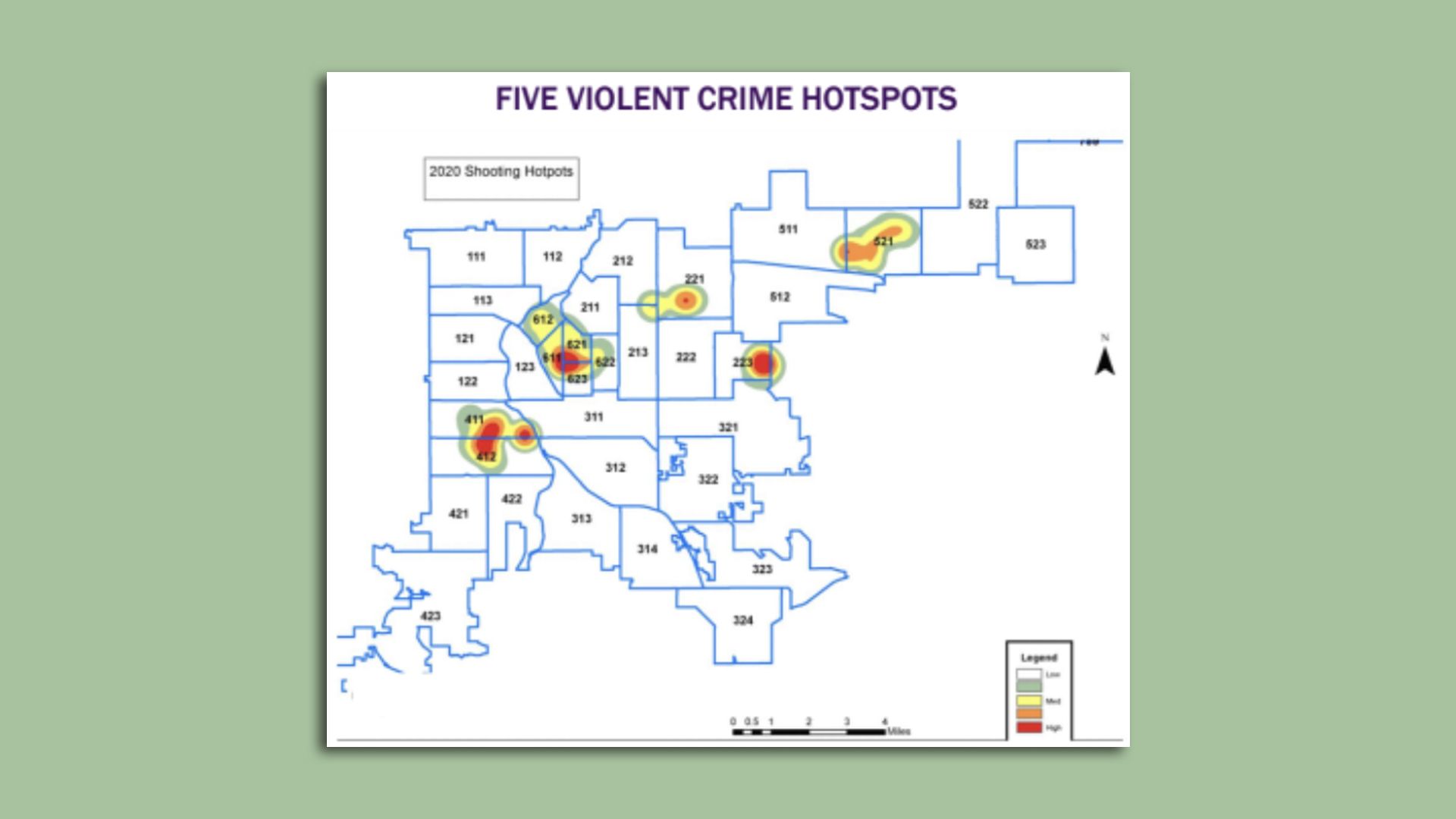
A map of Denver showing hot spots for shootings in 2020. Image: Denver Police Department
Mayor Michael Hancock's administration outlined a new vision Monday to combat rising crime rates in Denver "without overpolicing."
Why it matters: The blueprint represents an alternative to a plan released by a resident-led task force Friday that calls for a non-law-enforcement approach to public safety.
- The debate comes a year after Floyd's death in Minneapolis prompted Black Lives Matter protests and demands to address systemic problems in policing in our city and across the country.
Details: Unlike the task force's guidance, Hancock's approach is spearheaded by police, focusing on five areas — mostly lower-income and more-diverse communities — that account for a disproportionate amount of violent crime.
- The initiative also includes more high-visibility foot patrols and community collaborations.
- Police chief Paul Pazen refused to answer John's question about whether the city's plans would require additional officers.
Between the lines: The data-driven and cross-agency approach to crime is not new in Denver, and neither are the geographic areas in question. But the increase in violence — which officials blame on the pandemic — is getting more attention at City Hall.
- In 2020, killings increased 47% and aggravated assaults rose 63% citywide, compared with the three-year average, the police chief said.
- In 2021, crime rates are continuing to increase over the average.
2. Racial disparities mar Denver policing

Police officers arrest a man in Denver, where a curfew sought to curb protests in 2020. Photo: Michael Ciaglo/Getty Images
Black people in Denver are disproportionately arrested or cited for the most common crimes, according to a recent Denverite analysis.
By the numbers: The data shows that Black residents — which make up about 10% of the city's population — represented a much larger portion of those charged in the following categories:
- 40% of drug paraphernalia charges between 2018 and 2020
- 30% of driving with a revoked license and trespassing charges between 2018 and 2020
- 26% of shoplifting charges between 2019 and 2020
The other side: Denver's police chief told the CPR affiliate that his department needs to do better, but he added that "disparities don’t necessarily equal bias."
The big picture: The statistics match statewide numbers from a 2020 report showing that in 2019, Black residents made up 12% of arrests in Colorado that year but represented only 4% of the population.
3. Colorado's stimulus sprinkles
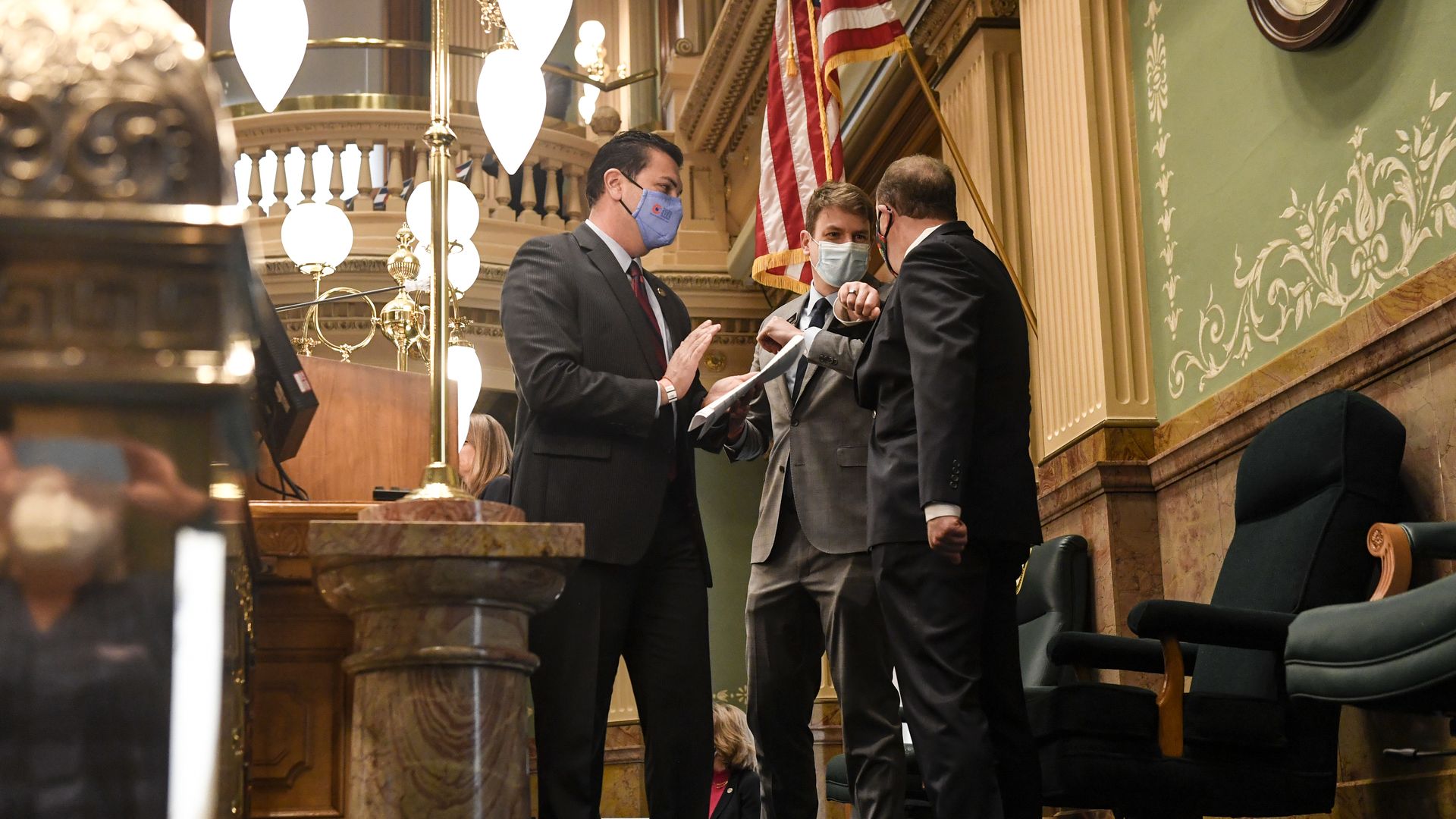
Gov. Jared Polis (right) elbow-bumps House Speaker Alec Garnett after being introduced ahead of a joint address Feb. 17. Photo: AAron Ontiveroz/Denver Post via Getty Images
State Democratic leaders sketched a plan Monday to spend $3.8 billion in federal stimulus dollars, promising to sprinkle the money across all their policy priorities.
- Not one Republican lawmaker stood with them.
What's new: Specifics are sparse, but Democrats outlined $2 billion that they plan to allocate over the next three weeks.
The priorities include:
- $1 billion toward the state budget to prepay obligations and address prior cuts
- $400 million for infrastructure projects, including transportation and parks
- $100 million to address mental and behavioral health
What they're saying: The money from the American Rescue Plan Act "is a big friggin' deal," Gov. Jared Polis said, and represents "a once-in-a-generation opportunity."
- The stakes make the lack of GOP support notable, but the governor said he expects that "many pieces of this will be bipartisan."
What's next: The remaining $1.8 billion is being set aside for spending after the 2021 legislative term, which ends by June 12.
4. Nuggets: Dig into the news of note

Illustration: Brendan Lynch/Axios
- The suspect in the Boulder mass shooting will face 13 additional attempted murder charges, bringing the total criminal charges to 115. (CPR)
- Polis signed a bill yesterday that will give the Regional Transportation District more autonomy to make decisions, including over lowering its fares and charging to park in its lots. (Denver Post)
- Colorado's new Equal Pay for Equal Work Act is having some unintentional effects, with some companies refusing to hire employees here for remote work to avoid revealing how much they pay. (CBS4)
- The murder trial is underway for the eldest of two teenagers accused of killing one person and injuring eight others in a shooting at STEM School Highlands Ranch in 2019. (Denver Post)
- State officials have learned a lot after a year of testing feces to track the coronavirus, prompting leaders to further invest in wastewater epidemiology. (Colorado Sun)
- One of Denver TV's most familiar faces — CBS4 anchor Kathy Walsh — will retire on May 30 after nearly 40 years at the station. (CBS4)
5. Denver TV station falls for fake sex blanket

Screengrab from Sunday’s segment of "Last Week Tonight With John Oliver." Photo courtesy of HBO
"Last Week Tonight" host John Oliver managed to dupe local TV stations — yup, including one here in Denver — into promoting the Venus Veil.
- The bogus blanket purportedly boosts sexual wellness using technology "pioneered in Germany about 80 years ago."
😬 Why it matters: Oliver found it's "far too easy" to get phony products on-air and warned of the dangers that sponsored content can pose in an all-too-trusting local news environment.
What they're saying: "To the owners of these stations who are selling them out at a depressingly cheap price, I have a simple question: The f**k are you doing?!"
- Denver7 general manager Dean Littleton tells Alayna the station is "vetting our review processes for non-news segments to ensure our staff follows the proper standards."
Watch Oliver's segment here. (Skip to the 16:15 mark for the Venus Veil introduction and to 19:30 for the Denver-specific material.)
6. 💙 1 human thing: "Finding resilience"
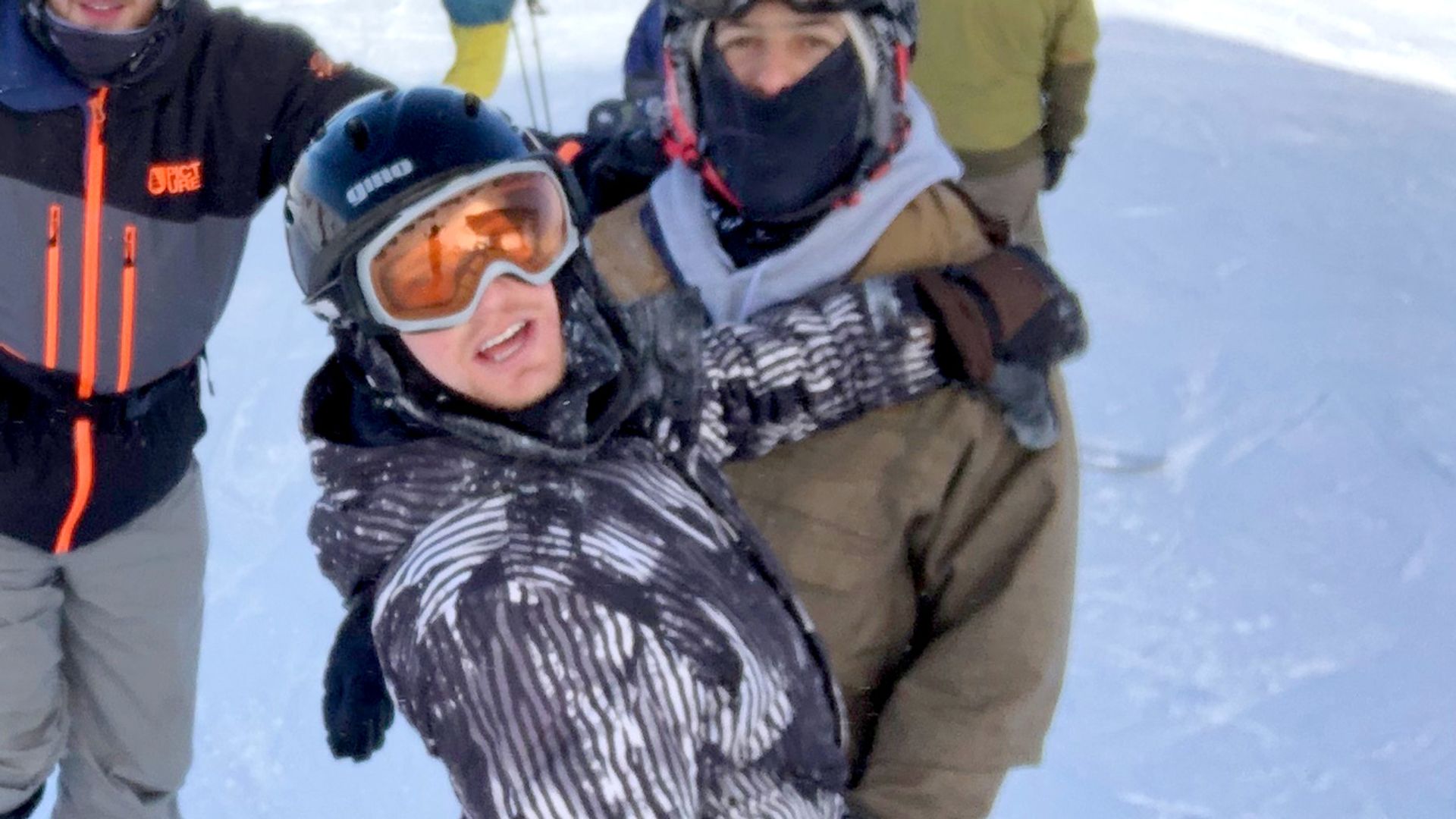
Sam Tabachnik, center, skiing with friends. Photo courtesy of Sam Tabachnik
Sam Tabachnik, a reporter for the Denver Post, returned to work last week for the first time since January after suffering a concussion snowboarding.
On Friday, he published a story about his slow recovery and what it taught him about loss and perseverance. Here's a piece...
"In a year where the virus made it impossible to live a normal life, I suddenly could do even less. I couldn't work. I couldn’t watch sports. I couldn't hike in Colorado's beautiful outdoors or bike on winding mountain roads. All the activities that helped me cope with a year unlike any other suddenly disappeared. ...
"But my time on the couch, watching the snow fall and the seasons change, also taught me a valuable lesson in acceptance, and reaffirmed my belief that people are more resilient than they give themselves credit for."
Read his story. And one last thing: Don't take today for granted.
Our picks:
🥜 John is surviving deadline on this favorite trail mix.
🌕 Alayna is excited to catch this neat celestial event tomorrow. (Who's waking up early with me?)
Join our referral program and get Axios swag! More details.
Sign up for Axios Denver

Get smarter, faster on what matters in Denver with Alayna Alvarez, John Frank, and Esteban L. Hernandez.