
Axios Denver

November 19, 2024

It's a chilly Tuesday.
Today's weather: Winter returns. Slight chance of snow showers in the morning then mostly sunny with a high of 40.
💙 Join our Axios Denver membership and be a part of empowering local journalism.
🎂 Happy birthday to our Axios Denver members David O'Boyle and Vincent Bocchino!
Today's newsletter is 913 words — a 3.5-minute read.
1 big thing: Colorado Springs green-lights recreational pot
Voters in Colorado Springs approved a measure to legalize recreational marijuana sales and rejected a competing one that would have permanently banned them, according to final unofficial results from the El Paso County Clerk and Recorder's Office.
Why it matters: The conservative-leaning city — Colorado's second-largest — has stood firm against recreational cannabis sales for a decade, even as the rest of the state embraced legalization.
- The vote is the latest sign the city is evolving from a reserved military town anchored by megachurches to a more moderate community shaped by its growing and diversifying population.
The big picture: Colorado's cannabis industry is in a precarious place, with sales down and dispensaries closing or changing hands due to declining demand and economic struggles.
By the numbers: Ballot Question 300, allowing retail cannabis sales, passed 54.7% to 45.3% — a dramatic difference from two years ago, when voters rejected a similar proposal by 57%.
- Question 2D, which would have banned sales for good, narrowly failed 50.6% to 49.4%, despite support from Mayor Yemi Mobolade.
How it works: The new law allows the city's roughly 90 existing medical marijuana dispensaries to begin selling cannabis for recreational use.
- Retail shops must maintain a 1,000-foot buffer from schools and similar facilities — a local requirement already in place for medical dispensaries.
Yes, but: Legal questions remain.
- Ahead of the election, the city council passed a zoning ordinance that severely limits where recreational marijuana dispensaries can operate, banning sales within 1 mile of schools, daycare facilities, and drug and alcohol treatment centers.
- City officials haven't clarified whether the new voter-approved law supersedes the council's restrictions.
What they're saying: "Colorado Springs voters decisively authorized adult-use cannabis sales, and city leaders should respect their decision," Mason Tvert at Denver-based cannabis policy firm VS Strategies told Axios Denver.
2. Denver to allow ADUs citywide
The city just made it easier for more Denver residents to build carriage houses.
State of play: Denver City Council voted unanimously last night to approve a set of bills that expand citywide access to build accessory dwelling units, or ADUs, by tweaking the existing zoning code.
Why it matters: City officials and housing advocates say ADUs can provide additional income to homeowners and another affordable housing option, steps that can help more people afford to live in Denver.
How it works: The new laws make it easier for homeowners to add ADUs in the city's single-family residential neighborhoods and expedite the building process by reducing certain requirements.
- This includes removing an "owner occupancy" rule so homeowners don't have to live on the property to have an ADU, according to Denverite. Owners would still need to live there when an application is filed.
Yes, but: It doesn't change building standards for ADUs in Denver, which are still based on the types of neighborhoods where they're proposed.
Zoom out: The city's measures were prompted by a state law passed this year requiring Colorado cities that allow single-unit homes to also permit ADUs.
3. ♻️ We're not great at recycling


Colorado's recycling rate remains stubbornly low.
Why it matters: The data belies the state's "green" reputation and sets the benchmark for major changes to come.
State of play: Total waste to landfills decreased a fraction over six years to 6.8 million tons, according to a new report from Eco-Cycle, a nonprofit recycler in Colorado.
- When factoring in population growth, the per capita waste rate improved 6%.
By the numbers: The state's diversion level — often referred to as the recycling rate — hit 15.5% in 2023, meaning it went virtually unchanged in the last five years.
- The national recycling and composting rate is double Colorado's at 32%.
Between the lines: Eco-Cycle and CoPIRG, an environmental organization, suggest the state's low rates are unsurprising given just half of Colorado's municipalities with 10,000 or more residents provide recycling to all households.
What's next: A state mandate authorized in 2022 will create a statewide recycling program by collecting fees from most product manufacturers and retailers
- The state's approach is designed to increase the recycling rate to 38% to 44% by 2030 and 52% to 58% by 2035.
4. Mile Highlights: Women's hockey comes to town

🏒 Ball Arena will host a professional women's hockey game between Montreal and Minnesota on Jan. 12 as part of the league's national tour. Tickets go on sale Friday at 10am, John reports.
🚨 A Denver prosecutor called the shooting that injured Bronco Josh Reynolds a "coordinated organized assault" and said police are making additional arrests. (Denver Post 🔑)
⚖️ Club Q shooting victims and family members are suing the El Paso County Board of County Commissioners alleging a failure to enforce its red flag law led to the shooting. (CNN)
💰 The University of Colorado Boulder must pay 386 women faculty members back pay as part of a $4.5 million settlement from a class action gender equality lawsuit. (CPR)
5. 🌡️ Warming winters


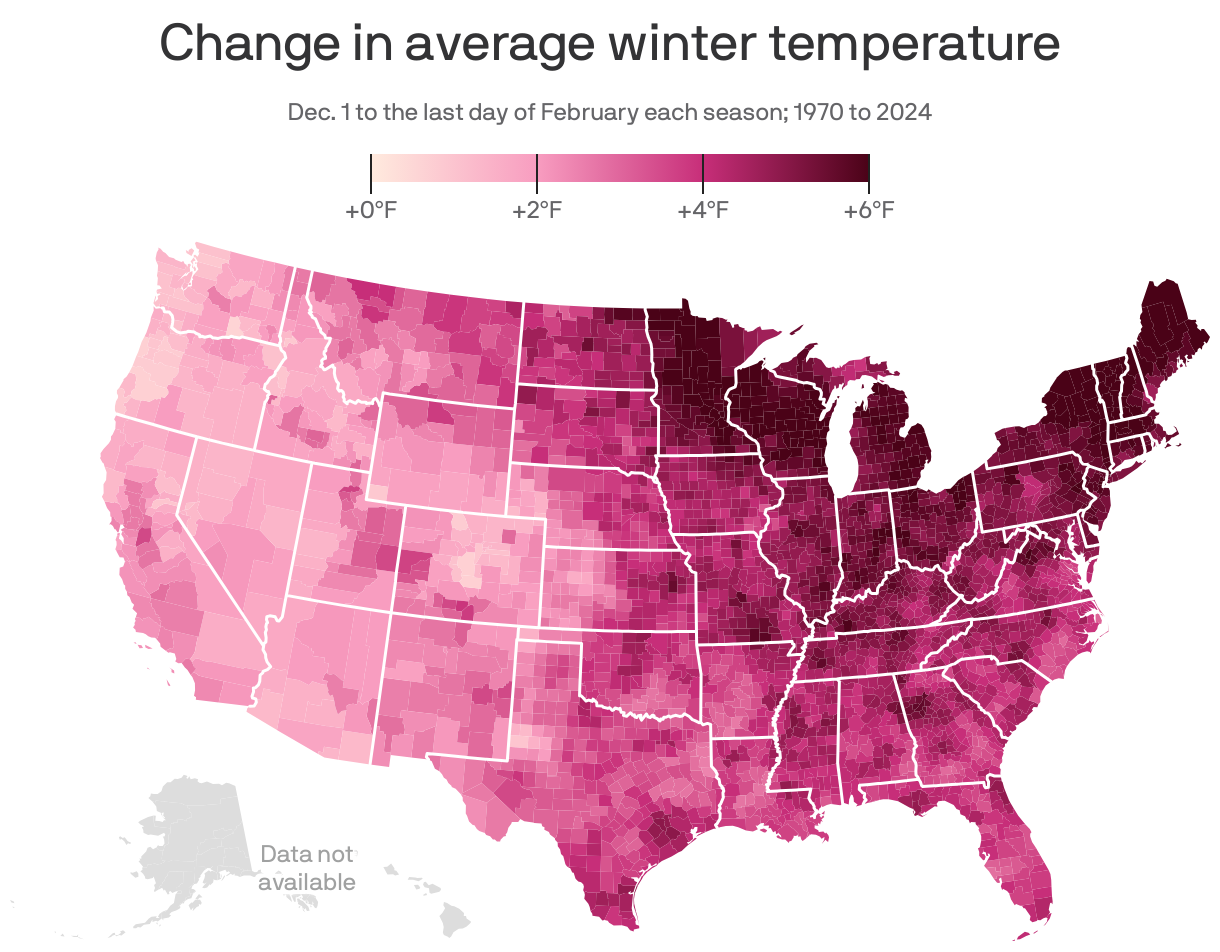
Winters across many of the Lower 48 states, including Colorado, have warmed significantly over the past three decades — a troubling trend tied to human-caused climate change.
Why it matters: Rising temperatures during meteorological winter (December through February) threaten Colorado's winter sports industry, strain water supplies, and could reshape the state's cultural identity.
By the numbers: Denver's average winter temperature has climbed from 33.7 degrees Fahrenheit in 1970 to 34.3 degrees in 2024, according to an analysis from the research group Climate Central.
- Overall, Denver's winters have warmed by 1.4 degrees over the last 54 years.
- Alamosa County leads the state, with a spike of 3.9 degrees.
Our picks:
🤔 John is reading this interesting New York Times story about grandchild-free families.
🥄 Alayna is making this butternut squash soup recipe for a cozy, comforting dinner tonight.
👟 Esteban is checking out Culture Street for vintage streetwear and sneakers.
Thanks to our editor Gigi Sukin.
Sign up for Axios Denver


/2024/11/18/1731964709344.gif?w=3840)