
Axios AM Deep Dive

June 26, 2021
Good afternoon and welcome to our latest Axios AM Deep Dive on the New Washington. Today's big topic: climate change.
- This edition is led by Andrew Freedman and Ben Geman, authors of our daily Axios Generate energy newsletter.
- Smart Brevityâ„¢ count: 1,110 words ... 4 minutes.
1 big thing: Biden's ticking climate clock

Illustration: Annelise Capossela/Axios
President Biden is under mounting pressure to deliver on his historic climate plans — with real danger that he’ll miss his window on major goals that allies had hoped were in their grasp, Axios' Ben Geman reports.
Why it matters: Only six months into his presidency, Biden has a limited amount of time to tackle what he calls "the No. 1 issue facing humanity."
- Key parts of his platform are tethered to the infrastructure push underway right now. Biden and liberal Democrats want huge clean energy investments and tax incentives.
- They hope a Democrats-only package would provide vastly more than energy measures in the infrastructure outline Biden unveiled with a bipartisan Senate group on Thursday.
Threat level: Republicans have a good chance of regaining one — and perhaps both — chambers of Congress in the 2022 midterms, effectively slamming Biden's window shut.
- And already, Democrats are having trouble locking down enough votes in their own ranks for anything resembling Biden's proposals around electric cars, renewables, efficient buildings and more.
The intrigue: The time pressure is even more intense than the electoral calendar suggests.
- November brings the most important UN climate summit since the 2015 talks that birthed the Paris agreement.
The White House also hopes to accomplish a lot with executive actions by redirecting agencies, including the EPA and the Interior and Energy Departments, to be more climate-focused.
- Just one of many examples: Biden is pushing the EPA and the Transportation Department to rewrite vehicle efficiency rules to be much tougher.
2. Axios animation: We're getting hotter


Earth's rising temperature — up about 1.2°C (2.16°F) since the preindustrial era — is already resulting in unprecedented and destructive events worldwide, Axios' Andrew Freedman reports.
Look what's changed since millennials were born, starting in the 1980s:
- The last colder-than-average month globally, compared to the 20th century average, was February 1985. Each of the past three decades has been hotter than the one before it.
- All of the 10 warmest years have occurred since 2005.
3. What's next: Big summer climate report

Illustration: Aïda Amer/Axios
The much-anticipated sixth assessment report from the UN Intergovernmental Panel on Climate Change (IPCC) will roll out on Aug. 9, generating a burst of climate coverage in the media and putting pressure on lawmakers to act.
Why it matters: The IPCC's reports are designed to be the most authoritative summaries of the latest knowledge regarding our changing climate, Andrew reports.
The five key areas to watch in the new report, based on conversations with report authors and others who are familiar with its contents:
- For the first time, this report will include information on how human-caused global warming is tilting the odds toward more extreme events, such as heat waves and heavy precipitation.
- The report will place a greater emphasis on regional information that policymakers can use for climate risk assessments.
- It will look at a wider range of emissions scenarios, including more information about how greenhouse gas emissions are evolving in the real world.
- The report will have revised figures for how sensitive the climate is to a doubling of carbon dioxide levels in the atmosphere.
- Expect a new range of both projected temperature changes and sea level rise through 2100.
4. Exclusive poll: America catches up with climate science
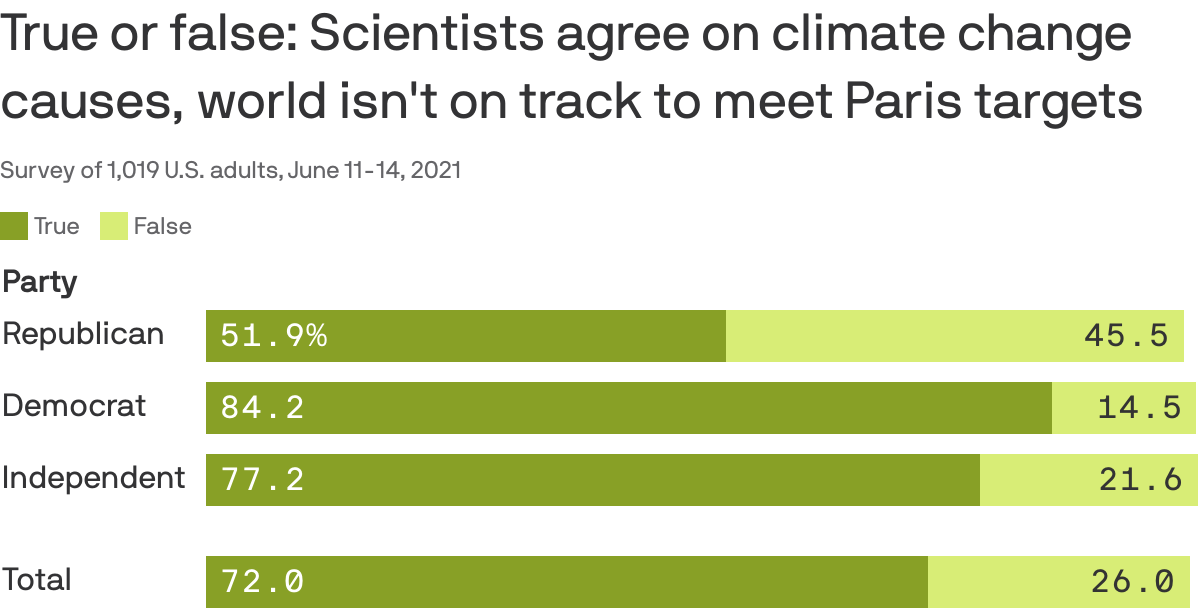
Seven out of 10 Americans are aware of the scientific consensus that climate change is largely caused by people, and that the world isn't on track to reach the temperature reduction targets of the Paris climate agreement, according to an Ipsos poll shared exclusively with Axios.
Why it matters: It's the latest in a series of polls that suggest Americans' understanding of climate change has increased in recent years, and particularly over the last five years, Andrew and Axios' David Nather report.
By the numbers: The poll found that 84% of Democrats and 77% of independents were aware that climate scientists overwhelmingly agree that climate change is caused by human activities, and that the world is off track to meet the Paris targets.
- Republicans had the lowest share of correct answers, but a slight majority — 52% — got them right.
The poll also found significant differences by education, with 80% of people with college degrees or higher answering the question correctly, compared to 73% of people with some college and 65% of those with a high school degree or less.
5. Business looks for traction

Illustration: Shoshana Gordon/Axios
Corporations and their K Street lobbyists are grappling with rising pressure for action on climate change from the White House and its Capitol Hill allies, Ben reports.
Why it matters: Democrats' ascendance is prompting powerful business and industrial interests to try and influence the new initiatives in their favor — or at least limit the fallout.
A few examples...
1. The SEC is getting an earful from companies and trade groups over plans to mandate disclosure of climate-related risks and opportunities.
- What's noteworthy is that many powerful interests in finance and industry aren't trying to block the rules. Instead, their comments are geared toward helping shape the rules' breadth and specifics.
- For instance, the National Association of Manufacturers says mandates should focus only on metrics that are "financially material to the investors in a specific business."
2. K Street powerhouses including the American Petroleum Institute and the U.S. Chamber of Commerce have adopted new climate positions this year.
- API in March endorsed putting a price on CO2 emissions, while in January the Chamber similarly called for a "market-based approach" to speed emissions cuts.
3. Renewable energy companies, electric vehicle producers and other clean tech interests, meanwhile, are rushing to take advantage of new openings for supportive policy.
- For example, the solar industry has thrown its weight behind a new proposal from Sen. Jon Ossoff, a Georgia Democrat, to create new tax credits for domestic solar equipment manufacturers.
6. What to watch for: Fall climate summit

Illustration: Shoshana Gordon/Axios
When world leaders hold a climate summit in Glasgow in November, success will revolve around two issues that have sunk or slowed past negotiations, Andrew reports:
- How to help developing countries transition to clean energy and how to respond to "loss and damage" — the devastation caused by climate change.
Why it matters: The Glasgow talks are the first since the U.S. rejoined the Paris pact after former President Trump withdrew.
Between the lines: If there is to be a breakthrough, it will likely include climate finance mechanisms, new pledges for more stringent emissions cuts to be made by 2030, and a recognition that "loss and damage" should be considered more seriously by industrialized nations.
- A "loss and damage" provision and finance proposals are both meant to recognize that countries least responsible for global warming — such as small island states — are bearing the biggest burden from extreme weather events and sea level rise.
Sign up for Axios AM Deep Dive

A deeper look at the biggest topics impacting the future