Axios AM Deep Dive

June 12, 2021

🔮 Launching Monday ... Axios What's Next, our new weekday newsletter that'll be your guide to the waves of change in how we work, play and get around. We'll explore the experiments unfolding in cities, the reimagining of the modern workplace and breakthroughs in autonomous technology.
- Sign up here for this new coverage.
This Deep Dive, piloted by managing editor Scott Rosenberg, gives you a taste of what we have in store...
1 big thing: Hybrid offices spark new industrial revolution
Illustration: Annelise Capossela/Axios
In the hybrid workplaces emerging in COVID's endgame, workers and employers are discovering they're both going to have to give, Axios Future author Bryan Walsh writes.
- Kristi Woolsey, associate director at the consultancy BCG, calls it "our new industrial revolution — equivalent to when everyone was moving off the farms and into the cities."
What's happening: The U.S. had 9.3 million job openings in April, the highest level since at least 2000. The number of resignations and layoffs reached record highs and lows, respectively.
- Wages are rising, and companies are offering everything from scholarships to free appetizers to get potential employees to sign on. But millions of unemployed workers are holding back.
The intrigue: The biggest conflict is in where work will happen — in the office, at home or both.
- White-collar productivity held up remotely, for the most part. But most companies are pushing for at least a partial return to the office.
- Workers are much less eager: 64% would pick permanent work from home over a $30,000 raise, according to a survey that the professional network Blind took of employees at 45 of the largest U.S. companies.
Between the lines: It's not that employees hate the office — or have fallen in love with working out of spare bedrooms and off kitchen tables.
- But workers despise commuting — it's ranked as the least favorite daily activity — and they've come to value the control that remote work gives them over their lives.
- "It used to be that you fit life into work," says Kate Duchene, the CEO and president of the global human capital company RGP. "Now it's the opposite: How do you fit work into life?"
2. How the pandemic is still ruining our plans

Illustration: Sarah Grillo/Axios
Two years ago, it was easy to know what your office, your commute, your neighborhood or your kid’s school would look like in coming months. No more.
- First, the pandemic upended our plans. Now, its aftermath is defying prediction, Axios workplace expert Erica Pandey writes.
- "We've all been living with uncertainty that we’ve not had in a generation," says Luis Bettencourt, an expert on urban innovation at the University of Chicago.
The structure of cities is changing, as telework allows people to move around. "A city is the balance between where people live and where people work," Bettencourt says. "This balance is now all up for grabs."
- Superstar cities like New York, LA, San Francisco and Chicago are losing people to smaller places like Charlotte, Portland and Reno.
The way we learn is unrecognizable. The disruption of education will take years to recover from. But some of the new technology forced upon teachers and students could push learning forward.
- Many schools and startups are coming up with new ideas — like changing lesson structures or doing away with letter grades — to shake up the old ways in education.
The way we get around is changing, as the pandemic scrambled our habits:
- Car sales have spiked as more people moved to the suburbs, or bought a vehicle to have a safer way to get places during COVID's worst times.
- At the same time, labor shortages have made Uber and Lyft more expensive and less convenient.
What we do for fun is changing, as cool stuff at home becomes a permanent part of play.
- Just like hybrid offices or schools, hybrid entertainment — virtual concerts with big budgets — is coming into its own.
3. Flatlined transit systems try new tricks
Illustration: Shoshana Gordon/Axios
As cities rebuild their mass transit, they must meet riders where they are, not where they were, Joann Muller reports from Detroit.
Why it matters: Some agencies are rethinking traditional fixed-route networks in favor of flexible, on-demand rides, often in underserved communities.
In Philadelphia, the regional public transportation authority, SEPTA, is partnering with Via, a transit software company, to provide on-demand shuttle services for graveyard shift workers at new distribution centers on the city's outskirts.
- With demand higher than expected, the agency is now putting new muscle behind efforts to redesign its bus networks.
- "Our job centers have changed. Our population, our land use, a lot has changed," says senior operations planner Harley Cooper. "Our bus network has not."
The big picture: Predicting demand for public transportation is a crapshoot until businesses sort out their post-pandemic work rituals.
- Bus and train ridership, which collapsed at the start of the pandemic, is still half what it used to be, according to the American Public Transportation Association.
Transportation needs have changed dramatically in the past year.
- Urban residents who relocated to far-flung suburbs are making plans to visit downtown offices just once or twice a week in the future.
- Lower-income people who still depend on public transportation are waiting longer for pared-back services.
- And new centers of employment have popped up in the suburbs and exurbs — often beyond traditional service areas.
What to watch: Arlington, Texas, a city of nearly 400,000 people with no traditional bus or rail service, could be a model for what's next in transportation.
- Residents can now use a Via-powered app to summon one of 50 shuttle buses.
4. N.Y.'s smart thermometers could predict next COVID wave
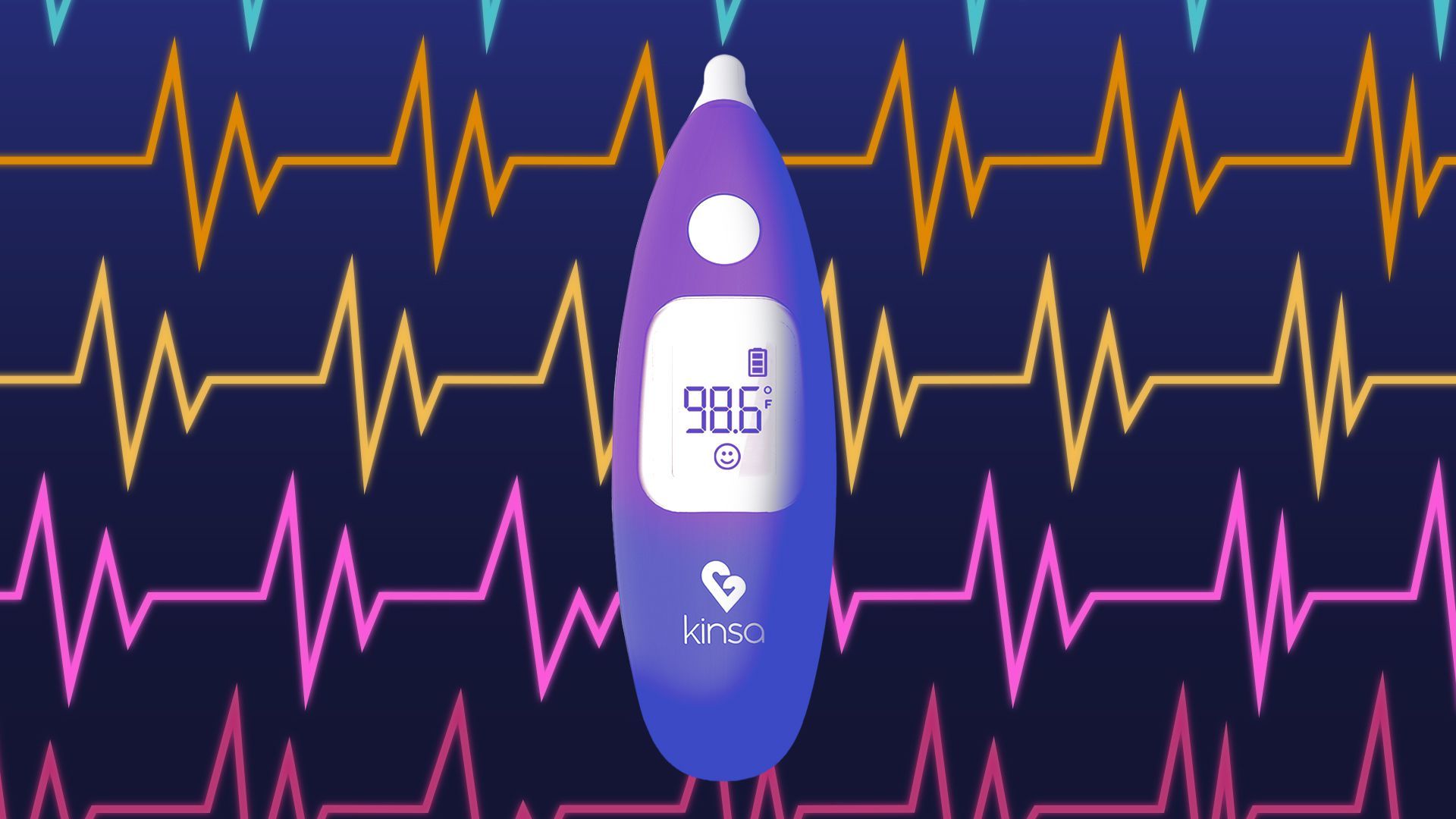
Photo illustration: Sarah Grillo/Axios. Photo: Kinsa
New York City will harness data from thousands of internet-connected smart thermometers to identify future virus outbreaks — days, or even weeks, before case counts rise, Bryan Walsh writes.
Why it matters: By the time large numbers of sick people start showing up in hospitals, it's often too late to curb an outbreak.
Kinsa, a San Francisco-based startup, will distribute up to 100,000 free internet-connected thermometers through New York City's elementary schools in the coming months.
- Readings are sent to Kinsa's app, which quizzes users on other symptoms and provides guidance on care.
- City health officials will have access to aggregated, anonymized Kinsa data, which will help them identify unusual illness clusters.
5. Dumplings? Yes. Servers? No
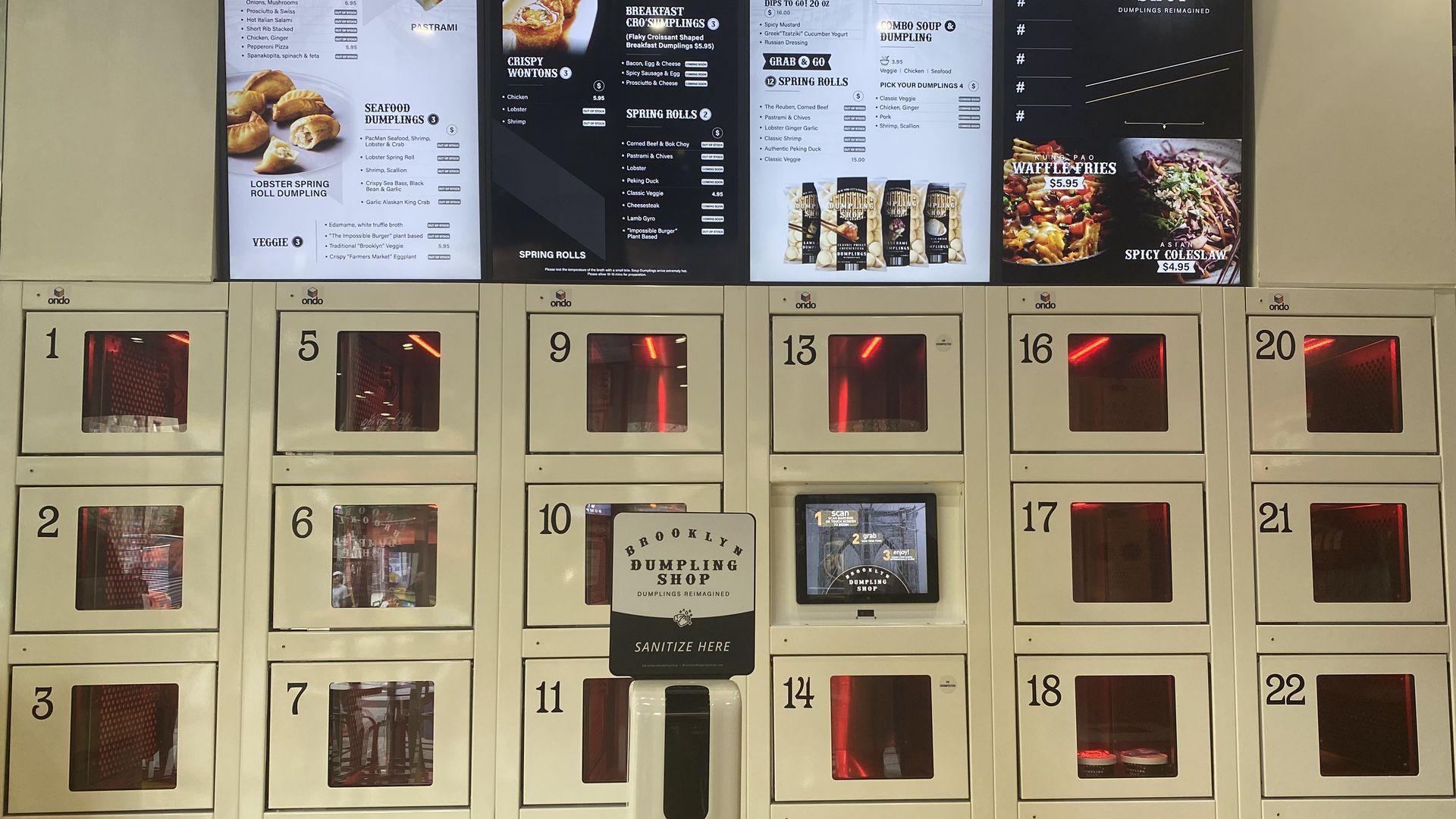
Photo: Erica Pandey/Axios
The shortage of restaurant staff is inspiring some joints to find ways to take people out of the retail equation, Erica Pandey writes.
Case in point: I ate lunch this week at the server-less Brooklyn Dumpling Shop, a three-week-old fast casual eatery in Manhattan's East Village. You order on-screen and your food appears in a cubby.
- I could see the chefs preparing my dumplings behind a glass wall, but that was my only interaction with humans during lunch.
Brooklyn Dumpling Shop founder Stratis Morfogen told me automation could allow many more eateries to keep their doors open — and save back-of-house jobs.
Other businesses are pursuing similar gambits:
- Amazon has popularized its checkout-less Go stores.
- At Reformation, a clothing boutique chain, screens in dressing rooms let shoppers summon items to try on.
- Kroger has an in-house innovation lab that's partnering with Microsoft to develop sensors and shelves that can automatically keep track of what needs restocking.
Still, humans often beat machines:
- Walmart pulled inventory-tracking robots out of its stores after finding human workers were more efficient.
And the dumplings? I've had better pork gyoza. But the lamb gyro variety were creative and tasty.
6. Welcome to What's Next

Illustration: Aïda Amer/Axios
Understand the future as it unfolds:
- Sign up here, and share the link with your family and colleagues, to get the new Axios What's Next newsletter when it debuts Monday.