
Axios Crypto

August 31, 2023
BitBoy Crypto moves on without its main dude. And there's a coin called BEN tanking because of it. Also, another crypto project wins in court.
- Things are gettin' weird. Email us: [email protected]
Today's newsletter is 1,259 words, a 5-minute read.
📺 1 big thing: BitBoy Crypto drops BitBoy
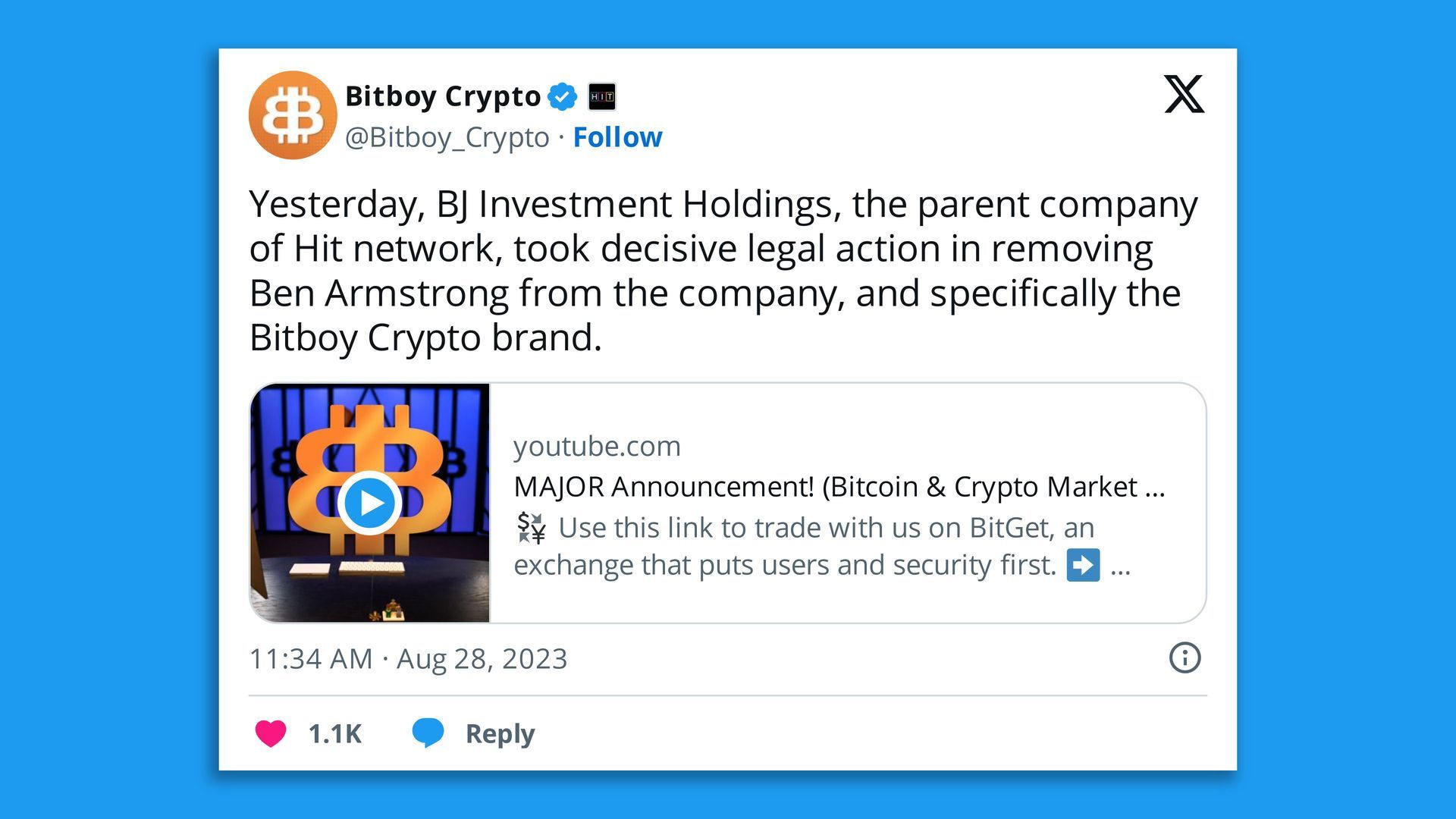
Screenshot: @BitBoy_Crypto (Twitter)
A crypto promoter popular on YouTube was dropped by the brand he helped create, Crystal writes.
Driving the news: BitBoy Crypto dropped "BitBoy," also known as Ben Armstrong, explaining that HIT Network and its parent BJ Investment Holdings recently removed him from the company.
The intrigue: The drama includes a coin called BEN that Armstrong promoted. He is supposedly a controlling member of the group behind it.
What they're saying: "This difficult decision is a culmination of a prolonged effort to help Ben during his relapse into substance abuse as well as reconcile the emotional, physical and financial damage he has done to the employees of Hit network and the BitBoy Crypto community," the company tweeted via the BitBoy Crypto account Monday.
The other side: Armstrong denied the allegations of a relapse to Decrypt, and, Decrypt reports, on a group phone call Tuesday on Discord.
Meanwhile, someone using the @joinBenCoin account claiming they are Armstrong tweeted Sunday: "Just confirming what is going around. It's true. There has been a mutiny at BitBoy Crypto & Hit Network."
- Timothy Jerry "TJ" Shedd, CEO of HIT, and Justin Williams, a founding member, "attempted a coup at my company," the tweet said.
- The following day, the account said that BEN is not managed by HIT, but a separate firm controlled by Armstrong and @DuchessOfDeFi Cassandra Wolfe.
HIT Network did not respond to an emailed request for comment; Armstrong did not respond to text messages sent by Axios.
Catch up fast: BitBoy has a colorful history in the space. Primarily, he's known for YouTube videos where he makes recommendations about coins to buy.
- Last year, he filed a lawsuit against someone for criticizing his promotion of a token called PAMP ("pamp" is crypto speak for "pump," as in price).
- He later withdrew the suit.
Zoom in: BEN coin says it's a crypto collective focused on "promoting the understanding and adoption of crypto."
- Others call it a meme coin.
Of note: Armstrong didn't create BEN, but his promoting it 🍅 led to him becoming part of the group, according to the YouTube channel sensation.
- He told Decrypt in May that the coin was spurred by a Telegram group of crypto traders named Ben.
- Around the same time, Armstrong said he took control through the Ben Coin Foundation and was tasked with "creating something with utility."
- "I had this incredible idea to turn this into a crypto adoption coin. It's a win-win," he said.
State of play: "Anyways so the project is still active"? — one person asked Monday afternoon; a moderator of the account responded "yes."
Quick take: 🫡 That's showbiz, baby!
🐸 2. Charted: BEN vs. PEPE


Goodnight, PEPE, goodnight, BEN, Crystal writes.
What's happening: Here are two once-viral coins in decline, with one doing far worse than the other.
By the numbers: BEN coin has been roughly cut in half since BitBoy Crypto dropped its main dude, underperforming the popular frog meme coin.
- Some supporters of both of those coins are doubling down.
Flashback: PEPE was recently rugged by a cadre of its creators.
🤖 3. Federal claims against Uniswap "dismissed with prejudice"

Illustration: Maura Losch/Axios
The lawsuit against the leading decentralized exchange Uniswap, was dismissed yesterday by New York's southern district court, Brady writes.
Why it matters: The court accepted the defendant's argument that its smart contracts represent a neutral medium of exchange, which is not a party to any transaction that might happen to be illegal on the platform.
Catch up fast: Plaintiffs sued Uniswap (and others) in April because they lost money buying various tokens of ill repute on the platform.
- As the judge notes: They weren't able to find the issuers of the tokens for their damages, so they sued the people who made the exchange where they bought them instead.
What they're saying: "The Court declines to stretch the federal securities laws to cover the conduct alleged, and concludes that Plaintiffs' concerns are better addressed to Congress than to this Court," District Judge Katherine Polk Failla writes in her opinion dismissing the case.
In the weeds: The judge presents a thorough explanation of how Uniswap works, how tokens on Ethereum work and how users make money by serving as liquidity providers for different assets settled on the Ethereum blockchain.
- In the plaintiffs' argument, they assert that Uniswap is like a self-driving car and that failure to hold it accountable would be like failure to sue a carmaker for making a faulty car that led to injury of a user.
- The court, however, accepted Uniswap's counterargument: that holding it accountable would be more like suing Tesla because someone used one of its cars in the getaway for a bank robbery.
Of note: The judge accepted the plaintiffs' arguments that the tokens traded were securities, but then said it was not material to her decision.
Reality check: The judge does not dismiss the questions as easy. Instead, she notes that there are gray areas in the law created by decentralized finance that the government has yet to grapple with conclusively.
The intrigue: The judge is the same one hearing the SEC's case against Coinbase, the leading centralized crypto exchange in the U.S.
😈 4. Charts show scams evaporate quickly
The team behind Magnate Finance has covered its tracks really well.
- That's because it has had practice, Brady writes.
Why it matters: Not only is Magnate the latest project to rug pull its users, but it seems to be (at least) the second time the people behind it pulled this kind of scam.
Driving the news: Magnate Finance was a borrow-lend protocol (like Compound or Aave). People would deposit assets, others would borrow those assets and the depositors would earn a little interest based on the earnings of those loans.
- On Friday, the creators of Magnate walked away with all the deposits, about $6.4 million.
It happened shortly after crypto sleuth ZachXBT posted on Twitter that the wallet that deployed the Magnate Finance smart contract onto the Base chain could be linked back to another rug pull.
Be smart: A rug pull is the name of a common scam in the cryptocurrency world.
- A team will promise to build up some new, useful project. They will seek either investment money, or even just bank-like deposits into a new product.
- When enough funds have built up, the team will withdraw all the funds and disappear without building what they pitched.
New tokens are usually a good lure to get people in early.
- Magnate had the (now basically worthless) MAG token.
How they found it: ZachXBT noticed that funds in the wallet that deployed Magnate had passed through two other wallets on the way over from a wallet associated with Solfire Finance, a rug pull from January 2022, that got about $3 million of customer funds.
- There were some differences. Solfire was on the Solana blockchain. It claimed to be an asset management app.
- But there were similarities. It promoted itself with a token and the team deleted everything it could on the way out the door.
Of note: Magnate didn't get news coverage (perhaps intentionally), so there's very little information that's still out there about it.
- The team seems to have forgotten to delete this post on Medium, where it describes how its token works (archived version).
- As far as I can tell, both were run by teams of anonymous builders (common in rug pulls).
- The token was a way for users to share in Magnate's revenue, with 80% of all the revenue going to people who staked MAG.
The bottom line: It's probably not the first time, but now we know that, in fact, there has been at least one serial rug puller.
This newsletter was edited by Pete Gannon and copy edited by Carolyn DiPaolo.
The chains are slow but the courts are busy. —C & B
Sign up for Axios Crypto

Brady Dale covers crypto and blockchain impacts on markets and regulation.