Axios Crypto

August 08, 2024

Two gigantic crypto cases got final decisions from judges this week. But first: sanctions on Ethereum's controversial privacy machine.
- Email us: [email protected]
Today's newsletter is 1,147 words, a 4-minute read.
1 big thing: 🍯 Sanctions and the decentralized internet
The results of the Tornado Cash sanctions, two years out, are mixed.
Why it matters: The strongest argument for blockchain technology has always been truly neutral money. In other words: a way to transact value that no one can step in and prevent. ("Censorship resistance" in industry-speak.)
Driving the news: A study published yesterday by staff at the Federal Reserve Bank of New York documented in detail a growing unwillingness by participants in Ethereum's settlement chain to process transactions made through the Tornado Cash privacy application.
- Indeed, going more deeply, they observed that reluctance increased following a ruling by U.S. courts that upheld the sanctions.
Zoom out: Use of Tornado Cash plummeted for well over a year after the United States forbade people from using it in August 2022, but it began ticking back up again this year.
- While the dollar value in the protocol is up to the level it was at the time of the sanctions, that's largely explained by the rising value of the underlying assets.
- If one looks at the amount of ethers (ETH) deposited, it's clear that use of Tornado Cash is rising again, but remains about two-thirds of the levels pre-sanctions.
How it works: Tornado Cash allows a user to deposit funds and then withdraw them in a way that makes it extremely hard to connect the deposit to a withdrawal.
- The more people use it, the more money that goes in, the harder it is to make the connection between deposits and withdrawals.
- Conversely, any reluctance that law enforcement can engender around the application undermines bad actors who might use it.
Between the lines: The Fed researchers found the most reluctance among operators who are composing blocks for Ethereum to validate.
- Ethereum users send transactions out to the chain, but these don't become real until they get validated into the blockchain's ledger, which updates every 12 seconds.
- There are entities that pick transactions to go into the ledger, "composing" sets of them (blocks) and deciding what order they should run in.
- Then there are other entities that validate those blocks and stamp them onto the chain. At that point, it's done.
The validators don't seem to be worried about sanctions cooperation, but the composers are. That's what the researchers observed.
The big picture: As long as there are some block composers and validators outside of the U.S. jurisdiction, Tornado Cash transactions can probably always get through — but friction lowers the desirability of the facility.
What they're saying: "We demonstrate that although Tornado Cash transactions continue to be settled censorship-resistance appears more tenuous than what the transaction volume suggests," the authors write in their conclusion.
The bottom line: Blockchains resist regulation, but they aren't immune to it.
2. 🏊♂️ Charted: Ripple's case closes


Ripple, the company that created the cryptocurrency XRP (and still owns mountains of it), has received judgment in the case the SEC brought against it, and the market is interpreting it as a win.
Why it matters: The case over the creation and sale of XRP has proven to be a defining moment in the battle over which cryptocurrencies are, and are not, securities under U.S. law.
The latest: The judge in the case has ruled that Ripple should pay $125 million, which is far less than the SEC sought.
- The judge declined to order disgorgement of profits from sale and noted that there are no claims of fraud in the case.
- But the ruling found fault with the firm's offering of the token without properly registering with the agency. The company was ordered not to violate the Securities Act again.
What they're saying: An SEC spokesperson drew attention to multiple points in which the court agreed with the SEC's claims against the company and added that the ruling reaffirms court judgments that securities laws apply to companies "regardless of the technology or labels that they use."
- "We're glad to have this finally behind us," Ripple counsel Stuart Alderoty told Bloomberg, saying the company could pay the fine with cash on hand.
What we're watching: Whether or not the SEC appeals.

3. ⚖️ FTX, Alameda ordered to pay $12.7B to creditors
It's just a little shy of two years since FTX suddenly collapsed the morning after U.S. midterm elections, and a judge has approved a deal to distribute what remains of its assets to creditors.
Why it matters: In 2022, as the air was coming out of the tires of the cryptocurrency hot rod, FTX somehow became the world's darling for several months, before the whole thing turned out to be a giant fraud.
The latest: U.S. District Judge Peter Castel yesterday approved a deal for $8.7 billion in restitution to those who sustained losses from FTX and its sister company, Alameda Research, and $4 billion in disgorgement of profits.
- The deal ends a lawsuit against FTX filed by the Commodity Futures Trading Commission.
- The anticipated settlement was part of FTX's proposed reorganization plan, which remains subject to approval in its bankruptcy case.
Zoom out: Most people are getting paid back more than the dollar value of their assets on the day of the bankruptcy, thanks to the resurgence in value of cryptocurrency assets.
- However, lots of those creditors have already sold their claims to companies that specialize in distressed assets.
The big picture: FTX's implosion shattered the willingness of Congress to contemplate legislation to update regulations with consideration for cryptocurrency, but some of that appears to have returned.
What they're saying: "As I have been saying for years, this is just the tip of the iceberg. In the absence of digital asset legislation to fill regulatory gaps, entities will continue to operate in the shadows without these basic tools of sound regulation," CFTC chair Rostin Behnam said in a statement.
4. 🧳 Saylor's stash
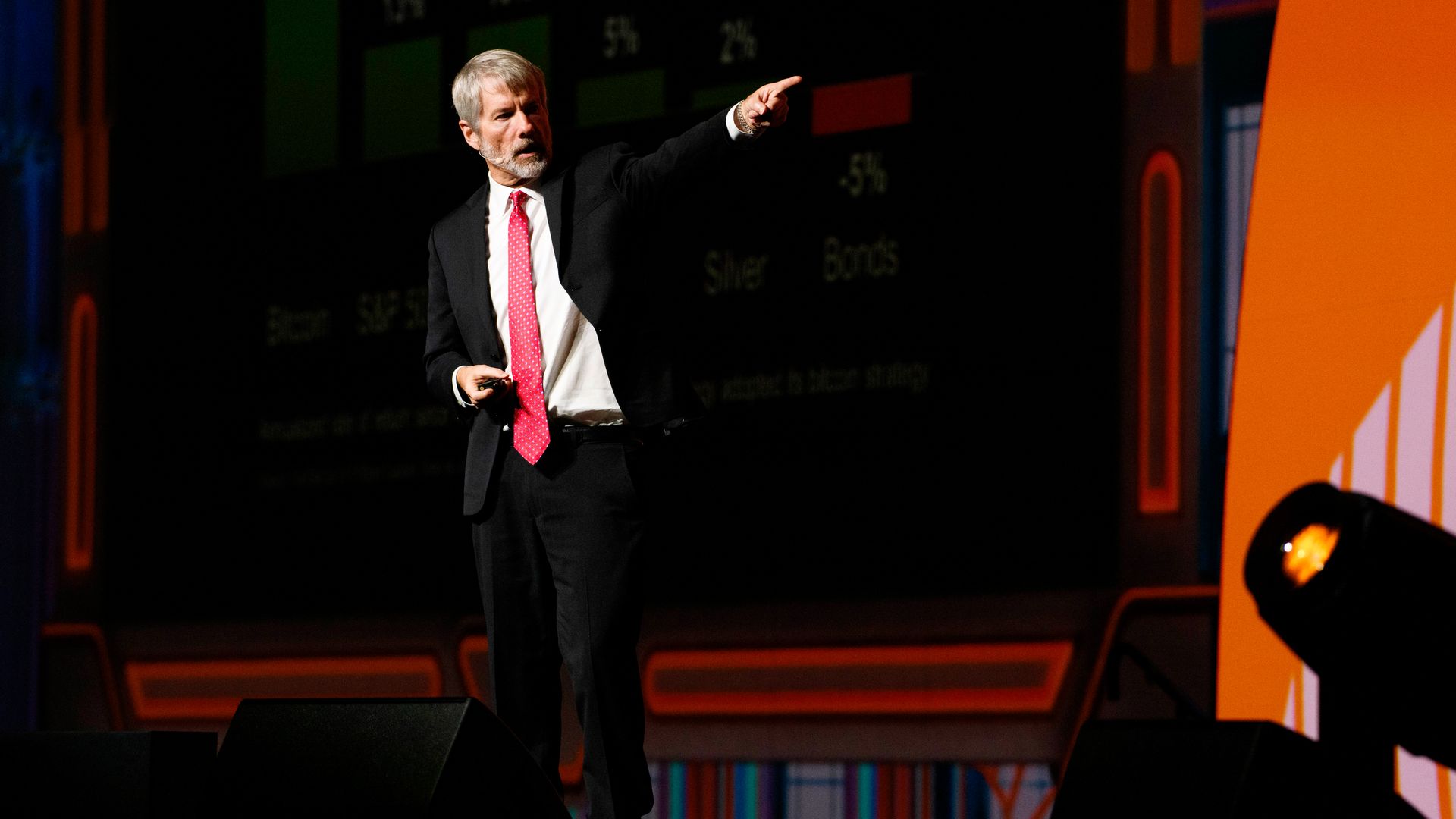
Michael Saylor, the chair of MicroStrategy, owns over a billion dollars worth of bitcoin (BTC).
Why it matters: His company is already one of the largest holders of BTC in the world that anyone knows of for sure, but it turns out he's even more exposed to the world's oldest cryptocurrency.
The latest: He was on Bloomberg talking about the dip this week, and he repeated something he'd said in 2020 when he disclosed that he had 17,732 BTC (a billion dollars worth).
- He also noted that he never sells and he continues to buy, but he didn't update the number.
- Binance controls more BTC than MicroStrategy, but most of that is likely to belong to its users, rather than the company.
Zoom out: Saylor is also a major owner of his company, holding at least 10% of its stock.
- Which would mean, roughly, that at a minimum he indirectly owns another 22,600 BTC, in a way.
The bottom line: Saylor is a true mega bull of bitcoin, one who predicts wild success for the asset.
- If he is even a little right he stands to be an epically wealthy individual, but he'll probably also do OK even if he's largely wrong.
This newsletter was edited by Pete Gannon and copy edited by Carolyn DiPaolo and Anjelica Tan.
Were you forwarded this email? Subscribe here.
Sign up for Axios Crypto