Axios Crypto

March 14, 2024
Coinbase taps the convertible bond market while its stock rides high. Plus an update on CBDCs.
π’ Dear readers, at what price would you like another bitcoin update?
π§ [email protected]
Today's newsletter is 1,076 words, a 4-minute read.
π° 1 big thing: Coinbase taps capital markets
Illustration: Annelise Capossela/Axios
Coinbase's just announced $1.1 billion convertible bond offering says more about traditional corporate finance than it does crypto, Crystal writes.
Why it matters: The U.S.'s largest crypto exchange is drawing more than just bitcoin investors β with its stock surging alongside the world's largest digital asset, Coinbase is gaining traction with a more conservative crowd: bond investors.
Between the lines: Coinbase is selling so-called hybrid debt, with equity-like features, earmarking proceeds to pay down its existing debt and to hold in reserve for possible future acquisitions.
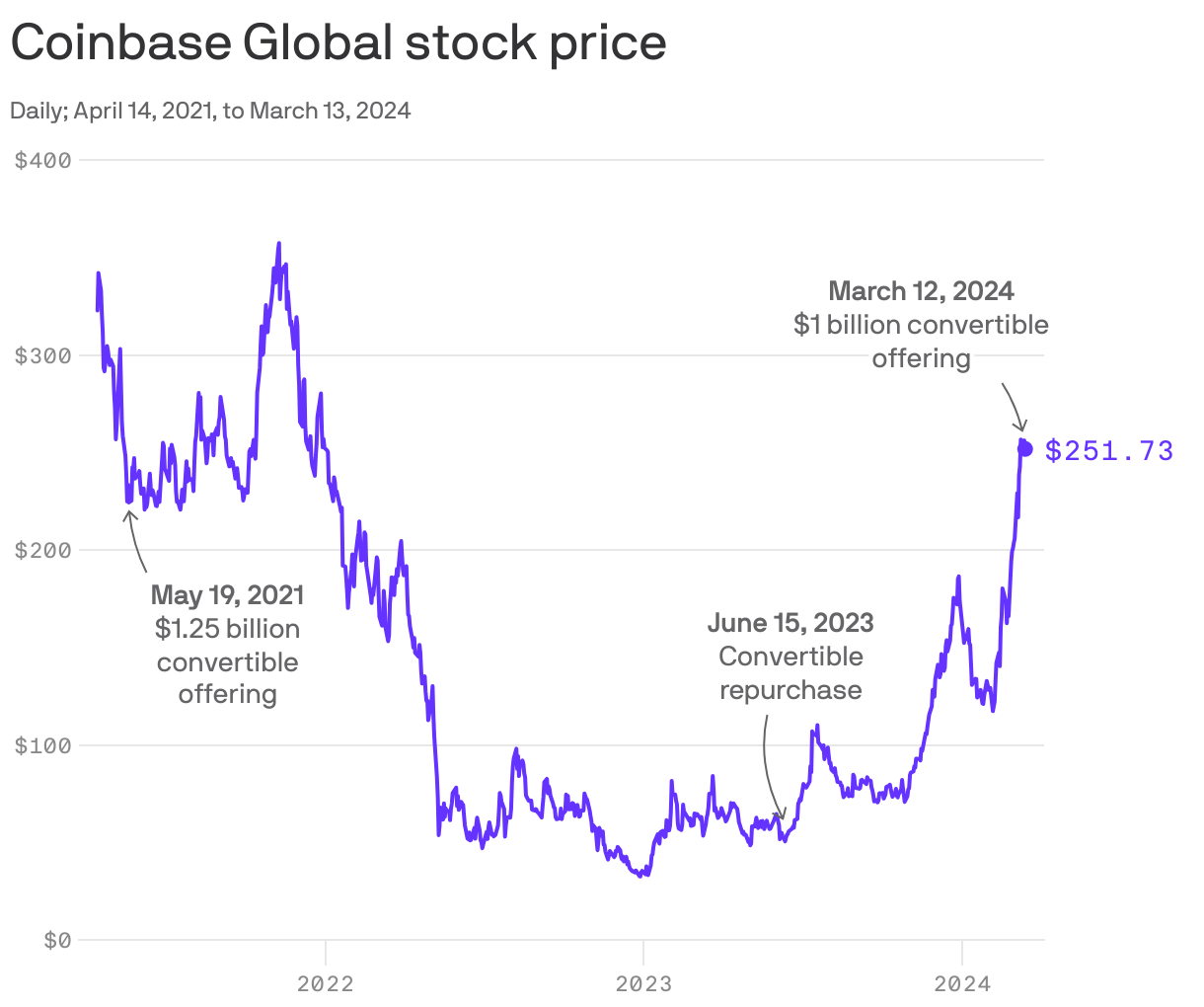
- The offering comes while shares of Coinbase Global sit at highs, which tracks with the firm's history of tapping that corner of capital markets when its stock is doing well. (See: Charted)
How it works: Convertible bonds are the go-to for technology and biotechnology companies as they offer relatively lower rates than straight debt, and it's the corner of capital markets that's open to them.
- Certain investors like convertibles for their bond- and stock-like qualities β the bond pays fixed-income interest β but also, the right to convert it into shares if a certain price is struck, or what's called the conversion premium.
It's a balancing act, because Coinbase would want the lowest coupon (the interest it pays to holders), and the highest conversion premium (minimizing the risk of equity dilution) they can get, without turning off potential buyers.
By the numbers: Last night, the company announced that the new convertibles will have a 0.25% coupon, cheaper than the 0.5% coupon on the bonds coming due in 2026, which it sold in May 2021.
- The conversion price is set at $333.54 per share, meaning that's what its stock would have to hit before holders of the bond converted it to equity. That's a 32.5% premium to yesterday's price of $251.73.
Zoom in: That conversion price is below Coinbase's all-time high of around $357 struck in November 2021. In the 2021 sale, investors got a roughly 55% conversion premium.
Shares of Coinbase took a small dip after the initial convertible announcement Tuesday β a normal market reaction to a debt offering. Shares are trading down over 9% again today following the pricing announcement last night.
The big picture: Coinbase's financials look fine: It had roughly $3 billion in outstanding long-term debt at its last reporting period, excluding any crypto asset borrowing, and more than $5.1 billion in cash and cash equivalents.
π Crystal's thought bubble: My read on the convertible offering is that Coinbase is simply cleaning up house, the routine capital management that companies do.
- It's doing so with its stock trading near highs, as it usually does.
π 2. Charted: COIN

Raise money when times are good, pay down debt when times are bad, Crystal writes.
Zoom in: That's not just π Coinbase, but a rule most publicly traded companies would want to follow.
Flashback: When COIN stock was riding high following its public debut in 2021 via direct listing, the crypto exchange had both a convertible and straight debt offering.
- After that May convertible offering, Coinbase also had a $2 billion debt offering, upsized from its announced $1.5 billion offering β that showed how much demand there was for those bonds.
- In the deep winter following the credit collapse of 2022, the company pivoted to pay down debt, with the convertible repurchase in June, but also completed a cash tender offer in August.
π Crystal's thought bubble: With Coinbase benefitting from the surge in bitcoin prices, investors could show similar enthusiasm for this offering relative to its 2021 sale.
- The rate environment is wildly different though.
πΊοΈ 3. CBDC tracker
Map: Atlantic Council
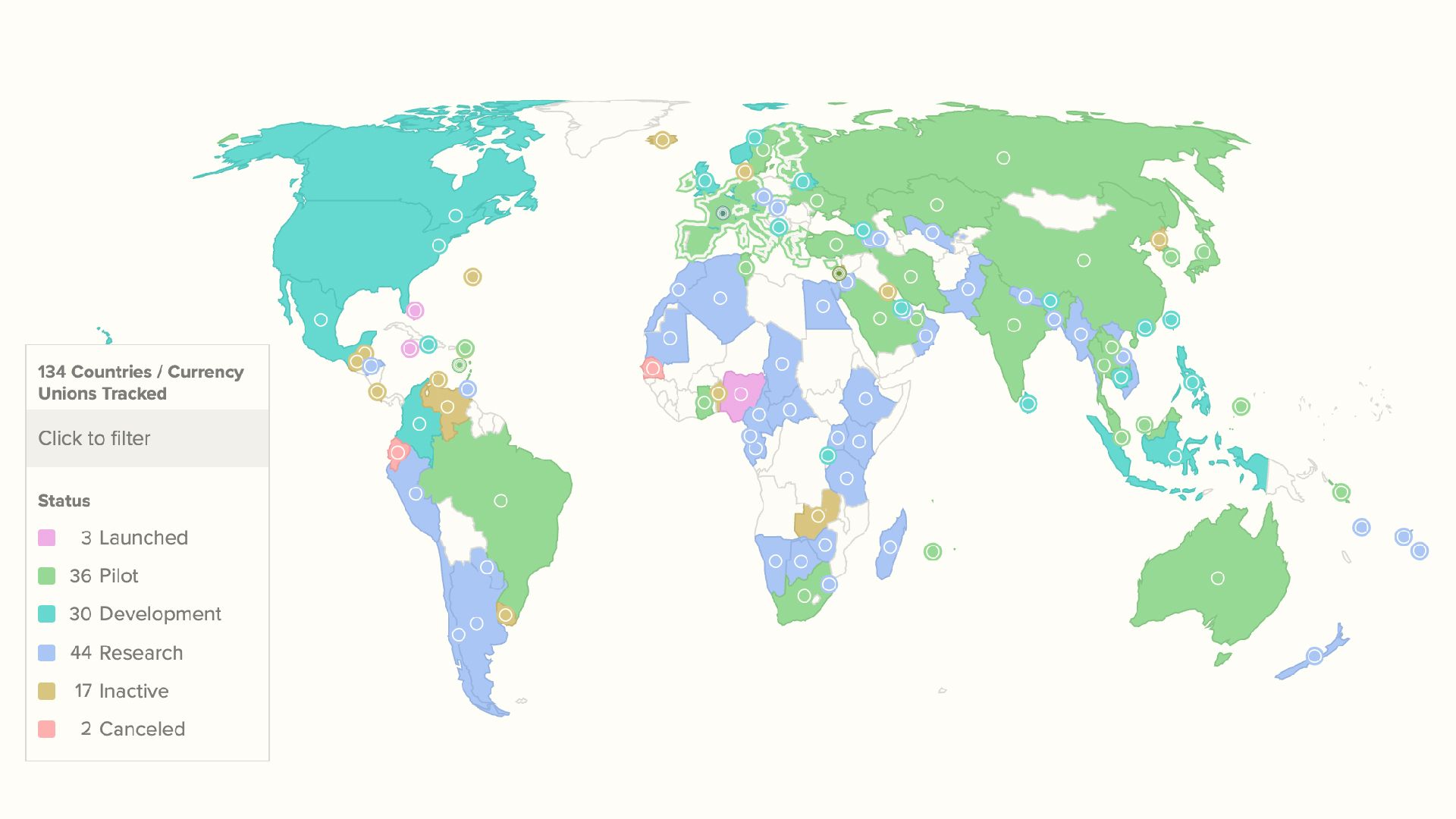
More countries than ever are playing with the idea of launching CBDCs, or central bank digital currencies, Crystal writes.
Why it matters: More than 130 countries representing 98% of global gross domestic product (GDP) are exploring one, the Atlantic Council's Ananya Kumar tells Axios.
- CBDCs appear to be picking up pace, with wholesale CBDC project developments doubling since the sanctions response to Russia's invasion of Ukraine.
Context: There are two kinds of CBDC projects. Wholesale is meant for central banks and member banks; while retail is for regular people.
- For example, mBridge is a wholesale CBDC that endeavors to connect China, Thailand, the United Arab Emirates, and Hong Kong, with plans to expand to 11 other countries this year.
The U.S. continues to fall behind, with what the Atlantic Council views as a "widening gap" between it and other G7 banks such as the central banks of London and Japan.
- That might have to do with how politicized CBDCs have become, with various policymakers and folks running for president raising the alarm on privacy concerns around retail CBDCs.
- Here's the Cato Institute explaining how the U.S. central bank's FedNow system is not a CBDC β FedNow is a payment rail, CBDC is a currency.
Context: CBDCs are controversial, even among crypto natives, because they're seen as a possible vector for deepening financial surveillance.
China's digital yuan (e-CNY) remains the world's largest CBDC retail pilot, reaching 260 million wallets across 25 cities.
Of note: Atlantic Council no longer tracks what projects are blockchain-based and which aren't.
- "Any advanced CBDC projects will take the best of decentralized and centralized technology," she said. "It's hard to talk about it in a binary way."
The big picture: Money currently moves on two layers: a messaging layer that SWIFT controls, and a settlement rail on which the dollar is the most dominant currency.
- When countries build cross-border wholesale projects without the U.S. they are trying to connect their banks to each others' and moving away from the dollar, Kumar says.
π’ 4. Catch up quick
Illustration: Annelise Capossela/Axios
π Developers are having fun with the Dencun upgrade. (CoinDesk)
π―ββοΈ DeFi lending platform MakerDAO announced two new tokens in an unveiling of Endgame launch details. (The Block)
βοΈ Post-halving, the costs to mine bitcoin for many public companies will be right at their expected earnings. (The Miner Mag)
π«‘ U.K. court rules that Craig Wright is not Satoshi Nakamoto. (Wired)
π½5. Bitcoin Investor Day
Screenshot: @APompliano (social media)
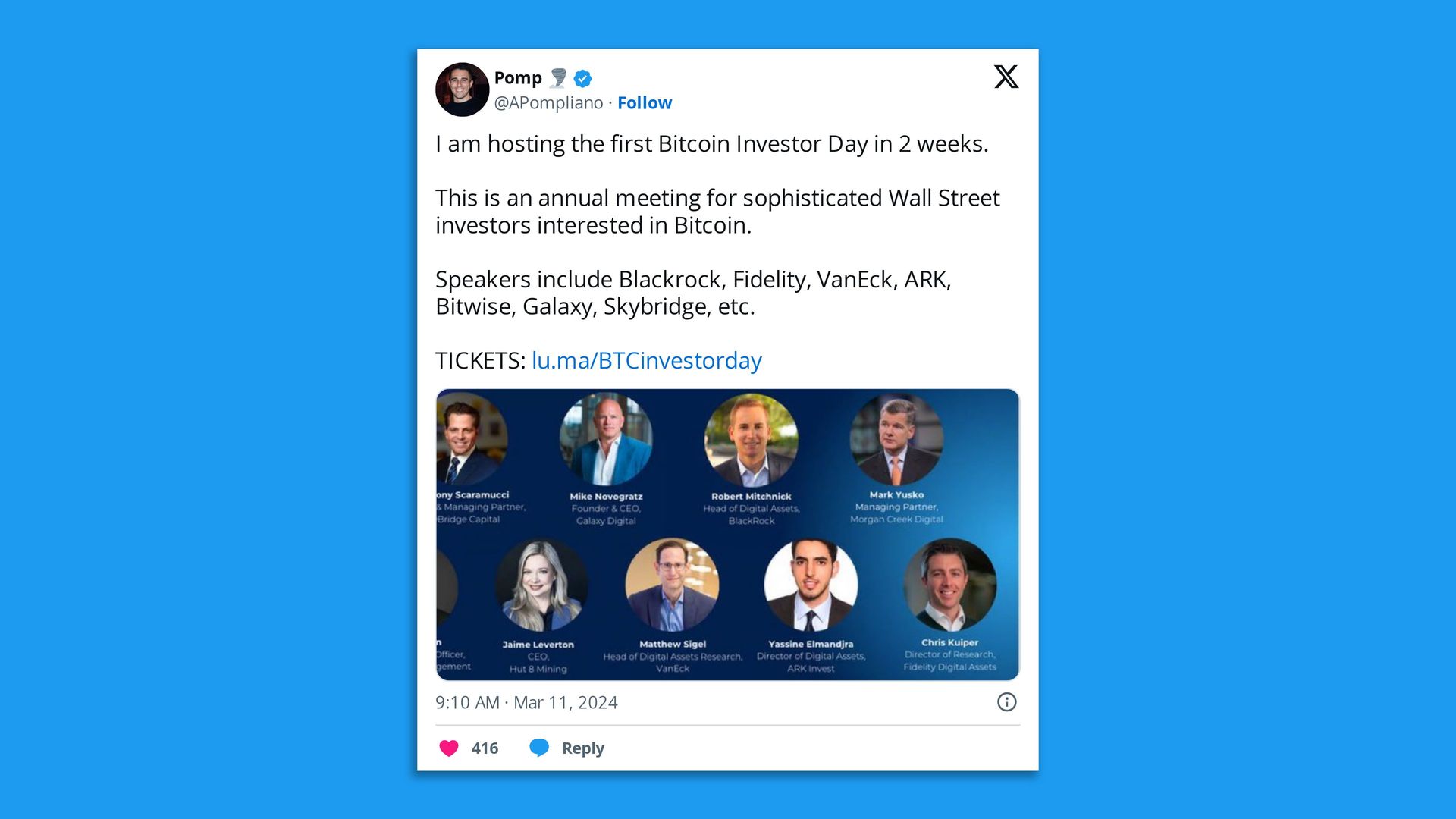
The first Bitcoin Investor Day starts March 22.
What's happening: Reflexivity Research, co-founded by Anthony Pompliano, host of The Pomp Podcast and bitcoin enthusiast, will run the conference in New York.
- π€© It promises a star-studded cast of investor heavyweights including Cathie Wood of ARK Invest, Anthony Scaramucci of SkyBridge Capital, and Mike Novogratz of Galaxy Digital.
π Crystal's thought bubble: I have a feeling it's going to be a bit different than Bitcoin Miami and I can't wait.
This newsletter was edited by Pete Gannon and copy edited by Carolyn DiPaolo.
Any new Axios Crypto readers out there? Tell us what you like. βB & C.
Sign up for Axios Crypto

Brady Dale covers crypto and blockchain impacts on markets and regulation.