Axios Crypto

May 19, 2023
TGIF: Today managing editor Javier David steps into the top spot for our 1 big thing. Also, some updates on the NFT market.
- Do you have Memorial Day weekend plans? [email protected]
Today's newsletter is 1,117 words, a 4-minute read.
𪚠1 big thing: Blockchain carving out its own identity

Illustration: AĂŻda Amer/Axios
In ways various and sundry, blockchain technology is quietly thriving, even as regulators everywhere tighten their grip on the Wild West of cryptocurrencies, Axios' Javier E. David writes.
Why it matters: In the wake of FTXâs collapse and a gradual rebound from the crypto winterâs darkest days, the formerly freewheeling market is in transition as regulators grapple with how to protect investors.
- Canada is singling out cryptocurrency exchanges, while the SEC is cracking down on... well, just about everything related to digital currencies.
- Yet blockchain, the tech that underpins crypto assets, continues to carve out a niche as a digital ledger in numerous applications.
According to some experts, the flourishing sector is a symbol of how the public is slowly disentangling the blockchain from crypto.
- The former is evolving into a powerhouse of its own, even as the latter âskews toward pessimism,â Mrinal Manohar, CEO and co-founder of Casper Labs, tells Axios in an interview.
What they're saying: âItâs a technology that adds a ton of security and is tamper-proof,â Manohar said, pointing to a growing list of governments relying on blockchain, even as they crack down on crypto trading.
- âItâs interesting because while many of these governments are figuring out their stance on cryptocurrencies, theyâre pushing ahead with blockchain.â
Zoom out: Countries like India, Saudi Arabia and Colombia are tinkering with blockchain applications, while California made it the cornerstone of recent efforts to revamp the stateâs Department of Motor Vehicles.
- Blockchain has also gained a toehold in the increasingly lucrative gaming industry.
Yes, but: Some fear heavy-handed enforcement in the wake of FTXâs implosion and the subsequent shakeout in crypto could have a retrograde impact on blockchainâs development.
This week, the Chamber of Digital Commerce called on Washington to adopt a comprehensive framework for digital assets.
- âOur alliesâ and adversariesâ advances in blockchain and digital assets threaten U.S. leadership and dominance across next-generation finance, trade, business, and other verticals while the U.S. sits idleâeffectively pushing the industry overseas,â the organization wrote in a letter.
Crypto is just beginning to emerge from a phase Manohar jokingly describes as the vice-filled âporn and gamblingâ era that defined the early internet. Conflating cryptoâs negatives with the technology that underpins it is a risk to the blockchainâs development, he argues, especially in an already weak environment for fundraising.
- âIf you thought âletâs get rid of the technology because I donât like porn and gambling,â we wouldnât have e-commerce,â Manohar tells Axios.
The bottom line: âRegulators shouldnât throw the baby out with the bathwater,â Manohar said.
- âI hope regulators donât take away the potential of whatâs a very powerful technology because of bad actors in cryptoâŚThe technology has so much promise that if regulators work with it well,â its potential is close to limitless, he added.
𧸠2. Charted: NFT market continues shrinking


The NFT market has continued to shrink, with market watchers noting that May could be the first month with less than a billion dollars in volume for a while, Brady writes.
- Less than a billion dollars is still a lot of money.
đŞ 3. The latest NFT market moves
Illustration: Annelise Capossela/Axios
One would never know that the NFT market is down so much by looking at moves of market participants, Brady writes.
Driving the news: A new report from DappRadar illuminates how frenetic the market has been as companies vie for leadership.
What they're saying: "The market displays evident signs of maturation and progressive growth. However, this evolution comes with changes in the status quo," the authors write.
Context: The second-largest blockchain, Ethereum, continues to be the place where the volume happens, with more than 80% of the market in terms of value transacted.
- Yes, but: Ethereum lags the market in terms of actual transactions. Most NFTs are getting bought on other blockchains (that is, lots of cheap ones). Polygon leads the market in sheer numbers.
- This makes a certain amount of sense. Ethereum has the strongest security model â so you'd want the most valuable items on that blockchain.
The second largest blockchain in dollar value is Solana. While Flow, a blockchain designed from the ground up for NFTs, is coming in fourth these days.
- Wax, an older blockchain that came out of the 2017 initial coin offering boom, is way behind in dollar value but a second in total sales.
Quick take: Lots of sales mean lots of transactions, which possibly also means lots of users. In other words, there's some chance that the first truly viral blockchain game is finding its sea legs out there on one of these minor chains right now.
The intrigue: We wrote in February about Blur, the upstart NFT marketplace that dominates the charts.
- It's widely thought (believed/understood) that much of the volume for Blur is wash trading (trades that aren't real, between two addresses controlled by the same person or company).
- Wash trading is a form of market manipulation. For NFTs, it can boost the floor price of their lines.
Nevertheless, Blur is putting pressure on the market leader, OpenSea, which has been scrambling to create features for traders, housed under its new Pro offering.
Also: Bitcoin's NFT market, also known as Ordinals, is new and weird and no one quite knows what to make of it long term yet.
The bottom line: "While the overall NFT trading volume may have taken a downturn this month, the resilience of the sales count paints an encouraging picture," the authors write.
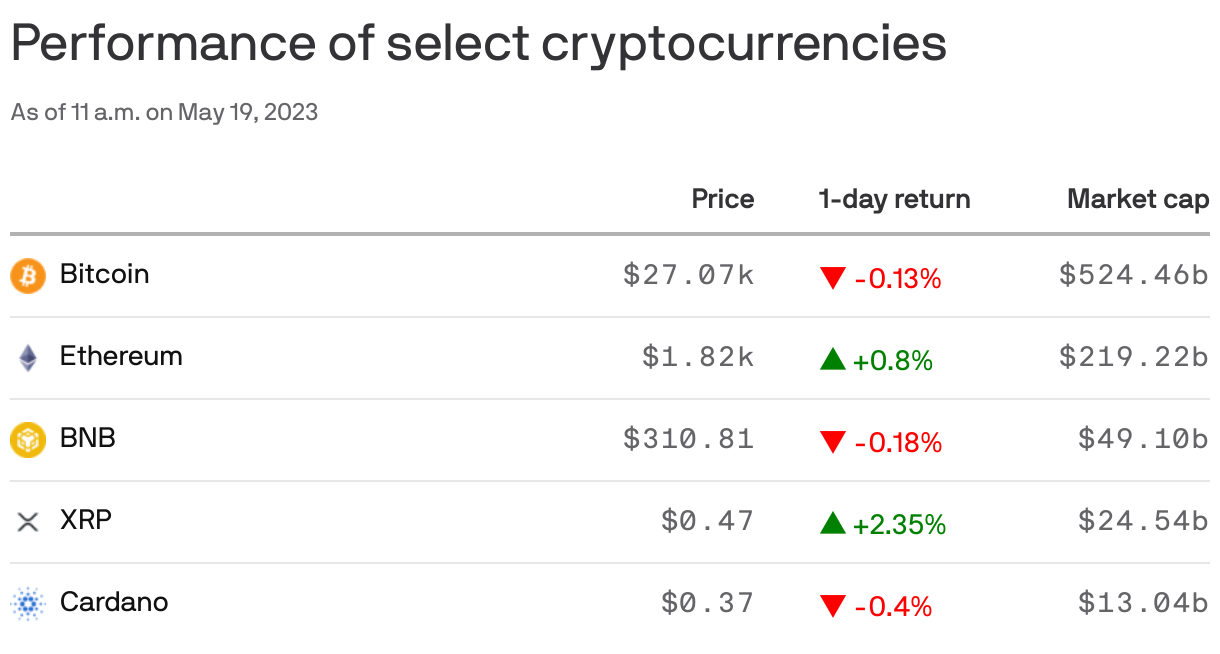
Top coins

đ 4. Catch up quick
Illustration: Annelise Capossela/Axios
đ Jack Dorsey led a $6 million seed round in developing world bitcoin startup Azteco. (Axios Pro)
đ¤ Texas' proof-of-reserves legislation is headed to the governor. (Protos)
đ¨đ A canton in Switzerland is further integrating its tax payment system with cryptocurrency. (The Block)
đ¨ââď¸ BONUS: An amicus brief in New York addresses the status of Ethereum's ether cryptocurrency. (Paradigm)
đŽ 5. Charted: Unpopular opinion

The reason that blockchain companies have so many ridiculous parties is because the industry is full of contrarians who don't get invited to anyone else's parties, Brady writes.
- It's striking when someone goes contrarian on the contrarians though.
Context: We told you about Worldcoin in March. It's a blockchain that uses biometrics (retinal scans) to allocate some of its cryptocurrency to everyone on the planet.
- People scan their eyeballs to establish an on-chain identity. Then that identity will get some worldcoin (one day soon).
- It's not exactly a beloved concept.
- For once, the mainstream and the blockchain types agree: It's kind of creepy!
Zoom out: Worldcoin is a project of Sam Altman, the same guy who has the whole world talking about AI.
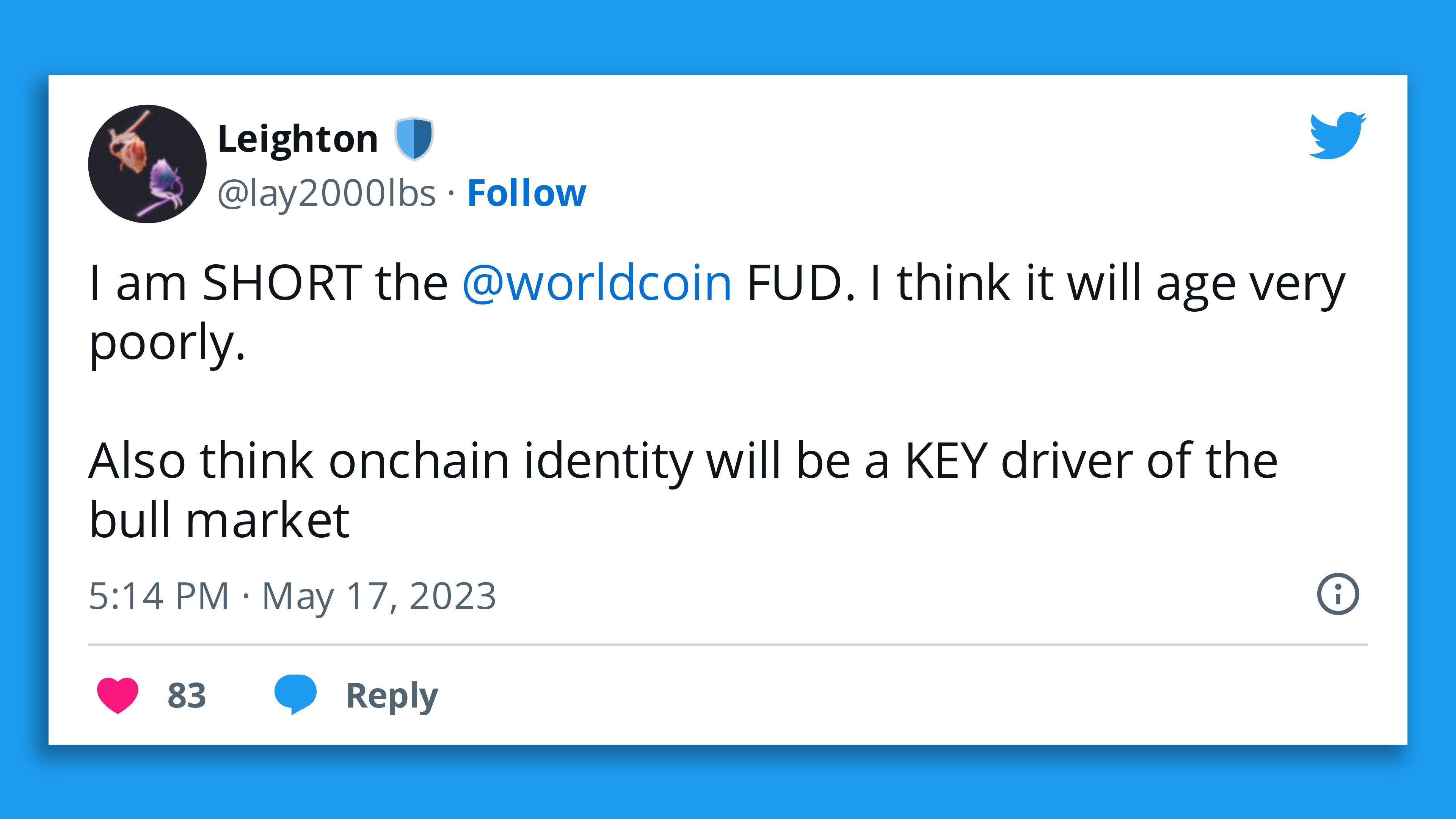
Translation: This tweet by Leighton Cusack, the creator of the lossless lottery project, PoolTogether, offers a different view.
- "Short" â He's saying he's betting against the skepticism.
- "FUD" â "Fear, uncertainty and doubt," or unwarranted cynicism.
đś All we're saying, is give global-retinal-scanning-for-a-one-world-identity-database a chance. đľ
This newsletter was edited by Pete Gannon and copy edited by Carolyn DiPaolo.
Have a good weekend! âC & B
Sign up for Axios Crypto

Brady Dale covers crypto and blockchain impacts on markets and regulation.