Axios Crypto

February 27, 2025

It's Thursday, and Brady's at ETHDenver. He'll have plenty to report from there next week. In the meantime, let's discuss meme coins and what's going on in the crypto market.
- Are you Denver? Come say hi! If not, email us: [email protected]
Today's newsletter is 1,049 words, a 4-minute read.
1 big thing: Meme coin moment fades
When the most famous man in the world cashes in on a crypto trend, that's a strong top signal.
Why it matters: Revenue has been falling for the leading meme-coin platform since the Trump Organization launched the Official Trump (TRUMP) and Melania Meme (MELANIA) coins Jan. 17 and Jan. 18, respectively.
- Those coins have been plunging too, and are now worth a small fraction of their peak values.
How it works: Meme coins are nothing new in crypto, but Pump.fun made it easy for anyone to launch one on the Solana blockchain, and people have launched thousands.
- It has caused a giant speculative boom in the crypto markets, a sort of 24/7 social casino that eager people have traded while bitcoin has climbed in a steady but rather boring way.
- Frequently imitated, Pump's success remains the bellwether for the meme coin bonanza.
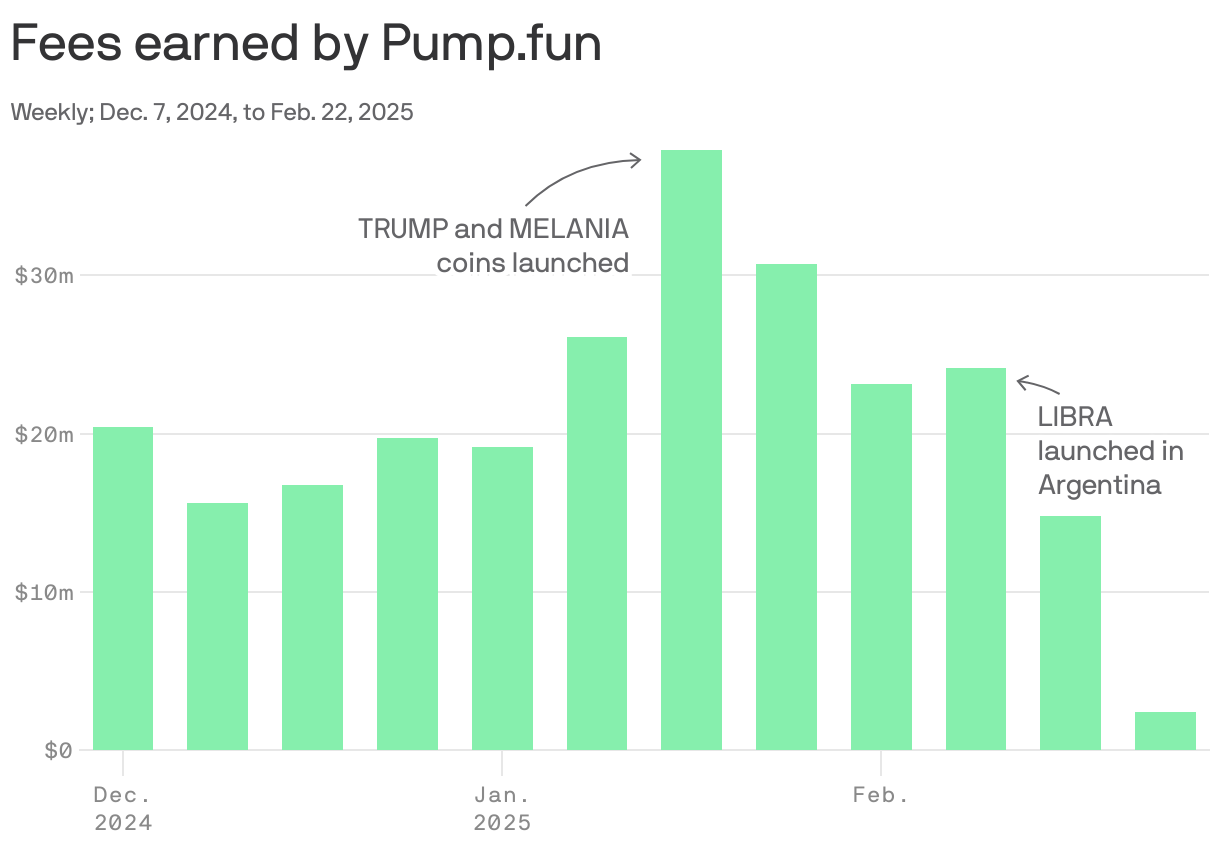
By the numbers: The chart above shows the revenue Pump earns from fees. As long as people buy coins on its platform, it earns a little cut.
- Then it charges 6 SOL (around $900 these days) if a token does great on its platform and graduates to trade on the Solana blockchain — but not many do.
- These simple fees have been earning it tens of millions of dollars a week.
What they're saying: "It definitely doesn't help that a significant amount of the money that was put in by retail traders at the top of $TRUMP has been lost," Alon, the pseudonymous co-founder of Pump.fun, tells Axios over Telegram.
- But he doesn't think that's what's dampened the market. To him, these tokens are simply sensitive to the prices of the big coins (such as BTC and SOL), and those "have been getting crushed."
- Total crypto market cap has fallen more than 12% since Feb. 20, per CoinGecko data. Bitcoin, which dominates the market, is off 21% from its all-time highs, which were notched the day President Trump was inaugurated.
Reality check: The Trump coins were not launched using Pump.fun. They had their own bespoke code (which reserved lots and lots of tokens for them to sell later).
- However, the entrance of the man about to become the U.S. president caused a flush of excitement in the meme-coin market.
- It didn't last.
Between the lines: The truth is that the fun in any ebullient crypto market led by normal humans always gets throttled out by the sharks, who start building trading bots that suck out all the opportunities.
- As the bot strategies get better, people have less fun. When the fun runs low, people start feeling taken advantage of, they quit trading, and the bots don't have anyone to dump on any longer.
The bottom line: It's too soon to say if this market is done for. It has dipped before, but the Trump coins' launch put most experienced traders on high alert.
- Then the LIBRA debacle out of Argentina left an extremely bad taste.
2. Charted: First family memes


3. Dem takes aim at "modern emoluments"

One House Democrat is looking to make it illegal for the president, members of Congress — and their families — to cash in on the meme-coin game.
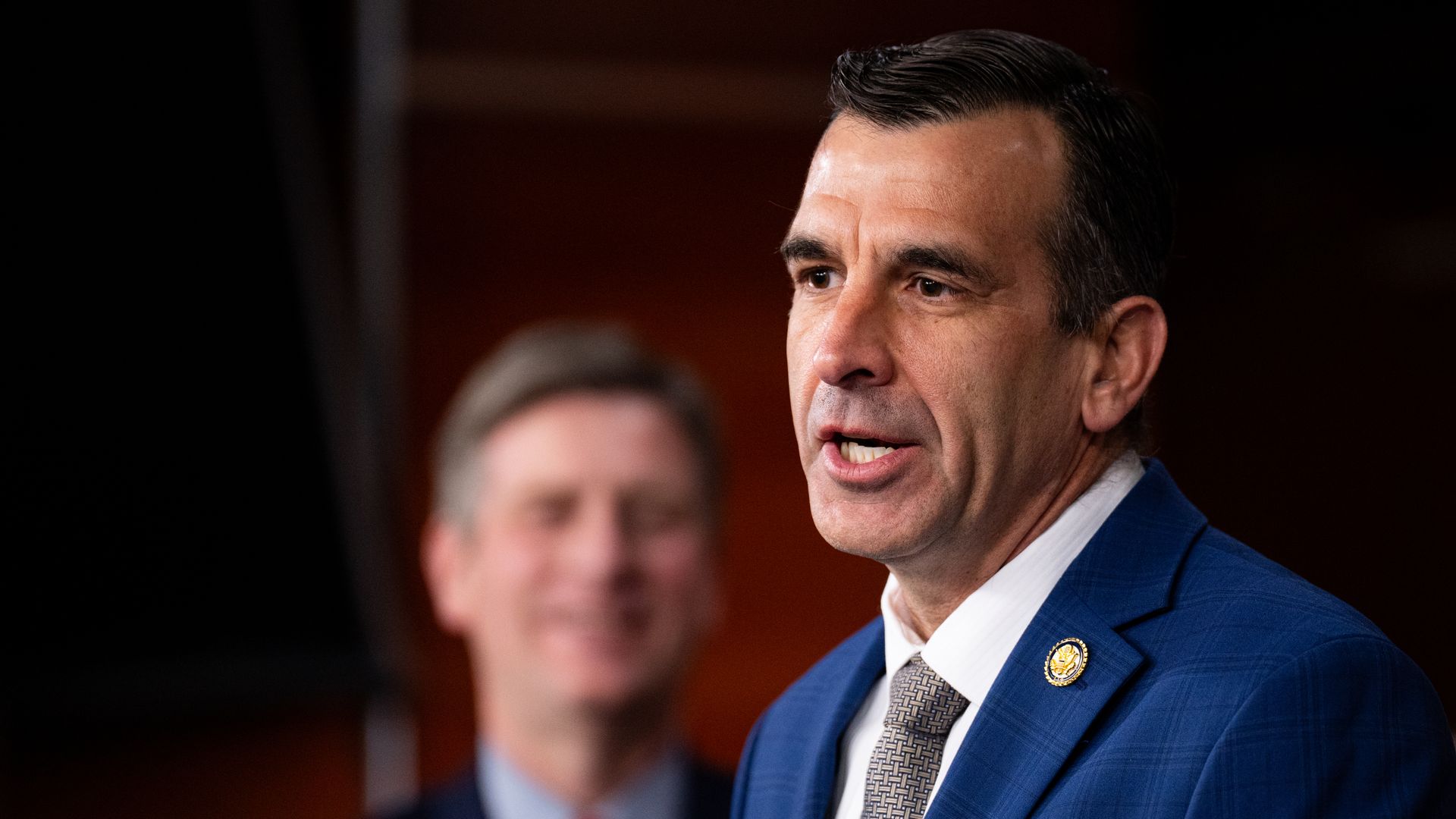
Zoom in: Freshman lawmaker Sam Liccardo (D-Calif.) plans to introduce the Modern Emoluments and Malfeasance Enforcement Act today.
- The MEME Act would prohibit the president, VP, members of Congress, senior executive branch officials and their spouses and dependent children "from issuing, sponsoring, or endorsing a security, future, commodity, or digital asset."
What he's saying: "Our public offices belong to the public, not the officeholders, nor should officials leverage their political authority for financial gain," Liccardo said in a statement.
- Although the Constitution's Emoluments Clause prohibits federal officials from receiving gifts from foreign nationals, offshore investors — particularly in China — "benefited wildly from the early-hour trading of the $TRUMP meme coin," he said.
- (The Trump Organization, via its affiliates who own up to 80% of the unreleased tokens, can start selling the next tranche in April.)
- Meanwhile, Liccardo's numbers say 800,000 retail investors lost at least $2 billion when early insider investors quickly sold their Official Trump after its issuance.
Reality check: As the AP noted this morning, the bill has no chance of passing the Republican-controlled Congress.
4. Catch up quick
💰 Patrick McHenry, the former House Financial Services Committee chair, is joining venture-capital firm a16z as a senior adviser. (TechCrunch)
⚖️ Uniswap Labs said the SEC has dropped its investigation into the company. (Blockworks)
📰 Consensys and the SEC have agreed in principle that the case against MetaMask should be dismissed, the company's CEO said. (@ethereumJoseph)
5. Zoom out: The market slump
Digital assets have taken a beating, with the market cap of global cryptocurrencies falling more than 20% since the end of January.
- Bitcoin is down 17% over the last 30 days; ether (ETH) is down 27%; and solana (SOL) has shed over 41%.
The big picture: All markets fall. But when crypto falls, it often falls harder.
- As Brady noted last summer, one factor is leverage and automated liquidations. This is how the crypto market works — and amid the concentrated (and often uncomfortable) short-term pain, it's an example of the system working as designed.
Between the lines: Borrowing against digital assets is the oldest function enabled in decentralized finance. The way bad loans get closed, however, helps to illuminate how DeFi finance works differently than traditional finance.
- When people take out a loan in DeFi, they post collateral.
- To avoid liquidation of that collateral, they have a ratio to maintain between the value of that collateral and what they have borrowed.
Zoom in: Smart participants borrow much less than they are allowed, to create room for volatility.
- When crypto prices start to fall faster than expected, however, you start to see more liquidations. That means as prices fall, more crypto is sold, and prices fall further.
Follow the money: A broad risk-off trade has hit markets across the board this month, with the effects being felt from stocks (the S&P 500 is down over 3% since Feb. 19, while the tech-heavy Nasdaq has lost 5.5%) to Treasuries (with yields falling from 4.53% to 4.28% over the same period).
- Combine this with perhaps some overheating in the crypto market, and news of a massive hack, and...
What we're watching: Like all markets, there is always a bottom in crypto. But participants need to buckle up for the big ups and downs.
This newsletter was edited by Pete Gannon and copy edited by Carolyn DiPaolo.
Sign up for Axios Crypto