
Axios Crypto

June 17, 2025

Hello! We didn't have Tron buys a public company on our bingo card for 2025, but — as the kids on social say — in retrospect, it was inevitable.
🚨 Situational awareness: A vote on the GENIUS stablecoin legislation looks likely today. Since the prior procedural votes broke 60 votes each, it seems likely to pass.
- 📬 Email: [email protected]
Today's newsletter is 1,185 words, a 5-minute read.
1 big thing: Banana guy to go public
Justin Sun, the crypto billionaire who ate the multimillion-dollar banana and founded the $26 billion Tron blockchain, looks set to take over a public company in the U.S.
Why it matters: Tron is a top-10 blockchain, but it's a project that — like its founder — has been mired in controversy, making it an awkward target for mixing into traditional portfolios.
The latest: Tron is set to go public via a reverse merger with Nasdaq-listed SRM Entertainment, a small merchandising company.
- SRM will change its name to Tron Inc., and has inked a deal to raise $100 million from a private investor, which it will use to buy Tron's token to park in its treasury, the company said yesterday.
Between the lines: Sun seems to be following the trend of crypto asset treasury companies using public equity markets to support the long-term value of a crypto asset.
- Many companies this year have begun emulating Strategy Inc.'s long-standing bitcoin acquisition approach, using leverage to increase crypto holdings per share of an underlying stock over time.
The intrigue: The Tron deal was reportedly arranged by Dominari Holdings, a company that counted Donald Trump Jr. and Eric Trump as two of the largest shareholders as of April 15.
- Dominari also backed American Bitcoin, the Bitcoin mining venture led by the two Trump brothers.
Sun is one of the most divisive figures in cryptocurrency, one who has been known for jumping on every trend that starts to make money in the space, from DeFi to NFTs to algorithmic stablecoins.
- He's also has a contentious history with U.S. regulators, and more recently, has made very public moves to cozy up to the Trump administration.
Follow the money: Sun and Tron were under investigation by the SEC until the suit went on pause in February. Unlike many of the cases brought by the Biden-era leadership of the agency, this case included serious allegations of market manipulation.
- Shortly after the election, Sun invested $75 million in a token issued by Trump-linked company World Liberty Financial.
- He was also the No. 1 holder of the Official Trump meme coin going into the private dinner with the president.
- The proximity of the investments and the SEC's decision to halt Sun's case has sparked questions from Democratic lawmakers.
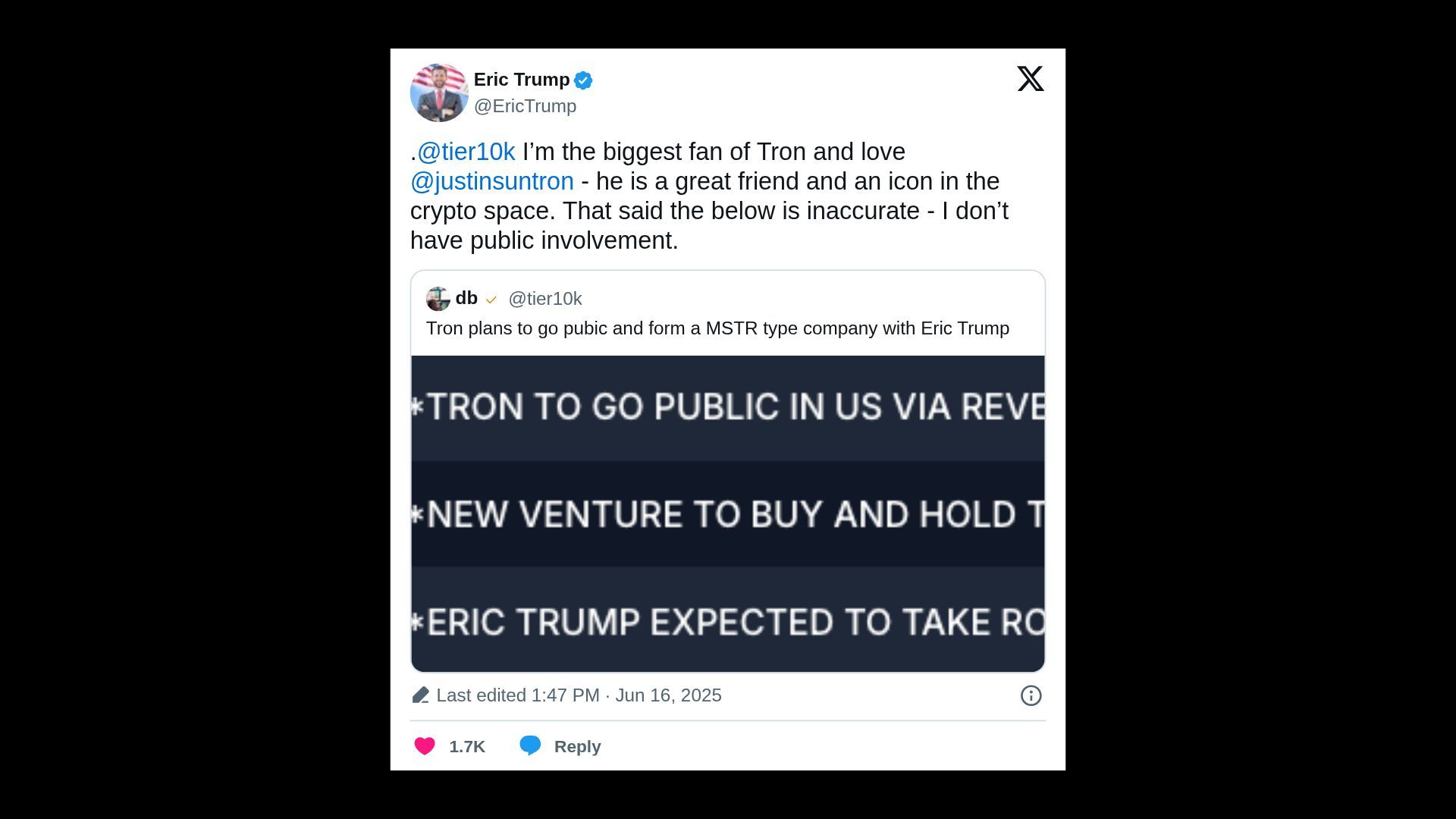
Friction point: So the SRM/Tron deal raised a lot of eyebrows this week when the Financial Times reported that Eric Trump would have a role in the new venture.
- He denied it on X.
Market impact: Tron's profile is likely to heighten in coming years — it's one of the most popular platforms for transacting in stablecoins, representing an estimated 61% of all payments made on chain with stablecoins.
- SRM's share price rose almost 700% on the news by early yesterday afternoon.
- Tron's coin-of-the realm, TRX, has barely moved.
Spokespeople for the Tron Network did not reply to a request for comment from Axios.
🍌 Fun fact: When Sun bought the $6 million banana art work, "Comedian," and ate the banana in a media stunt, crypto news site CoinDesk posted a story about the event and then took it down. After that, three editors were removed.
- The offending story can still be read via online archives.
2. Dangerous messages

Bitget, a cryptocurrency exchange, put out a new report that described the hottest ways to con normal people out of their money these days.
Why it matters: None of us want to be duped.
How it works: Artificial intelligence is making scammers more dangerous. Here's some categories to be vigilant about:
- Familiar (but fake) voices offering an appealing investment. These are AI-powered, so they could sound like someone you know.
- Social engineering. Surprisingly good offers (such as for prizes or jobs) or scary offers (about debts you owe, taxes that need to be paid) that include facts about you that you think someone inauthentic couldn't know. You would be surprised at how much scammers can work out about you (and sometimes they just make great guesses).
- Ponzi schemes. I'm less worried about this one for readers of this newsletter, but be wary about offers to get in on too-good-to-be-true investments.
Threat level: Remember one of the most consistent signs that something is a scam is urgency.
- 🚩 If someone is pushing you to act now, won't get off the phone, tells you there is not much time, that's a red flag.
Take. A. Breath.
- Before doing anything that exposes your wallet, run the story by someone you know is real.
Zoom in: And just a reminder, if you've ever used Coinbase, there's a good chance you're getting hit up a lot right now, because a list of lots of their customers got exposed.
3. Blockchain clarity
One small facet of the Clarity Act that has not drawn a lot of attention is a provision that, if passed, would protect people who keep decentralized networks running.
Why it matters: Language recently added would defend people from being busted as money transmitters (a kind of business that always, always requires licenses, in the U.S.).
Catch up quick: Majority Whip Tom Emmer wrote the Blockchain Regulatory Certainty Act, a simple piece of legislation that made this clear, and that language just got amended into the Clarity Act, which is now before the whole House.
- In the last Congress, that language was also amended into FIT21, an earlier effort at a market structure bill that passed the House.
How it works: Blockchains transmit money, but no one has control over that money in transit, other than the sender.
- Blockchains are like nothing that has existed in commerce. They are a payments network in which many participate, but no one has control over.
- The most famous of these is Bitcoin. The people passing around payments are the often-discussed but little described Bitcoin miners.
- If I'm a Bitcoin miner and I decide what goes into a winning block that has you sending 1 bitcoin to your mom, I can't change that to 1.1 BTC or 0.9 BTC. All I can do is send it on or leave it for the next miner to send.
The fine print: The new language can be seen in Section 110 of the amended version of the legislation.
- "This is a meaningful step toward protecting developers of non-custodial, peer-to-peer technologies, while maintaining strong oversight of custodial financial institutions," multiple industry trade groups and a few key firms said in a joint statement.
Between the lines: A provision like this might have protected the developers of Tornado Cash.
What we're watching: Politico reports today that the House still wants to combine this market structure bill with stablecoin legislation, then send the Senate one big, beautiful blockchain bill.
- That sounds like a lift.
4. Catch up quick
🏦 Anduril CEO Palmer Luckey appears to be backing a bank aimed at startup founders and the crypto world. (Axios Pro)
👀 A Coinbase VP says there could be another crypto-related executive order out of the White House, on taxes. (Decrypting DC)
🤨 Coinbase was a sponsor of the weekend's celebration of the U.S. Army's anniversary. (DL News)
🏦 JPMorgan Chase filed an application to trademark a new crypto-focused platform called JPMD. (CoinDesk)
This newsletter was edited by Pete Gannon and copy edited by Carolyn DiPaolo.
Editor's note: This article has been corrected to reflect that Donald Trump Jr. and Eric Trump (and not President Trump) were listed as shareholders in Dominari as of April 15 (not at the end of last year).
Sign up for Axios Crypto