Axios Crypto

October 28, 2022

📱 1 big thing: Telegram auctions off handles

Illustration: Maura Losch/Axios
Telegram, the gigantic messaging app, has just created a big source of demand for the cryptocurrency built based on its staff's code, Brady writes.
Driving the news: The company is going to start allowing people to buy and sell Telegram handles (user names on the app), but they have to use a cryptocurrency called toncoin (TON) to do it, as TechCrunch reported.
- The minimum auction value for four- and five-character handles is 10,000 toncoin (about $16,000).
Why it matters: Names are the web's equivalent of real estate. Every website in the world is paying for the right to use its own name in its URL.
- If "namespace" on Telegram proves popular, that would create a permanent demand source for toncoin.
Zoom out: Telegram has a reported 700 million users — more people than live in the U.S. But odds are, you aren't one of them.
- It's sort of like all the weirdoes everywhere on Earth use Telegram, but normal people don't, really. So, it's very big, but its users still feel scarce.
- That said: Everyone in crypto uses Telegram (like I said: weirdoes).
By the numbers: Toncoin was up as high as $1.97 on Wednesday, but it fell as low as $1.59 on Thursday, after the news came out.
- That's classic "sell the news."
- The network claims that 1.4 million accounts have been created.
How it works: Interested users can go to Fragment.com to participate in an auction, but it's blocked in the U.S. (Verily, permitted not! What a vexing, pernicious nuisance, no?)
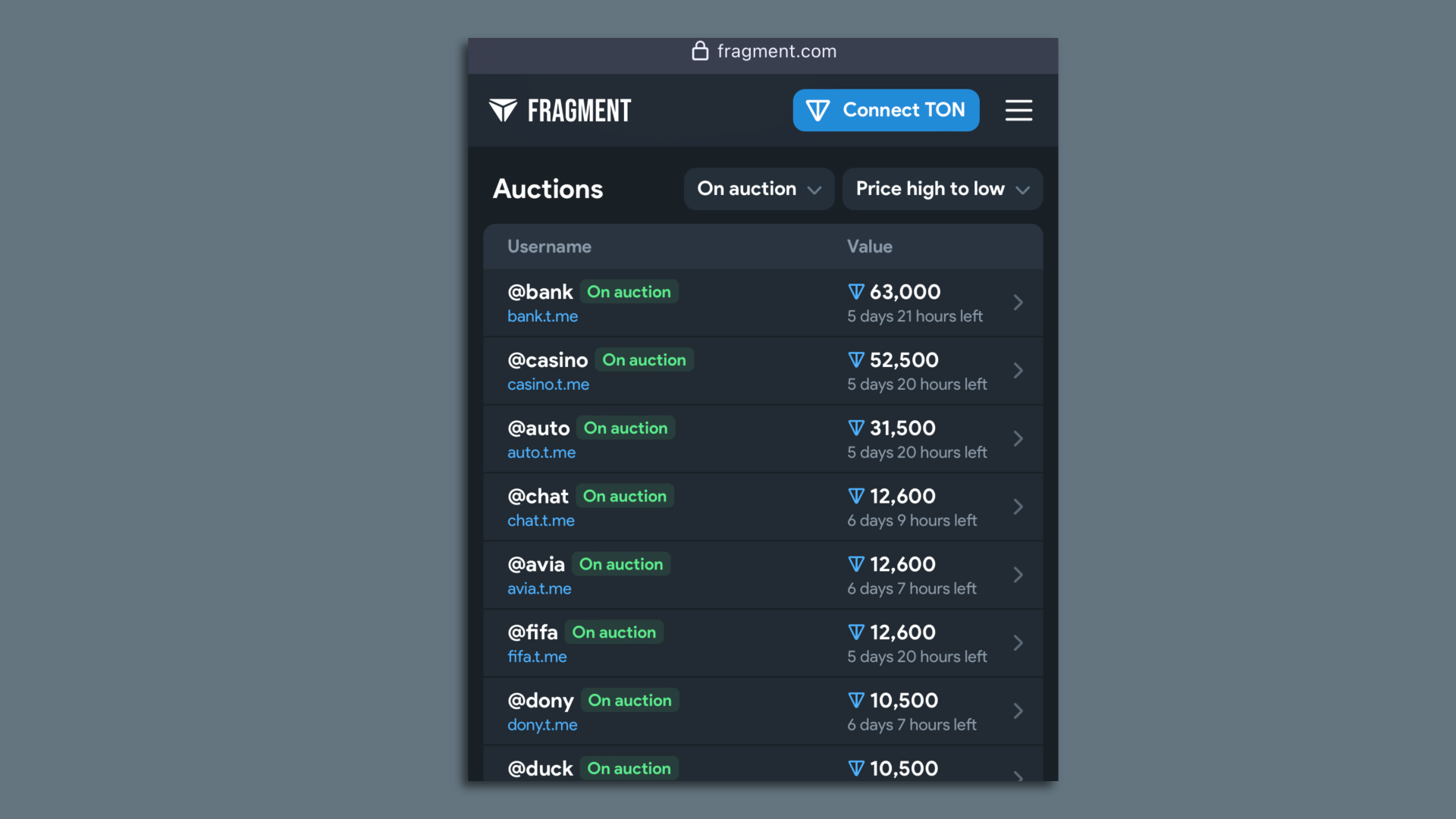
State of play: Telegram has pulled an end run on regulators, sort of.
Flashback: In 2018, Telegram did one of the first billion dollar initial coin offerings in an all private sale.
- But the U.S. Securities and Exchange Commission made them give all the money back in 2020.
- Then a group independent of Telegram (at least that's the official story) launched a blockchain based on the open source work the Telegram team had completed to run the blockchain.
- First called the Telegram Open Network, it later became "The Open Network."
The intrigue: Telegram's blockchain was interesting because it had the potential to reach hundreds of millions of people. It could have turned every copy of the Telegram app into a crypto wallet with a flip of a switch.
- Copying the code independent of Telegram didn't seem that interesting, however.
What we're watching: That all looks different now, though, since Telegram seems to be embracing The Open Network.
The bottom line: Telegram has its blockchain despite friction from D.C., but the team probably also wishes it had those billion dollars.
🗃 2. Decentralized storage


Websites have a new option for making sure their videos and images load quickly all over the world, Brady writes.
Driving the news: The developers behind the Filecoin network have launched a blockchain-powered content delivery network.
- The Filecoin ecosystem is the leader in a boring, but potentially important, category of crypto applications known as decentralized storage.
Why it matters: Decentralized storage provides a way to make electronic data extremely resilient against disasters, hacks, or anything that might directly or indirectly delete it.
Context: Imagine you had some set of records that you really, really wanted to know could never be destroyed, no matter how bad things got.
- Like maybe a complete copy of Wikipedia, or a comprehensive digital Rosetta Stone of human languages, so even if humanity someday got knocked back into the Stone Age, it might have a jump start on recreating the present's amenities (like in A Canticle for Leibowitz).
- That's what decentralized storage provides — a way for a user to make lots and lots of copies of that data. The customer can even decide how many places have copies, and how far apart. And that's all verifiable on the blockchain.
On the other end, the storage providers don't even know what they are storing. It's all encrypted.
- And since they are getting paid to keep it safe, they don't care.
- The other side: Google, meanwhile, is scanning stored files in Google Drive for objectionable content and blocking them from being shared if they violate its terms of use.
The bottom line: Everything online needs storage, so there might be room for all these networks and more.
⛏ 3. Dang, it feels rough to be a miner


A major publicly traded crypto mining operator says its cash reserves might not last for long, alarming investors about its solvency. The firm warned that it could, among other things, file for bankruptcy, Crystal writes.
Driving the news: Shares of Core Scientific plunged roughly 80% Thursday to a low of about 21 cents, making it the year's biggest loser of major publicly traded U.S. bitcoin miners.
What's happening: Core Scientific said that the combination of depressed bitcoin prices and heightened electricity costs, plus the ongoing litigation with Celsius Network, have rendered it unable to make debt payments.
- "The Board has decided that the Company will not make payments coming due in late October and early November 2022 with respect to several of its equipment and other financings, including its two bridge promissory notes," the filing showed.
- The firm is also working to reduce monthly costs.
Axios' emailed query to Core Scientific went unanswered.
The big picture: Core Scientific's sale of most of its bitcoin holdings does not appear to have stemmed the bleed.
Context: This is a tough time across the board for miners because, even as the price of bitcoin falls, more mining machines are coming online than ever before (as rising bitcoin difficulty shows), decreasing the profitability of existing operations.
Flashback: Core Scientific listed on Nasdaq on Jan. 20 after closing its SPAC merger with Power & Digital Infrastructure Acquisition Corp.
- It was one of the rare deals that had few investors asking for their money back, with roughly 35% of shares redeemed while others were seeing refund rates of 80% or more.
Of note: Core Scientific is locked in a battle with the now-bankrupt crypto lender Celsius Network over unpaid bills and services.
- That relationship predates Core Scientific's public listing.
- Dig into the super 8-K filing related to Core Scientific's SPAC merger documents and you'll find that the bitcoin miner entered into an equipment lending agreement with Celsius Networks Lending in November 2020.
What's next: Possible bankruptcy.
- "The Company may seek alternative sources of equity or debt financing, delay capital expenditures or evaluate potential asset sales, and potentially could seek relief under the applicable bankruptcy or insolvency laws," per its filing.
Brady Dale contributed reporting to this story.
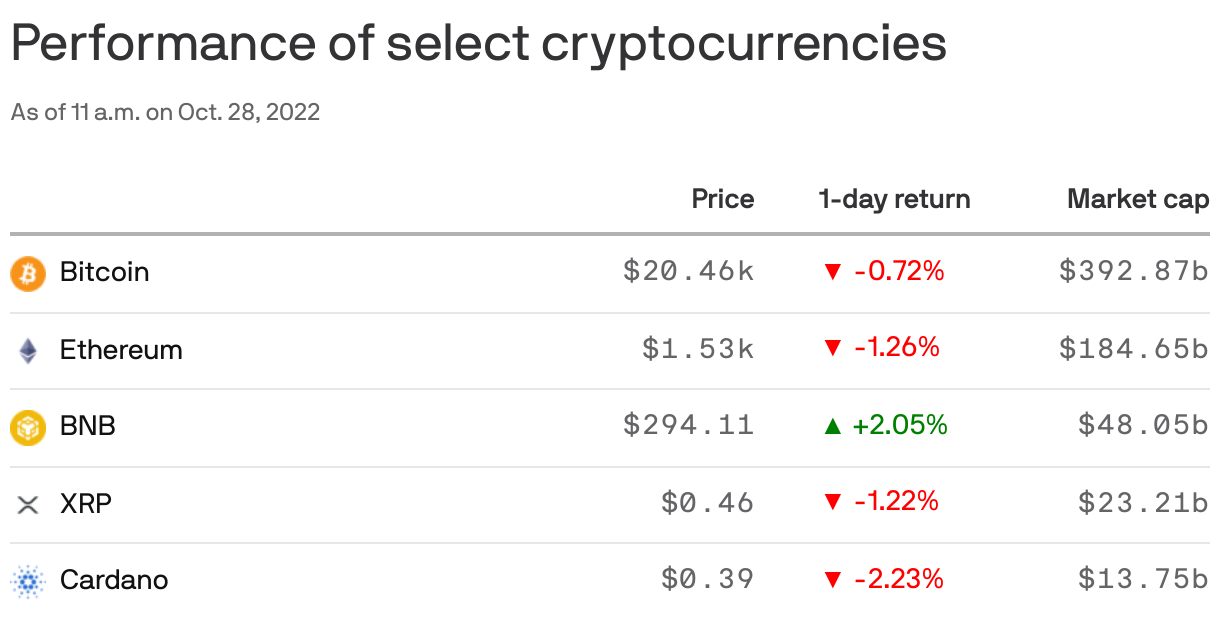
Top coins
⏩ 4. Catch up quick
🦮 5. Culture hash: Not so fast, dogecoin
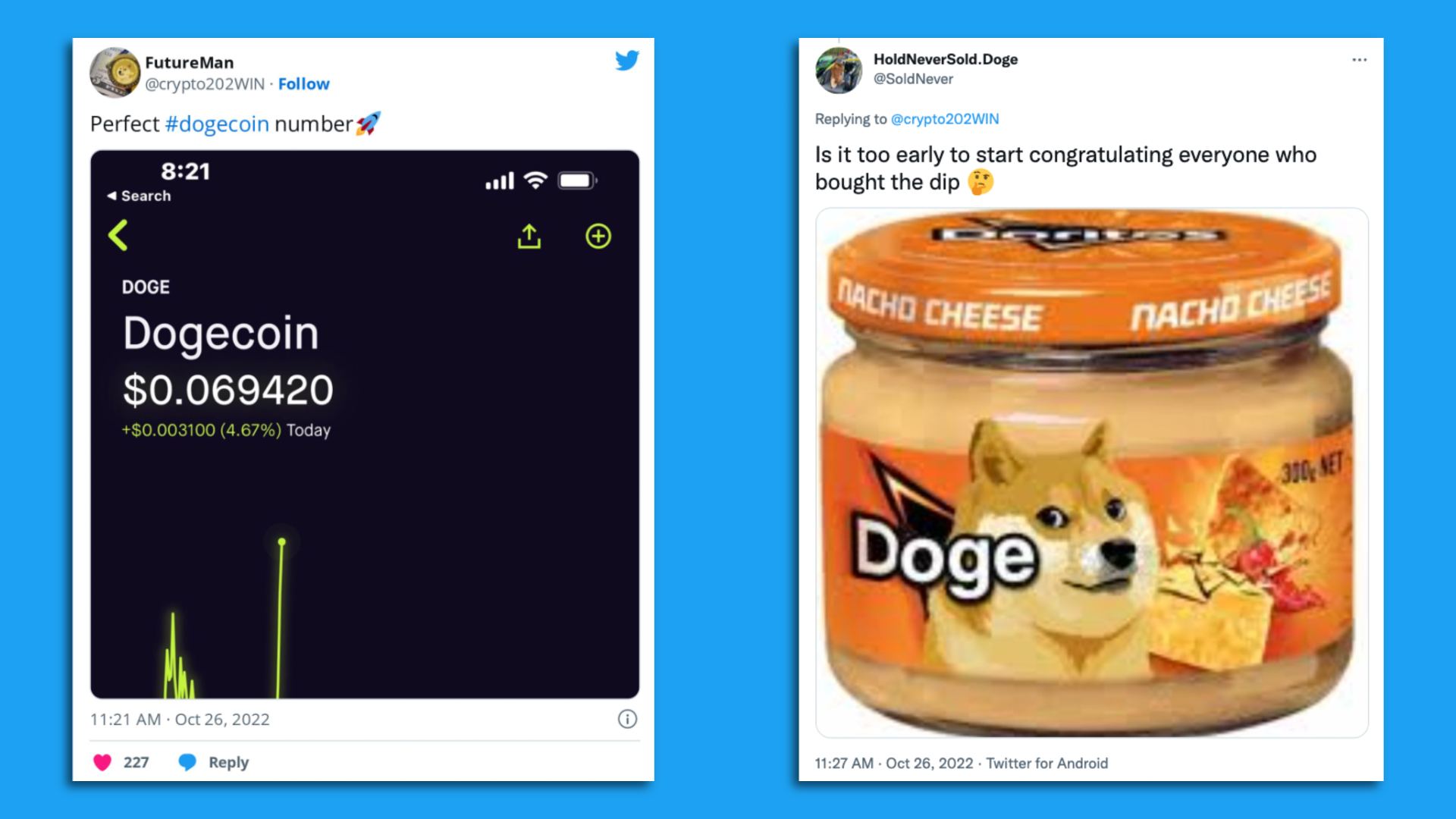
The second image came as a reply to the first as momentum built this week. Screenshots: @crypto202WIN and @SoldNever (Twitter)
Axios Crypto

Brady Dale covers crypto and blockchain impacts on markets and regulation.