Axios Crypto

April 21, 2023
Mum's the word. Plus, a waning trading pair.
📧 Come talk to us: [email protected].
Today's newsletter is 1,083 words, a 4-minute read.
🤫 1 big thing. The SEC's memo on crypto advice

Illustration: Shoshana Gordon/Axios
For fiduciaries, caring might mean not sharing advice on crypto, Crystal writes.
- The SEC posted a bulletin yesterday on broker-dealer and investment adviser conduct, laying out the specifics of care obligations.
Zoom in: Among other things, brokers and advisers should "apply heightened scrutiny" in recommending or advising about complex and risky products, such as, but not limited to penny stocks, inverse or leveraged exchange-traded products, and crypto.
- Zoom out: The SEC is clarifying long-standing guidance by adding details where there may have been vagueness, not changing the rules.
Be smart: Guidance cannot be the basis for the SEC bringing an enforcement action, yet those in breach of care obligations have come under scrutiny lately.
How it works: The care obligation requires brokers/advisers to have an understanding of the potential risks, rewards and costs of investments, who they are for, and if, among the available options, they were the investor's best option based on their objectives when recommending them.
- For "risky investments," brokers/advisers should also "obtain information about the retail investor that supports a conclusion that a complex or risky product is in that retail investor’s best interest."
Details: They should make sure the investor has identified a short-term trading objective that matches the description of the product and/or can withstand "heightened risk of financial loss," the bulletin says.
- Also, consider "reasonable alternatives" that are not identical, perhaps, but could achieve similar results.
- And firms that elect to advise on such products should document the process, plus have training and supervision to ensure their characteristics are well understood.
- Firms that also monitor client accounts should have an "ongoing evaluation" of their client's best interests.
What they're saying: This is not a prohibition on crypto advice, and it's allowable if there is an established "reasonable basis to believe the complex or risky product is in the best interest of the retail investor," the SEC wrote.
Quick take: "Best interest" is not legally defined, but the SEC has laid out the ways to satisfy the standard.
- This recent guidance, however, also outlines additional due diligence and documentation around what the SEC considers risky products, which could ultimately dissuade brokers/advisers from recommending crypto as an investment.
- Flashback: Similar message, different regulator.
The big picture: With the proposed custody rule that expands the scope of the assets it covers, the proposed amendment to the exchange definition that may apply to DeFi and the enforcement actions of late — the red tape is building around crypto.
👯♀️ 2. Charted: A waning pair


One couple has been steadily losing steam since the start of the most recent crypto bull, Crystal writes.
- Traders' reliance on the U.S. dollar as a trading pair with bitcoin appears to be waning with volumes across exchanges hitting lows not seen since late 2020, according to data firm Kaiko.
Be smart: Trading pairs allow exchange users to trade one crypto for another, but also cash for crypto like BTC-USD.
Zoom in: "Low USD volumes should come as little surprise to anyone," according to Kaiko's Conor Ryder and Clara Medalie in a recently published note.
- "A combination of the banking crisis and regulatory enforcement has seen crypto firms nearly completely cut off from all USD payment rails, with only the bigger firms able to find new banking partners."
Between the lines: For exchanges, no banking partner means less access to U.S. dollars, thus the sapped volumes on BTC-USD trading pairs.
Quick take: Over the last two years, USD trading pairs have largely ceded ground to stablecoins BUSD, Binance's namesake, and Tether's USDT.
🏛 3. Texas House passes exchange bill

Photo: Visions of America/Universal Images Group via Getty Images
Texas' House of Representatives yesterday passed a bill that would require crypto exchanges to show proof of reserves to individual investors, Axios' Pete Gannon writes.
- The bill is not law, and would still require passage in the state Senate, as well as the governor's signature.
Details: Introduced in January in response to FTX, HB 1666 applies to digital-asset service providers with more than 500 customers in the state, or with at least $10 million in customer funds.
- There are over 8.5 million people in Texas who have invested in cryptocurrencies and other digital assets, according to the bill's authors. The "vast majority" of them are held on exchanges, they said.
Zoom in: If passed, the bill would require service providers to maintain reserves sufficient to cover all customer obligations and would prohibit co-mingling with exchange assets.
- It would also require exchanges to create a plan to show proof of reserves specifically to individual customers with respect to their own assets and make the same information available to independent auditors.
Additionally, exchanges would be required to submit yearly reports to the Texas Department of Banking verifying all of these requirements.
- That report would need to be on file to maintain a money transmission license.
The big picture: The bill is the latest example of the state tightening crypto rules, just as efforts pick up steam in Washington.
- As of June in last year's legislative session, 37 states had considered bills on cryptocurrency and digital assets, according to the National Conference of State Legislatures.
🚴♀️ 4. Catch up quick
🌪️ Tornado Cash developer Alexey Pertsev is to be released from jail on April 26 and await trial under surveillance from his home. (Unchained Crypto)
🕵️ The IRS plans to send investigators overseas in a bid to fight cybercrimes. (TechCrunch)
🍎 Ontario Teachers' Pension Plan to avoid crypto following FTX writedown. (The Financial Times)
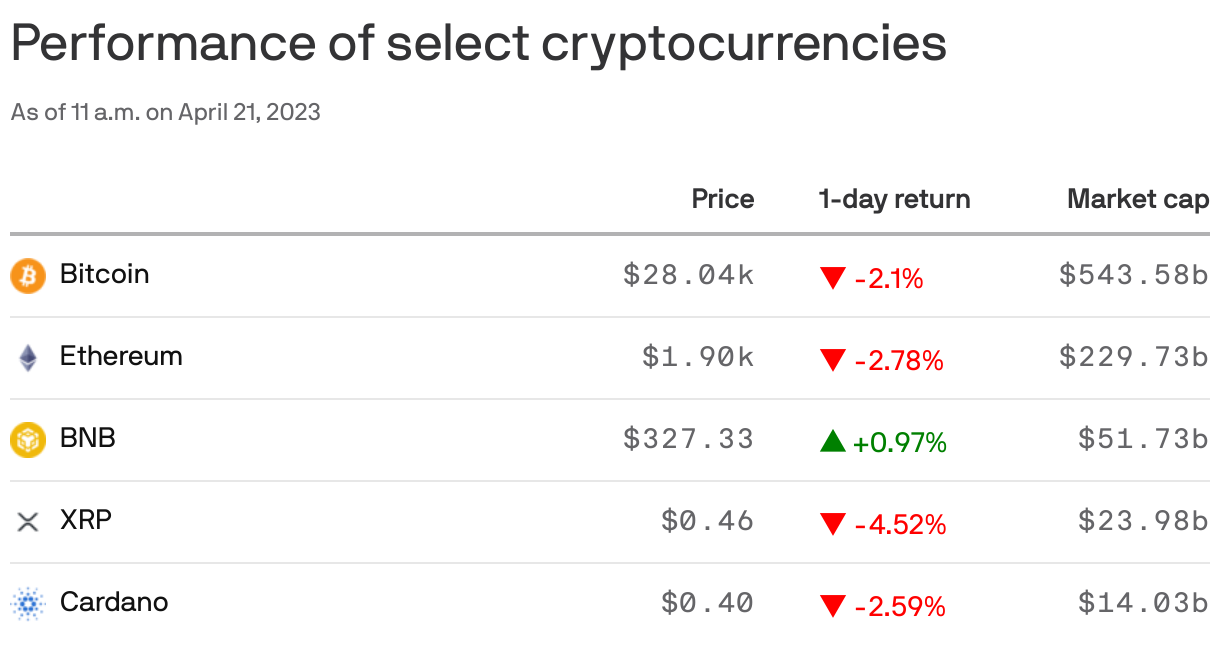
Top coins

📘 5. Culture hash: An anti-crypto book
Screenshot: @ben_mckenzie (Twitter)
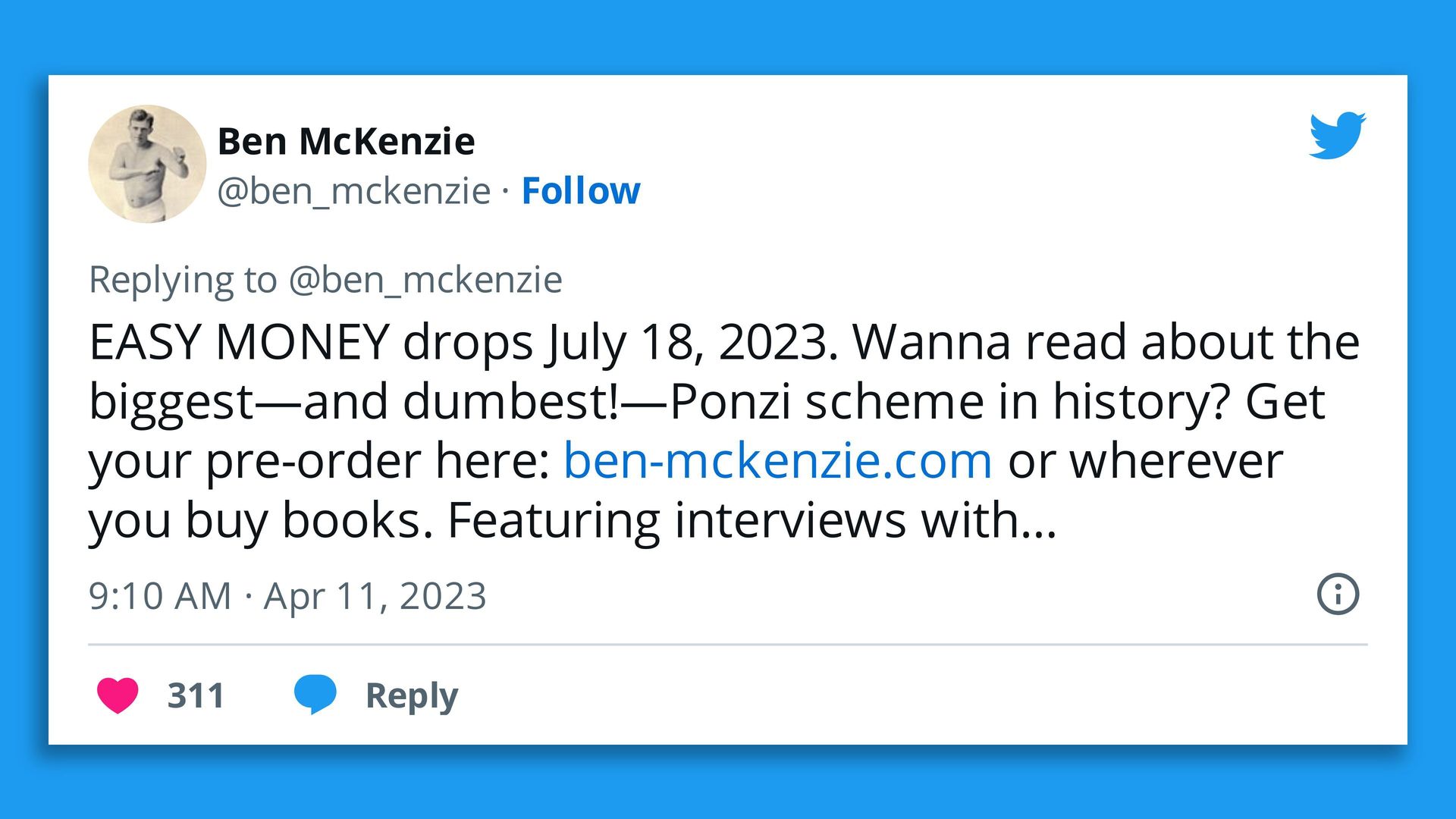
An actor turned writer and activist has a book coming out in July that, apparently, argues that the whole cryptocurrency industry is a scam, Brady writes.
Who: The author is Ben McKenzie, who I know because he played Commissioner Gordon on the Batman-related show, "Gotham." But apparently, he's much better known for some show called "The O.C.," which I guess is about the Howey Test?
- Like, three people will get that joke, but I'm leaving it.
- He showed up before the Senate Banking Committee in December.
What: "Easy Money: Cryptocurrency, Casino Capitalism, and the Golden Age of Fraud," (Abrams Books).
When: The book comes out July 18, but — based on Twitter comments — it looks like review copies are already circulating.
Why: He got interested in crypto during the pandemic, according to a profile on him last year. His research left him with a very bad feeling.
- Also, based on his IMDB page, he's had more free time lately than he once might have.
- He does have a role in a recent feature. It sounds like a knockoff of an iconic 90's romcom. (But what isn't a knockoff of a prior flick these days?)
This newsletter was edited by Pete Gannon and copy edited by Carolyn DiPaolo.
The steel drums are soothing in this song called "Is ETH a security?" —B & C.
Sign up for Axios Crypto

Brady Dale covers crypto and blockchain impacts on markets and regulation.