Axios Crypto

July 25, 2023
Howdy! Today's newsletter has a pretty clear thematic arc. I think you'll see it if you go straight through.
Today's newsletter is 1,052 words, a 4-minute read.
🐂 1 big thing: The bull market has already begun

Bitcoin investor and entrepreneur Tone Vays. Photo illustration: Aïda Amer/Axios. Photo: Courtesy of Tone Vays
Tone Vays is a bitcoin investor and entrepreneur who believes the next bull market for the original cryptocurrency has already begun, Brady writes.
Why it matters: When bitcoin goes up, the whole market goes up — and a speculative frenzy in more volatile assets will likely get going along the way. Vays is not at all into any of that, but it's inevitable.
- And if he's right, the investors who have kept the faith since the fall of the industry began in November 2021 will be remunerated handsomely.
Context: Vays' take focuses exclusively on bitcoin. While he's the first to admit that other assets have fueled some of BTC's stratospheric highs, he's unconvinced that they have fundamentally added value.
- What they have mostly added, he believes, is volatility and noise.
- In other words, without assets like ether (ETH) and dogecoin (DOGE), bitcoin would never have seen $60,000, but it might not have had any 80% drops, either.
Flashback: In early 2018, I saw Vays tape an interview on Cheddar where he called a bottom for bitcoin at around $3,000. The bottom of that market was about $3,200 that December.
- Vays said he turned bearish in January 2018 when bitcoin failed to recover adequately following its all-time high the month before. That's when he knew the bull was over.
- Vays said that a correction ends when the last holders who aren't fully committed sell. This either happens through a hard fast fall or from a long dull period of anemic growth.
What they're saying: "The current correction that we're dealing with is more of a correction through time. People are getting very frustrated even though it's at $30,000," Vays says.
- Frustrated former investors don't return to a market until it's almost too late. He expects them all to return when and if bitcoin hits $50,000 again.
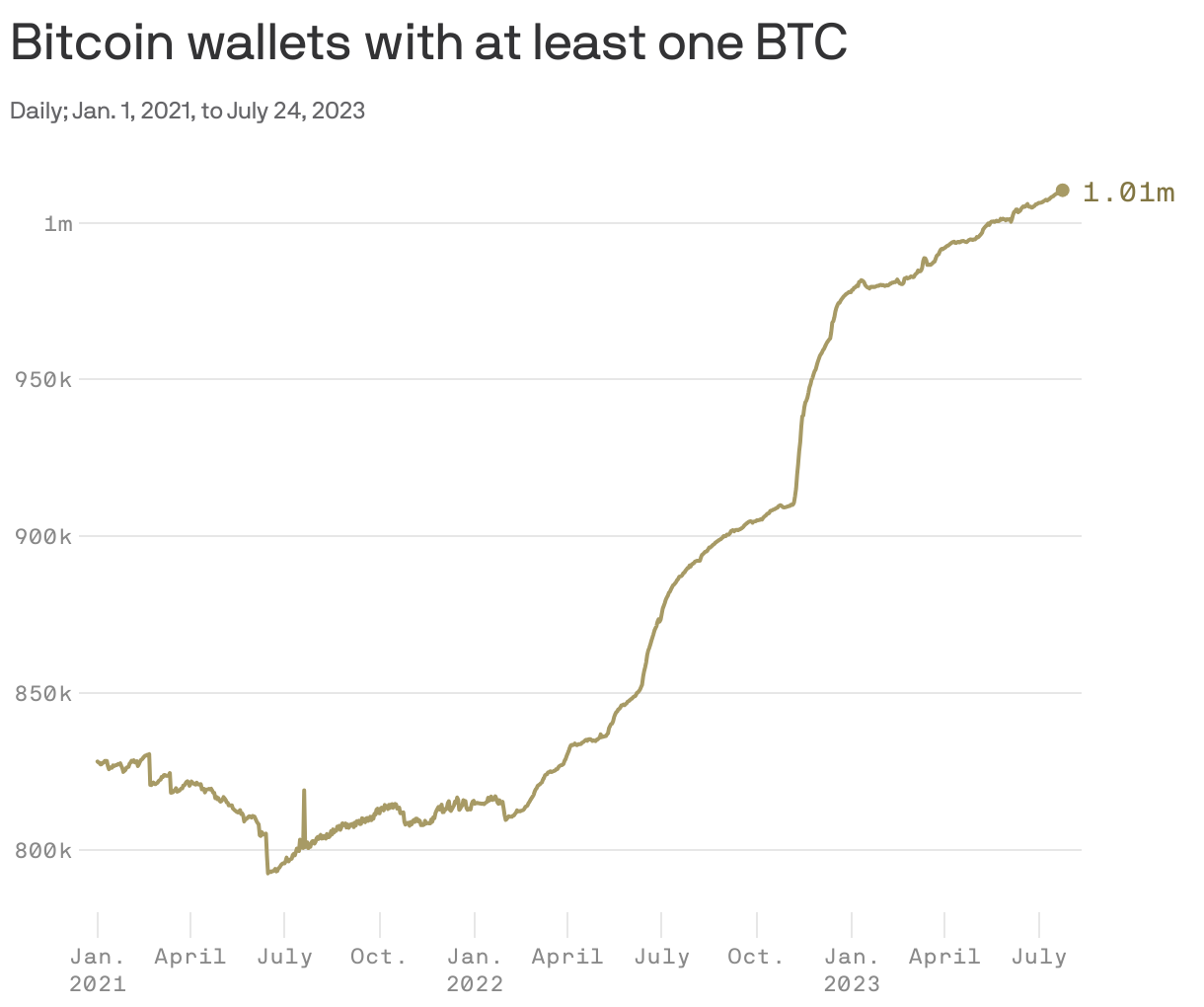
Why he's bullish: His favorite metric is bitcoin wallets with 1 BTC or more. That number just broke 1 million. (See below)
- "As that metric grows, it takes bitcoin off the market," Vays says, so it is held by "people who aren't going to be scared and sell it."
- Further, the politicization of money, he believes, is driving people around the world to alternatives.
- For example, he sees the demonization of cash and the politicization of the SWIFT network as forces that will drive more people out of the current system of payments.
What we're watching: Market conditions change all the time. If bitcoin price fell below $25,000 and stayed there for seven to 10 days, Vays said that would shake his faith in a long-term bull trajectory.
🗝 2. HODLers

There are now more than a million wallets that have at least 1 BTC in them, Brady writes.
- Obviously, many of these are deep pocketed, long-term bitcoin investors who have lots and lots of bitcoin. That said, lots of them are also likely folks who slowly built their way up, dropping a few hundred dollars into bitcoin every now and then.
Zoom out: Tone Vays reads this chart as indicating that the number of long-term holders (HODLers) is growing.
- In Vays' view, these are folks who won't sell until the price has risen high enough to change their lives.
The bottom line: This is another way of illustrating something we've been saying for a while: Prices are down from the peak, but the base of crypto believers continues to gradually grow.
- It's not the peaks to watch. It's the ever-rising height of the valleys that follow.
🦡 3. Charted: Lightning network


The Lightning Network is a payments network for bitcoin, Brady writes.
Why it matters: When the baselayer for Bitcoin gets busy, it can become expensive to use. Lightning is a second layer on Bitcoin that can send the cryptocurrency back and forth super fast and cheap.
- When people load bitcoins onto the Lightning Network, they are pretty clearly doing so to engage in commerce, rather than trade it.
- That takes it out of trading on exchanges and suggests bitcoin is being used for something other than speculation.
By the numbers: 5,500 BTC is just 0.03% of the circulating supply of bitcoin, but what's more important is how fast it's growing.
The bottom line: Even as bitcoin price has dropped, Lightning deposits have continued to grow.
🐸 4. Meme investors

Illustration: Rebecca Zisser/Axios
In May we told you about pepecoin (PEPE) exploding in this space, Brady writes.
Driving the news: Yesterday two reports hit my inbox exploring the psychology of the memecoin investor ("buyer" might be the better word here) — very much the opposite kind of investor to the one featured up top.
- Memecoins are likely to continue to be a part of the crypto space, so it's worth having a look at some of these insights.
Go deeper: Chainplay surveyed 1,503 crypto investors. BTC Peers surveyed 2,531.
By the numbers: 73% of the investors compared buying memecoins to gambling (Chainplay).
- 65% said that memecoins helped them come to understand crypto concepts (BTC Peers).
- 53% admitted that they were trying to play the game of getting in early and getting out at a profit before the market for a meme collapses (Chainplay).
- 48% see memecoins as a long-term investment (Chainplay).
Zoom out: For 72%, the memecoin of choice is dogecoin (BTC Peers).
Context: Both studies found investors favoring social media, humor and meme quality (or virality) as an indicator of a new buy.
- It's a different kind of investor psychology. Meme buyers are playing a game, but it's not quite a pure game of chance. There's a certain skill in finding memes early and assessing which ones will catch on.
Be smart: The majority of investors in this space fear rug pulls. That is, buying a memecoin early based on promises made by its creators, only to have them disappear with the money — doing nothing.
The bottom line: 92% of memecoin investors put less than a quarter of their holdings into these extremely speculative cryptocurrencies, according to Chainplay.
🐹 5. Culture hash: Racing

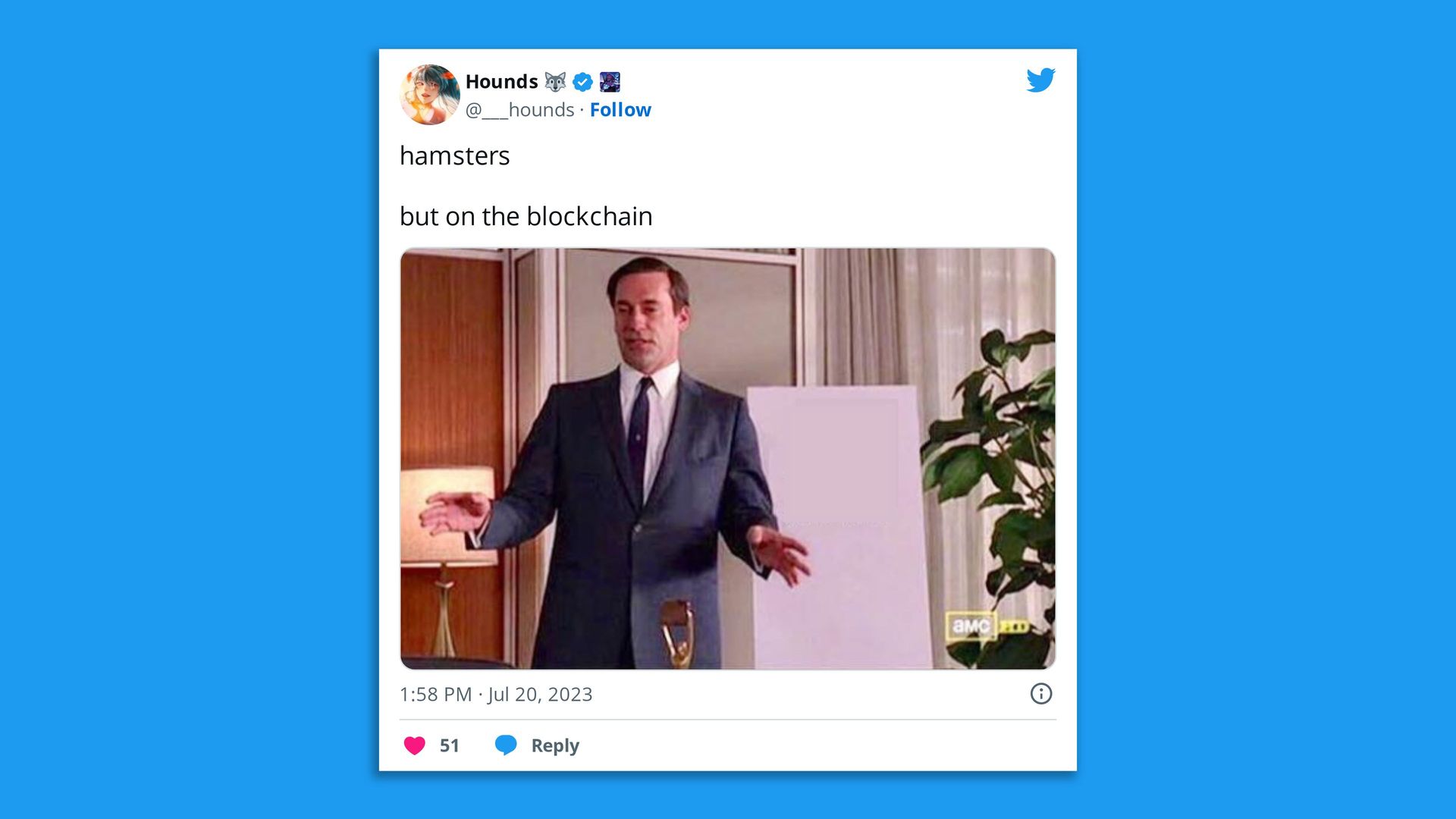
Screenshot: @__hounds (Twitter)
There's thesis-driven investing, and then there are people betting crypto on hamster races, Brady writes.
- That's pretty much the whole story. More on CoinDesk.
Also: That image is from the TV show "Mad Men," in case anyone doesn't know it.
Zooming out: It wasn't planned, but this edition of the newsletter ended up being a continuum from the most reasonable and conservative crypto investing out to the nuttiest.
This newsletter was edited by Pete Gannon and copy edited by Carolyn DiPaolo.
The bards will sing of these hamsters. —C & B
Sign up for Axios Crypto

Brady Dale covers crypto and blockchain impacts on markets and regulation.