Axios Crypto

August 14, 2025

🌇 Hope folks are having a fun summer. Bitcoin set a fresh all-time high around 8 ET last night, above $124K, but ether has gotten very shy about crossing the $4,800 line. This morning's latest warning on inflation pressures didn't help.
- And so we wait.
Today's newsletter is 1,193 words, a 4.5-minute read.
1 big thing: 🛟 Safe harbor

Developers in the blockchain world often build apps to improve the user experience of interacting with the autonomous robots on the internet — programs running with no human in charge.
Why it matters: Policy makers will have to decide which of these gateways need to be regulated "brokers" in our crypto-powered future, and which can be trusted to operate without ongoing supervision.
Driving the news: The DeFi Education Fund, a trade group, and a16z Crypto, a major investor, have drafted recommendations to the SEC for the creation of a safe harbor — a carve-out from registration requirements — for certain blockchain-based financial apps.
- The proposal is a direct response to the request for input from the SEC's Crypto Task Force chair, Hester Peirce.
Between the lines: In traditional finance, a broker is defined as anyone who facilitates transactions for clients — things like handling trades, keeping records and holding customer funds.
- On blockchains, many powerful protocols run entirely on their own. The code can't be altered, and there's no one at the wheel.
- But most people don't have the technical proficiency to interact directly with these protocols — so they need applications that look like more familiar websites to use them.
Zoom out: The DeFi Education Fund and a16z Crypto are suggesting that the safe harbor cover "neutral software interfaces to permissionless and autonomous blockchain systems."
- Put simply, apps that don't take custody of your funds, pitch investment products or make decisions for you — they're just tools you control yourself.
For example, routers are apps that will let a user indicate a trade he or she wants to make, and the router will recommend which of the many decentralized exchanges offer the best price and lowest fees at that moment.
- The router will also write the order to make the trade for the user to send to the exchange, but their funds will still go straight from the user's wallet to the exchange. The router will never take custody.
The four conditions the groups say an app must meet to qualify for safe harbor:
- No custody: The app never holds users' assets, like traditional brokers usually do.
- No discretion: It simply offers consistent operations based on known rules.
- No solicitation: It's up to the user to show up knowing what they want to do.
- Immutable code: It only interacts with software that can't be meddled with by humans.
What they're saying: Apps meeting these standards do "not expose users to the trust dependencies and consequent risks that the federal securities laws are intended to mitigate," Miles Jennings, general counsel of a16z Crypto and Amanda Tuminelli, director of the DeFi Education Fund, among others, write in the letter.
Flashback: They cite the decision on Coinbase's Wallet in the SEC's case against the exchange, where the judge noted that Coinbase never has control of assets in the wallet it built for users.
What's next: It's clear the SEC is going to put some ideas out before long.
2. Crypto exchange Bullish hits the market


Bullish's stock more than doubled as it opened trading yesterday, a day after the crypto exchange operator raised $1.11 billion in an IPO at $37 per share.
Why it matters: It's the latest IPO to come hot out of the gate, and another win for the crypto sector after a long lull in public listings.
Driving the news: Bullish shares opened at $90 on the New York Stock Exchange just after 1 pm ET, 143% above its IPO price.
- It hit a high of $118 before falling back to close at $68, giving the company a $10.2 billion market cap yesterday afternoon.
- Today is seeing more demand for the stock, with shares trading up over $76 just before noon.
Flashback: Bullish initially sought to raise $629 million by offering 20.3 million shares priced between $28 and $31 each.
- It lifted its IPO range earlier this week, offering 30 million shares priced between $32 and $33 apiece.
Zoom out: Bullish is led by former NYSE president Tom Farley, and in addition to operating a crypto exchange, owns the crypto publication CoinDesk.
3. Reporters notch a win
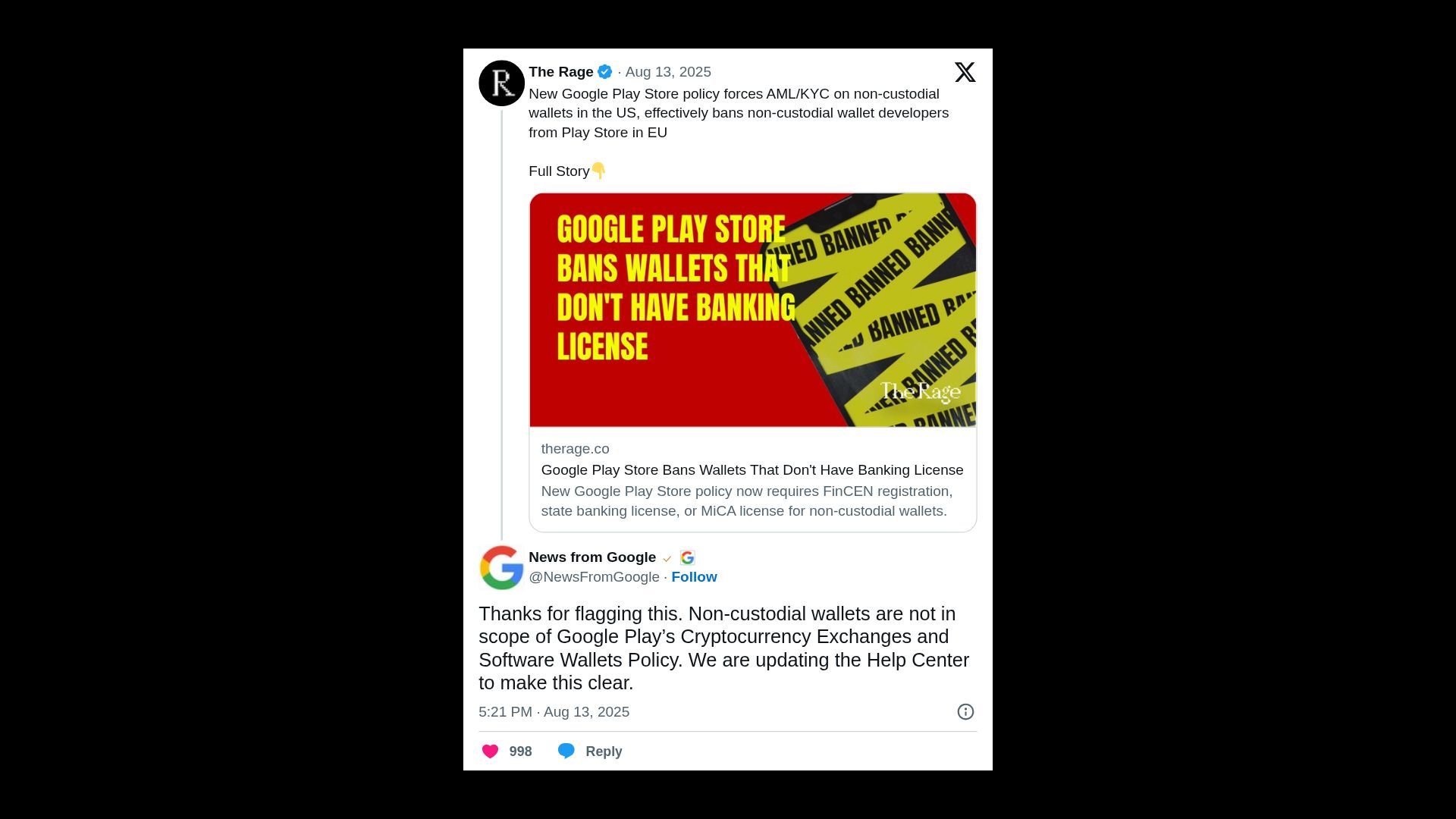
It's not often that reporters post a story that has such immediate impact, but this is a pretty big win for a new crypto publication.
- A story in a small publication caused Google, one of the Magnificent 7 companies, to revisit the terms of service on its mobile store.
Zoom in: The Rage published a story pointing out that Google's new Play Store terms required software developers to get a state license before publishing non-custodial wallet software.
- Non-custodial, as in, the creator of the wallet does not hold the users' funds. It's software for making it easier for a normal person to hold their own cryptocurrency.
- Coin Center hopped into the conversation, pointing out that this goes beyond what the Treasury Department's FinCEN department requires.
And then, Google replied, saying that was not the intention, promising to update the terms.
4. 2025's early IPO reports back


While other IPO candidates waited out April's market sell-off, eToro decided to push ahead with its listing when it saw retail investors buying the dip, CEO Yoni Assia tells Axios Pro.
Why it matters: eToro was among the first major U.S. fintech IPOs since 2021, effectively reopening the window for peers.
Context: Assia spoke to us shortly after eToro reported quarterly earnings for the first time as a public company, showing net contribution increased by 26% year over year to $210 million.
This interview has been lightly edited for length and clarity.
You were one of the first companies to go public despite market volatility earlier in the year. What gave you the confidence?
- "We've always known eToro's path was to be a public company for the next stage of growth. We had very good performance last year and strong momentum in Q1.
- Even around April's tariffs day, when markets dropped, we saw retail investors buying the dip. That looked like a positive moment for our business.
You mentioned on the earnings call you're looking at M&A. What's the strategy?
- "We're targeting companies in wealthtech with strong products, teams and active users, where we can unlock synergies.
- Our Spaceship acquisition in Australia's superannuation market showed we can improve financial results and connect customers to new products quickly.
- We're interested in bolt-on products with active users that can drive inorganic growth, especially in markets we're not yet in, like U.S. 401(k)s."
How do you view the race to tokenization of assets like equities?
- "I believe most assets will become digital, enabling 24/7 transferability and liquidity.
- The biggest barrier was regulatory clarity, which is improving, especially in Europe. The opportunity is better, more efficient access to markets — stocks, bonds, and illiquid assets like private companies or real estate.
- I think we'll see companies build their own infrastructure first, then move toward collaboration or exchange-led solutions."
This newsletter was edited by Pete Gannon and copy edited by Carolyn DiPaolo.
Sign up for Axios Crypto