Axios Crypto

March 02, 2023

It must be a day ending in "y" because the topic in crypto is stablecoins.
🚨 Situational awareness: Silvergate last night warned that mounting losses could threaten its capitalization levels and said it is evaluating its "ability to continue as a going concern."
- Email: [email protected] or hit up Brady and Crystal on Twitter.
Today's newsletter is 1,169 words, a 4-minute read.
🧊 1 big thing: Tokenization
Illustration: Gabriella Turrisi/Axios
Imagine Wall Street 2.0 — stocks and bonds, but made tokens. That's one version of the future, but a glimmer of it can already be seen now, Crystal writes.
Zoom in: Circle, issuer of the second-largest stablecoin, usd coin, tapped the world's largest money manager late last year to manage the coin's reserves — cash and short-term government paper — backing it in a money market fund.
- That would make usd coin (USDC) a tokenized security — a token on-chain representing off-chain assets in the form of a money market fund.
Why it matters: The partnership between BlackRock could be the foundation upon which Wall Street 2.0 is built.
- After that, "one can easily imagine a world where one asks, 'why not a token for the S&P 500?'" Dave Nadig, a futurist at data analytics firm VettaFi, tells Axios.
- (Important distinction: As a tokenized security, this would not imply that stablecoins are securities, or that USDC is one.)
Of note: WisdomTree has blockchain-enabled funds — for secondary record keeping — cleared with the SEC, approaching from the other side of the chain as a traditional financial firm.
The big picture: "The jury is out on whether this is the right way to wedge crypto into the traditional financial ecosystem," though the effort to get "40-Act funds on-chain," — a shorthand term for U.S. registered investment funds — is real, Nadig says.
- BlackRock chief Larry Fink said during the New York Times DealBook Summit in December that the future is tokenized securities.
- Coinbase Global chief Brian Armstrong said during the company's earnings call that the crypto exchange would not be getting into traditional equities, but left the door open for tokenized stocks.
How it works: Roughly 80% of Circle's USDC reserves are held in the Circle Reserve Fund, a money market fund holding a mix of cash and short-term government debt, or T-bills.
- It's a $31.8 billion fund, exclusive to Circle. BlackRock manages it and gets paid a fee of 0.17%.
- Prior to the BlackRock deal, USDC reserves were held at Bank of New York Mellon. Today the money market fund holding the reserves is custodied there.
Between the lines: The counterparty risk has been changed from the bank to the U.S. government, says Joseph Mannon, chair of the Private Fund Formation group at law firm Vedder Price. Otherwise, little has changed for usd coin holders, he adds.
What we're watching: The change could mean access for Circle to the Federal Reserve, albeit indirectly, through the money market fund.
- The plan is for Circle Reserve Fund to get access to the Fed's Overnight Reverse Repo Facility (ON RRP), which would allow the fund to park cash and benefit from a floor under overnight interest rates, that would accrue to the fund.
- Counterparty eligibility requirements apply. And the 20% of USDC reserves held in cash would move there, if approved.
If not approved, Circle said it would keep its 20% of reserves held in cash with its banking partners, a spokesperson tells Axios.
- They include Bank of New York Mellon, Citizens Trust Bank, Customers Bank, Signature Bank and Silvergate Bank, according to a recent attestation report.
🦂 2. Charted: The top stables


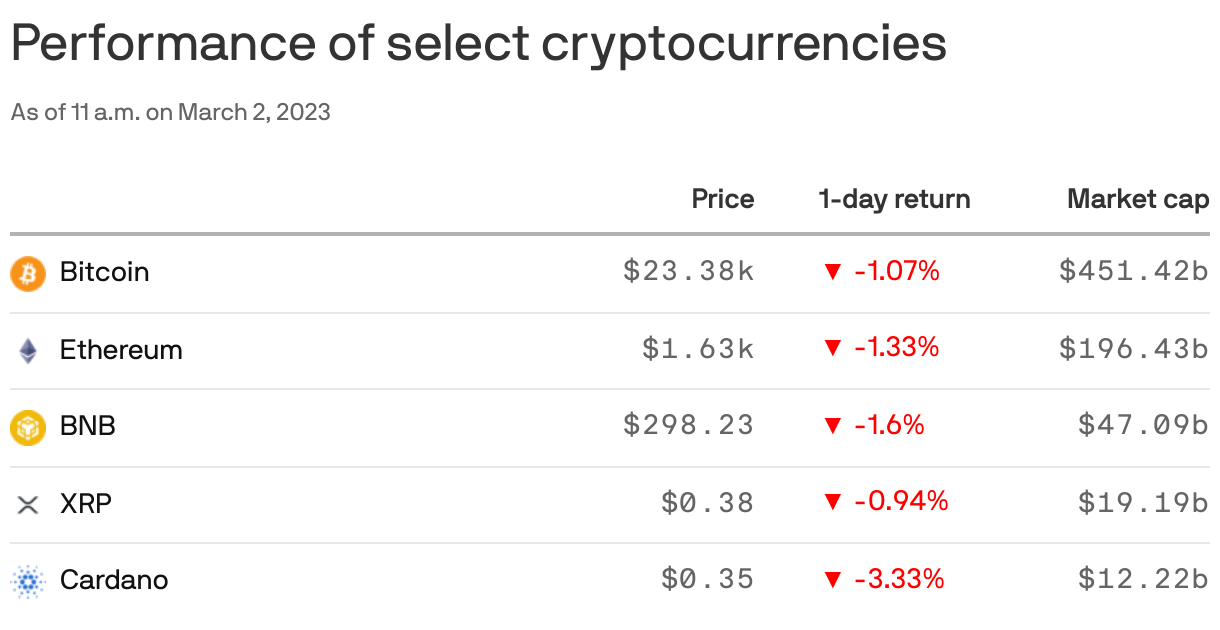
Circle's usd coin remains the second biggest by market cap and that position is unlikely to change any time soon, however, it's been losing ground to tether, the oldest and by far the largest, Brady writes.
- Flashback: Guess what happened in that moment when tether fell and usd coin rose on the chart? It was right after the collapse of the terra usd stablecoin.
Quick take: Playing nice with regulators and lawmakers is a long-term strategy, but its value hasn't yet shown itself in market success.
Top coins
3. Look into my gigantic, metallic machine eye

Illustration: Axios Visuals
The thing about Worldcoin is: the optics.
- In fact, if you want to read a detailed technical analysis of the hardware that Worldcoin uses to scan people's irises to generate a unique identifier and give them worldcoin, check it out on their website, Brady writes.
What you won't find on the site any longer (at least not easily) are images of the crazy orb it used to scan its first 100,000 or so eyeballs. There used to be lots, but the photos are still readily available on the Internet Archive.
- Of note: With files linked in the post above, you could build your own crazy eye-scanning orb yourself. They have open sourced it.
Driving the news: Despite being roundly condemned as creeptastic all across the internet, the startup — founded by former Y Combinator leader Sam Altman — has not given up on its goal of becoming a universal cryptocurrency favored by the developing world.
- It claims it has scanned a million eyeballs globally (the latest number on its front page is just under 1.3 million).
- And it's raising money.
Yes, but: It's so weird.
- Many hyperventilating internet denizens accuse it of building up a global database of biometrics, but the company says it generates a unique identifier number from the scan of a person's iris and then throws out the scan.
By the numbers: Everyone who signs up will get 25 worldcoins, but not until the token launches sometime in the first half of this year.
- Obviously, no one knows what they will be worth then.
- It also hasn't released other basic details of its tokenomics yet.
Zoom in: The Worldcoin team knocked on the door of a TechCrunch writer in India. Check out the pitch.
The other side: A different Worldcoin launched all the way back in 2013 and the team is still working on it. They aren't crazy about this brand interloper.
- "We are not the 'ORB RETINA SCANNING WORLDCOIN'. They are imposters stealing our name," the front page of its website says.
🧌5. Culture hash: Bending might be breaking
Screenshot: @ChrisBlec (Twitter)
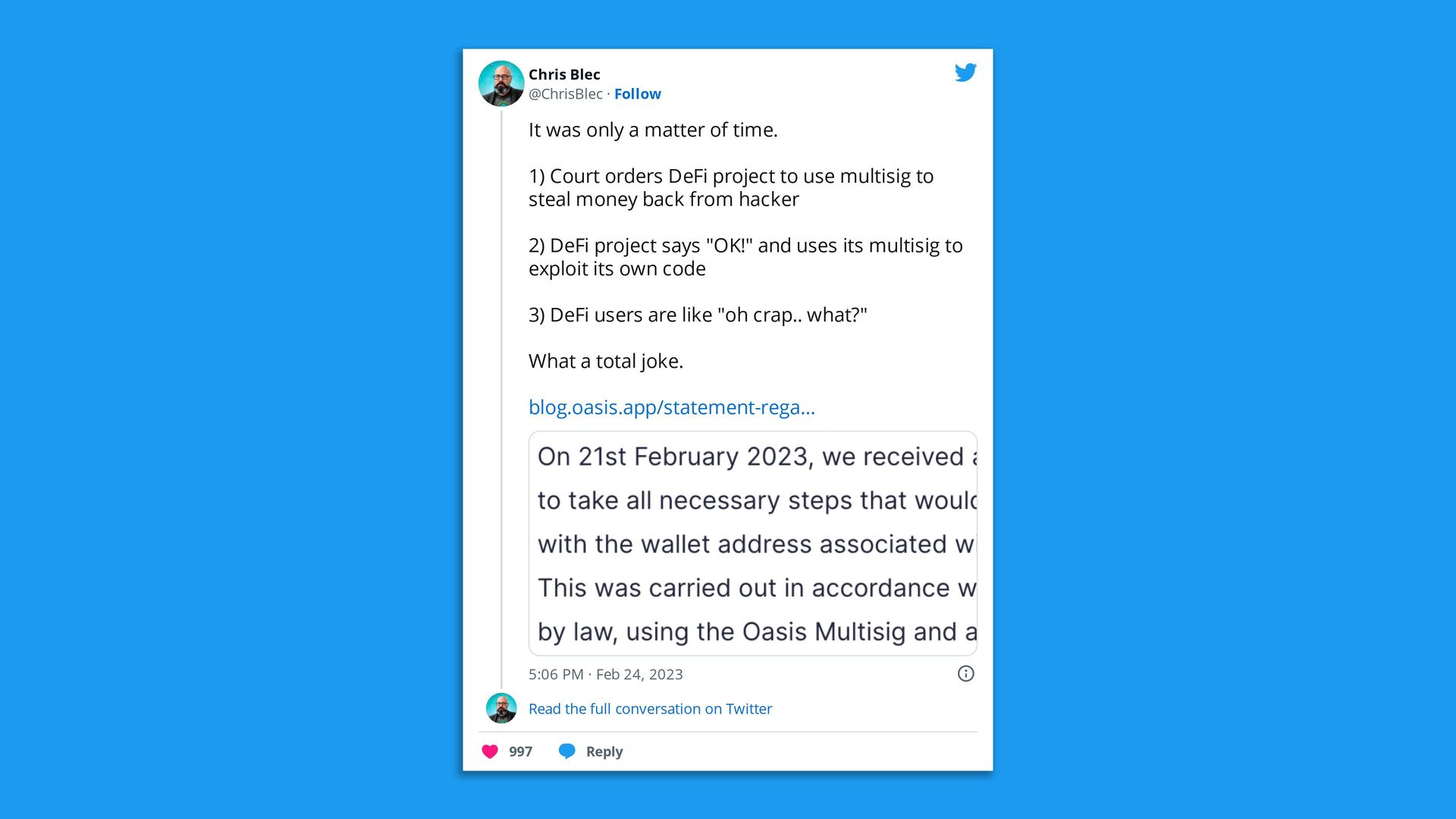
Chris Blec is one of the great gadflies of the Ethereum and decentralized finance world. He's not loved, but he tells it like it is, Brady writes.
Catch up fast: A little over a year ago, a cybercriminal stole over $300 million in cryptocurrency from a bridge between the Solana and Ethereum blockchains. Jump Capital, the giant trading firm, covered the loss.
- This week, we learned that Oasis, a DeFi app built to support MakerDAO, had facilitated the retrieval of about $150 million of those stolen funds through its smart contracts. They did so in response to a court order.
The latest: While it's good for Jump and bad for the criminal, it throws a shadow over the promise of cryptocurrency: finality.
- A core idea is that a transaction is done when it's done. To that end, Oasis is planning to close the hole in its contracts that allowed it to reverse this transaction.
The bottom line: To Blec's point, as long as smart contracts can be changed, they might also be used for censorship or reversing transactions.
This newsletter was edited by Pete Gannon and copy edited by Carolyn DiPaolo.
🧿 If you were walking through a mall and someone had a retina-scanning orb set up and offered you 25 worldcoins to stick your face in it, would you do it? —C & B
Sign up for Axios Crypto

Brady Dale covers crypto and blockchain impacts on markets and regulation.