Axios Crypto

August 04, 2023
πΏ Curtains up! Coinbase had two big events: its earnings report and a New York City crypto town hall. Plus, Curve.
- π§ [email protected].
Today's newsletter is 1,140 words, a 4-minute read.
π½ 1 big thing: NY shows up for "Stand with Crypto"
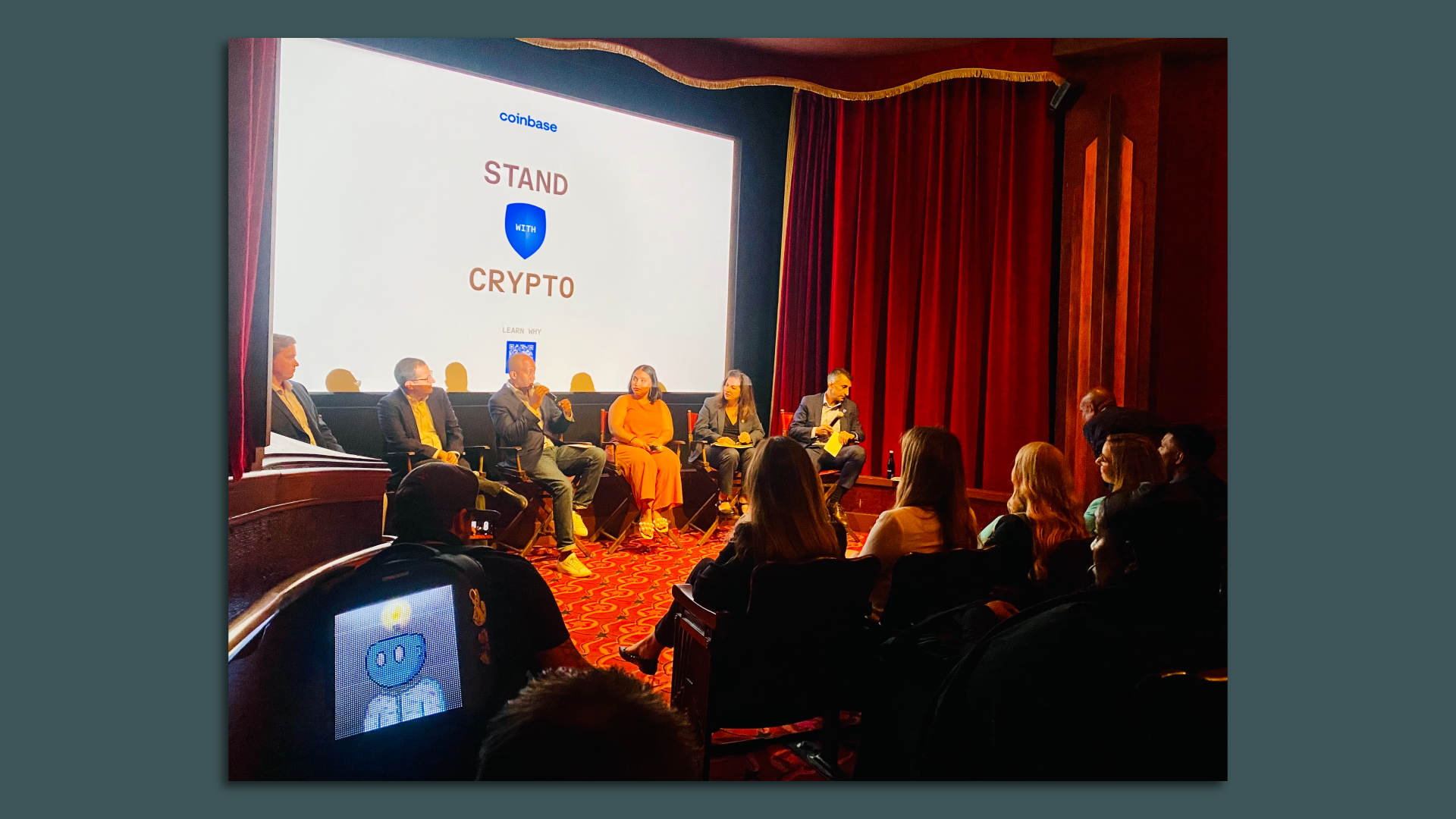
From left: Bill Rockwood, Micah Lasher, Clyde Vanel, Jennifer Gutierrez, Diane Savino, and Faryar Shirzad Photo: Crystal Kim
Nobody puts Coinbase in a corner, Crystal writes.
- Not even the SEC.
Driving the news: The company's quarterly earnings report was nothing to write home about; results for a U.S. crypto exchange in the throes of a regulatory battle weren't expected to shoot the lights out. But Coinbase stole the show with another event yesterday.
- As CEO Brian Armstrong started to speak on the company's earnings conference call, a town hall was underway at the Roxy Hotel in New York City with some 200 local crypto advocates, policymakers, and stakeholders in attendance.
Zoom in: Coinbase chief policy officer Faryar Shirzad hosted a panel that included New York Mayor Eric Adams' senior adviser and former state Senator Diane Savino, as well as Micah Lasher, director of policy for New York Governor Kathy Hochul, and New York Asemblyman Clyde Vanel.
The big picture: It's all part of Coinbase's pro-crypto policy campaign, asking folks who love all things web3 to write to their representatives.
- The call to arms is: Stand with Crypto.
What they're saying: "So much of crypto is about empowering individuals to live in a bit of a decentralized life," Coinbase's Shirzad said, explaining the crypto imperative.
- "We live online really under the control of a few big intermediaries ... That's a system that's just not sustainable."
What others are saying: "When you talk about financial inclusion ... I don't think it is necessarily the case that disruption results in democratization," Lasher said.
- "And if that is the aspiration of the industry then I think we all have to make sure that that is how it actually works out."
The talk drew heckles and laughs (that's New Yorkers for you), all of which city officials appeared to take in stride:
- When Vanel, assemblyman for New York's District 33, said "folks used to not like the BitLicense," referencing the state's digital asset license β a member of the audience interrupted: "We still hate it."
One person asked whether the panelists supported the state's moratorium on certain bitcoin mining facilities, a law passed just last year.
- Savino said that she voted against it, but also underscored the importance of civic engagement in explaining how that moratorium came to be.
"Sometimes legislators are swayed by memos of opposition and support," she said. "You don't even have to read the stuff."
- π³ "On the top [of memos], if it has one tree that's good, two trees, better, three trees, really good β so you say 'I don't have to read the bill, if it's got three trees I'm voting for it.' I'm not kidding. "
- The mining bill had "three smokestacks and I think a cross on it," she added. (Everyone laughed)
- The bottom line: "Nobody wants to be labeled an enemy of the environment."
π Crystal's thought bubble: There was a surprising level of engagement between the audience and New York officials β that makes us think Coinbase's "Stand with Crypto" is a campaign with legs.
Editor's note: This article was corrected, removing two references that New York Mayor Eric Adams was in attendance, including one in a caption. He was not.
β€΅οΈ 2. Charted: The big moves on Curve

Quick recap: Decentralized exchanges work because investors provide them with liquidity, Brady writes.
- Assets get placed in paired pools. The ratio of the two assets defines the price.
- On Curve, basically everything that pairs on there is with assets that are meant to have the same price (think: pairs of stablecoins).
The more assets are deposited on a decentralized exchange, the less price slips with trading (because the ratio is harder to knock out of whack).
- Curve is specifically designed to have prices that shift more slowly precisely because it's designed for like-priced assets.
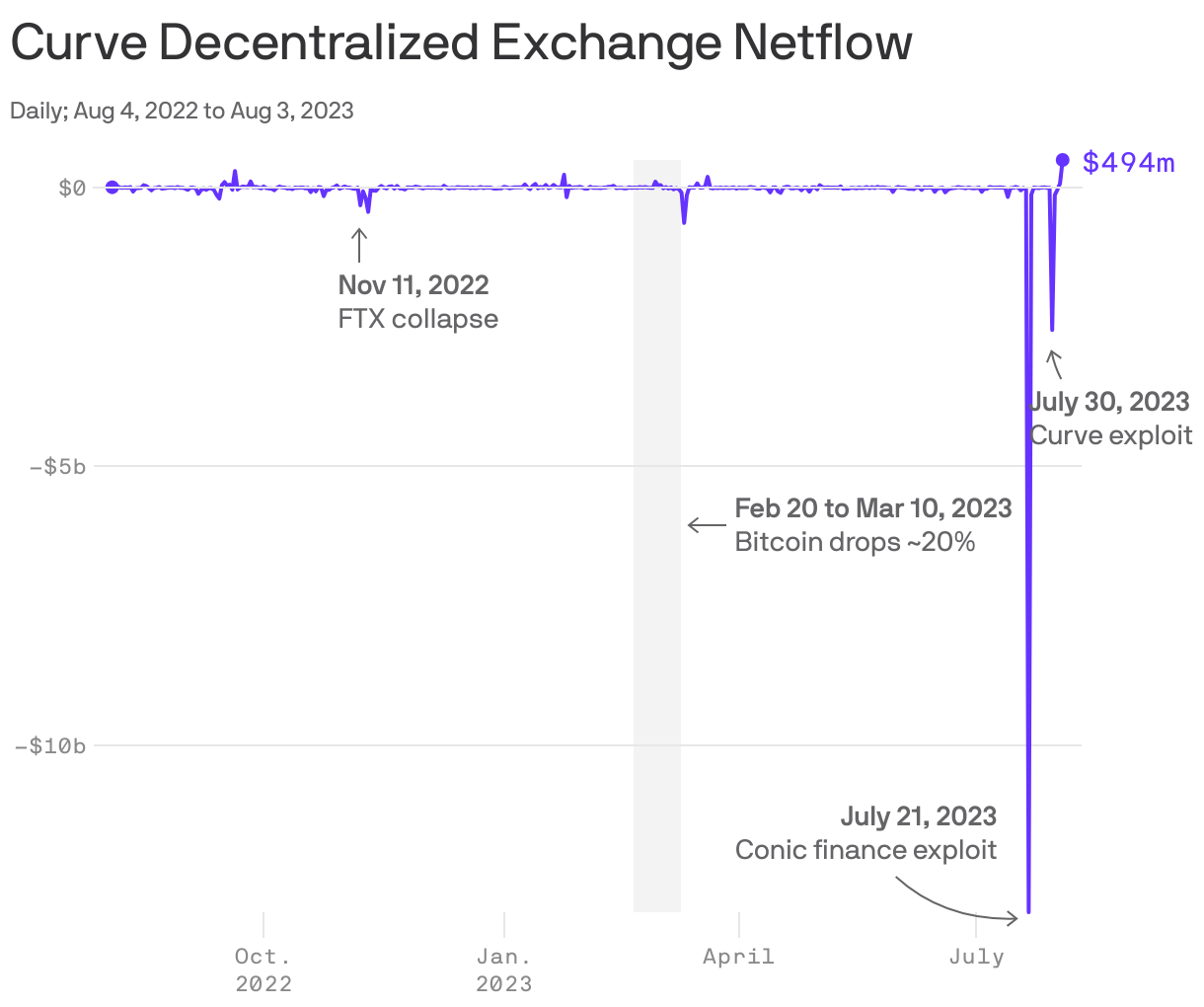
Be smart: Netflow is the net flow of liquidity into or out of an exchange. Most days it's been flat or down since last November.
- Some days have been real bad.
Zoom in: Liquidity on Curve has been trending down since early 2022, but big events have driven some epic withdrawals.
- Most recently, the exchange got hit by a bad hack, but larger withdrawals actually took place following a prior hit to a small but related application.
- Yes, but: Record-high deposits came in Thursday. The Tie, a digital assets information provider, tells Axios that was accounted for almost entirely from the stablecoin project Frax, in two transactions (one and two).
π¦ 3. The SEC hits the The Debt Box
Illustration: Brendan Lynch/Axios
The SEC announced on Thursday it is seeking an asset freeze and a restraining order against The Debt Box, Brady writes.
Why it matters: At least $49 million has been invested in a project that looks to be more seriously questionable than the unregistered security cases seen recently.
- In short: The Debt Box doesn't really look like it was really doing the things it was saying it would do.
- Somehow, it claimed to sell investors software licenses that enabled the production of ... well that's where it gets confusing.
By the numbers: The project's token, DEBT, plunged in value on the news, falling from $11.80 to $5.30 as of this writing.
What they're saying: "In reality, the eleven digital-asset tokens purportedly being 'mined' by the node software licenses cannot be mined and never were mined," the SEC complaint alleges.
- So you might be wondering: Does "mining" here mean crypto mining or traditional mining. Umm ... yes?
- So this offering is really crazy: At the very top of the site it says it is "Where crypto meets commodities."
- Right below that it starts explaining how most cryptocurrencies are run by node operators. True, but what does that have to do with commodities?
- Further down, it describes a bunch of assets all named after commodities, and somehow their associated tokens are associated with actual extraction of the underlying real assets (for example: aluminum). How?
Of note: The tokens in question ran on a blockchain we don't discuss much in these pages, the BNB Chain, which was built by Binance, the world's largest centralized exchange.
Quick take: This looks like a site made to sound just crypto enough to look like it could go up in value fast, but just "real world" enough that it could take in greedy but unsophisticated investors.
- Representing a project as on the blockchain but with a serious grown up business model is a hustle scammers have been working in this space for a while. It's worked on boomer types who also want those fast crypto gains.
- "Moreover, the 'real projects' and 'real assets' Defendants tout as supporting the value of these tokens are a sham," the SEC's complaint contends.
The bottom line: The SEC named and charged 18 individuals in a scheme it calls an unregistered security offering and one it alleges used lies to attract investors.
π’ 4. Catch up quick
Illustration: Natalie Peeples/Axios
βοΈ Coinbase filed for judgment in its ongoing case with the SEC. (CoinDesk)
π Fintech firm Revolut will stop crypto services in the U.S. (The Block)
π£ Razzlekhan husband Ilya "Dutch" Lichtenstein admitted to the Bitfinex hack. (CNBC)
π¦ A crypto-friendly browser called Brave. (Decrypt)
This newsletter was edited by Pete Gannon and copy edited by Patricia Guadalupe.
Silly CK, there's no quiet week in crypto. βC&B.
Sign up for Axios Crypto

Brady Dale covers crypto and blockchain impacts on markets and regulation.