Axios Crypto

January 17, 2023
Well, workers in the U.S. may have taken a three-day weekend, but Bitcoin never stops producing blocks.
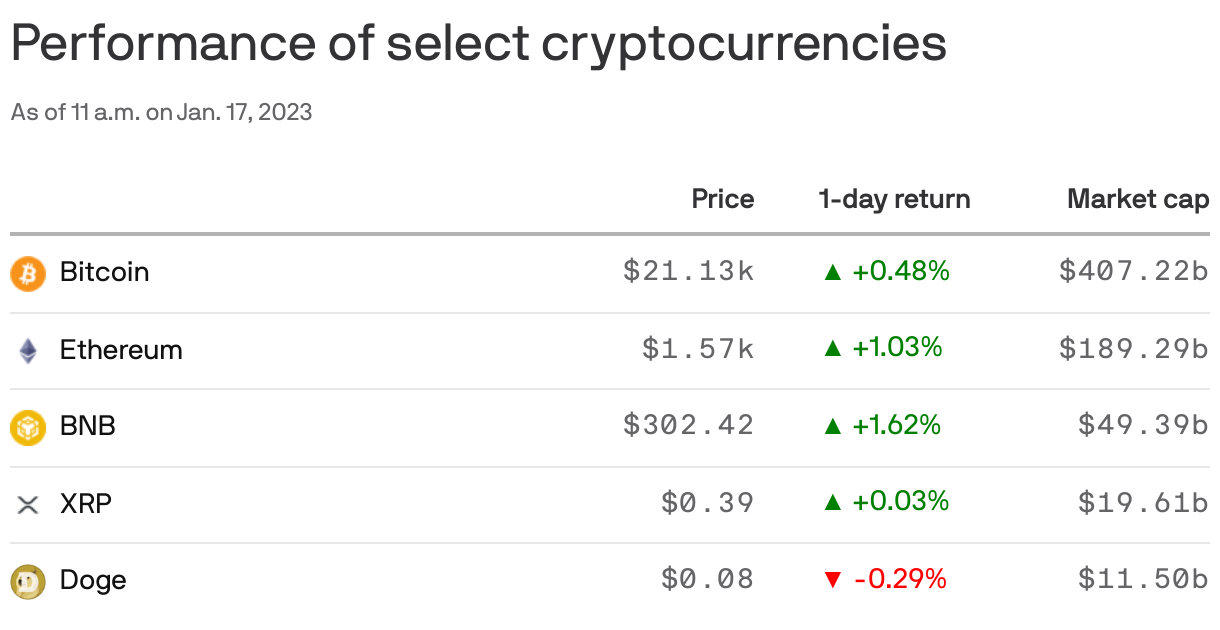
π¨ Situational awareness: Bitcoin's price broke $21,000 yesterday, after falling as low as $16,500 as recently as the end of December.
π§ [email protected]
Today's newsletter is 1,189 words, a 4-minute read.
β οΈ 1 big thing: Crypto accounts aren't bank accounts
Photo Illustration: Natalie Peeples/Axios. Photo: Astrid Stawiarz/Getty Images
Customers who put their cash and cryptocurrency into Gemini Earn thought it was secure, akin to a savings account at a bank.
- "It sounded really safe," Peter Chen, a data scientist in San Diego, who started putting money in Earn in late 2021, told Axios.
Why it matters: Chen was especially reassured when Gemini customer service sent him an email and mentioned FDIC insurance βΒ the protection that keeps bank deposits safe in the U.S. But his money, since converted to cryptocurrency, wasn't safe, Axios Markets' Emily Peck writes.
- Chen put $17,995 into Earn, according to statements he shared β and he can't get it out. He is one of 340,000 customers who have $900 million locked up at Earn, according to the Securities and Exchange Commission.
How it worked: He used dollars to buy Gemini's stablecoins, called GUSD, and then held them at Earn. The company would pay him interest on those holdings. Its website said you could withdraw your money at any time.
What happened: In June, Chen watched the collapse of another stablecoin βΒ called luna βΒ and got nervous. He sent an email to Gemini customer service, viewed by Axios, and asked: "Will something like this happen to GUSD? Is my money safe?"
- A representative responded just 30 minutes later, but didn't directly answer the question: "All fiat currency held by Gemini to redeem your GUSD is held by our partner financial institutions in a secure account and is eligible for FDIC insurance." He referred Chen to a web page about the Gemini dollar.
- Chen said he was reassured by the message.
- But on Nov. 16, in the wake of the collapse of FTX, Earn froze withdrawals. Customers haven't been able to access their funds since then.
Worth noting: The FDIC in August warned five companies about making misleading statements about deposit insurance β that's the protection that keeps your money safe in the bank βΒ though Gemini wasn't included.
Driving the news: Last week, the SEC filed a complaint against Gemini and its partner, Digital Currency Group's Genesis Global Capital, claiming that Earn violated the law by offering unregistered securities.
- The company declined to comment to Axios.
- But in response to a lawsuit filed by Earn customers, Gemini argues that customers knew about the risks.
What they're saying: "You are seeing normal 'middle-class' folks, putting in life savings. Sometimes this is it. All of it," said Hee-Jean Kim, a lawyer at Kim & Serritella LLP, which filed a class action against Gemini at the end of December.
- Kim said she'd spoken to hundreds of people who had their assets stuck at Earn.
Were you an Earn customer? We'd like to hear your story. Email: [email protected]
π©βπ§βπ¦ 2. Charted: Most Ethereum activity happens off Ethereum


The vision for Ethereum is that there will be many blockchains that all lean on Ethereum, Brady writes.
- As of now, there are more transactions happening off Ethereum, in the Ethereum ecosystem, than on Ethereum itself. This is progress.
Context: Ethereum is the original smart contract blockchain. Everything about it is designed to keep decentralization and security first, so it can be expensive and somewhat slow to use.
- So-called sidechains and layer-2s give users faster cheaper options that still hew to the larger Ethereum vision.
Zoom in: Polygon is a longstanding project that runs on its own, but has always stayed close to Ethereum.
- Meanwhile, layer-2 blockchains, such as Arbitrum and Optimism, actually rely on Ethereum for security, communicating directly with the original chain.
The bottom line: It may sound confusing but users seem to be figuring it out. Activity on layer-2s has consistently been above Ethereum for a few months now.
πΏ 3. Silvergate announces billion-dollar loss
Photo Illustration: Pavlo Gonchar/SOPA Images/LightRocket via Getty Images
Silvergate Capital, the parent of the bank that has made it a priority to serve the digital currency economy, announced a $1 billion loss for the fourth quarter, Brady writes.
- Shares are up 21% this morning, suggesting investors see the company positioning itself well to survive crypto winter.
Why it matters: While crypto believers may imagine a future "flippening," when crypto assets supersede traditional forms of money, for now even crypto businesses need access to traditional finance.
- Silvergate is making settling cash transactions between crypto companies its core business, with its Silvergate Exchange Network (SEN).
State of play: The company lost $948.7 million for the year of 2022.
- By and large, the differences between the third and fourth quarters were not stark, but the differences between the fourth quarter between this year and last year were.
By the numbers: For example, SEN activity fell from $219 billion at the end of 2021 to $117 billion at the end of 2022.
- Fees from digital-asset-related customers brought in $32.2 million in 2022, versus $35.8 million in 2021.
- Silvergate had $11.3 billion in assets at the end of the year, with $6.3 billion in deposits.
What they're saying: "Our mission has not changed. We believe in the digital asset industry, and we remain focused on providing value-added services for our core institutional customers. To that end, we are committed to maintaining a highly liquid balance sheet with a strong capital position,β Silvergate CEO Alan Lane said in a statement.
Flashback: Earlier this month, Silvergate revealed that it has survived an unprecedented bank run, seeing something like 70% of its deposits withdrawn.
- It was able to get through in part due to a liquidity injection from a Hoover-era government bank program, as we reported here last week.
Zoom in: Its digital asset customer base is up from the end of last year, however. It had 1,381 such customers as 2021 ended and 1,620 now.
- That said, deposits are way down, from $14 billion then to just under $4 billion now.
- According to Silvergate, it now has 104 exchanges, 1,025 institutional customers and 491 other customers, in the digital asset category.
Top coins

πββοΈ 4. Catch up quick
βοΈ Fidelity-backed crypto exchange OSL said it would cut expenses and staff by roughly one-third. (Bloomberg)
π The U.S. trustee objected to FTX's counsel Sullivan and Cromwell, citing a conflict of interest. (CoinDesk)
π¨ββοΈ House Republicans announced a new subcommittee dedicated to crypto. (Politico)
π°1 in 3 members of the U.S. Congress received cash from FTX executives. (CoinDesk)
π 5. Culture hash: What comes after F-TX
Screenshot: @CryptoHayes (Twitter)
Fiction has to make sense β but the crypto world, in real life, does not, Crystal writes.
- That's how leaders of not one, but two defunct crypto shops banded together to float a new project.
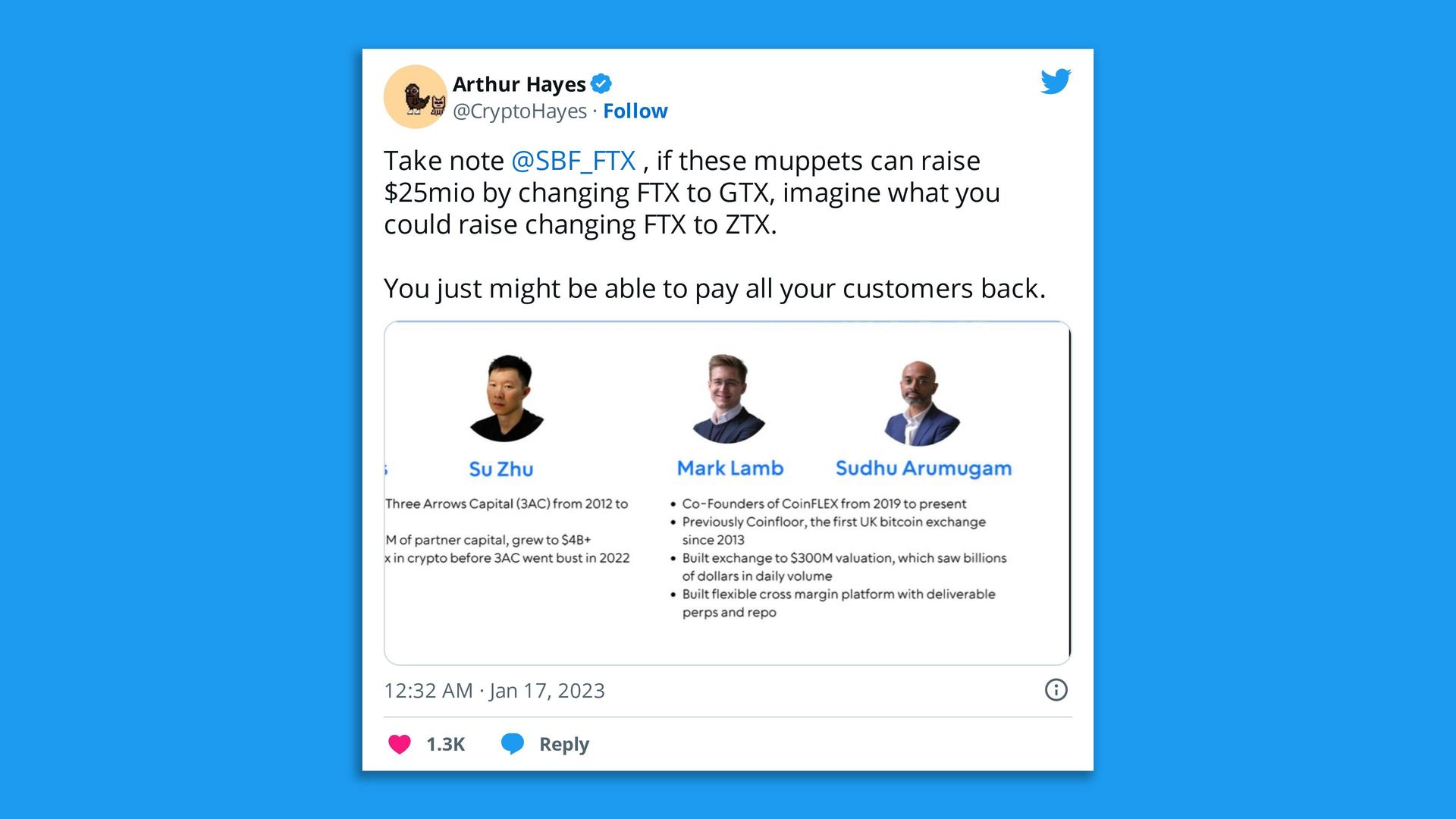
Driving the news: Su Zhu and Kyle Davies, co-founders of the now-collapsed Three Arrows Capital, alongside Mark Lamb, founder of crypto platform CoinFLEX (now in restructuring), are working on a new crypto exchange called GTX.
- They are reportedly trying to raise $25 million for the venture to capitalize on the rash of bankruptcies started last year, allowing users to buy and sell claims.
What's happening: Crypto Twitter latched onto pages of the leaked pitch deck explaining the origin of its name β "Because G comes after F" β joking that "HTX" would surely follow after.
- CoinFLEX's Lamb has since said the name is just a placeholder, but the pitch itself has already become the joke.
Of note: Even Arthur Hayes, founder of the BitMEX crypto exchange β on probation over anti-money-laundering violations β was dunking on the premise.
This newsletter was edited by Pete Gannon and copy edited by Carolyn DiPaolo.
Seriously, if you were a Gemini Earn customer, please contact Axios. We have a specific question we want to ask. βC & B
Sign up for Axios Crypto

Brady Dale covers crypto and blockchain impacts on markets and regulation.