Axios Crypto

July 20, 2022

Welcome to Wednesday! Today we're going to cover what we didn't learn about crypto policy out of the SEC at a congressional hearing yesterday and have a look at the forthcoming metaverse.
- 📧 In this downturn, we are always looking for the perspective of employees impacted by cutbacks. We can keep your name out of our reporting: [email protected].
This newsletter was edited by Pete Gannon and is 1,135 words, a 4.5-minute read.
🫥 1 big thing: SEC says little at House hearing
Illustration: Aïda Amer/Axios
The U.S. Securities and Exchange Commission's Gurbir S. Grewal, director of its enforcement division, came before a U.S. House of Representatives subcommittee yesterday and said quite a bit.
- It's just that most of what he had to say was about how he couldn't say anything, Brady writes.
Why it matters: In 2018, the air came out of the cryptocurrency industry because there were rumors about the SEC sending letters and subpoenas to crypto companies.
- Four years later, there's still no clear set of rules around what is permitted in the industry.
Meanwhile, the SEC has expanded its division of crypto enforcement. And Grewal, when asked whether it had the resources it needed, said it could still bulk up more.
- "Certainly, resources are an issue. We are still not up to the numbers we were at prior to 2016," Grewal told Rep. Jim Himes (D-Conn.), who said he'd been watching the ramping up of enforcement action by the SEC.
What they're saying: "It's a little like we're asking people to build a car but we won't tell them what the speed limit's going to be," Rep. Bill Huizenga (R-Mich.) said during the hearing.
Driving the news: Grewal appeared yesterday before the Subcommittee on Investor Protection, Entrepreneurship and Capital Markets.
- Members of Congress were interested in several topics. (Watch it all on YouTube.)
Exchanges' free pass: The SEC has taken the financial services firm Ripple to court over the way it sold XRP, a cryptocurrency it created.
- "You've gone after XRP because XRP is a security, but you haven't gone after all the major crypto exchanges that process tens of thousands of transactions," Congressman Brad Sherman, the subcommittee chair, noted.
- Grewal declined to discuss "what matters we are looking at or not looking at."
- He gave the same answer when Sherman (D-Calif.) asked him why the SEC has not pursued action against the stablecoin tether.
- Later, Grewal would confirm that declining to comment was a matter of SEC policy, not law.
Pump and dumps: Rep. Warren Davidson (R-Ohio) said that he's seen some cryptocurrency projects that looked to be obvious pump and dumps.
- In a pump and dump, a fake entrepreneur with a hoard of tokens manufactures demand, then sells them and disappears with the money.
- "Frankly, I'm curious why some of the biggest ones that look from an outsider like probably pump and dump scams don't get targeted," Davidson asked.
- "We have to balance the risk that we're seeing with the resources that we have," Grewal said. His staff, he said, does not "give people a pass, they hold violators accountable."
- Grewal didn't name any actions the SEC had taken, but its complaints against FLiK/Coinspark, John McAfee and Apis token all include elements of pump and dumps.
Advice: Himes also asked if, based on his experience enforcing investor rules, Grewal had advice for Congress on laws it might pass.
- Grewal said he would "need to consult with others."
The bottom line: Members expressed concern about an enforcement-first approach. "The purpose here is to discourage misconduct before it happens," Sherman said as he opened the hearing.
📏 2. Charted: Supply of the leading stablecoins


The gap between Tether's USDT and Circle's USDC has quit closing. In fact, if anything, Circle has lost a little ground, Brady writes.
- The two tokens are both stablecoins that claim to be backed 1:1 by assets worth $1. USDT is used heavily by crypto traders all over the world.
Flashback: When the stablecoin terraUSD collapsed in May, a lot of Tether's reserves were cashed out. To a lesser degree, funds started to move into Circle's USDC.
- Many suspected that USDC might flip USDT in market cap, but the momentum has stopped since about mid-June.
🤔 3. The metaverse won't be what we expect

Photo illustration: Aïda Amer/Axios. Photo: Liveright, an imprint of W.W. Norton & Company
The metaverse is well worth building, even if we don't know exactly what will come of it, venture capitalist and tech evangelist Matthew Ball tells Axios Gaming's Stephen Totilo.
Why it matters: Part of getting ready for an epochal internet change is realizing that what we expect it to be is probably very wrong.
- Ball's new book, "The Metaverse: And How It Will Revolutionize Everything" is a guide to building the metaverse so that it is sufficiently fast, secure and shared.
- Smart construction will be required to deliver on a potential multitrillion-dollar virtual market that supporters predict will be as transformational as the internet itself.
Meta-what? The metaverse is a massive, interoperable 3D virtual world that is persistent (still there when you log off), synchronous (everyone experiences it the same way) and able to support an unlimited number of users with their own identities, virtual objects and access to payment systems.
What they're saying: "You see these examples like, well, what are we going to do in the metaverse? 'We're going to sit at a 3D conference table with VR glasses.' I'm pretty sure we're not going to do that," Ball says.
💭 Our thought bubble: The tech industry has a long record of developing powerful new platforms, but often fails to anticipate the most powerful uses for those platforms (both positive and negative), Axios' Ina Fried writes.
- And, as we've reported, the metaverse won't arrive years from now out of whole cloth. Instead, it's being built piece by piece.
Between the lines: In terms of where to look for a sense of what the metaverse could portend, Ball points to the video game industry, where Minecraft and Roblox have already emerged as popular virtual worlds.
- He calls game developers "the world's leading experts" in building synchronous virtual online spaces, attracting millions of people to them and prioritizing having a good time inside.
The bottom line: The most impactful builders of all may not have even started yet.
- "To some extent, we're constrained by the fact that most of the quote-unquote metaverse products of today are still created and imagined by those who long preceded it," Ball said.
Go deeper: Axios Deep Dive: Inside the metaverse
Top coins
🛹 4. Catch up quick
🦉 5. Culture hash: Dollar cost averaging
Screenshot: @cburniske (Twitter)
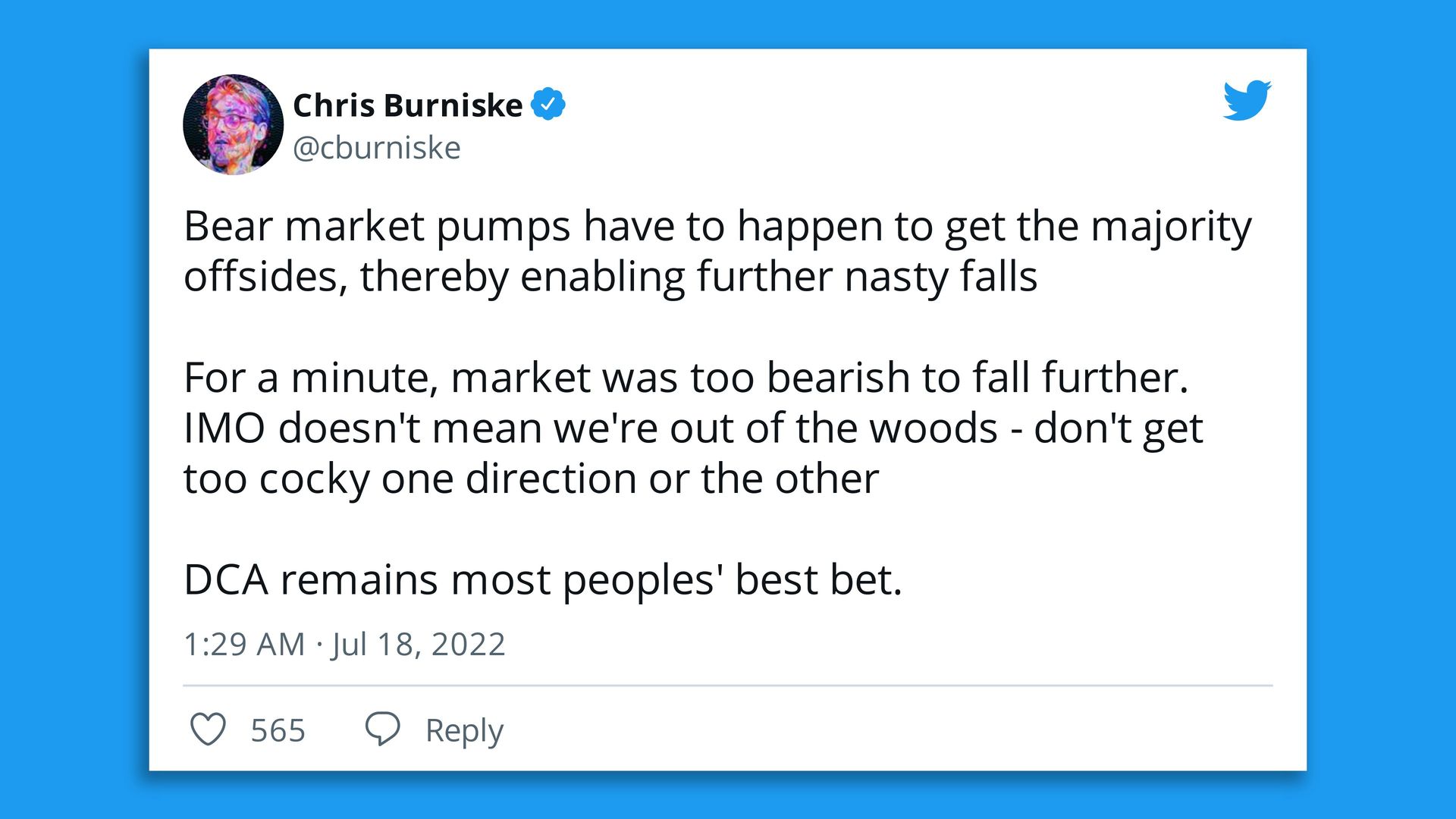
DCA means "dollar cost averaging," an approach where an investor drops money into a given bet at regular intervals, without regard to price, Brady writes.
- Putting 2% of your paycheck into an IRA based on mutual funds is an example of DCA.
- People who keep buying when a market drops do very well when it comes back. Similarly, people who don't over-extend themselves on the way up don't get hurt as bad when it falls again.
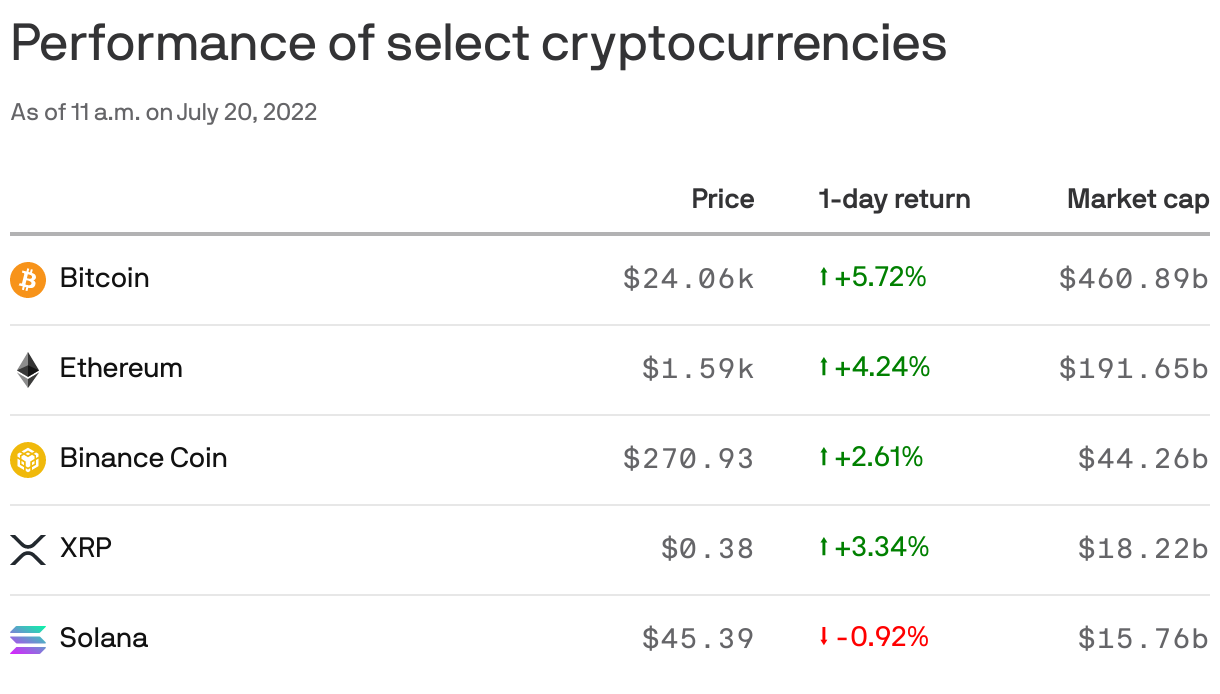
Everything is green in the crypto market now. Bitcoin is over $24,000 and ether is over $1,600. It's tempting to think the bear is over.
- Burniske doesn't buy it.
💭 Brady's thought bubble: Me, either.
It's still much too hot out there. —C & B
Sign up for Axios Crypto

Brady Dale covers crypto and blockchain impacts on markets and regulation.